






Lebowski89
Members
-
Joined
-
Last visited
Everything posted by Lebowski89
-
Getting some label UI oddities here and there. For example, with Traefik, I've put the correct URL (http://192.168.##.##:port) in the Web UI column but it opens the localhost IP without a port. Then for Whisparr the WebUI is also correct, but when you open it the IP you've entered is doubled (http://192.168.##.##/192.168.##.##:port). Have tried stack down, up, updated, deleted containers, etc.
-
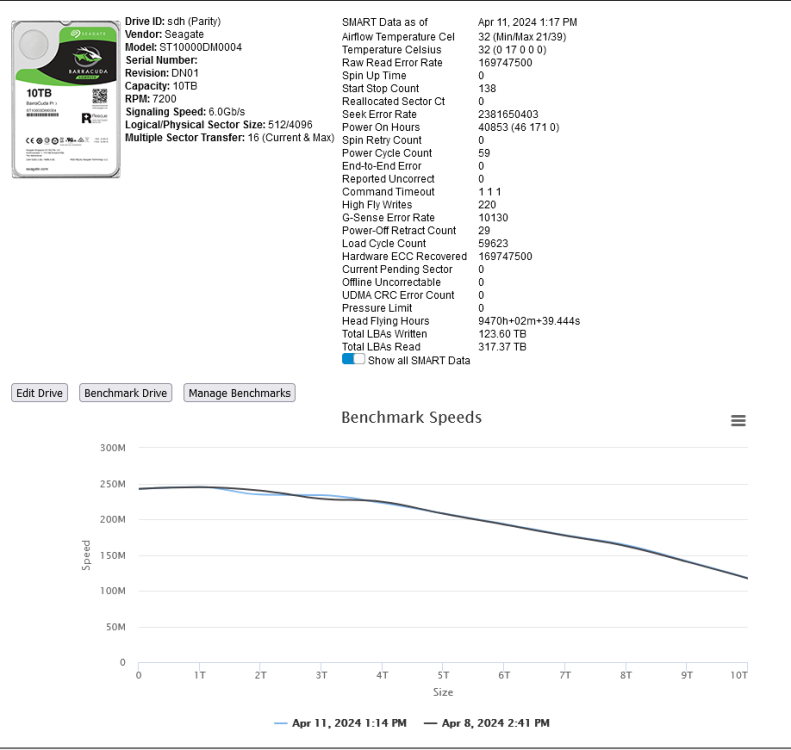
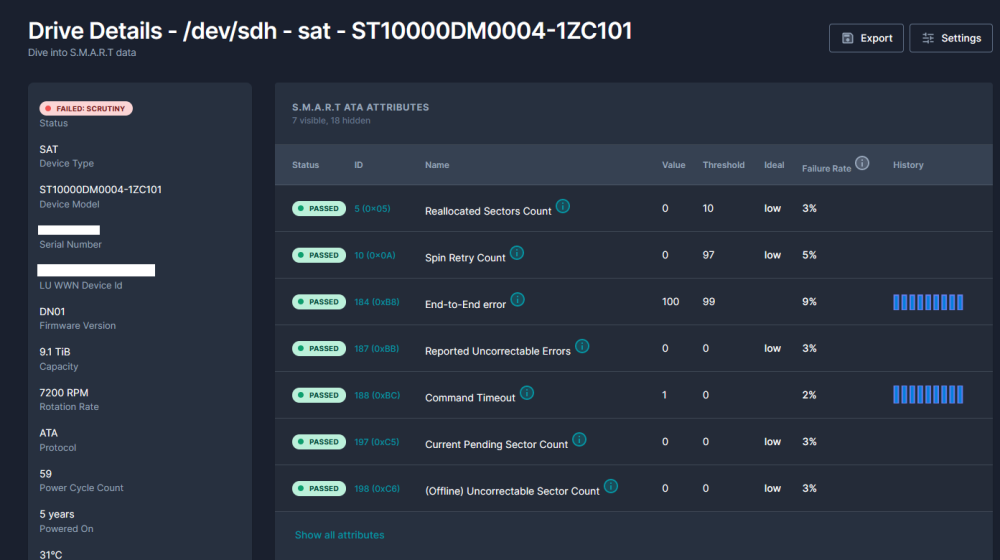
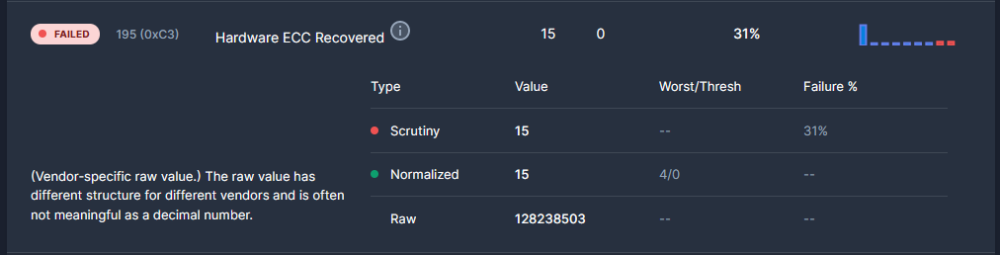
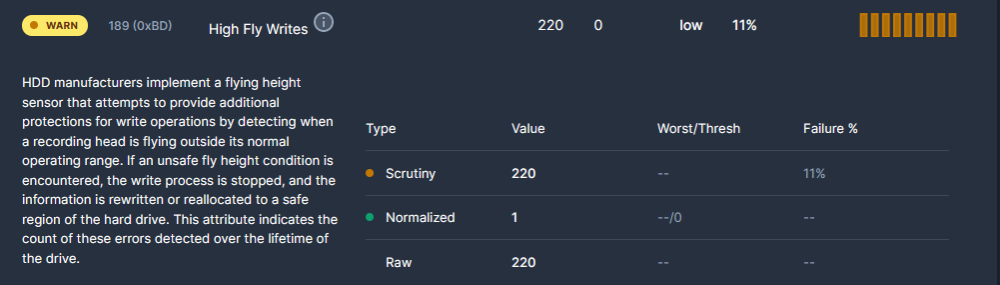
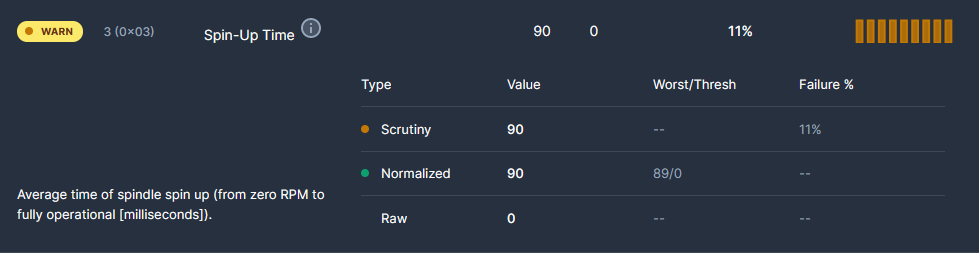
Hi, A few weeks ago I installed Scrutiny (first from app store and then moved to Docker compose), and everything was great - all my drives passed with no problems. In the last week I have since converted an array drive to ZFS and also removed 3 drives from the array into their own ZFS pool. After this, I rebuilt parity. I then checked Scrutiny a few days after this and my parity drive is listed as failed. None of the critical values have failed, but it has given me a warn for Spin up time, High fly writes, and a fail for hardware ECC recovered. UnRaid lists the drive as healthy, and the drive is benchmarking the same as before it was listed as failed (using DriveSpeed). I'm currently doing an extended SMART test (will take some hours). The drive is a Seagate Barracuda Pro - 10TB - 5 years power on, used as a parity drive its entire life. I haven't messed with the Seagate power management settings, so the drive has quite a lot of load cycle count, but well within rated spec. Should I be concerned here? Or is this just Scrutiny not playing nice with Seagate drives? TIA
-
Welp, the menu I have been skipping over the whole time was the one thing I was about to come ask about. Works fantastic. Have switched every single one of my docker containers over to compose (with help of Composerize). Edit: I notice only .png are working for the icons. Using an .svg displays a blank icon. This differs from Docker Folders which accepts both. Is this intentional?
-
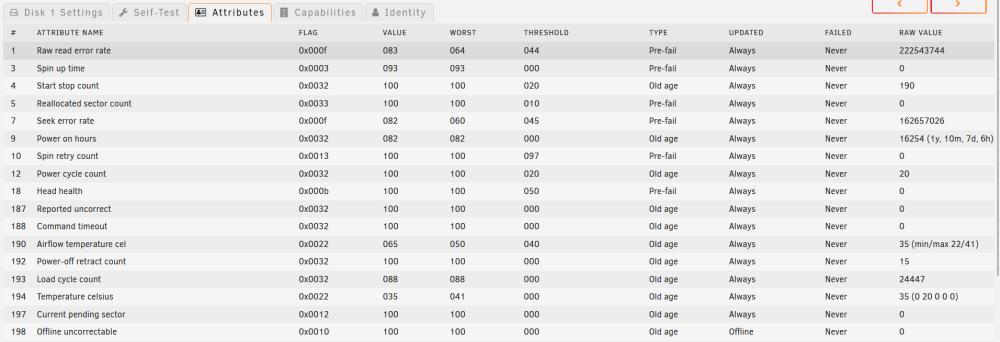
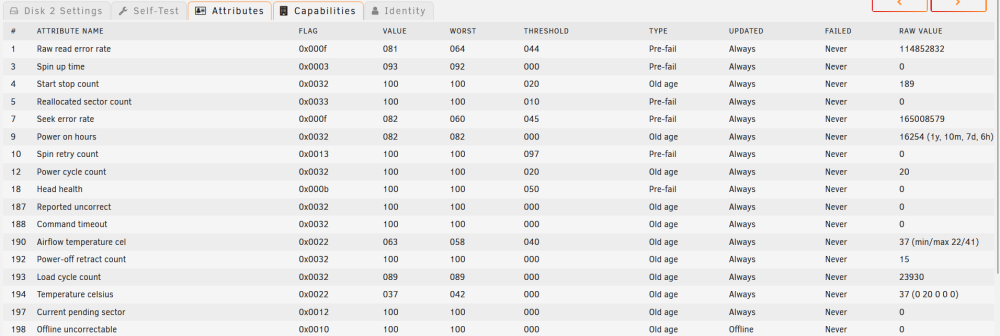
Hi, Have been running 2x 10TB Seagate Exos in my array for nearly two years. I never messed with EPC/powerBalance or any of that. They've been parking their heads as they are known to do, and have clocked up over 20k LCC during that time - 10x the amount of some WD Reds I have with 8 years power on time. The Exos have been performing great, no issues. Reading up on this on Reddit, there seems to be range of opinions, but mostly divided between people that freak out and load up seatools to disable EPC, and people who are not fussed as the drives are rated to over 600k LCC. I've been getting around to converting some drives to ZFS this week, and am wondering if I should bother trying to lower the rate of LCC on them? Being rated at 600k LCC, I won't be hitting that for years if at all with these drives, but people have me paranoid.
-
Good script. Found the options for rclone/mergerfs a bit off for having files sent to the local directory. Files were being uploaded straight to the remote. Sub-optimal if you want to use something like cloudplow for uploads, or don't want uploads. Found these do the job for a Google remote (directory cache time set high because the remote will be polled frequently for changes, but if you were running something like an sftp remote you'd have a very low directory cache time): (With local folder mounted first). Essentially the same options as Saltbox uses. category.create=ff being the key setting to have files actually show up in the local directory.
-
Edit: Post removed. Permission issue fixed by adding --uid 99 and --gid 99. Docker apps successfully mapped remote files. Cheers!
-
What do you mean? Did it the same format as Saltbox. It works - remote files are mounted in remote and merged into mergerfs. And to test if it was working correctly, I copied some files into the local folder and they were successfully merged into the merferfs folder to show up with the remote files.
-
This is what I'm aiming for, btw. Missed this post before I made mine. I'm just about there, just dealing with some permission issues with the docker containers trying to access the mergerfs folder. In my case, I have: The remote gdrive files correctly show up on the remote mountpoint and are successfully merged in the mergerfs mount point. With radarr and co's docker data path pointed at: /mnt/user/data/ But I just tried to add the mergerfs folder as the root folder in radarr and it was a no-go. Permission issue. 'Folder '/data/mergerfs/Media/Movies/' is not writable by user 'hotio' (using hotio containers for the most part). Will double check permissions and mount points and will and go from there.
-
I see. Well I assume deleting the files would be something Google would let me do as they're the ones wanting me to free-up space. I'm not actually at the read-only stage yet, but it happens eventually. To quote some random from Reddit: So I'll call it 'read-only' in the Google, offered unlimited storage for years and years and is no longer doing so, sense of the word. What I'm thinking is, maybe I can have unionfs/mergefs mount the local media folder and cloud files, so that radarr/lidarr/sonarr think they're all housed in the same directory on the same file system, and then just not doing the next step that seedbox/cloud solutions (like Cloudbox/Saltbox) do and uploading the files to the cloud with cloudplow. I assume that radarr/lidarr/sonarr would still be able to delete the previous file (the one that would be located in the cloud), and then simply store the new one locally on UnRaid.
-
Yup. Cloud storage is dead for many and many of us. What I have to work out is how to have files on a read-only cloud drive, and then have them deleted from that cloud drive and stored locally whenever one of the starr apps wants to upgrade the file (usually radarr).
-
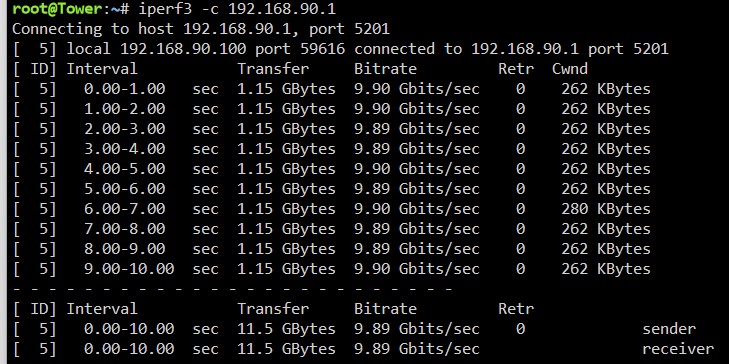
Np, ich, thank you for trying to help. The tool itself is well made and easy to navigate. I'll ask around if anyone has had something similar with my cards. But in the meantime, the NICs are working and doing what they're designed to do. iperf3 results show they're good to go. It's just a mystery of what the heck is going on with the firmware and can it be updated, if it even needs to be updated.
-
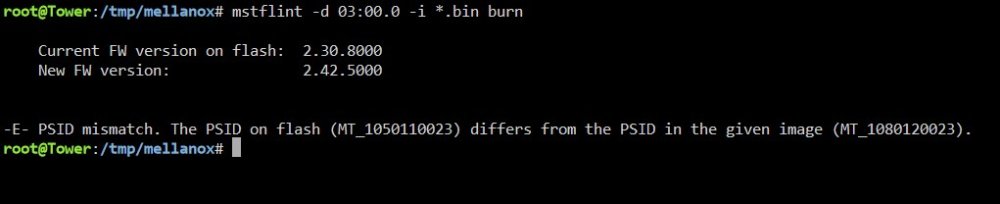
That's what I assumed as well. But I get this: Edit: I know you can change the PSID with the tool, but I saw this 'Please note that the numbers after the letters, in this case "IBM" and "MT_", should be the same otherwise it is very likely that you have the wrong Firmware for the wrong card'
-
Thanks for the reply. Sadly, ebay in their wisdom only show up to 3 years of purchase history, and I can't find it in my Paypal. But it looks like this: https://www.ebay.com.au/itm/192515477316 There is a sticker on the card, but I can't access it at this second. Can open my case up and check it out later today. In UnRaid system devices it is listed as: 'Ethernet controller: Mellanox Technologies MT27500 Family [ConnectX-3]'
-
Hi ich, Have had a Mellanox Connect-X3 card running for over 3 years now. Has worked fine. Performs as it should over SFP+, etc. I've just seen your Mellanox firmware tools addon and given it a try, but I can't seem to find the right firmware for my card. Listed PSID is MT_1050110023, but on firmware download page it is MT_1080120023. I've googled MT_1050110023, and all I see is some old firmware release notes for MCX312A-XCA. Current firmware for the card is listed as 2.30.8000 by the tool. Mac addresses are shown, but the GUIDS is shown as 'ffffffffffffffff ffffffffffffffff ffffffffffffffff ffffffffffffffff'. It was an ebay purchase, so who knows what it doing on here. It does work, but would be good to see if I can update the firmware if there is an update possible.
-
Tbh, I've ordered all sorts of things from Chinese sellers and never had an issue. As long as the HBA card does what it is supposed to do, I don't care how they source it. The seller in this case has tons of positive feedback, with a tiny minority of negative - 99% positive. Has sold many HBA cards, including 17 of the item I linked (but many many more of the more common LSI parts). I think it is a pretty safe gamble. Regarding Hong Kong: That is listed as his location in profile (https://www.ebay.com.au/str/qin1983218?_tab=1) But the items are sold from either China (https://www.ebay.com.au/itm/144475270744) or local (to me) stock as I listed above. Judging by the delivery time, it probably is local.. or they got it here from China fast.
-
I've bought from that Chinese seller, Jiawen2018. Like a lot of the Chinese sellers, they do some things that can be annoying - seller is based in Hong Kong, but will list themselves as having local stock in countries like Australia. And they typically list used products as brand new, even when you and they both know there is no way it can be brand new. However... The HBA card I purchased from them did arrive very quickly, so maybe there was some local stock? Or someone express shipped it quickly from China. And the card does appear to be genuine. But could this be so for the rest of the items? Who knows. I'm currently looking at the LSI 3200-16i from Jiawen2018: https://www.ebay.com.au/itm/145188328142 It does look genuine, but it is more money than I have spent before on these HBA cards, so I'm naturally a bit nervous. But there are not many other options when it comes to shipping to our region, a lot of the time. tbh, I hope you didn't shell out that much for a 9201 from that serverart dude, that is taking the pee asking that much. Especially when you see what those in the US can get (https://www.ebay.com/itm/384974502033).
-
Did you solve this issue?
-
I remember NBA League Pass would do this (and probably still do).. with some countries being massively cheaper than others. So then everyone would just VPN themselves to that country so they could get the cheapest-rate possible. The cost of UnRaid is fine, you get value for money in the long run. Charging $150 for a one-on-one session with Ed and the others? That's a different story.
-
Thanks for the link will study it. I didn't even think of that. Tbh, I have been running a Windows 10 VM on a WD Black NVME passedthrough for 3 years. Moving to Windows 11 was a case of upgrading within the VM, and then removing the Windows 10 template for a Windows 11 template (switching to TPM, Q35, etc in the process). I used DDU to remove the Nvidia drivers and plopped the AMD stuff on top. I've noticed a few oddities, like the OS being reported as Windows 10 to applications and benchmarking apps, despite obviously being on Windows 11. I probably should do a Windows reinstall before doing anything too drastic. Especially now I'm passing through a second NVME that holds my Steam Library away from the OS drive. All of my PCIE (MSI X570 MEG UNIFY) slots have something going on with them, GPU in first slot, LSI SAS9201-16e (connected to 16 Bay DAS) in second, and Mellanox connectx-3 10GB SFP+ NIC in third. Speaking of which, I should probably pass through the motherboards unused 2.5GBE port to the VM. I could juggle them around to different slots, but I would hope to be able to have the GPU in a Gaming VM rig in the first slot without issues. (I agree about Adrenaline, really enjoying it. I actually bought a G-Sync monitor in 2018 (Acer Predator XB-1 27" 1440p 144hz) that has an earlier module that only works with Nvidia cards. Have given that monitor to my partner along with the 1080. Had to go out and buy an adaptive sync monitor that does G/Free-Sync so I'm not tied down to any company. I realised my Acer Predator was GSync only AFTER buying the 6700XT, which was not very fun. So I had to spend more money than I bargained for. Probably could have just bought a 4070, but am very happy with new monitor) Edit: My 6700XT is a Gigabyte Eagle. I've seen people having issues with other Gigabyte 6700XT (AORUS) cards. I jumped on this model because it was at a great price, I didn't think there would be different compatibilities or issues with passing through the cards.
-
I'm suspecting it does have something to do with it. The big issue I've noticed is a reset bug, but you can't call it a reset bug.. because they say this generation of cards doesn't suffer from it, lol. Basically, if I shut down or reset the VM, it will go black screen, refuse to shut off, then it will give me the ol' code 127 error message. And when I load UnRaid it will whine about not being able to change power state of the GPU. Basically, similar to the issues experienced in these topics: https://forum.level1techs.com/t/6700xt-reset-bug/181814 https://forum.level1techs.com/t/sapphire-rx-6700xt-nitro-unable-to-reset-after-shutting-down-vm/180360 Will have to make a separate topic on it with my diagnotics, etc, but I see a bunch of other topics that have gone unanswered on it, and others.. where the person with the issues never sorted it out and tried different GPUs instead. Really don't want to give Nvidia any more money, tbh.
-
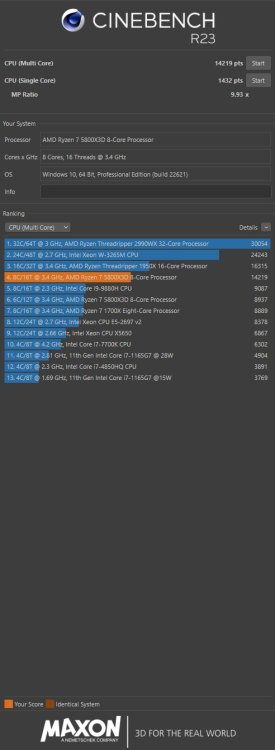
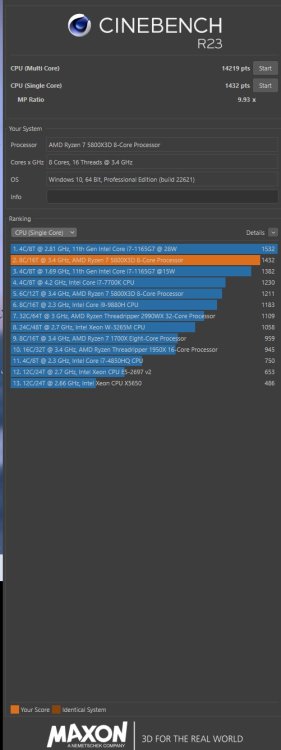
Hi m00n, thank you very much for these tips. I implemented all of these and it hasn't improved anything from what I can see. There's something still struggling in my system. Backstory: I did the all-in-one UnRaid Server - Windows 10 VM Gaming Machine for over 3 years following SpaceInvaders guides. Specs were a Ryzen 1600 & 3600 (in 2020), with a MEG Unify X570, and a Gigabyte 1080G1 (with downloaded VBIOS), 32GB Ram. With Windows 10 being installed on a WD Black NVME that I passed-through (meaning I could boot directly into Windows at any time if I wanted). This worked fantastic and I hardly noticed a difference between the Sever/VM boot and booting directly into Windows (bare bones or whatever it's called). Had a few dockers, like Plex running 24/7, and gamed heavily in the VM. I pinned all but 2 cores for the VM, but didn't isolate any cores (as I felt the 3600 didn't have enough cores to be isolating that many). Fast-forward to 2023: I have replaced my 3600 with a 5800X3D, I have replaced the 1080 with a 6700XT, I'ved added a secondary 1TB NVME that is passed-through with the sole purpose of holding my steam library, and I have moved to Windows 11 (meaning switching from CSM to Secure Boot, etc - changing UnRaid VM template from Win10 to Win11 (i440 to latest Q35, tpm, etc). I've kept the MEG Unify X570 and updated its BIOS. I made a new VM template and passed through everything, pinned all but 2cores/threads to the VM, and loaded it up. It booted into Windows 11 fine... but right away I knew there was something major up. My 5800X3D was running 20oC hotter (usually around 34-37oC when idle... but in VM it is 50oC+), and randomly spiking, and loading up on just one core. I then jumped into the main game I usually play (War Thunder), in which I would typically get 60fps in the menu, and 200+ FPS when in an actual game @ 1440p (when I was booting directly into Windows with the new parts), but was getting around 10FPS in menu and around 60-120FPS in the game, with random stutters here and there. I've messed with a few things like isolating the cores, and even turning off all dockers, etc, but it has made no difference. Since the upgrade, I have basically been having to boot directly into Windows if I want to game at all. With this guide: So I have done all the changes here, and it certainly isn't spiking the CPU as much, but the CPU is still running hotter, and my FPS is still much much lower than booting directly into Windows. I'm not sure if the culprit is something to do with the CPU or GPU. I'm actually thinking the 6700XT, because I have other issues with it that I have to deal with: 1) when I boot into UnRaid, I get a warning about not being able to change the power state of the GPU, and It seems to have the reset bug? I basically cannot close the VM, it will just go black screen with the VM staying on. I basically have to force close the VM to get it to shut off. I have the correct VBIOS, made sure rebar is off in BIOS, and have the latest (pro) drivers installed. But I've also compared cinabench r23 scores of the 5800X3D and it seems to be a pretty big difference in both single core and multicore. Obviously the VM is getting 2 less cores and threads (so 6 core 12 thread), but it seems to be a bigger issue than just that. I've included the screenshots of the benchmarks (Both 5800X3D in those lists are my scores - higher being the stock direct Windows test, and the other being the 6/12 VM test). Any ideas of where I can go from here?
-
Did someone help this guy out? I've run a 1080 in a gaming VM with zero issues for years, but am having issues with my new 6700XT. Mine doesn't crash. It just doesn't let the VM power off, and whines about not being able to change power state of it when booting up. Is there some issue with 6700/6750XT? Edit: Not sure why you're bothering with VNC if you're intending to game, etc. Ideally you've already installed an NVME or SSD in the server and have installed Windows on that. Then it's just a matter of passing-through the NVME/SSD. Then it's just a matter of passing through GPU/GPU-Sound/NVME or SSD/Mouse and Keyboard/Headphones. All explained years ago in SpaceInvaders tutorials. One PC, One GPU, One Monitor - good to go UnRaid VM and Gaming Machine all-in-one. He does need to refresh some of his guides for Windows 11's quirks, though.
-
Just a note that War Thunder, which uses EAC, has never had an issue with VM launches in Windows 10 or 11. Seems to be a few trash games acting out against VM.
-
Hi all, Like many people here, I was one of those who turned my gaming PC into an all-in-one UnRaid/Gaming VM machine following Space's tutorials. I first did this with a system comprising of a Ryzen 1600 - ASUS Strix B350-F, and 1080 GPU (using downloaded vbios), 32GB DDR4 3200, with windows installed on a pass-throughed WD Black NVME. During 2020, I replaced the 1600 and Strix, with a 3600 and a X570 MEG UNIFY. I ran this set up without a single real issue, and I could hardly notice any overhead from the UnRaid VM setup. Fast forward to last week. I slotted in a 5800X3D to replace the 3600. I replaced my 1080 with a Gigabyte Eagle 6700XT. I upgraded motherboard bios in the process. The part installation went well. I booted directly into windows, uninstalled previous display drivers and installed new ones. As the motherboard bios upgrade reset my bios settings and enabled secure boot, I took this opportunity to upgrade to Windows 11. I gamed and things were great, did Cinebench r23 and everything was solid - performance / temps (idle and load) / stability. No software issues, just plain sailing. I then made a Windows 11 VM with the following settings: <?xml version='1.0' encoding='UTF-8'?> <domain type='kvm' id='1'> <name>Windows 11</name> <uuid></uuid> <metadata> <vmtemplate xmlns="unraid" name="Windows 11" icon="windows11.png" os="windowstpm"/> </metadata> <memory unit='KiB'>17301504</memory> <currentMemory unit='KiB'>17301504</currentMemory> <memoryBacking> <nosharepages/> <source type='memfd'/> <access mode='shared'/> </memoryBacking> <vcpu placement='static'>12</vcpu> <cputune> <vcpupin vcpu='0' cpuset='2'/> <vcpupin vcpu='1' cpuset='10'/> <vcpupin vcpu='2' cpuset='3'/> <vcpupin vcpu='3' cpuset='11'/> <vcpupin vcpu='4' cpuset='4'/> <vcpupin vcpu='5' cpuset='12'/> <vcpupin vcpu='6' cpuset='5'/> <vcpupin vcpu='7' cpuset='13'/> <vcpupin vcpu='8' cpuset='6'/> <vcpupin vcpu='9' cpuset='14'/> <vcpupin vcpu='10' cpuset='7'/> <vcpupin vcpu='11' cpuset='15'/> </cputune> <resource> <partition>/machine</partition> </resource> <os> <type arch='x86_64' machine='pc-q35-7.1'>hvm</type> <loader readonly='yes' type='pflash'>/usr/share/qemu/ovmf-x64/OVMF_CODE-pure-efi-tpm.fd</loader> <nvram>/etc/libvirt/qemu/nvram/cc763292-b368-f892-9ae0-cc7575a89b1f_VARS-pure-efi-tpm.fd</nvram> <boot dev='hd'/> </os> <features> <acpi/> <apic/> <hyperv mode='custom'> <relaxed state='on'/> <vapic state='on'/> <spinlocks state='on' retries='8191'/> <vpindex state='on'/> <synic state='on'/> <stimer state='on'/> <vendor_id state='on' value='none'/> </hyperv> </features> <cpu mode='host-passthrough' check='none' migratable='on'> <topology sockets='1' dies='1' cores='6' threads='2'/> <cache mode='passthrough'/> <feature policy='require' name='topoext'/> </cpu> <clock offset='localtime'> <timer name='hypervclock' present='yes'/> <timer name='hpet' present='no'/> </clock> <on_poweroff>destroy</on_poweroff> <on_reboot>restart</on_reboot> <on_crash>restart</on_crash> <devices> <emulator>/usr/local/sbin/qemu</emulator> <disk type='file' device='cdrom'> <driver name='qemu' type='raw'/> <source file='/mnt/user/isos/virtio-win-0.1.190-1.iso' index='1'/> <backingStore/> <target dev='hdb' bus='sata'/> <readonly/> <alias name='sata0-0-1'/> <address type='drive' controller='0' bus='0' target='0' unit='1'/> </disk> <controller type='pci' index='0' model='pcie-root'> <alias name='pcie.0'/> </controller> <controller type='pci' index='1' model='pcie-root-port'> <model name='pcie-root-port'/> <target chassis='1' port='0x8'/> <alias name='pci.1'/> <address type='pci' domain='0x0000' bus='0x00' slot='0x01' function='0x0' multifunction='on'/> </controller> <controller type='pci' index='2' model='pcie-root-port'> <model name='pcie-root-port'/> <target chassis='2' port='0x9'/> <alias name='pci.2'/> <address type='pci' domain='0x0000' bus='0x00' slot='0x01' function='0x1'/> </controller> <controller type='pci' index='3' model='pcie-root-port'> <model name='pcie-root-port'/> <target chassis='3' port='0xa'/> <alias name='pci.3'/> <address type='pci' domain='0x0000' bus='0x00' slot='0x01' function='0x2'/> </controller> <controller type='pci' index='4' model='pcie-root-port'> <model name='pcie-root-port'/> <target chassis='4' port='0xb'/> <alias name='pci.4'/> <address type='pci' domain='0x0000' bus='0x00' slot='0x01' function='0x3'/> </controller> <controller type='pci' index='5' model='pcie-root-port'> <model name='pcie-root-port'/> <target chassis='5' port='0xc'/> <alias name='pci.5'/> <address type='pci' domain='0x0000' bus='0x00' slot='0x01' function='0x4'/> </controller> <controller type='pci' index='6' model='pcie-root-port'> <model name='pcie-root-port'/> <target chassis='6' port='0xd'/> <alias name='pci.6'/> <address type='pci' domain='0x0000' bus='0x00' slot='0x01' function='0x5'/> </controller> <controller type='pci' index='7' model='pcie-root-port'> <model name='pcie-root-port'/> <target chassis='7' port='0xe'/> <alias name='pci.7'/> <address type='pci' domain='0x0000' bus='0x00' slot='0x01' function='0x6'/> </controller> <controller type='pci' index='8' model='pcie-root-port'> <model name='pcie-root-port'/> <target chassis='8' port='0xf'/> <alias name='pci.8'/> <address type='pci' domain='0x0000' bus='0x00' slot='0x01' function='0x7'/> </controller> <controller type='pci' index='9' model='pcie-root-port'> <model name='pcie-root-port'/> <target chassis='9' port='0x10'/> <alias name='pci.9'/> <address type='pci' domain='0x0000' bus='0x00' slot='0x02' function='0x0' multifunction='on'/> </controller> <controller type='pci' index='10' model='pcie-root-port'> <model name='pcie-root-port'/> <target chassis='10' port='0x11'/> <alias name='pci.10'/> <address type='pci' domain='0x0000' bus='0x00' slot='0x02' function='0x1'/> </controller> <controller type='pci' index='11' model='pcie-root-port'> <model name='pcie-root-port'/> <target chassis='11' port='0x12'/> <alias name='pci.11'/> <address type='pci' domain='0x0000' bus='0x00' slot='0x02' function='0x2'/> </controller> <controller type='pci' index='12' model='pcie-root-port'> <model name='pcie-root-port'/> <target chassis='12' port='0x13'/> <alias name='pci.12'/> <address type='pci' domain='0x0000' bus='0x00' slot='0x02' function='0x3'/> </controller> <controller type='pci' index='13' model='pcie-root-port'> <model name='pcie-root-port'/> <target chassis='13' port='0x14'/> <alias name='pci.13'/> <address type='pci' domain='0x0000' bus='0x00' slot='0x02' function='0x4'/> </controller> <controller type='pci' index='14' model='pcie-root-port'> <model name='pcie-root-port'/> <target chassis='14' port='0x15'/> <alias name='pci.14'/> <address type='pci' domain='0x0000' bus='0x00' slot='0x02' function='0x5'/> </controller> <controller type='pci' index='15' model='pcie-root-port'> <model name='pcie-root-port'/> <target chassis='15' port='0x16'/> <alias name='pci.15'/> <address type='pci' domain='0x0000' bus='0x00' slot='0x02' function='0x6'/> </controller> <controller type='virtio-serial' index='0'> <alias name='virtio-serial0'/> <address type='pci' domain='0x0000' bus='0x0a' slot='0x00' function='0x0'/> </controller> <controller type='sata' index='0'> <alias name='ide'/> <address type='pci' domain='0x0000' bus='0x00' slot='0x1f' function='0x2'/> </controller> <controller type='usb' index='0' model='qemu-xhci' ports='15'> <alias name='usb'/> <address type='pci' domain='0x0000' bus='0x00' slot='0x07' function='0x0'/> </controller> <filesystem type='mount' accessmode='passthrough'> <driver type='virtiofs' queue='1024'/> <binary path='/usr/libexec/virtiofsd' xattr='on'> <cache mode='always'/> <sandbox mode='chroot'/> </binary> <source dir='/mnt/user/appdata'/> <target dir='appdata'/> <alias name='fs0'/> <address type='pci' domain='0x0000' bus='0x01' slot='0x00' function='0x0'/> </filesystem> <filesystem type='mount' accessmode='passthrough'> <driver type='virtiofs' queue='1024'/> <binary path='/usr/libexec/virtiofsd' xattr='on'> <cache mode='always'/> <sandbox mode='chroot'/> </binary> <source dir='/mnt/user/data'/> <target dir='data'/> <alias name='fs1'/> <address type='pci' domain='0x0000' bus='0x02' slot='0x00' function='0x0'/> </filesystem> <filesystem type='mount' accessmode='passthrough'> <driver type='virtiofs' queue='1024'/> <binary path='/usr/libexec/virtiofsd' xattr='on'> <cache mode='always'/> <sandbox mode='chroot'/> </binary> <source dir='/mnt/user/Movies'/> <target dir='Movies'/> <alias name='fs2'/> <address type='pci' domain='0x0000' bus='0x03' slot='0x00' function='0x0'/> </filesystem> <filesystem type='mount' accessmode='passthrough'> <driver type='virtiofs' queue='1024'/> <binary path='/usr/libexec/virtiofsd' xattr='on'> <cache mode='always'/> <sandbox mode='chroot'/> </binary> <source dir='/mnt/user/Music'/> <target dir='Music'/> <alias name='fs3'/> <address type='pci' domain='0x0000' bus='0x04' slot='0x00' function='0x0'/> </filesystem> <filesystem type='mount' accessmode='passthrough'> <driver type='virtiofs' queue='1024'/> <binary path='/usr/libexec/virtiofsd' xattr='on'> <cache mode='always'/> <sandbox mode='chroot'/> </binary> <source dir='/mnt/user/Personal'/> <target dir='Personal'/> <alias name='fs4'/> <address type='pci' domain='0x0000' bus='0x05' slot='0x00' function='0x0'/> </filesystem> <filesystem type='mount' accessmode='passthrough'> <driver type='virtiofs' queue='1024'/> <binary path='/usr/libexec/virtiofsd' xattr='on'> <cache mode='always'/> <sandbox mode='chroot'/> </binary> <source dir='/mnt/user/Pictures'/> <target dir='Pictures'/> <alias name='fs5'/> <address type='pci' domain='0x0000' bus='0x06' slot='0x00' function='0x0'/> </filesystem> <filesystem type='mount' accessmode='passthrough'> <driver type='virtiofs' queue='1024'/> <binary path='/usr/libexec/virtiofsd' xattr='on'> <cache mode='always'/> <sandbox mode='chroot'/> </binary> <source dir='/mnt/user/Sports'/> <target dir='Sports'/> <alias name='fs6'/> <address type='pci' domain='0x0000' bus='0x07' slot='0x00' function='0x0'/> </filesystem> <filesystem type='mount' accessmode='passthrough'> <driver type='virtiofs' queue='1024'/> <binary path='/usr/libexec/virtiofsd' xattr='on'> <cache mode='always'/> <sandbox mode='chroot'/> </binary> <source dir='/mnt/user/TV'/> <target dir='TV'/> <alias name='fs7'/> <address type='pci' domain='0x0000' bus='0x08' slot='0x00' function='0x0'/> </filesystem> <interface type='bridge'> <mac address='52:54:00:d6:c7:f5'/> <source bridge='br0'/> <target dev='vnet0'/> <model type='virtio-net'/> <alias name='net0'/> <address type='pci' domain='0x0000' bus='0x09' slot='0x00' function='0x0'/> </interface> <serial type='pty'> <source path='/dev/pts/0'/> <target type='isa-serial' port='0'> <model name='isa-serial'/> </target> <alias name='serial0'/> </serial> <console type='pty' tty='/dev/pts/0'> <source path='/dev/pts/0'/> <target type='serial' port='0'/> <alias name='serial0'/> </console> <channel type='unix'> <source mode='bind' path='/var/lib/libvirt/qemu/channel/target/domain-1-Windows 11/org.qemu.guest_agent.0'/> <target type='virtio' name='org.qemu.guest_agent.0' state='disconnected'/> <alias name='channel0'/> <address type='virtio-serial' controller='0' bus='0' port='1'/> </channel> <input type='mouse' bus='ps2'> <alias name='input0'/> </input> <input type='keyboard' bus='ps2'> <alias name='input1'/> </input> <tpm model='tpm-tis'> <backend type='emulator' version='2.0' persistent_state='yes'/> <alias name='tpm0'/> </tpm> <audio id='1' type='none'/> <hostdev mode='subsystem' type='pci' managed='yes'> <driver name='vfio'/> <source> <address domain='0x0000' bus='0x30' slot='0x00' function='0x0'/> </source> <alias name='hostdev0'/> <rom file='/mnt/user/data/Vbios/Gigabyte.RX6700XT.12288.210303.rom'/> <address type='pci' domain='0x0000' bus='0x0b' slot='0x00' function='0x0'/> </hostdev> <hostdev mode='subsystem' type='pci' managed='yes'> <driver name='vfio'/> <source> <address domain='0x0000' bus='0x30' slot='0x00' function='0x1'/> </source> <alias name='hostdev1'/> <address type='pci' domain='0x0000' bus='0x0c' slot='0x00' function='0x0'/> </hostdev> <hostdev mode='subsystem' type='pci' managed='yes'> <driver name='vfio'/> <source> <address domain='0x0000' bus='0x01' slot='0x00' function='0x0'/> </source> <alias name='hostdev2'/> <address type='pci' domain='0x0000' bus='0x0d' slot='0x00' function='0x0'/> </hostdev> <hostdev mode='subsystem' type='pci' managed='yes'> <driver name='vfio'/> <source> <address domain='0x0000' bus='0x23' slot='0x00' function='0x0'/> </source> <alias name='hostdev3'/> <address type='pci' domain='0x0000' bus='0x0e' slot='0x00' function='0x0'/> </hostdev> <hostdev mode='subsystem' type='usb' managed='no'> <source> <vendor id='0x046d'/> <product id='0x0a6d'/> <address bus='5' device='5'/> </source> <alias name='hostdev4'/> <address type='usb' bus='0' port='1'/> </hostdev> <hostdev mode='subsystem' type='usb' managed='no'> Apart from the part upgrade, I made some notable changes to the settings. With my previous setup, due to only using a 6/12 processor, I would pin CPU cores but not isolate. This time I have pinned and isolated cores. I have also made use of the virtios passthrough mounts for my shared folders (before I would just use SMB). I'm using a new vbios for the new GPU (obviously), and a newer machine model (Q35-7.1). With the above settings the VM loads up just fine, but I have noticed the following issues: My 5800X3D seems to be working harder when idle - random spikes in activity - sometimes just on one of the cores. As a result - I've seen it idling at 40-50oC, when it idles around 33oC when booting baremetal. In the main game I play (War Thunder), where I was previously getting over 200fps in the game after the upgrades, I am lucky to get 100 in the VM. In the menu, where it should be around 60FPS - it is struggling to get over 10FPS and it stutters. If the VM needs to restart (say for an upgrade...) it will do so, but with no display, just a black screen. If you try restart the VM it will not do anything, and you then have to force close to get it to close. But you will have to reboot Unraid to actually get the VM to run again. Not sure what is going on. I'm passing more cores through, they're isolated, I've offloaded my docker containers to another system. Could it be issues with Windows 11? Could it be a vbios issue? What is causing the 5800X3D to be working harder even at idle in the VM? Any help here? Thanks
-
Hey all, In 2020, during the pandemic I embarked on a project to rid myself of my consumer router (Netgear R7000) and NAS (Synology DS415+) in exchange for an Unraid Server/Gaming machine (game in a Windows VM on Unraid ) attached to a 16bay DAS/pfsense server (both being in Lian Li PC-P80 cases). If you remember those months, you'll remember that prices for things like GPUs and Ryzen X570 motherboards were through the roof. Well.. using ebay, I nabbed a few Mallanox CX312A and a LSI SAS 9200-16E 16-Port 6Gb/s card. The build went great, and continues to run great today. Things are strange when it comes to Mallanox and 9200-16E prices where I am (Australia) at the moment, though. Everything else, like CPUs, GPUs, Motherboards, have had substantial price decreases in the past year, but the 9200-16E for example, has gone up from the 60-70AUD mark in 2020 (I paid 69AUD), to well over $140. Now I know this is the second hand market and prices can fluctuate, but even when I look at Chinese based sellers, the prices are just up everywhere. Has there been a shortage of Mallanox NICs and SAS cards? Or are more people just getting into building their own servers, DAS, and routers? (I want to chuck another 9200-16E card into a secondary PC, so it can enjoy the benefits of the DAS (have a whole bunch of bays that are just not being used that I could use for other PCs), but it is hard paying nearly double what I did two years ago..)





