





yogy
Members
-
Joined
-
Last visited
Everything posted by yogy
-
This has something to do with Nginx Proxy. You should take a look at your Nginx settings and config files. Not many people are using Nginx Proxy, usually Swag or Nginx Proxy Manager. I use the latter and didn't have to change or add anything to my proxy configuration. Maybe someone could provide you with some assistance who is actually using Nginx Proxy.
-
New repository is: vaultwarden/server:latest Change it in docker settings: Stop the container Rename repository to vaultwarden/server Hit Apply and start the container That's it. Don't forget to go to unRAID Settings >> click on Fix Common Problems (if the scan doesn't start automatically then click RESCAN) and you will receive a notification to apply a fix for *.xml file change. I just went through this procedure and can verify everything went smooth and well.
-
Can someone please explain what's with this new vaultwarden. Bitwarden_rs is now deprecated, so can we just change the repository or we should start from scratch (create a new docker container)?
-
Ussualy you set NPM proxy hosts to use http. This is because docker containers ussualy don't use https port (variables should allow ssl). Just to be clear, this is in your local network, so no harm done. When you use http in NPM proxy host this doesn't mean your will access docker app via http over internet, that is if you set correct subdomain in your domain cPanel (CNAME) and use the same subdomain in Domain Names in NPM. With Let's Encrypt certificate which is free to use, you will only be able (if you set NPM correctly - SSL tab in NPM) to access your docker app via https.
-
WEBUI broken again with last update 😪
-
I know, I wrote this post. But I should also correct the first sentence "You can access Bitwarden server through the browser by entering local IPaddress:port assigned by unRAID". I just tried that. IT DOESN'T WORK. It requires https. Just block the admin access, use a trusted certificate, long password (with lower case, upper case, numbers and special characters, at least 14 characters long) and you are good to go.
-
Trusted Self signed certificate. But you need to store it somewhere in bitwarden configuration. I didn't yet test that and I'm not sure if it's even possible, but it would be worth to try.
-
Many thanks to @yinzer for making an initial guide and @HojojojoWololo for the update. I have successfuly created a working Matrix and Element-web docker with Nginx Proxy Manager. I have a few questions but first let me introduce this guide how to become an administrator of your own server. This gide is provided by BRIAN MCGONAGILL and you can find the whole article on his webpage: Open terminal and go to your appdata matrix folder (mine is in /mnt/user/appdata/matrix Now we need to get into the sqlite shell for the file homeserver.db. So we use the command sqlite3 homeserver.db Now we'll search for our user in the database with the command SELECT * FROM users; It should look something like this @your-user:your-server-url|sNyRQNH/aCDj7XSeRqreHtGuVe9ZoxGEUyyT5UF78QWw3S|76098|0||0|||||0|0 And make note of your username. It looks like this @youruser:your-server-url Copy your username and paste it in the next command to look like this UPDATE users SET admin=1 WHERE name='@your-user:your-server-url'; Now re-run the command to search you should see that a 0 (zero) is now a 1 (one) out to the right SELECT * FROM users; You should see that a 0 (zero) is now a 1 (one) out to the right and should look like this @your-user:your-server-url|sNyRQNH/aCDj7XSeRqreHtGuVe9ZoxGEUyyT5UF78QWw3S|76098|1||0|||||0|0 Finally type .quit and press Enter to exit the SQLite shell All thanks go to BRIAN MCGONAGILL for providing this guide, I just modified it (just a little bit). Now to my question. I would like to see who registered in my self hosted server (registration is enabled). It's obvious I can't see this now. Is it possible to approve users registration before they log in. I have setup SMTP and it's working in homeserver.yaml
-
Thanks @bytchslappa for the heads up. Everyone using a User Script for Nvidia GPU Power State just edit the script to: #!/bin/bash nvidia-persistenced fuser -v /dev/nvidia* and leave the schedulle At first Array start only unchanged.
-
So you don't own a domain and you don't use Nginx Proxy Manager? If that's the case then I understand. Otherwise you can make use of Bitwarden way better.
-
You can access Bitwarden server through the browser by entering local IPaddress:port assigned by unRAID (only https is allowed). Don't know if Android app and browser extension works with local IP. I don't know why you don't use Nginx Proxy Manager, it's very safe if you own a domain name and use it with Let's Encrypt certificate. To double your security you should enable two factor authentication. You don't need to forward any ports with Nginx Proxy Manager in your Router (except the ones used by NPM). Also for local access you don't need any port forwarding. No, this is done through Command Line / Terminal in unRAID. You can use Putty for that. You need to know where NPM is located (ussually /mnt/user/appdata/NginxProxyManager/nginx/proxy_host or similar). You need to access coresponding *.conf file with vi or nano command to add those lines. You don't manage port forwarding from unRAID. In this case you don't have to do anything on your router / firewall. Look for the IP address and port for Bitwarden docker container and put this in your browser. That's how you access Bitwarden localy. But again, I don't see much use of it this way.
-
# Proxy! include conf.d/include/proxy.conf; } location /admin { return 404; } # Custom include /data/nginx/custom/server_proxy[.]conf; } I did it like this and it's working great. When I access admin page through the internet (with domain) I get 404 error, when I do it through local address I can access it just fine. And yes, I'm using Nginx Proxy Manager.
-
Yes, I'm doing some tests with OPNsense and XPEnology VMs and would like to passthrough the card with physical NICs (don't want to use virtual, since I have the network card I can use)
-
I'm gonna ask here since search on the forum didn't bring anything related to my question. I'm on v6.9.1 stable Is it still the correct way to reset pci network card and add this command "vfio-pci.ids=8086:105e" to syslinux config file and then reboot the server so changes can take effect. This is the network card with 2 eth NICs IOMMU group 47:[8086:105e] 01:00.0 Ethernet controller: Intel Corporation 82571EB/82571GB Gigabit Ethernet Controller D0/D1 (copper applications) (rev 06) IOMMU group 48:[8086:105e] 01:00.1 Ethernet controller: Intel Corporation 82571EB/82571GB Gigabit Ethernet Controller D0/D1 (copper applications) (rev 06) They are both market as "currently in use by Unraid" and I cannot BIND SELECTED TO VFIO AT BOOT. I would like to use this network card assigned to VM passthrough. If my assumption is correct, does this command need to stay in syslinux config permanently. EDIT: Didn't do my search homework thoroughly. I found the solution in this post bellow
-
Hi all. I would like to try and install XPEnology as a VM on unRAID. I will do a passthrough of 2 HDDs and a PCI card with 2 network interfaces. My question is what do I need to change in synoboot.img file. Just the serial number and NIC MAC address? What about VID and PID? Can I leave those as is? Anything else worth mentioning? EDIT: Successfully installed. No VID, PID change required Followed the thread on xpenology forum
-
+1, hopefully new release will fix this.
-
Thanks for answering. Is it fair to assume it will be somewhere in the near future?
-
Hi, has anyone tried to implement (or know how to do it) bitwarden send on your self hosted app. It's a very usefull feature if you need to send passwords to someone.
-
Yeap, that did the trick. No parity check after changing the disk timeout setting. What do you think caused this. Is it v6.9.0 related?
-
Hmm..... this is something new for me. Where can I change that and to what value.
-
Here is the diags file unrsrv-diagnostics-20210307-1236.zip
-
Since the upgrade to 6.9.0 after every clean reboot of my server, parity check is starting. This wasn't the issue on 6.8.3. From the syslog I get: Mar 7 12:39:34 unrsrv emhttpd: unclean shutdown detected, but all I did was a click to REBOOT button in the main page. Please find attached my diagnostics file. unrsrv-syslog-20210307-1155.zip
-
Hi @ich777, What do you recommend to do with the old Nvidia build if I upgrade from 6.8.3 to 6.9.0 since stable is already out. Do you recommend to uninstall the old build and when upgrade install the new/regular one. Thanks
-
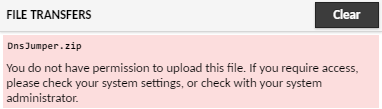
My shared folder (following @SpaceInvaderOne great video guide) have some permission issues. I created the share following the same procedure but getting errors when I want to upload or change some files. Here is the error message: You do not have permission to upload this file. If you require access, please check your system settings, or check with your system administrator (picture attached) Edit: RESOLVED! (My mistake. Incorect path naming in Device Redirection >> Drive path). Now it's working like a charm.
-
I'm using OnlyOfficeDocumentServer (from onlyoffice). Since the recent update I don't have onlyoffice icon anymore (? simbol in grey colour). When I check the Icon URL in Dockers Advanced View it says https://pbs.twimg.com/profile_images/801693107125362689/al5MQBQM_normal.jpg. Entering the link to the browser leads to an error. Can someone please post the correct link.


