MPC561
Members
-
Joined
-
Last visited
Everything posted by MPC561
-
Also meinst Du nicht Coil Whining? Sprich Spulenfiepen? Nagelnde Festplatte klingt niederfrequenter. Das sollte ich gehört haben. Aber, Steck das Teil erstmal in ein Gehäuse. In meinem gedruckten höre ich nix. (Ich höre nichtmal sen 120er Lüfter der mit 600rpm läuft wenn der Prozessor über 60 Grad ist btw.). Das PLA scheint da gut zu dämmen.
-
@boernie77 Sieht schon viel besser aus! Wenn Du wieder da bist das mal in der Konsole eingeben. Dann sehen wir welche Devices noch tiefere Package States verhindern. Ich tippe auf deine Killer E3100G Netzwerkverbindung: sudo lspci -vv | awk '/ASPM/{print $0}' RS= | grep --color -P '(^[a-z0-9:.]+|ASPM |Disabled;|Enabled;)' Und Messwerte wieviel Du brauchst wären noch nett für uns. Wenn ich richtig lese jetzt 20W bzw. 24W (mit Raid1 beim Cache?) Aber wie gesagt, nach dem Wochenende! Und damit auch: Ein schönes Wochenende mit der Familie! Gruss, Joerg PS: Wenn wir von 35W ausgehen und 20W auf denen du jetzt bist (die 2. SSD für Raid 1 beim Cache lasse ich Jetzt mal raus, die braucht man übrigens nicht wenn man die Cache SSD jeden Tag automatisiert backups von /App aufs Array macht) dann hast Du bei einem Stromprise von ca. 30 cent über 5 Jahre gerechnet bei 7/24 Laufzeit des Servers schon 200 Euro gespart.
-
@boernie77 Kann es sein das du die NVME in den Slot gesetzt hast der direkt mit der CPU verbunden ist? Das könnte auch eine tiefere Pkg States verhindern. In dem Falle bau die NVME mal in den anderen Slot der via DMI und nicht direkt mit der CPU verbunden ist (meist Slot 2.). Einige hatten schon dadurch Probleme mit Pkg States. Ansonsten, 27 W klingen besser aber noch nicht gut.
-
Kann ich mich leider nicht wirklich erinnern. Habe das Board ausgepackt (keine Ahnung ob es roch) in Betrieb genommen (auf dem Tisch liegend) Unraid Grundkonfiguriert und bin dann erstmal 2 Wochen in Urlaub gefahren. Hatte also Zeit auszumoseln. Na ja hängt auch davon ab wie "idle" der Prozessor selber wirklich ist. Wenn eine VM unter Unraid läuft kommt der nicht in tiefe Pkg States. Das hat auch schon ein Franzose (zumindest glaube ich das es einer war) mit dem ich mich auf reddit gestritten habe gesagt. Ich habs erstmal abgetan weil ich nix höre. Kann aber auch sein das ich es einfach nicht höre weil ich ein Hörproblem bei gewissen Frequenzen habe bzw. im Alter geht ja die maximal Frequenz die man hören kann nach unten. Bin jetzt 50... Also mal abwarten ob jüngere was dazu schreiben.
-
Same issue here with another user (in German, but the pictures say enough): https://forums.unraid.net/topic/148272-butcha89s-erster-unraid-server/?do=findComment&comment=1338109 The user also did not understand why he only reached C3. I asked him to do: sudo lspci -vv | awk '/ASPM/{print $0}' RS= | grep --color -P '(^[a-z0-9:.]+|ASPM |Disabled;|Enabled;)' And the result was also that ASPM was disabled. In this case with an RTL8125. (Which supports my fear that now nearly all Boards with Realtek Chipsets are affected) Me also not. A German moderator said me I should go to the kernel GitHub something. Made me a bit pissed... Sorry. Greets, Joerg
-
Link not working for me.
-
Don´t missunderstand me. I avoided Realtek Network Chipsets like hell, as I had some negative experiences with other boards (many years ago) which I intended to use with Unraid. I have now 4 Unraid Systems, 2 of them have an Intel Network chipset, the 2 other ones Realtek. And Realtek worked correctly the approx. last 3 years. As Realtek is used in the majority of the smaller boards you can not really avoid them anymore...
-
Depends on your mainboard and the used extension cards, as I told nearly all MB´s with RTL network chipset are affected. With the N100DC-ITX it´s not a lot (6.12.4 I had 7W mean consumption, with 6.12.5 I had 9W) so 2W. Other systems may have 5W+ difference. With the energy prices we have in Europe in some countries we discuss here over 5 years of additional energy cost of approx 100 euro in addition. With my system here in Germany and my energy price with 2W more over 5 years it´s only 29 Euro. Surely not. The correct example would be: Dell sells me a laptop with an OS with hard integrated Browser from another company which stops to work after an update. In this OS I have no admin rights and also BIOS is locked and so it´s not possible to replace the browser/install a new one. Dell sends me to the browser supplier instead of solving the problem with the browser supplier itself. Limetech selled me UNRAID OS and I expect that it works. They are also my first level support. If they have not a solution they should run to the kernel development team and not me. It´s of course much more evil than the problem itself.
-
Don't know. Me did not open one.
-
@vmasip The problem is not only with this board. It hits nearly every board with Realtek Network Chip (8111, 8168, 8125, 8152). So the problem is much bigger than an N100 Board. I know already the argumentation will be: It´s the Kernel. We are not developing the kernel. But I paid my license from Limetech after this special board was tested by me and running. Now the state is worse as it consumes more power. It´s like I would by an iPhone with a new linux based OS and with a big bug and Apple would send me to the Linux Kernel developer that me demands they fix it instead of doing it itself with them...
-
Sure, the processor itself and the other peripherals on the board need lesser voltages than 12V. Only 12V may be critical as the 3,5inch HDDs need this. Yes it is, but this drivers will not change the situation. They were made for some "special" versions of the RTL hardware which generally did not work or do not support multi qeue feature. But ASPM is with this drivers disabled. See the readme of the repo. btw. me tried them but still C3. They are also available via Apps in Unraid already. The funny thing is it will show that ASPM is ok but the board does not go below C3. PS: 2 o'clock AM in good old Germany. I will go to sleep now.
-
No. I reverted to 6.12.4 where everything is fine and pray that with 6.13.x the problem is solved.
-
Don´t know. Me uses only SSDs and no HDDs and the SSDs have not such peak currents like HDDs in startup when the motors spinning up. Also 3,5inch HDDs need 12V for the motors while SSDs are only powered via 5V. We had until now only one problem with the 12V in this thread, when saber1 connected 1xNVME and 4 HDDs (via additional PCie SATA Card). Then with his 12V PSU the disks did not spin up (maybe due to the high current a kind of voltage drop from 12V to a much smaller valued). With a 19V 90W PSU they spinned up btw..
-
Das ist die Lösung. Die Daten der Docker, die VMs müssen auf den Cache. Dann werden die zwei anderen HDs auch schlafen, das spart dir schonmal 10-15W. Ich weiß jetzt auch warum dein Sysrem nicht in den C2 geht. Das ist die Nextcloud VM. Die kostet halt Power. Braucht man aber gar nicht. Die meisten inkl. mir haben Nextcloud im Docker laufen. Dann geht das Board auch in tiefere Pkg states. Spart nochmal 5W. Ich schreib später wenn der kleine im Bett ist noch was du machen solltest um das zu mit /App /System /iso zu korrigieren korrigieren. PS: Hat @alturismo ja schon beschrieben.
-
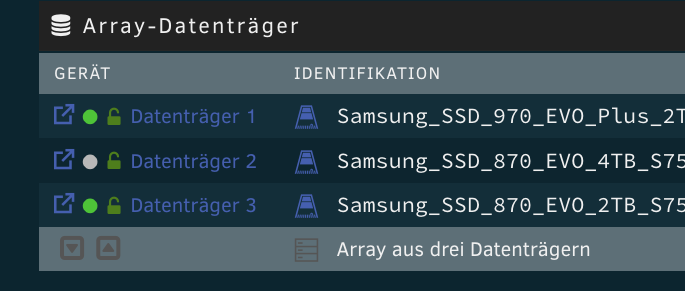
Siehst Du unter Start wo alle Datenträger aufgeführt sind. Sieht so in etwa aus: Dabei sind die 1. und die 3. Platte am laufen und die 2. die den grauen Punkt hat im Spindown. Mann kann sogar auf den grauen Punkt klicken, dann wird die Platte aufgeweckt oder auf den grünen das geht sie schlafen (wenn nicht gerade davon gelesen oder geschrieben wird.). Wenn alle dein Platten an sind ist dein Verbrauch von 35W ok. Sind alle aus ist dein Verbrauch Scheisse.
-
Ja natürlich. Weil es ganz normale SATA Festplatten sind ohne irgendeinen Raid. Deswegen hab ich das davor ja lang und breit erklärt. Das einzige was passieren kann ist das dein Mainboard wegen der PCie SATA Karte nicht mehr in tiefe Pkg States kommt und du paar W mehr Saft brauchst. Kannst Du konfigurieren wie Du willst und wird am Ende von der Datenmenge abhängen. Wenn Nextcloud auf dem Array ist weckt es dauernd die Platten selbst wenn Du es gerade nicht verwendest (hochgradig Scheisse, Lebensdauer, Strom und so), deswegen hab ich alle Daten auf dem Cache. Ist aber nicht viel bei mir. Vielleicht 20-50GB je nach Füllstand. Ich lade da nur automatisch die Handybilder meiner Frau und von mir hoch wenn wir in einem WLAN sind und später kommen die von da in meine Bilderdatenbank. Dann noch Paar Dateien, Treiber und so kram.
-
@faxxe71 @pappaq ITE IT87 Driver oder Nuvoton NCT6687 Driver könntet ihr mal probieren. Sind Treiberpakete im App. Erst das eine dann deinstallieren, dann das 2. testen.
-
Die Festplatten sind wirklich im Spindown? Wieviele hast du eigentlich? 3 wie auf dem screenshot?
-
@saber1 Na ja, Samsung sagt wenigstens 3 Bit MLC. Andere Hersteller bringen es durchaus und ändern innerhalb des Lifecycle des Produktes einfach von MLC auf TLC oder TLC auf QLC. Sprich bei Markterscheinen als gut getestet/gereviewed aber dann heimlich ändern so das die Teile dann Scheisse sind. Verdammt ich kann mich nicht mehr genau erinnern wer das letztens gemacht hat, war das nicht Crucial mit der BX500 die sie klamm und heimlich von TLC auf QLC geändert haben?
-
Huch, sorry. Hab kein "m" gesehen, das "i" übersehen und das AX wohl als ATX missinterpretiert. PS: Das Drama bzgl. Stromverbrauch mit den Synologies kenne ich auch. Hatte eine DS1815/18/17 jahrelang im Einsatz (DS416play auch noch als Backupsystem). Die DS1817 40W im Idle, 120W bei Datenzugriff, da durch SHR2 Raid bei jedem Filezugriff als Platten anliefen. Das wird mit Unraid um Welten besser, selbst wenn Du Idle 30W brauchen solltest. Beim Datenzugriff läuft dann nur noch die eine Platte an auf der die Daten auch liegen oder wenn die gar auf dem Cache sind nur die SSD/NVME. Sprich dein Durchschnittsverbrauch sinkt gewaltig.
-
Was da rauskommt ist schwer zu sagen. Wir messen hier den idle normal nach den Hardwareluxx regeln (um Vergleichbarkeit zu haben). Sprich nacktes System (Board , RAM, Prozessor, 1xNVME oder SSD und der Unraid Stick, dann Netzwerkkabel dran und Tastatur), mit allen Energiesparmechanismen im Bios aktiviert wie ich oben schon schrieb. Alles was unter 10W ist, ist gut. Wobei die Schmerzgrenze da bei jedem woanders ist. Dann musst Du rechnen das Du pro angeschlossener HD ca. 1W im Idle mehr brauchst. So braucht mein W480 System mit i3-10100 und 8xHDDs ca. 16W im Idle mit einem laufenden Docker (Jellyfin). "Ich" halte das für sparsam. Wenn ich sehe das Du eine VM aktiv haben wirst (immer?) hast Du eh schon was was dein System nicht in tiefe C-Pkg States lässt. Wenn es die Funktionalität als Docker gibt wäre das besser. Auch 15 Docker werden eine gewisse Grundlast erzeugen. Nextcloud kostet mich zum Beispiel ca. 1W Grundlast. Wenn Du das Board testen kannst dann teste es wie gesagt einfach erst. Keiner kann Dir hier sagen was es an Saft zieht. Ich kenne bis dato keinen hier der es einsetzt. Ist halt ATX. ATX hat mehr slots und Features und das kostet eben Strom. Deswegen kaufen die meisten uATX oder ITX (wenn es denn was mit ITX gibt).
-
Ich traue dem ATX Board nicht bzgl. Idle Verbrauch. Noch dazu haben die Aorus die mir untergekommen sind Ärger mit ASPM gemacht. Das sind meine einzigen Bedenken. Aber da deine Grenze 30W im Idle ist... Das sollte eigentlich auch mit dem Teil gehen. Würde ich als erstes Testen wenn Board, RAM, PicoPSU da sind. Zusammenbauen, nur eine SSD rein, Unraid Teststick mit Nerdtools und Powertop. Bios richtig einstellen und erstmal idle messen mit Powertop --auto-tune.
-
Die ist nicht schlecht wenn sie ASPM vernünftig beherrscht. Vor allem nicht bei 65 Euro für 2 TB. Da würde ich sogar selber zuschlagen. Und TLC ist auch ok, zumindest kein QLC. @saber1 Die 970 Evo (Plus) hat auch TLC. Nur die Pro Serie hat noch MLC, sagt jedenfalls Tante Google.
-
Das aktuelle System reicht. Selbst der Prozessor sollte locker reichen. Docker Container sind meist nicht so anspruchsvoll. Wie gesagt ich hatte das auf einem J4105 ATOM board was Du auch an Dockern planst und das lief gut. Solange du keine VMs nutzt brauchst Du nichtmal 16GB RAM. Würde ich auf jeden Fall erstmal testen. Aufrüsten kannst Du immer noch. Unraid heißt Unraid weil es eben nicht mit RAID arbeitet. Was ist ein Raid? Raid5, z.B. 4 Festplatten gleicher Kapazität bei denen eine ausfallen kann und man kann die ersetzen und die Daten wiederherstellen. Aber das macht Unraid (also "Kein"Raid) eben anders. Du hast dann 3 Datenplatten und eine Paritätsplatte. Auf den Datenplatten liegen ganz normal Daten (kann man in einen anderen Rechner stecken und einfach lesen wenn nötig) und bei schreiben der Daten wird eine Paritätsinformation auf der Paritätsplatte abgelegt, mit der man dann ggf. auch eine Platte wiederherstellen kann. Diese Datenplatten + Parität ist dann das Array. Hab ich nie gemacht aber geht wohl beim Cache/Pool (ohne Raid HW, sprich Softraid,, wobei Raid 1 ja eh nur Spiegelung ist). Ich hab mir das gespart, ich kopiere via einen Backupprogramm alle wichtigen Docherdaten täglich noch aufs Array. Deswegen verliere ich da max. einen tag Daten. Dafür spar ich Strom. Wie das unter deinen Windows Server war ist irrelevant, ich meine unter Unraid. Da kann man einstellen das die Platten auch x Minuten in den Spindown gehen wenn keine Daten in dem Zeitraum geschrieben oder gelesen wurden. Dadurch sinkt der Stromverbrauch der Platte von ca. 10W auf 1W. Und das die Platten nicht dauernd hochfahren müssen kann man auf zwei Arten realisieren. Zum einen den Cache nutzen. Der ist NVME/SSD und geht nach paar ms schon in den sleep und wacht auch so schnell wieder auf. Die zweite Möglichkeit ist Daten die man sehr wenig braucht auf einer Platte (oder mehreren) zu speichern und die Daten die man öfter braucht auf eine andere Platte zu legen. Zum Beispiel. Du hast Videos und Musik. Nehmen wir an Videos und Musik sind so gross das sie jeweils auf eine Platte passen würden. Musik hörst Du jeden Tag. Videos schaue Du nur am Wochenende. Dann machst alle Videos auf eine Platte und die gesamte Musik auf eine andere statt alles zu mischen. Dann schläft die Videoplatte faktisch die ganze Woche bis aufs Wochende und die Musikplatte halt immer wenn Du Musik hörst. Btw. ich hab meine Musik sogar auf dem Cache weil ich die täglich höre.
-
@boernie77 Ist jetzt alles aktiviert. Aber Du hast noch zwei Probleme. Zum einen das der Realtek Chipsatz (Netzwerk) ab 6.12.5 tiefere Pkg States als C3 verhindert und noch dazu den USB Chipsatz. Wegen dem USB Chipsatz mal einen anderen, am besten USB2 Port nutzen und schaust ob der zusätzliche Controller im Bios deaktivierbar ist. Trotzdem verstehe ich nicht das Du nichtmal in den C2 oder C3 kommst...