





3560freak
Members
-
Joined
-
Last visited
-
I'll take a closer look into the User Shares section that you referenced. Thank you for the replies.
-
I wonder why UnRAID shows two different sizes in the pool? Total size shows 1.5TB but Free Space shows only 1TB.

-
I've had an UnRAID server for years but only recently decided to add cache drives/pool as I was seeing it come up more an more on UnRAID tutorials as a good way to reduce disk spinups. I have added two SSD drives (2TB and 1TB) to UnRAID as a RAID1 btrfs pool, giving me 1.5TB of usable space. These are repurposed drives that were no longer in use but have relatively low power on hours. I read of the UnRAID guide here [ https://docs.unraid.net/unraid-os/using-unraid-to/manage-storage/cache-pools/ ] but that provided no info about implimentation. What my expectations/understandings of a cache drive/pool would be that any data copied to the array (including movies for PLEX) will go to the cache drives and then at some speicifed point in time, or as cache pool reaches X amountof storge remaining, that it copies these files to the actual array. Is this a correct assumption or do I misunderstand what a cache drive/pool is supposed to do? Am I also to understand that I should copy all of my exisitng application data from my array to the cache pool? Will doing this break the Dockers that I have in place, or will nothing really change as they will still point to the same shares/data on the array? Happy to follow a proper guide, video or forum post if anyone has one and doesn't feel like repaeting what has likely been asked many times before. Thank you for any assistance with this.
-
This fixed my issue (Quadro P card), thanks.
-
Just wanted to thank you again for all of the help. Running smoothly with new parity drives and old parity drives formatted for data storage.
-
Thank you. Additional (possibly dumb) question. Can I simply keep disk4 where it is (with all data intact) and replace disk3 (the 4TB drive with no data on it) with the old parity 10TB drive (formatted) and add the second old parity 10TB drive (formatted) as Disk5? I have fixed the drive layout that I displayed above to accurately reflect the drive assignments. Current drive layout Parity 1 (10TB) Parity 2 (10TB) Data Drive 1 (10TB) Data Drive 2 (10TB) Data Drive 3 (4TB) Data Drive 4 (10TB) Desired drive layout Parity 1 (14TB) Parity 2 (14TB) Data Drive 1 (10TB) Data Drive 2 (10TB) Data Drive 3 (10TB) * old parity 1 Data Drive 4 (10TB) Data Drive 5 (10TB) * old parity 2
-
You are correct. I meant disk 3 and not 4. I had it labeled as 3 (on the physical drive) from another build that I had pulled it from. Any different procedure to follow after view the diagnostics? Thank you again for your time.
-
Updated diagnostics as requested. Thank you diagnostics-20230205-1415.zip
-
I appreciate the second look. Here are my diagnostics
-
I have read over the wiki process but am still not 100% confident. Would someone mind confirming that I am taking the correct steps? Current drive layout Parity 1 (10TB) Parity 2 (10TB) Data Drive 1 (10TB) Data Drive 2 (10TB) Data Drive 3 (10TB) Data Drive 4 (4TB) Desired drive layout Parity 1 (14TB) Parity 2 (14TB) Data Drive 1 (10TB) Data Drive 2 (10TB) Data Drive 3 (10TB) Data Drive 4 (10TB) * old parity 1 Data Drive 5 (10TB) * old parity 2 My understanding is that I should remove current Parity 1 drive (10TB) from it's assignment and then assign one of the new 14TB drives. This will rebuild parity for the array. After that is completed, I then remove current Parity 2 drive (10TB) from it's assignment and then assign the other new 14TB drive. Allow this parity to rebuild and then I can assign both old parity drive to data slot 4 and 5 respectively. There is currently no data on the Data Drive 4 (4TB) so a copy wouldn't be necessary. Does this seem like the correct process or can I do more steps at the same time to reduce the overall time to complete the process? Thank you for any assistance holding my hand through this.
-
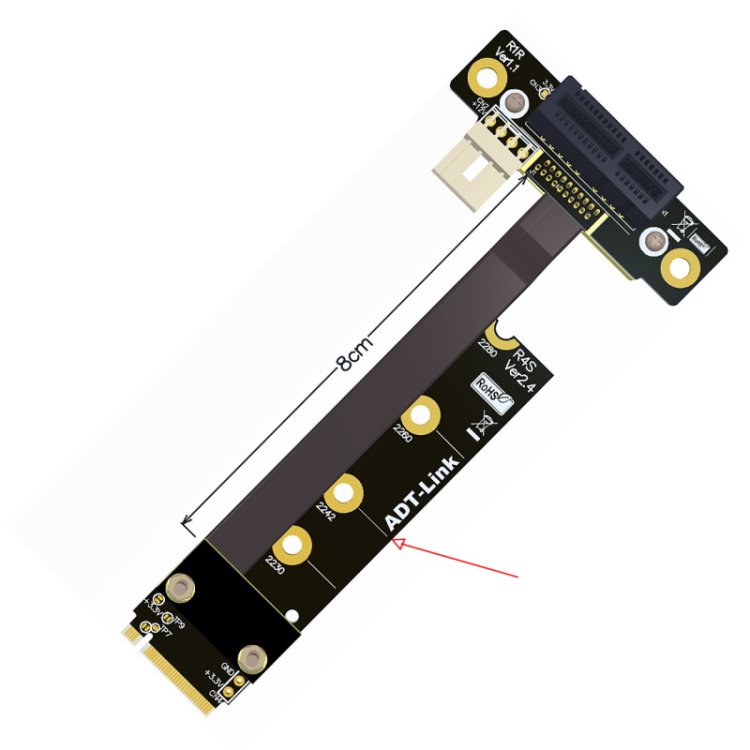
I am the reason that they say measure twice, cut once (SMH). I ordered the M.2 to SATA adapter only to realize that my MB has a half length M.2 slot (2242). The case/drives block my from using this longer/standard card. I will need to go with the M.2 to PCIe riser solution. I am going to make the assumption that I can trim down the PCB since the cabling/components are all in the base of the card (hopefully this is accurate, see image). Thanks again for all of your help, JorgeB.
-
Thanks for the reply. My only other question was to confirm that the ASM1166 chipset is desired over the JMicron JMB585, due to compatibility with UnRAID, correct? My inclination is to go with a Silverstone ECS07, because they seem like the most reliable company selling these M.2 adapters, but if the chipset that they use does not play well with UnRAID then that is a moot point.
-
I am not in the market to change boards/case/CPU etc right now so I have been looking at these m.2 to SATA expansion cards (specifically ones using the ASM1166 chipset) to add storage to my array. I am currently on mITX (so only one PCIe slot) and cannot afford to give up my NVIDIA card to cover PLEX transcoding (my ASUS P11C-I with it's C242 chipset doesn't allow for iGPU passthrough). Question 1: Can anyone tell me if there is any downside to having my two parity drives (currently run dual parity) on the expansion card vs the motherboard's onboard controller? Question 2: Seeing reports about flimsy PCBs on these expanders, potentially being the point of failure. Would it make more sense to get an m.2 to PCIe riser card and use my existing ECS06? Cost is small enough with either option, just wanted the one that is the most reliable of the two. Thanks for any suggestions/tips.
-
I appreciate the tip. I'll contact ASUS to see if there are any workarounds.
-
I might possibly be in a similar situation. My MOBO is an ASUS P11C-I with an i3-8100 and the newest BIOS. I don't see anywhere in the BIOS settings where I can enable iGPU, and there is mention in the manual about using a jumper to enable/disable the onboard VGA controller (ASUS manual pg 2-23). Is my only option at this point to get a NVIDIA GPU to support HW transcoding? Thanks for any support that you can provide.

