





SP67
Members
-
Joined
-
Last visited
Everything posted by SP67
-
Thanks JorgeB. All has been stable for the last week.
-
Ok, I've re-created the VM with the same qcow file and it's again working fine!
-
Hello again, One of my VM won’t start. Here’s the xml file. The only thing I did was to change the network type to virtIO-net as I said… Thanks! <?xml version='1.0' encoding='UTF-8'?> <domain type='kvm'> <name>Home Assistant</name> <uuid>950bf7bc-b0ee-0fde-2ca3-22f921ce8069</uuid> <description>VM for Home Assistant</description> <metadata> <vmtemplate xmlns="unraid" name="Linux" icon="default.png" os="linux"/> </metadata> <memory unit='KiB'>2097152</memory> <currentMemory unit='KiB'>2097152</currentMemory> <memoryBacking> <nosharepages/> </memoryBacking> <vcpu placement='static'>2</vcpu> <cputune> <vcpupin vcpu='0' cpuset='0'/> <vcpupin vcpu='1' cpuset='2'/> </cputune> <os> <type arch='x86_64' machine='pc-q35-6.2'>hvm</type> <loader readonly='yes' type='pflash'>/usr/share/qemu/ovmf-x64/OVMF_CODE-pure-efi.fd</loader> <nvram>/etc/libvirt/qemu/nvram/950bf7bc-b0ee-0fde-2ca3-22f921ce8069_VARS-pure-efi.fd</nvram> </os> <features> <acpi/> <apic/> </features> <cpu mode='host-passthrough' check='none' migratable='on'> <topology sockets='1' dies='1' cores='1' threads='2'/> <cache mode='passthrough'/> </cpu> <clock offset='utc'> <timer name='rtc' tickpolicy='catchup'/> <timer name='pit' tickpolicy='delay'/> <timer name='hpet' present='no'/> </clock> <on_poweroff>destroy</on_poweroff> <on_reboot>restart</on_reboot> <on_crash>restart</on_crash> <devices> <emulator>/usr/local/sbin/qemu</emulator> <disk type='file' device='disk'> <driver name='qemu' type='qcow2' cache='writeback'/> <source file='/mnt/user/domains/home_assistant/haos_ova-9.0.qcow2'/> <target dev='hdc' bus='virtio'/> <boot order='1'/> <address type='pci' domain='0x0000' bus='0x04' slot='0x00' function='0x0'/> </disk> <controller type='pci' index='0' model='pcie-root'/> <controller type='pci' index='1' model='pcie-root-port'> <model name='pcie-root-port'/> <target chassis='1' port='0x8'/> <address type='pci' domain='0x0000' bus='0x00' slot='0x01' function='0x0' multifunction='on'/> </controller> <controller type='pci' index='2' model='pcie-root-port'> <model name='pcie-root-port'/> <target chassis='2' port='0x9'/> <address type='pci' domain='0x0000' bus='0x00' slot='0x01' function='0x1'/> </controller> <controller type='pci' index='3' model='pcie-root-port'> <model name='pcie-root-port'/> <target chassis='3' port='0xa'/> <address type='pci' domain='0x0000' bus='0x00' slot='0x01' function='0x2'/> </controller> <controller type='pci' index='4' model='pcie-root-port'> <model name='pcie-root-port'/> <target chassis='4' port='0x13'/> <address type='pci' domain='0x0000' bus='0x00' slot='0x02' function='0x3'/> </controller> <controller type='virtio-serial' index='0'> <address type='pci' domain='0x0000' bus='0x02' slot='0x00' function='0x0'/> </controller> <controller type='sata' index='0'> <address type='pci' domain='0x0000' bus='0x00' slot='0x1f' function='0x2'/> </controller> <controller type='usb' index='0' model='ich9-ehci1'> <address type='pci' domain='0x0000' bus='0x00' slot='0x07' function='0x7'/> </controller> <controller type='usb' index='0' model='ich9-uhci1'> <master startport='0'/> <address type='pci' domain='0x0000' bus='0x00' slot='0x07' function='0x0' multifunction='on'/> </controller> <controller type='usb' index='0' model='ich9-uhci2'> <master startport='2'/> <address type='pci' domain='0x0000' bus='0x00' slot='0x07' function='0x1'/> </controller> <controller type='usb' index='0' model='ich9-uhci3'> <master startport='4'/> <address type='pci' domain='0x0000' bus='0x00' slot='0x07' function='0x2'/> </controller> <interface type='bridge'> <mac address='52:54:00:d2:23:76'/> <source bridge='br0'/> <model type='virtio-net'/> <address type='pci' domain='0x0000' bus='0x01' slot='0x00' function='0x0'/> </interface> <serial type='pty'> <target type='isa-serial' port='0'> <model name='isa-serial'/> </target> </serial> <console type='pty'> <target type='serial' port='0'/> </console> <channel type='unix'> <target type='virtio' name='org.qemu.guest_agent.0'/> <address type='virtio-serial' controller='0' bus='0' port='1'/> </channel> <input type='tablet' bus='usb'> <address type='usb' bus='0' port='1'/> </input> <input type='mouse' bus='ps2'/> <input type='keyboard' bus='ps2'/> <graphics type='vnc' port='-1' autoport='yes' websocket='-1' listen='0.0.0.0' keymap='es'> <listen type='address' address='0.0.0.0'/> </graphics> <audio id='1' type='none'/> <video> <model type='qxl' ram='65536' vram='65536' vgamem='16384' heads='1' primary='yes'/> <address type='pci' domain='0x0000' bus='0x00' slot='0x1e' function='0x0'/> </video> <hostdev mode='subsystem' type='usb' managed='no'> <source> <vendor id='0x10c4'/> <product id='0xea60'/> </source> <address type='usb' bus='0' port='2'/> </hostdev> <memballoon model='virtio'> <address type='pci' domain='0x0000' bus='0x03' slot='0x00' function='0x0'/> </memballoon> </devices> </domain>
-
Ok, I've just did that. Do I need to do the ethtool -K ethX tso off every time I restart the server? EDIT: I've seen that I can add the command to the go file in /boot/config/go so that I runs automatically at start-up. Regards!
-
Hi again, I have restarted the system again and run the command to accomplish what you said: ethtool -K ethX tso off I've also changed the network type of my Home Assistant VM from VirtIO to VirtIO-Net as I've read it might cause instabilities. I'm currently running the parity check but I'm seeing some warnings in the logs related to ata7.00: Regards,
-
Thanks, I'll try that when I'm back home.
-
Dear forum, Since two days ago, my server has been randomly crashing. When it happens, the only thing I can do is press the physical power button on the case and wait for the graceful shutdown timeout (90 seconds, if I recall correctly) to power off the machine. After restarting, it boots normally but eventually crashes again at unpredictable intervals. I've been on version 6.12.15 since its release, and the server had been perfectly stable for months until this started. During one of the restarts, I saw error messages related to /dev/sda1, so I took the following steps: - Replaced the USB drive with a new one. - Plugged the USB into a different port on the back panel, in case the original motherboard connector was faulty. However, the server crashed again this morning. Any ideas on what to troubleshoot next? I’m inclined to think it’s a hardware fault, but I’m not sure where to begin. I'm attaching the diagnostics file for reference. The server is a 4770K with a Gigabyte UDH3 and 16 GB DDR3 RAM. The power supply is a Be Quiet Pure Power 12 550-650W with max 3 years. No hardware changes at least in the past year. Thanks in advance, nas-diagnostics-20250410-2241.zip
-
Important notice I read on the update notes:
-
Hi there, I’ve been struggling with presumable hardware stability issues. I want to try removing/adding some hardware but everything the system freezes I have to do a hard shutdown, risking data integrity and having to re-check parity. How would you advise me to do the test? I’ve thought about not starting the array but without docker containers and some load I don’t think the system will fail as often. thanks!
-
So lets say I want to try some tweaks I've found online (updating the BIOS to a beta version that some people say improves stability, playing with the DRAM voltage and timmings, etc.). What would you guys recommend me so that I don't force my system to go through several parity checks if/when the system crashes?
-
It might be worth to look again then. For reference the board is a Gigabyte Z87-UDH3. I'll write back if I find anything. Thanks! Wow, it does seem like its a really common issue with Gigabyte motherboards and 4 RAM modules when you enable XMP: Fix for gigabyte 4 dimm memory instability | Page 3 | tonymacx86.com Gigabyte Z87 mobos freeze when using 4 healthy sticks of RAM | tonymacx86.com Z87 When will Gigabyte fix the 4 DIMM memory issue? (giga-byte.co.uk)
-
So it does seem that despite the RAM passing MemTest correctly, if I remove 2 sticks and leave the system with 2x8GB instead than 4x8GB everything runs smoothly. Thanks
-
Solved: VM's on br0 cannot access the internet after 6.12.0 - VM Engine (KVM) - Unraid
-
Had the same situation. Really appreciate you took the time to come back and describe how to solve it. Also, crear the cache or use private mode if vnc is still not working after this change.
-
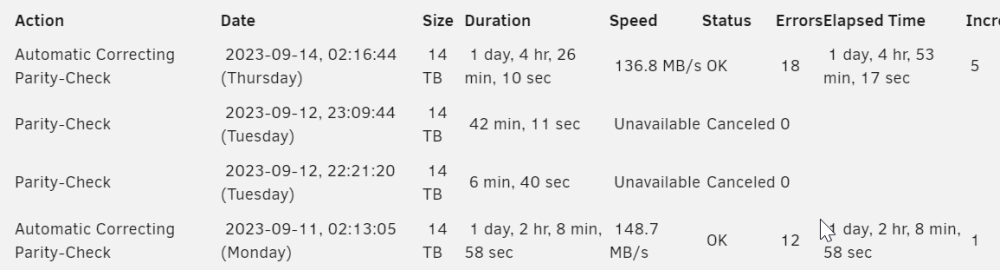
I see. So in this case I guess that the errors are corrected and are generated again when the server crashes.
-
Follow up question. Every time I crash and the parity check starts it detects 12 sync errors. Are these errors getting corrected and new every time or are then always the same? thanks
-
I see. It does seem that at the end it’s going to be hardware. I’ll try with only 2 ram sticks. Thanks
-
I'm trying different things to see if stability improves. Currently running with 2 NICs (one for Docker and one for unraid), with bridging and bonding disabled as with this config it was stable for a month with 6.12.3. However, I'm seeing some weird call traces on red on the logs. My Home Assistant VM just crashed and the GUI is not responding as fast as usual. Can you please take a look at the logs? It started at 18:02:21 with a "Sep 14 18:02:21 NAS kernel: kernel BUG at drivers/md/unraid.c:356!" Edit: I can't run diagnostics because the process hangs at lsof -Pni 2</dev/null|todos >.... syslog-192.168.88.253 (3).log
-
Kept investigating. If I try a debian 11 or debian 12 VM neither of them will get an ip address. I believe it has to do wth disabling bridging on unraid's network settings to see if stability improved. However, my Home Assistant VM does get an ip (vhost0) despite bridging being disable. What's happening here?
-
Hello I'm having issues accessing one of my VMs (a Proxmox Backup Server). I think issues started after update to some 6.12.X version. The VM will start but gets no IP assigned. VNC from the VM icon reports a "can't connect". Thanks! nas-diagnostics-20230913-1626.zip
-
I tried changing network to ipvlan and disabling bonding and bridging as in 6.12.3 it was stable with this (though I used a second, USB NIC for Docker). It crashed again less than 24h later. I've changed back to macvlan. I have reset the BIOS in case there was something miss configured. I'm attaching the logs but I don't see anything relevant. Regards syslog-192.168.88.253 (1).log nas-diagnostics-20230910-0012.zip
-
Sorry, I meant the log on the 1st post if after today's crash. I don't have the log of Saturday's crash. I'll post again if/when it crashes but I'm afraid of my data integrity.
-
Last time it crashed I did't have syslog activated. It was on Saturday, after I installed two additional hard drives. Last time my shares also disappeared and my array didn't start so I opened this post: Help! No shares and array won't start - General Support - Unraid Regards Edit: last time it crashed with docker and vms modules inactive.
-
Hello, I have had a server crash. It's the second since I updated to 6.12.4 (I had another couple crashed related to macvlan in 6.12.3 but those seem resolved with 6.12.4). I'm attaching syslog and diagnostics since I'm at a loss. I have run memtest and all tests passed fine. Thanks in advance syslog-192.168.88.253.log nas-diagnostics-20230908-1833.zip
-
Thanks Jorge. I am actually using it (it crashed while a proxmox was trying to backup some files to a share exposed via NFS). However, there might be something miss-configured as I'm seeing a lot of "refused mount request from 192.168.77.250 for /mnt/user/cache_tdarr (/): not exported". I'll let you know.


