HomerJ
Members
-
Joined
-
Last visited
-
Hey! Reporting a compatibility issue where the Fix Common Problems UI fails to load (blank screen / empty box) on the Unraid 7.4.0 beta-3. Tracing the execution through the terminal with PHP error logging turned on pinpointed a few fatal PHP 8.x errors and missing dependencies that immediately halt the script: 1. Uncaught ValueError on uninitialized $fixPaths (tests.php): Warning: Undefined variable $fixPaths in /usr/local/emhttp/plugins/fix.common.problems/include/tests.php on line 40 Fatal error: Uncaught ValueError: Path must not be empty in /usr/local/emhttp/plugins/dynamix/include/Wrappers.php:48 tests.php evaluates $fixPaths['var.ini'] right at the top, but doesn't include paths.php. In PHP 8.x, passing null to file_get_contents() throws a fatal ValueError rather than a soft warning, immediately killing execution. 2. Missing Wrapper definition for my_parse_ini_file(): Fatal error: Uncaught Error: Call to undefined function my_parse_ini_file() in /usr/local/emhttp/plugins/fix.common.problems/include/tests.php:39 If Dynamix wrappers aren't pre-loaded by the caller, tests.php dies here because it has no direct include for Wrappers.php. 3. Function collision with curl_socket(): Fatal error: Cannot redeclare function curl_socket() (previously declared in /usr/local/emhttp/plugins/fix.common.problems/include/helpers.php:530) in /usr/local/emhttp/plugins/dynamix/include/publish.php on line 18 While my_parse_ini_file() in helpers.php has an if (!function_exists(...)) check, curl_socket() around line 530 does not, causing a fatal redeclaration clash with Dynamix's publish.php. --- Temporary CLI fix that confirmed resolution: In RAM, wrapping curl_socket() in helpers.php with if (!function_exists('curl_socket')) { ... } and adding: require_once("/usr/local/emhttp/plugins/fix.common.problems/include/paths.php"); require_once("/usr/local/emhttp/plugins/dynamix/include/Wrappers.php"); to the top of tests.php completely resolved the crashes and allowed scans and the UI to render normally. Could these checks/includes be added to an upcoming release for Unraid 7 compatibility? Thanks for all your work maintaining this!
-
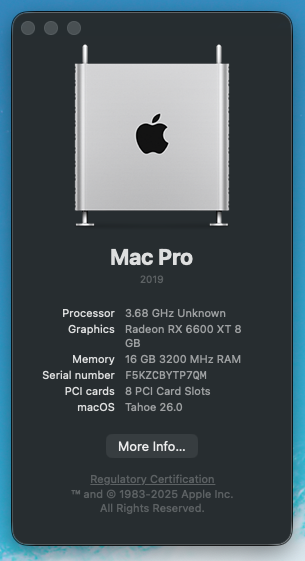
Hey all I just had to share the news with you all; I have Tahoe running beautifully! I started by installing Sonoma and I upgraded to Tahoe last night without incident. I'm using a Radeon 6600XT GPU and it has Metal Acceleration. The only issue that I do have, which has been present from the very beginning, is I can't get the audio to work through the GPU. I have tried heaps of stuff and had a lot of help from chatgpt but nothing I've done fixes it. I would like to have it fixed, but if I don't I'm going to use a USB audio controller. I know this thread has been pretty quiet of late, but with I first started trying to make this years ago, I got a lot of help from people here, so if there is anything I can do to help someone else, I'm happy to try. If anyone has any ideas on what I could do to get audio working through my GPU, please share! Cheers!!
-
Has anyone here been successful getting a macos system running with a 6600xt GPU?
-
I may have solved this. I opened an incognito page in my browser and where the area for the server, and it looks like it's starting fresh from the beginning.
-
Hi all I hand an issue with Jellyfin, I don't know if this is the best place to post this, so mods please feel free to move this if it really should be somewhere else. I setup a Jellyfin server at a bad time as I was trying to do too many things at once. Soon after I had to leave it be and some time has passed until we get to today when I tried to finish the setup. Unfortunately I've forgotten the username and password. I had read that you can sometimes find these details on the logs, but I couldn't find them. I'd also read that in what I think I remember as system.xml you could make a change so it would start the onboarding process, which I did but I saw no change. I tried refreshing the browser which made no difference. I then figured I could just start the whole thing again, so I deleted the docker container as well as it's files in appdata. I then installed Jellyfin again. When I start the server for the first time, it acts like it's expecting a username and password despite it being a new setup. I've when tried a different Jellyfin container and the same thing happens. I really don't hand any idea what to do next. I don't know all that much about this sort of stuff, but from what I understand, when I deleted the docker container and then removed it's folder from appdata, everything works be gone and when I install the next Jellyfin everything would be new, but it seems that this isn't the case. I'm hoping someone smarter than me can help me with this! Thanks in advance!
-
Thanks, yeah I went a little too far lol all good now though, my new server has a trial licence and I'll worry about transferring licenses later.
-
Hi all I have just bought a new (to me) server which hopefully will replace the two unRAID servers that I already have. Both those servers have paid unRAID licenses on them. Initially, all 3 will have to be up and running. What I did was I created a new unRAID USB drive. I then transferred all the config folder from my main server that I have(not the new one) but I didn't transfer the licence key. So in the end I have a brand new USB drive for the new server which has just all the standard files on it, plus my licence key; then I have my original main server with all the required files on the USB drive MINUS the licence key as that's now on the drive for the new server. Problem is that unRAID isn't happy. It's telling me that the licence key is missing, which does makes total sense coz I know that it's attached to the unique USB uuid. What I was hoping was that I'd be able to run one of the servers for a month using the trial key, but I guess that is easier said than done. What should I do next? Right now I'm thinking that I will setup my new server using a brand new created USB stick and later transfer the licence; if I go this route, will I have any issues? Thanks in advance!
-
Thanks for your reply! I'm in the process of setting it up now. Short term it's in my bedroom. It is a little louder than what I already had running, but it isn't too bad. I'll definitely look into your GPU suggestions!
-
Hi all I originally posted most of this in the wrong place, and was told that this was a better section to ask this. I'm seriously thinking about buying a HP DL380 Gen 9 which has 2 x Xeon E5 2697 V3, 8 x 16GB DDR4 for a total of 128GB RAM, an Nvidia grid K2 GPU, LSI SAS HBA connected to 12 x 8TB HDDs for a total of 96TB, and is currently setup with Truenas Scale already installed on a pair of 120GB enterprise SATA SSDs. This is my first adventure into this sort of server, all my previous limited experience is with using gaming motherboard etc for unRAID. I'm hoping someone here can confirm whether or not they can see me having any issues using this as an unRAID server before I buy it. Right now I'm just assuming that because it currently has truenas running on it, that it should be pretty straightforward to turn it into an unRAID server. I'm also interested in some feedback on how best to setup the server. I plan to stop paying Google to store my pics and will do this on this server. The server will also be used as a media server, as well as run 2 Home Assistant VMs. The server has 5 PCI slots so I plan on throwing a 1080ti GPU in it for video transcoding. The unRAID server this will be replacing has all array disks formatted in xfs with cache as btrfs. I was thinking of formatting the cache drive as ZFS but I know very little about it. The reason for looking into getting this server is because I'm currently running two unRAID servers and was hoping this new one would replace them both. My current main server is a 12th gen Intel i5 12600k with 64 GB RAM, with 8 disks and one Parity giving a total of 58TB which is close to being full. I also have a Windows 11 VM and I also run Klipper for 4 3D printers. I also have a Scrypted docker container that feeds cameras to Home Assistant but no video storage is going on because I just don't have the storage. The second unRAID server is a HP Proliant Microserver Gen 7 which I recently got for free to extend my storage but it is extremely underpowered and all CPU cores are usually always maxed out. I do have some capacity for more storage in the Intel 12 Gen server, but all the CPU cores are already often maxed out, particularly when the Windows VM is running. I could upgrade with normal consumer stuff, new motherboard, CPU, DDR5 RAM etc, but the cost of that will probably come close to this new server. So, do you think I should get it? If your answer is yes, please share what file system I should choose. If you think not, can you please share what you think I should do? I'll appreciate any and all responses! Cheers!
-
I'm still struggling to figure out why none of my disks will spin down. Things I have done: Confirmed that none of the Docker containers write to the array directly. Checked Jellyfin and Plex aren't doing any scans of the array. From what I can see and understand of the File Activity plug in, no files of the array have been accessed for many hours. I do have a Windows VM set up which has unRAID shares mapped in Explorer, so I've shut down this VM. My future plans to try and figure this out: I shut down all Docker containers 10 minutes ago. If I did miss any Docker containers that were accessing the array and were the cause of my issue, I'll know more in 5 or so minutes as the disks are set to spin down after 15 minutes. This is where I'm hoping for a little help, as I don't really know what to do next. Shares on the array have been set up to enable sharing on the network, so I did think for a moment that this could be an issue; when if they weren't being accessed maybe just having the tunnel there might be enough, but I have a second unRAID server which is setup so that all its shares are setup for network sharing so all my media Docker containers can interact with them, but this doesn't stop its disks from spinning down so I can't see this being the issue. Thoughts anyone?
-
Update: I've managed to fix the xfs file system and then delete the leftover folder, so I can't see any reason now for the drives to not be able to spin down. They are currently set to spin down after 15 minutes, so I shouldn't have to wait long.
-
Hi all I had a major crash a few weeks ago after swapping out one of the GPU's, so I had to re-setup everything. I've noticed that none of my drives ever spin down. They are all set to default which today I set to 15 minutes. I don't understand why this is happening because they used to spin down before. I have checked to make sure no files like docker are being accessed from the array; all shares like system etc are set to cache only. But I do have an appdata folder on disk 1 which contains the left overs from an old Plex installation which no matter what I do I can't delete. It's taking up barely anything so I haven't worked too much about it and besides the container that it was attached to is long gone. But I got thinking that coz it's the appdata share, unRAID might still be going to it, so I've been trying to delete it but I've had no luck. The closest I feel I've come is from using Midnight Commander and getting the error "Structure needs cleaning". I'm now trying to figure out how to fix this, then all the appdata files will be on the cache drive, but I'm not too hopeful that this will fix the spinning down issue coz this errant folder is only on disk one, so why don't all the others at least spin down? Seems really weird to me. If someone could take a stab at my issue, I'd much appreciate it! In case it helps, the diagnostics file is below. Cheers! tower-diagnostics-20250814-1244.zip
-
Thanks for the tip! I did run a normal SMART test and it reported everything fine, but looking at the diagnostics, there was definitely an issue. I'll do a test now.
-
Hi all I was given a HP Proliant Microserver recently and a couple days ago I set it up as a second unRAID server to extend available data space, and paid for the unRAID licence. Yesterday I started moving a few things from the main server to this new server using Krusader. I just checked on how things were going and I find one of the disks have been disabled. This is my first time having this sort of issue. Does this mean that the disk is basically dead and the only way forward is to replace the drive, or is there something I can do to keep using the drive? I have attached the diagnostics. Thanks in advance! tower2-diagnostics-20250729-0303.zip
-
Hey all I'm here just to confirm that the above works great. I now have a pi as a VM which runs Klipper, Mainsail etc. It works very well!