





purplehexagon
Members
-
Joined
Everything posted by purplehexagon
-
I have checked my log over the last 20 hours, and no errors have occurred. So replacing the cable with a new one seems to have fixed the problem. Thanks @JorgeB for your help!
-
I've swapped the cable for Main 4 (sdf) bc following logs leads me that sdf is responsible, isn' it? Even though today's log is dated 2026-05-16, it was also "ata8.00" yesterday and the day before. May 16 13:38:16 PurpleGravity kernel: scsi 7:0:0:0: Direct-Access ATA Samsung SSD 870 3B6Q PQ: 0 ANSI: 5 May 16 13:38:16 PurpleGravity kernel: sd 7:0:0:0: Attached scsi generic sg5 type 0 May 16 13:38:16 PurpleGravity kernel: ata8.00: Enabling discard_zeroes_data May 16 13:38:16 PurpleGravity kernel: sd 7:0:0:0: [sdf] 7814037168 512-byte logical blocks: (4.00 TB/3.64 TiB) May 16 13:38:16 PurpleGravity kernel: sd 7:0:0:0: [sdf] Write Protect is off May 16 13:38:16 PurpleGravity kernel: sd 7:0:0:0: [sdf] Mode Sense: 00 3a 00 00 May 16 13:38:16 PurpleGravity kernel: sd 7:0:0:0: [sdf] Write cache: enabled, read cache: enabled, doesn't support DPO or FUA May 16 13:38:16 PurpleGravity kernel: sd 7:0:0:0: [sdf] Preferred minimum I/O size 512 bytesI'll monitor the log today, and if the same errors occur again, I'll check the cables on the ASM1166 controller.
-
Since the day before yesterday (first 7.2.6 as of today 7.3.0), I’ve been seeing the error below more and more frequently. At first, it happened every few hours. Now, it’s happening every few minutes. I have a total of 6 SATA SSDs in my setup. However, since I only have 4 SATA ports on the motherboard, I had to install an ASM1166 expansion card in an NVMe slot, to which two of the SSDs are connected. Unfortunately, the error doesn’t specify exactly which drive is causing the issue. I’d like to ask for some help with this. May 15 14:15:11 PurpleGravity kernel: ata8.00: exception Emask 0x10 SAct 0x400000 SErr 0x400100 action 0x6 frozen May 15 14:15:11 PurpleGravity kernel: ata8.00: irq_stat 0x08000000, interface fatal error May 15 14:15:11 PurpleGravity kernel: ata8: SError: { UnrecovData Handshk } May 15 14:15:11 PurpleGravity kernel: ata8.00: failed command: WRITE FPDMA QUEUED May 15 14:15:11 PurpleGravity kernel: ata8.00: cmd 61/18:b0:68:4b:9a/00:00:89:01:00/40 tag 22 ncq dma 12288 out May 15 14:15:11 PurpleGravity kernel: res 40/00:01:00:00:00/00:00:00:00:00/00 Emask 0x10 (ATA bus error) May 15 14:15:11 PurpleGravity kernel: ata8.00: status: { DRDY } May 15 14:15:11 PurpleGravity kernel: ata8: hard resetting link May 15 14:15:11 PurpleGravity kernel: ata8: SATA link up 6.0 Gbps (SStatus 133 SControl 300) May 15 14:15:11 PurpleGravity kernel: ata8.00: supports DRM functions and may not be fully accessible May 15 14:15:11 PurpleGravity kernel: ata8.00: supports DRM functions and may not be fully accessible May 15 14:15:11 PurpleGravity kernel: ata8.00: configured for UDMA/133 May 15 14:15:11 PurpleGravity kernel: ahci 0000:00:17.0: port does not support device sleep May 15 14:15:11 PurpleGravity kernel: ata8: EH complete May 15 14:15:11 PurpleGravity kernel: ata8.00: Enabling discard_zeroes_datapurplegravity-diagnostics-20260515-1435.zip
-
Correct. Anything but the message is working! Thanks for the amazing work done here.
-
I waited for the official release of 7.2.0 so that I could continue testing. Now that 7.2.0 has been released, I tried again to create a Wireguard tunnel with IPv6 only and a tunnel with IPv6+IPv4 combined. And indeed: a connection is possible, everything seems to be working again. The only thing that still appears in the logs is the following line: Nov 4 09:25:32 PurpleGravity http_get_contents: Curl error 28: Connection timed out after 15002 milliseconds. Requested url: 'https://wanip6.unraid.net' Before 7.2.0 i was able to curl -v --interface br0 https://wanip6.unraid.net/ and get a corret response. Now with 7.2.0 i can't get a response with any interface. The exact answer of my above command is: Host wanip6.unraid.net:443 was resolved. * IPv6: 2600:1f14:b8f:3b02:2f81:a0d1:f4d9:9e12 * IPv4: (none) * Trying [2600:1f14:b8f:3b02:2f81:a0d1:f4d9:9e12]:443... * socket successfully bound to interface 'br0' * connect to 2600:1f14:b8f:3b02:2f81:a0d1:f4d9:9e12 port 443 from <redacted> port 43296 failed: Connection timed out * Failed to connect to wanip6.unraid.net port 443 after 133307 ms: Could not connect to server * closing connection #0 curl: (28) Failed to connect to wanip6.unraid.net port 443 after 133307 ms: Could not connect to server
-
I've read the plugins code and if I'm reading it correctly the problem is not the plugin it self, it is how the docker caching works. The page is build on a foreach loop with the contents from the "getAllInfo();" function which is included by /usr/local/emhttp/plugins/dynamix.docker.manager/include/DockerClient.php The Function "getAllInfo" uses "getDockerContainers" which lastly returns the docker cache with this line: if (is_array($this::$containersCache)) return $this::$containersCache; To fix the wrong display on previously deleted containers you can just reboot your system to clear the cache an untested alternative might be the the usage of following command:docker builder prune
-
Leider nein. Mir sind die Ideen leider auch ausgegangen.
-
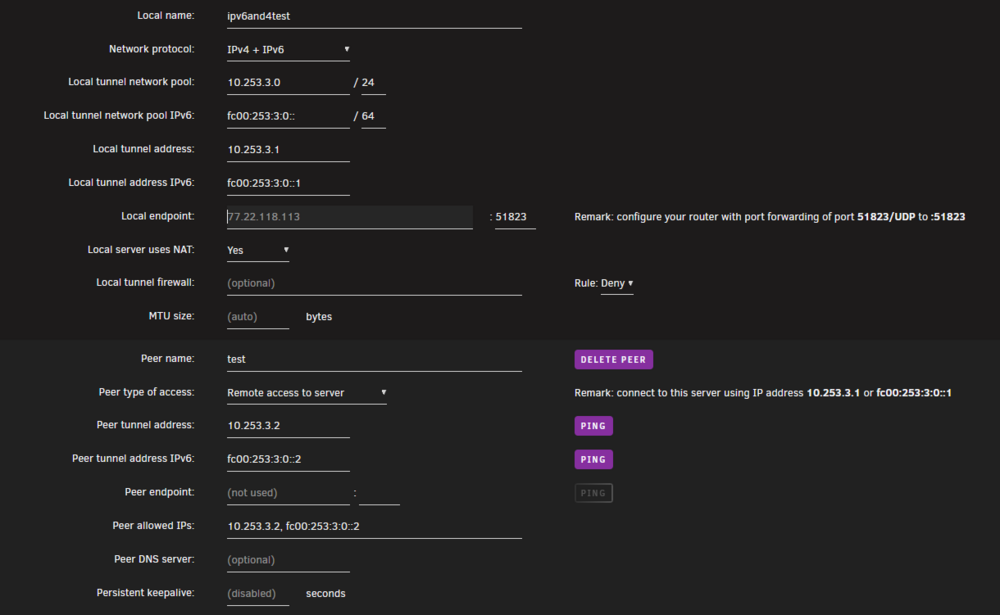
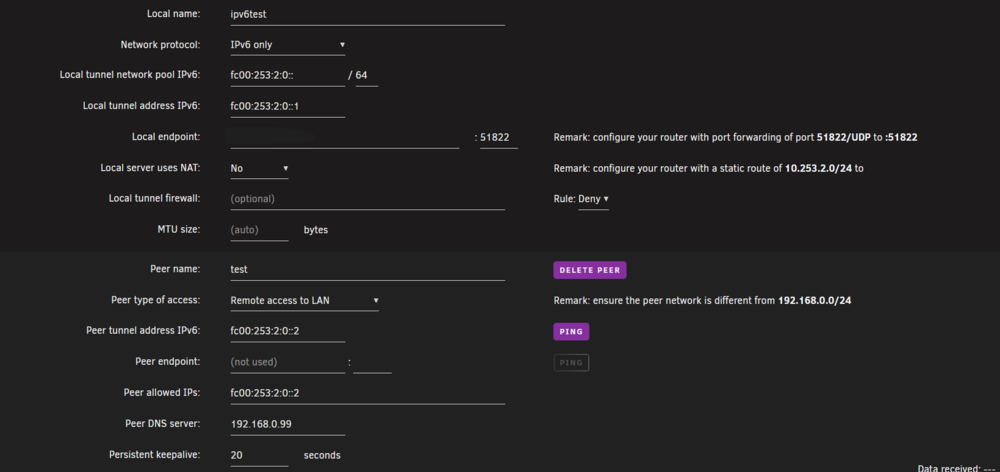
Yes, I see it as part of your report too, but I suspect it's not the final cause. In the end though, I'm no expert. Yes, I think it is something else. If I set up a tunnel where both ipv4 and ipv6 are used (screenshots attached), the tunnel can be activated, but the WAN IPv6 request to https://wanip6.unraid.net/ is still not answered. As I described at the beginning, the request can be resolved on the DNS side, but it ends in a timeout. To me it looks like the IPv6 traffic can leave Unraid, but receiving is impossible if the traffic comes from outside my local network. I have now tested again and made both my smartphone and my Raspi reachable via an ipv6 address, and I was able to ping both devices from outside my local network. So it must be my Unraid server blocking incoming IPv6 traffic, or am I on the wrong track here? That means even if the WireGuard tunnel could be switched on, it would be of no use as Unraid remains unreachable via IPv6. However, I have no idea what the problem is either. Sceenshots for wg3 where using IPv4 and IPv6: wg-quick of wg3 after enabling the tunnel: Timeout error:


-
Thank you. Yes, it seems like Unraid is trying to create an ipv4 route, but this can't work because there is no ipv4 address for an ipv6-only tunnel. However, this is only one half of the errors mentioned. I still don't understand why I can't ping my server from outside my internal network via ipv6 and that Unraid keeps throwing timeouts in the logs when trying to resolve the WAN IPv6 address. Inside my network everything seems normal my global unique address ist reachable from inside but from the outside it isn't and infact for unraid only. I run the connectivity checks via a smartphone hotspot paired to my laptop without connecting to my internal network, if that matters
-
Thanks in advance. If you need something else f.e. my routing table or network settings don't hesitate to ask.Okay, dass das Docker Image schon mal nicht voll ist, ist gut. bzw eigentlich nicht weil die Lösung einfach gewesen wäre. Schau mal im Share wo deine Nextcloud Daten liegen was unter "Minimum Free Space" eingetragen ist, eventuell ist eine Platte schon zu voll und der Wert verhindert weiteres Beschreiben. Welches Docker-Image wird für Nextcloud benutzt, AIO oder Stand-Alone?Sorry for the missunderstanding.
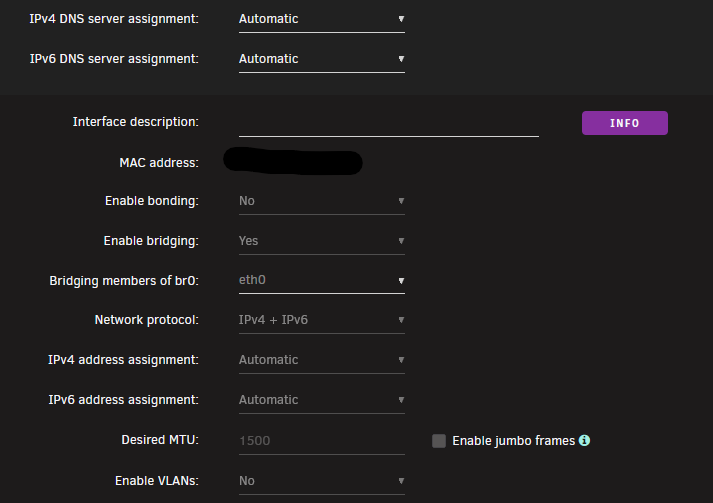
 Hier sieht es aber tatsächlich so aus als wäre deine Platte voll. Kannst du einmal bitte die komplette erste Zeile posten, insbesondere der Pfad ist interessant /app/www/public ... bitte da einmal komplettieren. Ansonsten mal prüfen wie voll das Docker Image ist. Dazu vllt mal unter Settings -> Docker -> Enable Docker auf off, oben rechts die Erweiterte Ansicht an danach n Screenshot von den Settings machen und mal posten. Ggf. ist das Docker Image voll gelaufen und muss vergrößtert werden. Ist aber nur eine Vermutung.Hey dear Unraid community, I've been having problems using Wireguard with ipv6 since 7.1.0. I've created an IPv6-only configuration and whenever I try to enable it, the switch immediately disables itself again. To be more precise, the tunnel can be switched on if no peer is present. As soon as a peer is present, the tunnel cannot be activated. In the logs of Unraid I see again and again that Unraid tries to retrieve the WAN IPv6 address via https://wanip6.unraid.net/. Unfortunately, the query times out after a while. I did check where the error is using “curl -v https://wanip6.unraid.net/”. The address is resolved correctly but I get no response. Briding is enabled in my network configuration. When I try to retrieve the WAN IPv6 address over br0 using “curl -v --interface br0 https://wanip6.unraid.net”, everything works and I get my correct address. I've already been able to rule out that this is due to the rest of my network hardware. I'm using a Fritzbox as a router and a RasPi as an Adguard Home server. I've activated the RasPi for PING6 on the Fritzbox as a test. The RasPi's IPv6 GUA address is publicly accessible and also provides a response when pinged. Likewise, “curl -v https://wanip6.unraid.net/” also works on the RasPi. I enabled the Unraid for PING6 via the Fritzbox, but unfortunately I get no response. I also used “trace route / tracert” to check where exactly the traffic is discarded. The RasPi responds normally and shows my Fritzbox in the penultimate hop and the RasPi itself as the last hop. Unraid, on the other hand, also shows the Fritzbox in the penultimate hop, but after that all connections go nowhere. I have currently been on Unraid 7.1.4 for a week. Unfortunately, the problems are also present in the latest version. IPv6 worked under Unraid 7.0.1.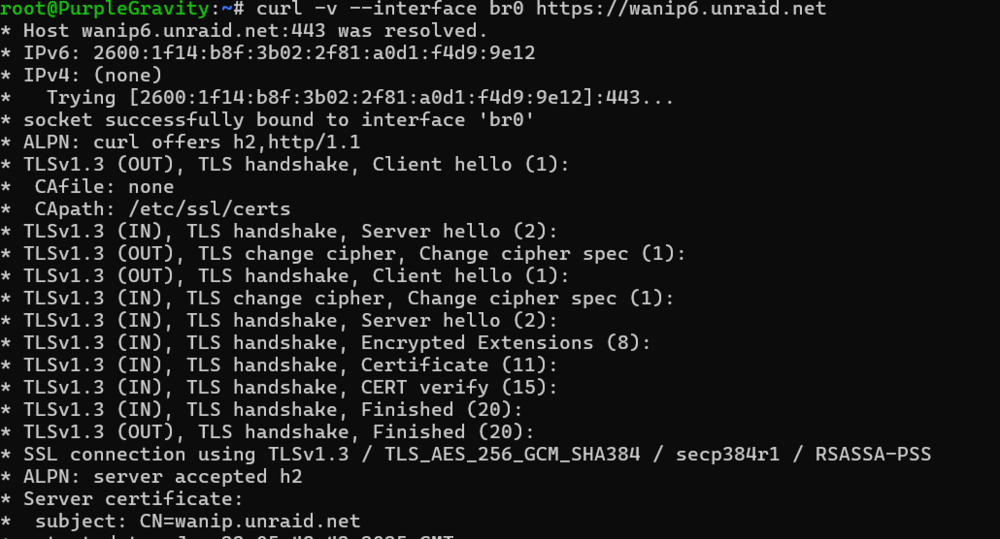

 Well, I'm really sorry. For me it was just a typo in /etc/ssh/sshd.config where I had written "autorized_keys" without an "h". I will mark it as resolved.Hey, since upgrading to 7.1.2 I have problems logging in via ssh. I use a publickey, which I have previously entered under Users -> root -> SSH authorized keys. Under Unraid 7.0.1 the authentication has worked without any problems. Now I seem to get a public and private key mismatch. Under Windows I have already checked if I can verify the private and public key. The following commdand executed under windows returns me exactly the publickey that is entered under the authorized keys: ssh-keygen.exe -y -e -f <private_key> The following can be seen in the logs: May 14 15:17:43 PurpleGravity sshd-session[3945698]: Failed publickey for root from 192.168.0.10 port 64792 ssh2: ED25519 SHA256:<another key>"Another key" is neither the public- nor privatekey fingerprint I use for authentication I have also tried to create a fresh key pair again, unfortunately the same error occurs, also with a mismatchDanke erst einmal für alle Nachrichten bis hier hin, ich versuche nach und nach auf alles einzugehen, was bisher geschrieben wurde. Da habe ich auf jeden Fall einen Tippfehler eingebaut, ich meinte die 12600K. Und wie du schon richtig gesagt hast, ich hab die ausgewählt da sie ein bisschen günstiger ist als die Non-K-Variante. Undervolten bzw runtertakten würde ich die dann auch. Ich hatte bei den Riegeln auf nichts spezielles geachtet, es waren lediglich welche, die auf der Memory Support Liste des Mainboard aufgetaucht sind und ein 64GB Kit waren. Hast du / habt ihr, hier auch noch mal eine Empfehlung für ein 64GB-Kit? Ursprünglich hatte ich das SF450 von Corsair gesucht, leider habe ich das nicht gefunden. Allgemein hatte ich das Gefühl das gute(1) PSUs im SFX Format, unterhalb von 500 Watt vergriffen oder kaum auffindbar sind, weswegen ich dann zu der 600 Watt PSU geriffen hab. Und ja, 5 HDDs, 2 SSDs, Ram, CPU und Mainboard sollten auch mit weniger auskommen, ich habe leider nur nichts mit Gold- oder Platin-Zertifizierung gefunden, dessen Marke ich auch vertraue. Um Thermaltake z.B. mache aus Erfahrungswerten einen großen Bogen. Und eventuell soll nacher noch eine kleine GPU mit in das Case. Das war nicht bekannt, nein, danke auf jeden Fall. Soweit ich das sehen kann, würden die höheren C-States durch meine derzeit verbaute NVME nicht erreicht werden, die ist zumindest nicht mit ASPM ausgewiesen. Auf Recherche habe von dir einen Post gefunden in dem du die Patriot Viper lite VP4300L 4TB, Lexar NM790 4TB und ADATA LEGEND 960 nennst. Viele sind da wohl auch mit der 970 Evo zufrieden und erreichen gute bzw. höhere C-States. Da würde ich allerdings auch nach Preis gehen. Kann ich je bei Patriot und der Viper auch zu den 2TB Modellen greifen? Welche Platten ab 12 TB würdest du / würdet ihr denn empfehlen? Ich lese häufig entweder von Seagate Exos und Ironwolfs. In Reddit-Foren lese ich ebenfalls des öfteren, dass die Seagates im Vergleich zu den WD Red Plus Platten sehr laut sein sollen. Ich würde Helium gefüllte Festplatten im Bezug auf die Lautstärke vorziehen, sind in dem Fall allerdings auch beide. Am Ende solles es Exakt 7 Platten sein, bzw. 6 wenn man die NVME nicht mitrechnet. 5 in das Case, in die dafür vorgesehenen Schächte und eine SATA-SSD in das Gehäuse zum Mainboard, da ist auch noch ein Platz an der Wand für eine 2,5" vorgesehen. Ich glaube das Risiko würde ich eingehen. Leider finde ich nur das Gigabyte B760i AORUS, eine nicht AORUS-Variante habe ich nicht finden können. Das Asrock H610M-ITX/ac sieht gut aus, hat aber leider nur einen NVME Sockel, damit wäre der Plan bzgl. der Erweiterungskarte nicht mehr umsetzbar. Trotzdem danke für die Empfehlungen! Und ja, 2.5Gbit sollten es schon sein... 😅 Super, danke für das Feedback! (1) vorallem bezogen auf diese beiden Listen https://docs.google.com/spreadsheets/d/1TnPx1h-nUKgq3MFzwl-OOIsuX_JSIurIq3JkFZVMUas/edit?gid=110239702#gid=110239702 https://cultists.network/140/psu-tier-list/Bei den benötigten Upload-Raten für 1080p und 4k lese ich mich noch ein. Geschätzt, ohne dass ich das mit entsprechenden Rechnungen oder Fakten unterfüttern könnte, hätte ich bei einem 1080p Stream ca. 5 Mbit veranschlagt. Bei 4k dann etwa 20 Mbit. Die Schätzungen beruhen auf Reddit-Posts. Natürlich soll es auch halbwegs "gut" aussehen, also sollten es schon 1080p sein bzw. minimal 720p. Am Ende kann ich die Anzahl der streams natürlich auch reduzieren.Zugegeben, aktuell habe ich nur 50mbit Upload. Das soll sich aber hoffentlich in naher Zukunft verzehnfachen. Die 5-10 gleichzeitigen Streams wären der absolute Edge-Case. Wahrscheinlich werden es eher 3 gleichzeitige Streams. Das sollte mit 500mbit Upload aber hoffentlich drin sein.Hallo liebe Unraid-Community, ich bin aktuell in der Vorbereitung mir einen neuen Unraid-Server zusammenzukaufen. Derzeit benutze ich nur einen ASUS Intel NUC 14RVH mit 32GB ECC-Speicher und zwei ZFS-Pools mit einer Sata-SSD für Backups und einer NVME-SSD als Cache-Drive (Docker), beide Platten haben je 2 TB. Nun ist System leider stark limitiert, was den Speicherplatz angeht und ich möchte dementsprechend auf- bzw. umrüsten. Meine Anwendungsgebiete für den Server sind Docker-Container (Arrs, Homepage, Vaulwarden, Nextcloud, Grafana, Glances, Home-Assistent, Adguard, Paperless, Jellyfin und ggf. noch weitere kleinere Dockers), ein kleiner Minecraft-Game-Server (ebenfalls Docker), Virtualisierung (VMs) zum Testen, Lernen und Entwickeln und einfach als typisches NAS (Backups und Shares). Der Server soll 24/7 laufen. Ich plane insbesondere bei Jellyfin mit 5-10 gleichzeitigen Streams (2 im eigenen Netz auf den heimischen PC / Fernseher, 5-8 von extern) Nextcloud wird maximal zwei, drei User haben, wobei hauptsächlich Sync, Kalender, Lesezeichen und Kontakte wichtig sind. Wichtig für den Server wären mir folgende Punkte: Stromsparender Betrieb im Idle Möglichst leiser Betrieb des Systems "Gute" Transcoding Leistung für die Streams von Jellyfin Mini-ITX Formfaktor für Jonsbo N2 (Case kommt in ein Regal) Flexibilität in der Anwendung Zum Anfang meiner Recherche habe ich das Setup um ECC-Speicher herum geplant (AMD Ryzen 5 5655G Pro, GIGABYTE B550I AORUS Pro AX) allerdings bin ich aktuell an dem Punkt, dass sich ECC-Speicher für mich als Privat-Mensch kaum lohnt und die Trancoding-Leistung beim AMDs, den von Intel iGPUs deutlich unterlegen ist. Und ja, leider muss es ein ITX-Board sein. Dass diese teurer sein können, bzw. sind ist mir bewusst. Leider ist Platz bei mir ein Mangel, weswegen es auch das N2 sein soll und nicht das größere N5, mit ATX-Formfaktor Hardware-Übersicht: CPU: i5-25600K Mobo: GIGABYTE B760I AORUS Pro DDR4 RAM: ADATA XPG Gammix D35 Black Edition DIMM Kit 64GB, DDR4-3600, CL18-22-22 Case: Jonsbo N2, weiß, Mini-ITX PSU: be quiet! SFX-L Power 600W SFX-L 3.3 (BN239) Cable: CABLEDECONN Mini SAS 36P SFF-8087 auf 4 SATA 7-Pin 90 Grad Target Festplatten-Datenkabel blau 0,5 m CPU-Fan: Noctua NH-L9i-17xx Case-Fan: Noctua NF-A12x25 PWM, 120mm (Normalerweise passt nur ein 15mm Lüfter rein, der 25mm Lüfter geht mit einer 3D-gedruckten Mod)* Storage: 1x Western Digital WD_BLACK SN850X NVMe SSD 2TB (wird als ZFS-Cache aus dem Altsystem übernommen) 1x Western Digital WD Red SA500 NAS SATA SSD 2TB (wird aus dem Altsystem übernommen und in den ZFS Cache Pool aufgenommen) 3x Western Digital WD Red Plus 12TB, 24/7, 512e / 3.5" / CMR / Helium (Platten für das Array, 1x Parity, 2x Storage) Später, wenn noch weitere Platten dazukommen sollen, würde ich eine NVME-Expansion-Card kaufen für mehr SATA-Anschlüsse. 1x WANGCL NVME zu SATA Adapter M.2 zu SATA-Konverter 6Port mit Aluminium Radiator Unterstützung PM-Funktion Die ganze Hardware hier auch noch einmal als Liste bei Geizhals: https://geizhals.de/wishlists/4305668 *Case-Fan-Mod: https://www.printables.com/model/526778-jonsbo-n2-extended-fan-module Nun würde ich gerne einmal nach Verbesserungen und Empfehlungen fragen wollen, um zu überprüfen, ob ich da auf einem gangbaren Weg bin. LG




