7eventy7
Members
-
Joined
-
Last visited
-
Forgive my stupidity, I'm pretty certain I've got a corrupt/dying flash drive that I need to replace. I've been using this plugin as my only flash backup, but I have over 10 backups I can revert to. My question is, how do I revert to a flash backup? I'm assuming it's a manual process but I couldn't find any documentation on the subject. The only stuff I found was on the official flash backup in unraid tools.
-
I'm experiencing this exact issue at the moment and can't for the life of me figure out why.
-
Keep getting the error from the title, a restart of unraid resolves the issue and allows the docker service to start but then it just crashes again after a bit. I tried to refresh my docker.img by reinstalling all my apps but sadly that did not work and after about 2 hours I got the same crash again. I followed the steps below to refresh my docker.img but that doesn't seem to be the problem. At this point we've narrowed it down to a bad flash drive being corrupted/dying or a docker container acting up and causing this. I uploaded my diagnostics and if anyone could take a look I'd be much appreciative. Thanks in advance for any help! sienna-diagnostics-20241017-0903.zip
-
Thank you so much for this post.
-
Thanks for making this! I had GPT4o write a user-script to help out with the backup process and it all works great! Wanted to share the script as someone might find it useful What the script does: 1. The script stores credentials for multiple users. 2. It sets up the main backup directory. 3. For each user, it sets environment variables and starts the backup process. 4. The script waits 5 minutes for the backup to complete. 5. It finds and moves the backup folder to the user's specific directory. 6. The script deletes older backups, keeping only the newest one. 7. It cleans up non-user folders from the main directory. 8. The script prints progress messages and completes the backups for all users. TL;DR: The script backs up data for multiple users, moves the backup files to user-specific folders, and deletes old backups, keeping only the newest one. It also cleans up non-user folders from the main backup directory and prints progress throughout the process. THE USER-SCRIPT: https://gist.github.com/7eventy7/5e6c10f9d0a537ad5c8d6ee4000d8c08 To use the script just replace the "GOES HERE" sections at the top of the script under the user credentials dictionary. If you need a specific amount of users other than the 2 in this script, I'd recommend asking ChatGpt to add them as there a few sections that need to be changed. I highly recommend using this script alongside the "appdata backup plugin" so you can keep a few copies of the backups, this script only keeps the latest backup. Also make sure to set script to run on a cron schedule, enjoy!
-
I used to have no issues with pulling docker containers and extracting everything, but recently when installing new apps it has been incredibly slow. It takes around 30 seconds to pull the first layer and often takes several minutes for a small app like mealie or immich to fully finish. I uploaded my diagnostics, thanks in advance for taking a look! sienna-diagnostics-20240830-0254.zip
-
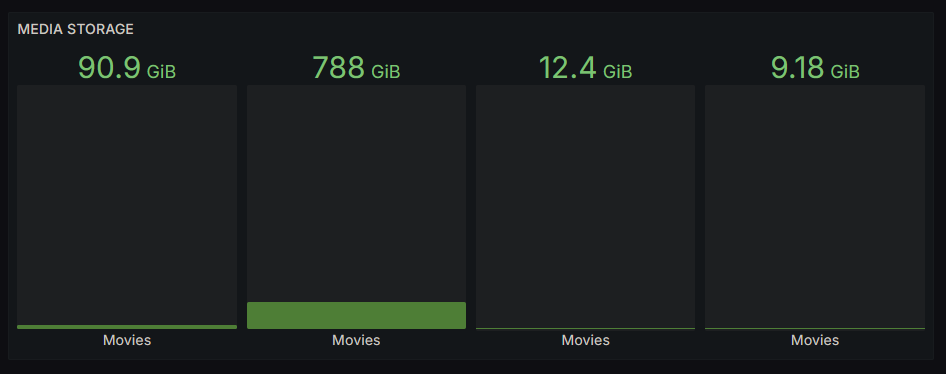
You have been so immensely helpful I can't thank you enough. This step by step was the most clear and easy to follow guide on how to set this up, thank you so much for writing it. I got it working and now I can make my pretty media storage panel in grafana!
-
I managed to get a script that I believe is working, but I'm stuck trying to figure out how to edit the prometheus.yml file for node exporter to add the metrics I created. Any idea how I can access, and edit this file to include my newly created metrics? #!/usr/bin/env sh # # Expose directory usage metrics for specified directories. # # Usage: add this to crontab: # # */5 * * * * /path/to/directory-size.sh | sponge /tmp/media_directory_size.prom # # Author: Original: Antoine Beaupré <[email protected]> # Modified for specific directories for Sienna # List of directories to monitor directories=( "/mnt/user/media/Movies" "/mnt/user/media/Shows" "/mnt/user/media/Music" "/mnt/user/media/Clips" ) # Print Prometheus metrics header echo "# HELP node_directory_size_bytes Disk space used by specified directories" echo "# TYPE node_directory_size_bytes gauge" # Loop through each directory and get its size for dir in "${directories[@]}"; do du --block-size=1 --summarize "$dir" \ | awk '{ print "node_directory_size_bytes{directory=\"" $2 "\"} " $1 }' done
-
Thanks for the lead! Any guidance on how I can write such a script? Examples maybe?
-
How can I add paths to the node_filesystem_files metric? I would like to monitor my media libraries but I'm not sure how to get the metric exported, thanks in advance for any help