





unraidinterested
Members
-
Joined
-
Last visited
Everything posted by unraidinterested
-
Hey, macht mir die Hardware nicht madig, die ist noch gut Ernsthaft, Ivy Bridge ist ein gravierender Leistungs- und Featuresprung. Die Hardware liefert auch 10Gb, aber es praktisch auch zu erreichen, ist auch bei neuen PCs/Macs an Blut und Tränen (und in der Tat falsche Erwartungen) gekoppelt, sprich, auch mit Geld hätte ich nicht automatisch volle Leistung. Und man liest so viel Blödsinn.
-
danke Dir. Falls dann nicht noch ein anderer Tip kommt werde ich mal auf die neue CPU nächste Woche warten mit meinen Tests (E3 1280v2). Dann sollte PCIe3.0/1600MHz RAM verwendet werden, die CPU hat single-core ein wenig mehr Bumms und dann machen interne Tests mehr Sinn). Die CPU ist jetzt nicht am Anschlag. Aber vielleicht finde ich ja auch noch ein blödsinniges BIOS-Setting...
-
Hallo,, ich bin mit der Performance meines Unraid-Systems noch nicht zufrieden. Mein Netzwerk ist 10Gb-tauglich und ich kann das auch mit den anderen beteiligten Rechnern saturieren, d.h. im Prinzip funktioniert es ohne Fehler. iperf3 liefert 10Gb in jede Richtung (auch mit Unraid). Mir ist klar, dass das Unraid-Array über User-Space geht und schon von daher begrenzt sein kann. Deshalb ist die Empfehlung, den exklusiven Share bzw. an User Space vorbei zu testen und ich habe dazu ein paar SSDs (SATA und NVMe) sowie flotte Festplatten (Toshiba 12TB). Der Aufbau ist: Xeon E3-1240 (Sandy Bridge) 32GB ECC UDIMM 1600MHz (derzeit 1333) Supermicro X9SCM-F (gewechselt von X9SCA-F, weil die PCI-Slots für mich gut für nichts waren) Transcend 220S 1TB (Cache) (Broadcom/PLX Bridge) Transcend 220S 2TB (disk2) (Broadcom/PLX Bridge) Samsung 870 EVO 2TB (disk1) (onboard C204-SATA6G) -keine Parity Disk- Toshiba 12TB x4 (hddtank, ZFS Raidz1; nicht im Unraid-Array, LSI SATA6G) intel X520-DA2 (intel 10Gb SFP+), (PCIe 2.0 x4, CPU lanes - sollte passen, nur ein SFP wird verwendet) LSI 9207-8i (x8, CPU lanes) ...läuft derzeit noch mit PCIe 2.0, es ist geplant, eine Ivy Bridge-CPU einzubauen, falls nötig die X520 gegen eine X550 zu tauschen außerdem ist noch eine Hauppauge PCIe-TV-Karte im Slot mit DMI-Lanes eingebaut (x1) außerdem ist ein 4x Drive-Schacht eingebaut (LSI, SAS12G=>SATA6G), um Backupfestplatten im Netzwerk verfügbar zu haben. Ich erhalte von einem Mac-Client (15.2) aus (der meist verwendet wird) mit dem Blackmagic Disk Speed Test auf -das Array via /mnt/user und SMB 110MB/s read/320MB/s write -auf NVMe SSD via /mnt/cache 450MB/s read/320MB/s write -auf SATA SSD via /mnt/disk2 420MB/s read/320MB/s write Ich verwende grundsätzlich ZFS. Ich kann nicht anders als zu glauben, da ist noch etwas, was begrenzt und es ist nicht verschmelzende Dateisystem. Nun habe ich in Samba extra auch noch ein paar Dinge eingetragen, von denen ich aber den Eindruck gewonnen habe, dass sie nicht fundamental verschlechtern (sondern für die Zusammenarbeit mit Macs auch recht wichtig sind). socket options = IPTOS_LOWDELAY TCP_NODELAY SO_RCVBUF=131072 SO_SNDBUF=131072 SO_KEEPALIVE read raw = Yes write raw = Yes interfaces = 192.168.1.191;capability=RSS,speed=10000000000 aio read size = 1 aio write size = 1 strict locking = No oplocks = yes use sendfile = yes server multi channel support = yes vfs objects = catia fruit streams_xattr aio_fork fruit:metadata = stream fruit:model = MacSamba fruit:veto_appledouble = no fruit:nfs_aces = no fruit:wipe_intentionally_left_blank_rfork = yes fruit:delete_empty_adfiles = yes fruit:posix_rename = yes ea support = yes fruit:posix_rename = yes fruit:metadata = stream Bin dann noch auf das Tips and Tweaks Plugin für Unraid gestoßen und habe dort den Governor auf Performance umgestellt - ich würde sagen null impact. Ich bin ja sicherlich nicht der einzige, der Unraid als 10Gb nutzt, finde aber tatsächlich mit google nicht wirklich was (was auch an der monetären Ausrichtung googles und dessen Algorithmus liegen kann; unraid 10gb optimization slow finde ich schon passend). Wer stand vor demselben Problem und wie habt Ihr's gelöst bekommen? 500MB/s read/write ist für mich das Ziel bei allen Laufwerken (bis auf einzeln laufende Spinner). Danke.
-
root@Unraid:# zfs upgrade This system is currently running ZFS filesystem version 5. All filesystems are formatted with the current version. Das war es dann nicht oder? (Edit: mit zfs set compression=on BKUP2 ging das Kommando fehlerfrei durch, wahrscheinlich nicht lz4 aber ist mir dann auch egal...)
-
Hallo, würde gerne ZFS compression einschalten: root@Unraid:/mnt/user/Storage/root/fan-control-script-main# zfs set compression=lz4 BKUP2 cannot set property for 'BKUP2': pool and or dataset must be upgraded to set this property or value (Ich weiß, dass verschiedene Featuresets Bestandteile bestimmter ZFS-Versionen sind, die aktiviert werden müssen und werde einen Teufel tun, das voreingestellten Default zu ändern; unRAID wird hier schon was vernünftiges eingestellt haben - falls das safely möglich ist, gerne Info). Stattdessen habe ich in den Einstellungen der unassigned disk ein compression = yes gefunden und gesetzt sowie dann mounten lassen. Aber ich bekomme immer noch: root@Unraid:/mnt/user/Storage/root/fan-control-script-main# zfs get all BKUP2 | grep compression BKUP2 compression off default weswegen ich denke, dass das nicht dasselbe ist. Vermutlich macht unRAID einfach selbst lz4 oder so, da frage ich mich dann, wie kompatibel ist der Inhalt des Datenträgers, wenn ich ihn woanders dranhänge. Wie bekomme ich compression aktiviert? Am besten über ZFS. Danke. (Natürlich habe ich vorher gegoogelt, aber die Suchmaschine ist mittlerweile dysfunktional). Noch zum Hintergrund, obwohl ich lieber meine Fragen konkret beantwortet hätte: ich habe ein paar Festplatten für Backups, die ich in das unRAID-System schiebe. Kompression mag ich aktivieren, weil ich ein paar unkomprimierte, sehr große tar-Files habe (3-6TB), die relativ viel Potential für Kompression haben sollten und will versuchen, die auf nur eine Festplatte zu bekommen.
-
der Parity Check war auf weekly eingestellt. Geändert habe ich eigentlich nichts, allerdings bin ich auf den Hinweis gestoßen, dass Parity Check Tuning auch die Möglichkeit eröffnet, die Checks zu pausieren und automatisch fortzusetzen. Da bin ich wohl noch zu grün hinter den Ohren und noch nicht genug Erfahrung. Danke für die Hinweise. Den Parity Check habe ich jetzt etwas ausgedehnt. Dann werde ich mich mal damit befassen, wie ich denn das Array und den Cache frei bekomme von bereits installieren Docker-Conteinern/VMs, um das Array löschen zu können, ein Pseudo-Array anzulegen und den Inhalt wiederherzustellen.
-
Dankesehr! am Anfang mag es natürlich sein: rumspielen, instabiler Zustand weil man noch weiß was man darf und was man nicht tun sollte... Aber seit ein paar Tagen würde ich sagen, die Konfiguration ist final. Da habe ich mal ein reboot von der Shell gemacht - parity check. Das ist für mich ein valides Kommando. Und seitdem heute früh nach vier Tagen oder so erneuter parity check (scheint geplant/normal) zu sein. Muss ich denn überhaupt einen parity check machen lassen oder wird die parity nicht eh dauerhaft aktualisiert?
-
Hallo, mein letzter Post ist wohl untergegangen, daher noch mal. Ich bin noch frisch in Unraid und habe mir eine Lizenz erstanden. Aktuelle Konfiguration ist ein alter Xeon E3-1240v2 mit 32GB, 8x IT-Mode-HBA und 10GbE-NIC sowie ein ganzer Schwung an Festplatten. Ein Teil soll in einen Wechselrahmen, damit ich damit Backups machen kann. Ein Satz von 4 Festplatten ist 12-14TB groß - der würde sich anbieten, ein RaidZ1 zu erstellen. Zum einen, weil ich mir damit grundsätzlich die Performance erhöhe (RaidZ1 hat eine sequentielle Transferrate von n-1 Laufwerken), zum anderen, weil mich die doch recht häufigen Parity Checks stören, die ganz schön an den Festplatten nagen. Alle 4-5 Tage jeweils über 12TB Parität bauen, da bekomme ich die TBW der Enterprise-Platten in Nullkommanichts zusammen und das, wo das Setup völlig oversized ist. Dass ich ein RaidZ1 _NICHT_ in einem Unraid-Array verwenden sollte weiß ich. Derzeit habe ich Unraid 6.12.14. Gehe ich recht in der Annahme, dass ich für mein Vorhaben auf Unraid 7 warten/umsteigen muss? Oder meinetwegen ein "Pseudo-"Unraid-Array aus einem Laufwerk? Oder sonstige Anmerkungen? Danke!
-
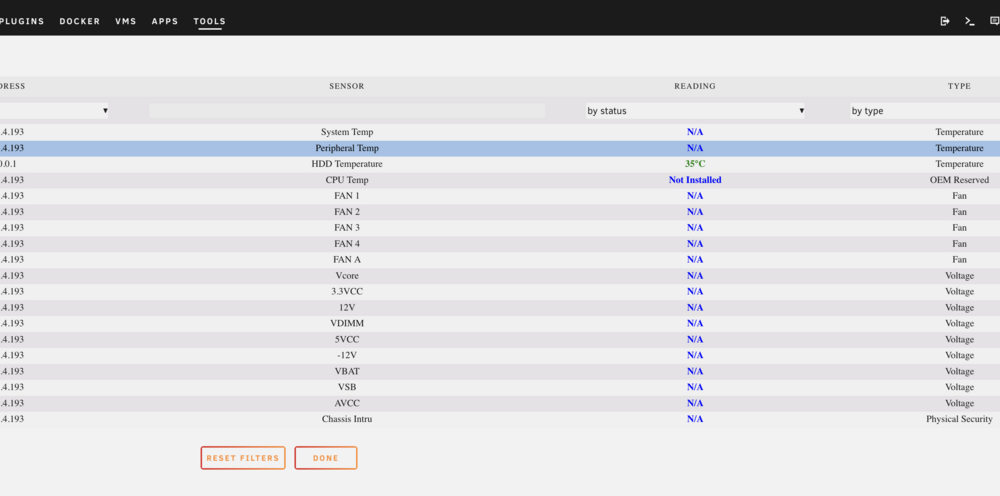
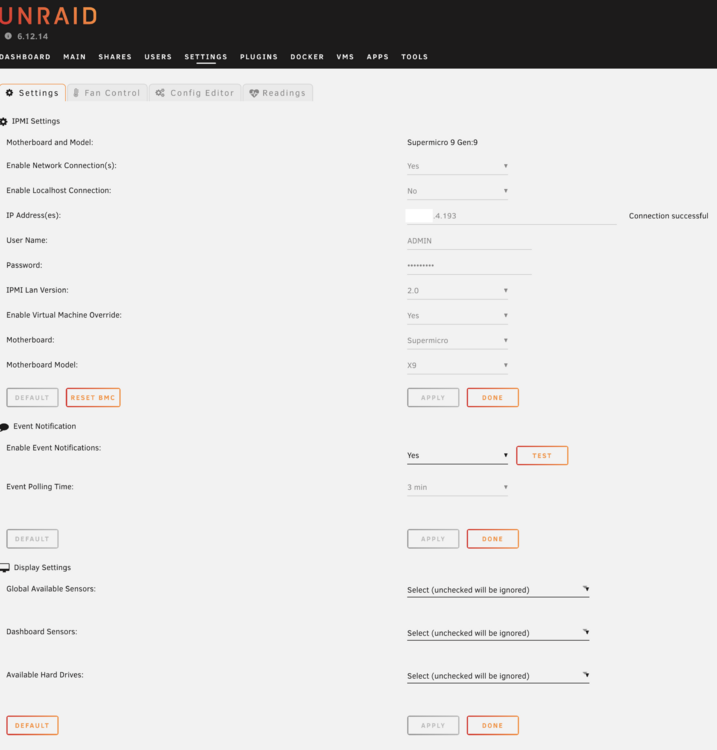
Hello, I have a Supermicro X9SCA-F and only recently started playing with Unraid 6.12.14. I installed IPMI Tools 2023.12.12. IPMI is configured. I can reach the BMC from the subnet and the settings page says "Connection successful". But in each reboot. sensor readings suddenly disappear (showing na or N/A). It's as if something is blocking the readout and i don't know what it is. When the computer is shut down, the BMC shows all sensor green. The BMC firmware is the latest i found (3.38). I have installed other plugins like Dynamix System Temp and Dynamix Systems Stats (uninstalling does not really help). Stopping the Netdata docker container also does not change the behavior. Is the observation known behavior? What can i do? (My ultimate goal is to have sensor readings and then do fan control where i do understand that with my Noctua fans, i will have to play a bit). These are the currently installed apps: Community Applications Disk Location Dynamix S3 Sleep Fix Common Problems IPMI Tools Nerd Tools (ipmitool) Parity Check Tuning Unassigned Devices Unassigned Devices Plus (Addon) Unassigned Devices Preclear unbalanced User Scripts
-
...i have used the shell to create a mountpoint, mounted all the filesystems and am now tarring to a locally connected backup drive. So the urgent need for the above is gone while at the same time giving the best performance rather than Gigabit Ethernet.
-
Hello, last thing before going to sleep, i attempted to boot up an old server from 2009. It worked, but with Unraid, i could not get sharing the existing disks to work. We are talking about 2 RAID5 from a 3Ware 9690SA-8i and some internal SATA disks. I would like to make a backup of all that content because i am going to rip everything apart and throw it away or in the basement. All drives are detected, it seems to have loaded the 3Ware drivers. The problem seems to be the filesystems. If i remember correctly, i have used LVM2 extensively and none of the disks mount (albeit the RAID arrays bring a different error message than the single disks; don't know if this is because they lack any GUID partition table and only have MBR). Anyway, they should contain Linux-supported filesystems as a Debian 11 or so was running. Is there a guide to get such drives working or am i better off just trying to run Clonezilla (I'd prefer backing up the files as opposed to the partitions as this would mean another step of complexity for future recovery of some files, should i detect i need it)? Going into the shell, i see that all the LVM2 VGs are available. I guess i can look to mount them manually somewhere, all i need is a way to share a user-specified directory.
-
Hello @MAM59, many thanks for your answer, it has helped me tremendously! 😀👍 As a matter of fact, i have now organized a trial on a VM with simulated hard disks, just to see the software in action and it's better for understanding. I also stumbled on Space Invader One's set of formidable videos on Youtube and watched maybe 10 or so explaining some things i figured would be the essential topics, like intro, moving files, Apps, some use cases, parity, mover, caching - in the parity regard, he also explained the RMW, that everything has to be reread, then calculated and written again. That Unraid is special was already somewhat known to me but the more i dig into the topic, it blows me away how special it actually is and how large the community is. I operate a self-built Truenas Scale and it was a 2 year project to even build it (leave alone the day-to-day operations which i have yet to fully master, like ZFS backups). I think that Unraid with its UA has a particular use case, therefore i am wondering what's their way forward as in 7.0 they seem to support all the ZFS part. I would never use Unraid for speed currently, i think they need to concentrate on the UA for the future as well (in my mind, that's the flexibility, e.g. being able to just throw in leftover disks that makes home users use it). I ordered some parts to build my setup, i.e. some disks, a used mainboard/CPU/RAM for rather cheap but still luseful. I hope to be able to create a machine that can host some backup storage for sudden needs (i.e. you notice how complicated working with big-sized NAS it can become if you cannot shift data around, one NAS culminates in the need for another and so forth). I also hope i can put it to sleep when not in use so the power consumption should not be an issue. For 1), i think my format of XFS was an accidental good decision to use the 20TB backup disks in a hotswap cage, then add them to a non-parity protected UA. They should mount and i can create a share and put a "how-to-fill-the-drive" policy, which should get 2) covered.
-
unassigned means not part of an array but still be able to be shared? Then this sounds promising and that's what i meant.
-
Hi, i am new to Unraid but not to computing (30+ years experience). The software has created interest in me because it's quite different to professional approaches, yet very useful in the home domain it seems. I have some hard disks (20TB) that i want to use for backups. Actually, twice the number to allow for two backup sets. 1) I am wondering if i can format the disks as stand-alone disks with e.g. ZFS or XFS and put them into Unraid to share their contents via SMB? No fear of accidentally formatting them, anything to take care of? That way, i don't need to connect a USB-SATA dock to the system to-be-backed-up, i can just backup via network (10Gbe) and, once completed, take out the disk and store it. 2) I would also like to be able to use Mergerfs so i can have two disks appear as one - i read some Unraid users are doing already? Thanks a lot for any advice.

