FDM80
Members
-
Joined
-
Last visited
-
Posting the steps I took to successfully use the "GLM-OCR" model for OCR duties in paperless-gpt with an ollama backend. 1) Make sure you get glm-ocr from ollama.com. I'm using the "bf16" version, not the "q8_0", since VRAM is not an issue for me. I would avoid using any other .gguf, as an example from huggingface.com, with the ollama backend as I think those other versions were assembled to be used on other backends and could be slightly different. 2) I'm using context lengths between 8k and 64k with this model. Anything smaller or larger than that results in poor output or the model crashing for me. 8k = 8192 16k = 16384 32k = 32768 64k = 65536 3) I changed the ocr prompt in paperless-gpt to the following: ----------------------------------------------------------------------------------------------- Extract text from the provided document/image while preserving all original formatting and layout. Use precision mode on. Output a text file with these requirements: • Maintain original spacing between paragraphs and lines. • Preserve special characters and mathematical notation (use ... for equations). • Do not add any metadata, comments, or modifications beyond what appears in the document. • For unclear text, leave as-is without correction. • Ignore non-text elements unless they contain readable text. Output should be a clean text file containing only the document's content. ----------------------------------------------------------------------------------------------- The model has 3 modes, text recognition, table recognition, and figure recognition. I believe the output that we would be striving for is text since that is what the "Content" field in paperless-ngx supports. As an example, when you get html output, I believe the model is trying to recreate a table via table recognition mode. The above ocr prompt, for me, does a good job of steering the model to focus on text extraction mode. I've successfully used this on images and pdfs.
-
https://forums.plex.tv/t/pms-1-32-6-hw-transcoding-issues-and-corrections/853757 For anyone that cycles their container and is surprised by a downgrade, looks like Plex pulled the latest builds and you will have 1.32.5 installed by default which will restore the ability to transcode with HDR tone mapping turned on.
-
According to a Plex forum post, they are aware of the transcoding issue in the latest beta server release (1.32.6.7468). The solutions tossed around are 1) disable HDR tonemapping (which seems to fix it) 2) revert to the last stable release 3) wait for the fix in a future beta release
-
Copy and pasted from the pihole entry on dockerhub. As of 2022.04.01, setting CAP_NET_ADMIN is only required if you are using Pi-hole as your DHCP server. The container will only try to set caps that are explicitly granted (or natively available)
-
I was fiddling with my plex container the other day and noticed that the template did in fact change. The part of the template with the directions about switching to advanced view to add the extra parameter, etc is no longer present anymore. The NVIDIA_VISIBLE_DEVICES environment variable field now needs to be added manually.
-
Looks like they fixed HDR Tone mapping with v.1.29.1. Anyone who stayed on v1.28.0 to maintain that functionality can try and upgrade. https://forums.plex.tv/t/pms-1-29-1-hw-tonemapping-testing-questions-and-answers/812785
-
Posting to document my findings and possibly save other people time if they run into the same thing. Hardware transcoding (quicksync) doesn’t work in 1.27.2.5929 when HDR tone mapping is enabled. Hardware transcoding works when disabling HDR tone mapping. Reverting back to 1.27.1.5916 restores full functionality. Hardware transcoding works with HDR tone mapping enabled.
-
Current message I'm getting when attempting to update. "bad file MD5"
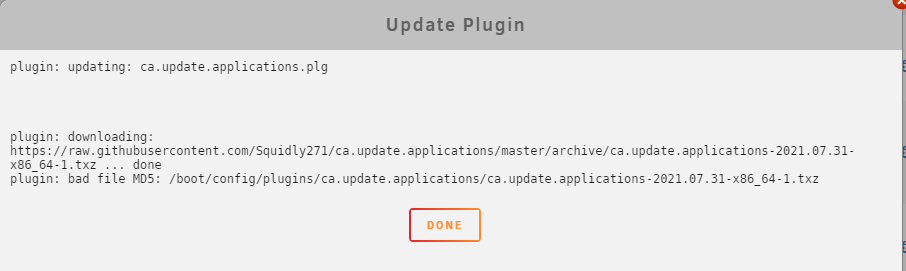
-
Yeah, I can confirm that the disk spinning up bug is back. You load the Main tab and the disks will spin up one by one.
-
Just a small side effect of temporarily removing the plugin. I noticed that I kept getting the log entry: flash_backup: adding task: /usr/local/emhttp/plugins/dynamix.my.servers/scripts/UpdateFlashBackup.php update while the plugin was uninstalled every minute. I had to make sure the flash backup was deactivated prior to uninstalling.
-
I had been having my array drives spin up when I logged in and the Main tab loaded for the last few days. Signing out of the plugin, then uninstalling it for the time being worked.
-
It is just the browser cache that needs to be cleared. On mobile devices I had to clear my cache. On Windows 10 in Chrome, all I had to do was a "Ctrl+F5" to refresh and force a bypass of the cache.
-
https://github.com/pi-hole/docker-pi-hole/issues/469 We'll see what comes of this.
-
You should check out this website. Ad blocking, telemetry, malicious sites, etc. that you can add to your pihole. https://firebog.net/ For starters, I'd recommend the below list which is all the ones on the website with a check mark next to them. It is the list that is least likely to interfere with normal browsing habits (ie: not as aggressive as some of the other lists) https://v.firebog.net/hosts/lists.php?type=tick
-
We are waiting for the official docker container to be updated. Once that happens, we will have caught up with the rest of the group. https://hub.docker.com/r/pihole/pihole/ If you look at the Tags tab, you can see the one we normally use (latest) is 7 days old and there is a dev version that is 3 days old.