





CaptainTivo
Members
-
Joined
-
Last visited
Everything posted by CaptainTivo
-
I did this and it worked out fine. Thanks.
-
I want to remove 3 disks and I would love it if someone would check my math :-) I am removing and storing 2 disks (disk1 and disk3) and I am not leaving the data on the array (they are backup copies) I want to move the data from a 3rd disk and remove it, too (disk7). Here is my checklist: Procedure: 1. Stop all backup scripts to prevent writing to anything during the process 2. disable dockers to prevent writing 3. move share /user/appdatabackup from disk3 to disk9 disable appdatabackup plugin run unbalanced and move /disk3/appdatabackup to /disk9/appdatabackup go to Shares and assign appdatabackup to disk9 4. stop mover change settings/mover to monthly 5. list all the files and dirs on disk7, use this to verify that all data was copied to disk10 6. run unbalanced and copy all data from disk7 to disk10 7. make sure all data was copied from disk7 to disk10 (use list in step 5) 8. delete all data from disk7 9. stop array and remove disk1 and disk3 from the server, leave disk7 in the server 11. reboot 12. MAKE A NEW CONFIG Screen shot disk assignments Reset the array configuration using Tools → New Config, choosing the option to preserve all current assignments. Unassign the disk1, disk3 and disk7 Start the array, but do not check the "Parity is valid" box. 13. mount disk7 as an unassigned disk Have I missed any steps, no matter how small? Any help is appreciated.
-
My problem: I have share that contains two disks. I want to remove the two disks from the server and put them into cold storage. I DO NOT want the data on the disks to remain on the server. I know that the rule is to delete all data on a disk before removing from a share. I can't do that because I want the data to be preserved offline. I don't have enough free space to copy it to another disk. I just want to remove the disks and have the Share disappear. How do I do that? Thanks.
-
I have been running unRaid since 2008. I know not to copy from share to disk or vice versa. As to what I did wrong, I still have no idea. Chatgpt said you can't do this: mv /mnt/user/Backup1/backups/Tower/Home\ Video/dashcam /mnt/user/Backup1/backups/Tower/dashcam this should move the dashcam directory up one level in the share and also in the disks that are included in the share right?
-
I have a problem that I have been trying to solve, described here : Someone on Reddit replied saying they did not know the answer but had asked ChatGPT! I went to the chat and after a few back and forths, ChatGPT said: The core rule you accidentally violated (everyone does once) Unraid cannot safely do what you asked it to do. essentially, you can't do that! That is, you can move a directory around inside a share if the share contains more than one disk. I have never heard that and, in fact, I'm pretty sure I have done just that. Or maybe I was just lucky and when I did move directories, I just happened to never move one that was split across disks? Can someone point me to the Unraid documentation where this very common action is no allowed?
-
I have a user share comprised of two disks. I want to put one in cold storage (it's all backed up files). Here is the layout: Share: Backup1/ backups\ Tower\ Home Video\ dashcam\ Backup1 contains disk1 and disk3 only I want to move all the files and directories in Home Video/ from disk1 to disk3 EXCEPT dashcam/ To make this simple, I decided to move dashcam/ up one level and then move all the other directories in Home Video\ from disk1 to disk3 So I executed: mv /mnt/user/Backup1/backups/Tower/Home\ Video/ .. then I moved all the other directories from disk1 to disk3 mv /user/disk1/Backup1/backups/Tower/Home\ Video /user/disk3/Backup1/backups/Tower Note that in this case I moved from disk to disk not within the share. I expected that the move within the share would have moved the same named directories on both disks. But then I got a warning that I was running low on space on both disks. In fact, not all of the files in the dashcam directory had been moved up. Checking, I found that some 681 GB had been left on disk1 and 427 GB on disk3! Doing a careful check, I discovered that these leftover directories actually had copies of files that had supposedly been "moved" up one directory level! In other words, some 600 GB of files were both in /mnt/disk1/Backup1/backups/Tower/dashcam and /mnt/disk1/Backup1/backups/Tower/Home\ Video/dashcam! and the same on disk3. I should have stopped at this point but I thought: OK I will just make sure that all the files are actually duplicated and then just delete the extra directories. I did this. I checked and found duplicates of the all the files in /mnt/disk1/Backup1/backups/Tower/Home\ Video/dashcam were duplicated in /mnt/disk1/Backup1/backups/Tower/dashcam so I did rm -rf /mnt/disk1/Backup1/backups/Tower/Home\ Video/dashcam and the same on disk3 and Voila, I now had about 500 GB free on each disk. Case over right? Nope. Next day, I check the Unraid main GUI page and find that each disk on has 81 GB free! What the hell? So I checked and lo and behold, all the files I deleted are back! I know this has been a long post but I am hoping someone can tell me what happened here and how to fix it. I am starting to think I don't know how Unraid works at all. Thanks.
-
I want to move some data around the array and remove a couple of disks. I would like to do it with only one parity rebuild if possible. Here's my current layout: I have a single share with two disks called Backup1. I contains only data that is in other shares on the array. I only have one server so to "backup" data that I can otherwise not duplicate, I "back it up" onto another share that only contains that type of data. That is, the share consists of 2 disks that are assigned only to that share. I know, this is not a real backup but I arrived at this solution because it seems to me that backing up this data onto, say, an external attached disk would actually be less safe because there would be no parity so why not put those disks into the array? Anyway, there are currently 2 disks in this dedicated Backup1 share. I want to remove both disks from the array. One of the disks I will simply remove and put in cold storage. The other I need to copy the data onto another disk so as to retain the backup data and then I want to remove it too from the array. Here is the current setup: Backup1 share: 7.3 TB disk1 current has 6.6 TB allocated 7.3 TB disk3 currently has 6.8 TB allocated other disks: 9.1TB disk4 currently has 8.2TB allocated 13TB disk10 currently has 40GB allocated My plan is to move all the data from disk4 to disk10 leaving disk4 empty then move all data from disk1 to disk4 this would become the only disk in Backup1 share then remove disk1 and disk3. disk3 would go into cold storage. disk1 would become a new unassigned disk used to do incremental backups of other data (movies) for eventual removal to cold storage. My question is: what procedure will result in only one "new config" and thus parity rebuild? Thanks for any help.
-
Hi, Since this has been removed from CA, can someone tell me how to install it? Thanks.
-
Right, typo. Thanks for the help.
-
I am going to zero out and remove a disk from my array. I am using the The "Clear Drive Then Remove Drive" method to avoid a parity rebuild. I am using this method to zero the disk: Can someone verify the the numeric part of the UI name is the device number. I.E, if the UI says "Disk 2" then this is /dev/mt2p1? The reason I ask is that I can't find this information anywhere in the Unraid docs and if anyone knows where it is documented, could you supply a reference? Thanks.
-
Actually, why don't you need to do a "new config"? This sounds like a new config to me. When is "new config" actually needed?
-
Thanks. I googled but ended up in "parity swap" page instead of this one.
-
I want to replace my current 10TB parity drive with a 14TB. After some research, some say it is as simple as 1. stop array 2. select parity drive and then "unassigned" 3. select new drive and the select "parity" 4. start array But don't I need to do a "new config" for this?
-
Thank you for that. I suppose I did this years ago when I last reset my config but forgot about it.
-
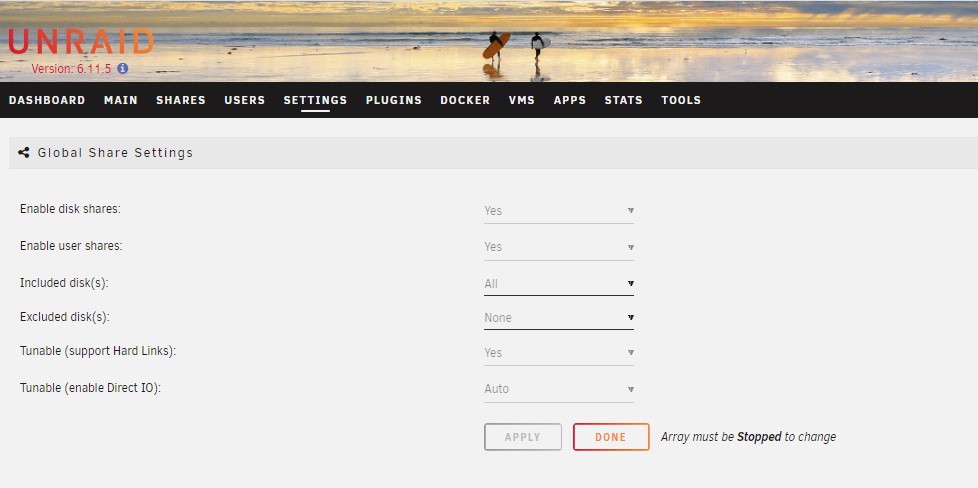
I just finished removing a disk and rebuilding parity after a new config. I find that user shares are visible on SMB (Windows 10) but disk shares are not. They were mounted before I did the new config and they show that they are still enabled in Setting/Global share settings (see below). I have stopped the array, disabled disk shares, then restarted and stopped again and set enable disk shares and restarted. The disk shares are still not visible on \Tower. (see below) Is there something else I need to do the have Unraid mount them on SMB? Thanks.
-
D'oh. I did not notice the apply, just the "Done". I don't do this often..
-
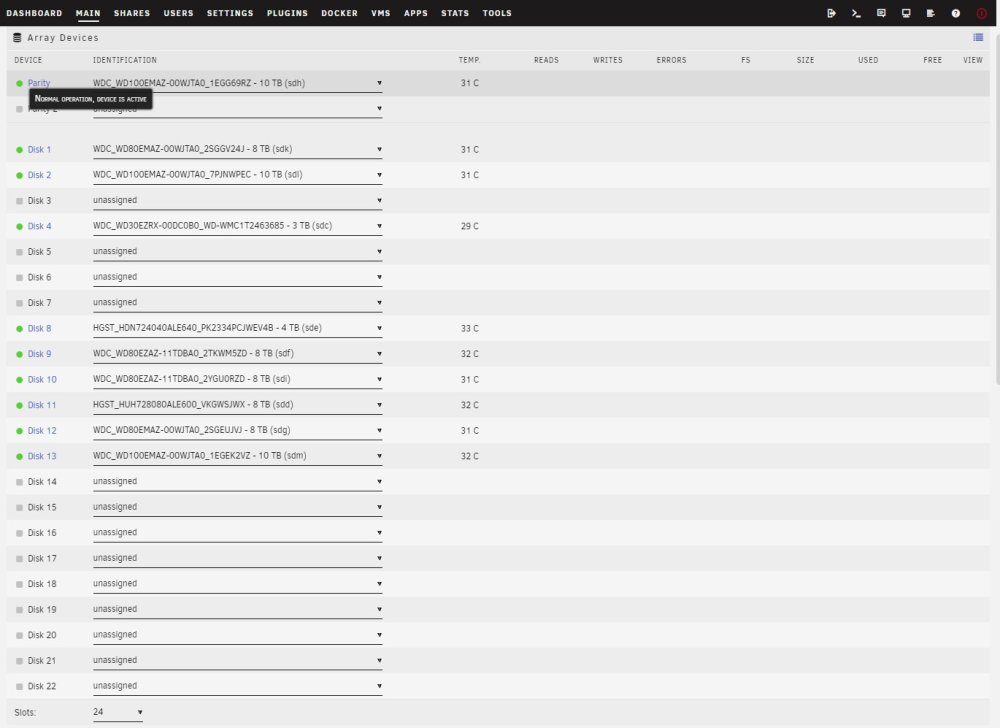
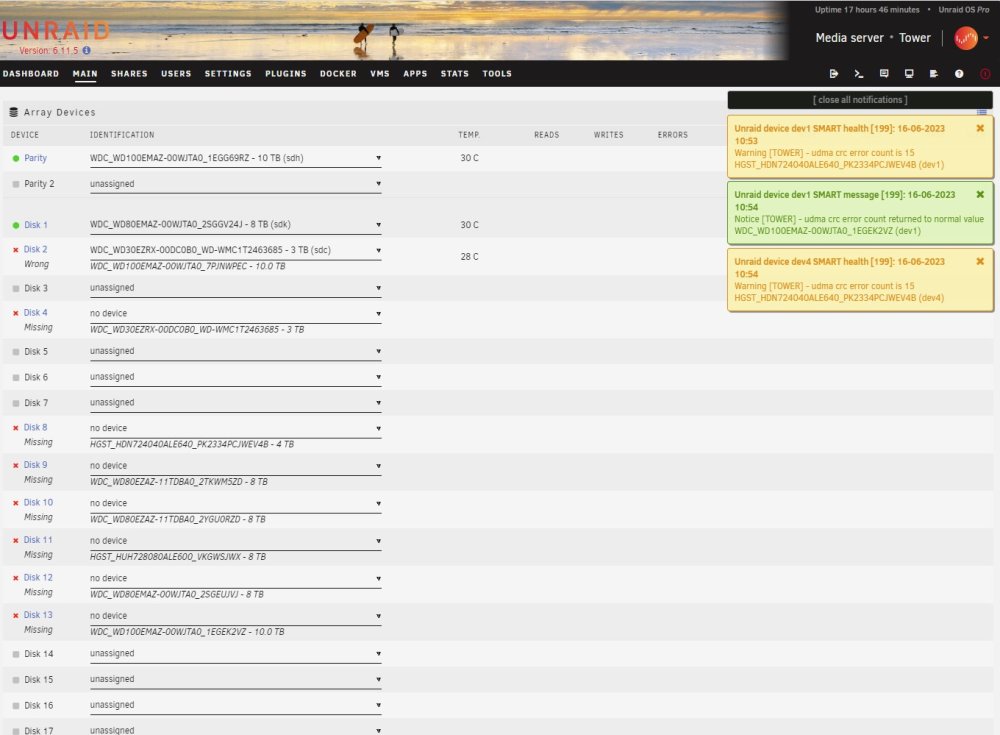
Hello, I am attempting to re-assign all my disks to new disk slots. I am following this guide: https://docs.unraid.net/unraid-os/manual/storage-management/#reset-the-array-configuration I have done steps 1, 2, 3 and returned to the main page However, even though I selected to save none of the current assignments, they are still there. Worse, if I attempt to unassign a disk to a current slot, it will then show "missing". If I assign a different disk to that slot, it will show "missing". Here is what it looks like after doing the "New Config" And here is what it looks like after selecting "no device" for a slot. Shouldn't I have the choice to "unassign" a slot and then get a dropdown with the list of unassigned disks to select from? What should I do now? Thanks for any help.
-
Hello, I am going to remove a drive from my array. I copied all the data from it to a new disk (already in the array) and will now un-assign it remove it from the array. Over the years, I have removed and added many drives and the disk numbers are really fragmented so I would like reassign all the disks in numerical order before I rebuild the parity. I currently have only two top-level shares: Backup and Videos. Of course, they are defined using the current disk numbers. After I do the New Config, I will re-assign all the disks and so I need to reassign which disks are included in the Shares definitions. Now, I have never "redefined" a share before. I know that a share must have no data in it before it can be deleted, so I can't just delete the shares. So, should I just leave the share definitions as is? Will they have the same include/excluded disks after the new config reboot? Or shoud I delete all the "Included disk(s)" numbers before the "new config" and then change these numbers to the correct disk numbers after the restart? Any help is appreciated. Thanks.
-
I have two shares, Backup1 and Backup2 Backup1 is defined as: Included Disk(s): disk4, disk10 Backup2 is defined as: Included Disk(s): disk1 I want to combine the two shares into a single share named Backup1 and containing only the three disks: disk1, disk4 and disk10. Is this as simple as renaming the top directory on disk1 to "Backup1"? I don't see a "delete share" button so I don't see a way to delete a share? Thanks.
-
D'oh! Of course, the reconstructed disk would be bit-for-bit, wouldn't it? See, I knew I should ask first before acting! I have never before had to reformat a disk. Ok. Plan B. Should I use unbalance or just rsync myself?
-
I have been getting a warning "reiserfs on disk8" and I am running out of space on one of my shares so I thought I would fix both problems. The only disk I have that is RFS formatted is disk8 (4 TB) I have a new disk (10 TB) which I have pre-cleared. I would like to: 1. add the new 10 TB disk to the array 2. move the data from disk8 (RFS) to the new disk 3. reformat disk8 to XFS At first, I planned to simply add the new disk to the array and use rsync to copy the data from the old RFS disk to the new one and then shrink the array. But multiple sources say the better way is to simply rebuild the disk. Here is my plan: 1. Replace disk8 with the new 10 TB disk a. stop array b. unassign disk8 c. start array d. stop array e. assign 10TB disk to slot disk8 f. start the array - this will rebuild the data from old disk8 (4 TB) onto new disk8 (10 TB) When will all the data be copied to the new disk8? How will I know when to copy is finished? 2. preclear old disk8 RFS disk 3. add old disk8 to array, format as SFS and assign it to share Backup1 a. stop array b. assign old disk8 to a new slot c. start array d. since disk have been pre-cleared, now format disk as XFS e. after disk is mounted, add this disk to Backup1 share I know this extremely detailed but I just don't do this stuff often and I have upgraded the Unraid since then so I want to be sure that I have all the details right. Any advice/comments are appreciated. Thanks.
-
Thank you! It had been so many years since I enabled reconstruct writes that I had forgotten the "side effect". Mystery solved!
-
After some investigation, I found the cause. I had specified a network share on the server as the target for a Windows backup, including "Back up using File History" and I specified "Every hour" as the frequency. The target is a share on the server which I I defined a Share on the server with "Included disks" set to "Disk1" and "Excluded disks" set to empty (no entry). My understanding is that you either use "Included disks" OR "Excluded disks" to define your share, not both. So why did Unraid to spin up ALL the disks in the server if the share is only on one disk? If I additionally excluded the other disks in the server would it then not spin them up? Anyway, I will mark this SOLVED and ask the other question in a new thread. Thanks.
-
Correction: my spindown time is 15 minutes. This makes more sense when you read the log. Sorry about that 🙂
-
I was poking around in my newly updated server (6.11.5) and noticed in the system log that SMART data is being read on every drive every half hour! By default, I spin down all drives after 30 minutes of idle (no access) so this means that they are all spinning about half of the time, 24/7! This not good. I run the Scrutiny docker so I thought that might be doing it, but I stopped that docker and that did not stop the SMART reads. Apr 7 23:06:27 Tower emhttpd: read SMART /dev/sdk Apr 7 23:06:27 Tower emhttpd: read SMART /dev/sdh Apr 7 23:06:27 Tower emhttpd: read SMART /dev/sde Apr 7 23:06:27 Tower emhttpd: read SMART /dev/sdf Apr 7 23:06:27 Tower emhttpd: read SMART /dev/sdc Apr 7 23:06:38 Tower emhttpd: read SMART /dev/sdg Apr 7 23:06:38 Tower emhttpd: read SMART /dev/sdl Apr 7 23:07:31 Tower emhttpd: read SMART /dev/sdj Apr 7 23:07:31 Tower emhttpd: read SMART /dev/sdd Apr 7 23:22:32 Tower emhttpd: spinning down /dev/sdj Apr 7 23:22:32 Tower emhttpd: spinning down /dev/sdk Apr 7 23:22:32 Tower emhttpd: spinning down /dev/sdh Apr 7 23:22:32 Tower emhttpd: spinning down /dev/sdd Apr 7 23:22:32 Tower emhttpd: spinning down /dev/sde Apr 7 23:22:32 Tower emhttpd: spinning down /dev/sdf Apr 7 23:22:32 Tower emhttpd: spinning down /dev/sdc Apr 7 23:23:02 Tower emhttpd: spinning down /dev/sdg Apr 7 23:23:02 Tower emhttpd: spinning down /dev/sdl Has anyone noticed this or it just my system? Any ideas what is causing this and how to stop it? As always, thanks for any help. tower-diagnostics-20230427-1538.zip


