slize
Members
-
Joined
-
Last visited
-
@Squid would it be possible to add a option which prevents a script from running twice (when it already gets executed)? I think flock could help here: https://manpages.ubuntu.com/manpages/bionic/en/man1/flock.1.html
-
I just found the issue. Very strange but it seems like that a WireGuard VPN Connection "Remote Access To Server" is not enough. You need "Server to Server Access" to get Syncthing/rsync deamon to work.
-
@jbat66 Is the sync between your unraid servers still working fine? I tried it and it seems like as long as i create the files that should be synced its working fine. But as soon as i copy a file in the SMB share that syncthing is watching, the whole sync process get stuck at 0%.
-
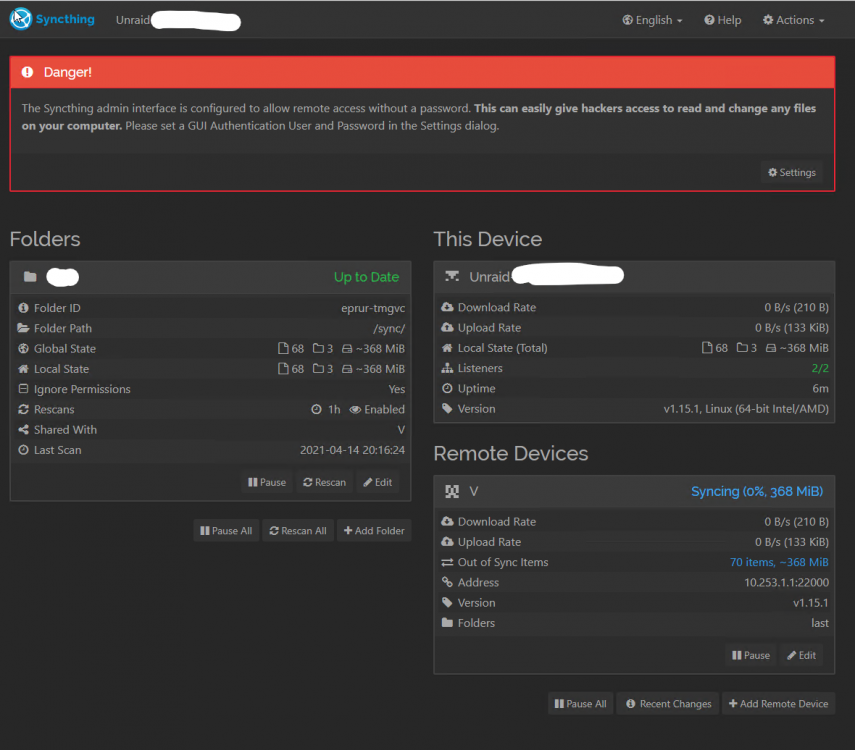
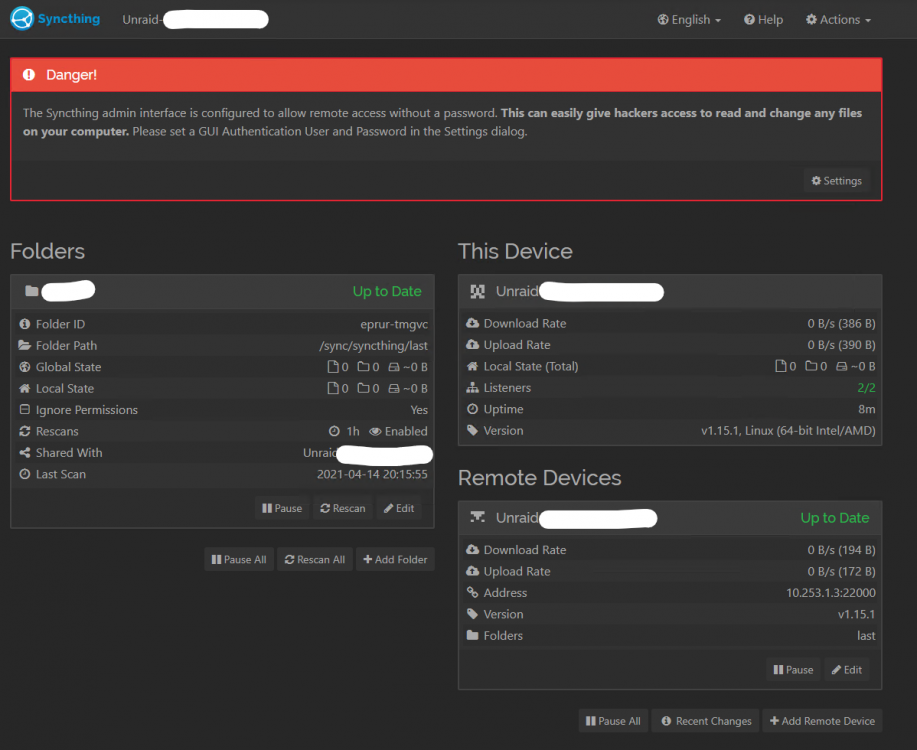
I literally cant get syncthing to work with my shares. To my setup: I got two unraid server connected via the WireGuard VPN plugin. Both servers are running the latest version of this container and are connected in the syncthing gui. When im sharing the default folder (which is just running inside the container) everything is syncing fine and super fast. When i try to sync one of my unraid shares (by mounting it as RW into the docker of the main server) + sharing the folder with the other server it starts the sync process but gets stuck at 0%. The target server does not even state that a sync is running. So there has to be an issue with the mounted share/the files in the share. As long as i mount an empty share and i am creating the files in the share from within the container the sync is running fine. "Ignore Permissions" is checked on both ends and "UMASK_SET" has the value "000". Can someone tell me whats wrong with my files in the share that causes the sync process to get stuck?
-
Awesome stuff! Thank you - i searched for that option in "Disk Settings". That looks way better now :-). Also thank you too @John_M!

-
Isn't there an option to encrypt the new 'pool' devices like the array disks? Maybe i am missing it, but i just created a new pool and the drives are formatted to btrfs instead of encrypted btrfs.
-
@Squid, @bonienl, @dlandon sorry to ping you guys, but i really think this feature would add so much value for UNRAID especially in those two points: #1 Humans do make mistakes and a snapshotted version of an office document would help a lot when overwritten accidentally. #2 Ransomware has become an serious issue around the world from large companies to very small networks. As long as a user cannot delete a snapshot and the server is not compromised it would not be as big of an issue if you get hit at one day. (Sure you can create backups every day but snapshots would be much more convenient.) It would be awesome to get some prominent attention on this topic and maybe see an plugin coming in 2021. I think this topic would also fit very well on @SpaceInvaderOne's YouTube channel.
-
I would also like to see this in the plugins section
-
Thank you very much for the fast reply! Its working perfectly now.
-
Is there currently a way to do a unraid server - unraid server connection via the VPN Manager plugin? I would like to sync my server via a vpn to another location. I manged to get a vpn connection via a Windows VM and the unraid server but i cant figure out how to connect to an vpn via the VPN Manager plugin.
-
Thanks for the hint with Userscript. As for the vcpusched - i searched the whole internet for solutions and found one post with a guy who was mentioning it. I tried "rr" and "fifo" - for me "rr" works the best. But its still not perfect. Im getting little peaks and max execution times up to 3248us. But most of them in the 20us to 200us range which is quite good.
-
Thank you for your reply! I tried to switch to Q35 but it does not seem to make a difference. Im currently experimenting with the settings in the xml below (also as far as i can tell for now including or excluding the cpu 1 and 7 doesnt make a difference aswell). I got the best results by adding a custom scheduler (which needs some tricks on unraid). SSH to the server and type (would be nice if you @testdasi or someone else can tell me how i can get these commands to be persistant after a rebbot): ulimit -r 99 sysctl -w kernel.sched_rt_runtime_us=-1 <vcpusched vcpus='0-7' scheduler='rr' priority='99'/> <?xml version='1.0' encoding='UTF-8'?> <domain type='kvm' id='8'> <name>Windows 10</name> <uuid>ee1750e8-629d-9ca9-860f-d590e2b60e56</uuid> <metadata> <vmtemplate xmlns="unraid" name="Windows 10" icon="windows.png" os="windows10"/> </metadata> <memory unit='KiB'>57671680</memory> <currentMemory unit='KiB'>57671680</currentMemory> <memoryBacking> <nosharepages/> </memoryBacking> <vcpu placement='static'>8</vcpu> <iothreads>2</iothreads> <cputune> <vcpupin vcpu='0' cpuset='2'/> <vcpupin vcpu='1' cpuset='8'/> <vcpupin vcpu='2' cpuset='3'/> <vcpupin vcpu='3' cpuset='9'/> <vcpupin vcpu='4' cpuset='4'/> <vcpupin vcpu='5' cpuset='10'/> <vcpupin vcpu='6' cpuset='5'/> <vcpupin vcpu='7' cpuset='11'/> <emulatorpin cpuset='1,7'/> <iothreadpin iothread='1' cpuset='1'/> <iothreadpin iothread='2' cpuset='7'/> <vcpusched vcpus='0' scheduler='rr' priority='99'/> <vcpusched vcpus='1' scheduler='rr' priority='99'/> <vcpusched vcpus='2' scheduler='rr' priority='99'/> <vcpusched vcpus='3' scheduler='rr' priority='99'/> <vcpusched vcpus='4' scheduler='rr' priority='99'/> <vcpusched vcpus='5' scheduler='rr' priority='99'/> <vcpusched vcpus='6' scheduler='rr' priority='99'/> <vcpusched vcpus='7' scheduler='rr' priority='99'/> </cputune> <resource> <partition>/machine</partition> </resource> <os> <type arch='x86_64' machine='pc-i440fx-4.2'>hvm</type> <loader readonly='yes' type='pflash'>/usr/share/qemu/ovmf-x64/OVMF_CODE-pure-efi.fd</loader> <nvram>/etc/libvirt/qemu/nvram/ee1750e8-6211-9c38-860f-d590e2b60e56_VARS-pure-efi.fd</nvram> </os> <features> <acpi/> <apic/> <hyperv> <relaxed state='on'/> <vapic state='on'/> <spinlocks state='on' retries='8191'/> <vendor_id state='on' value='none'/> </hyperv> </features> <cpu mode='host-passthrough' check='none'> <topology sockets='1' cores='4' threads='2'/> </cpu> <clock offset='localtime'> <timer name='hypervclock' present='yes'/> <timer name='hpet' present='no'/> </clock> <on_poweroff>destroy</on_poweroff> <on_reboot>restart</on_reboot> <on_crash>restart</on_crash> <devices> <emulator>/usr/local/sbin/qemu</emulator> <disk type='file' device='disk'> <driver name='qemu' type='raw' cache='none' io='native'/> <source file='/mnt/disks/Force_MP600_19288230000124356/Windows 10/vdisk1.img' index='1'/> <backingStore/> <target dev='hdc' bus='virtio'/> <boot order='1'/> <alias name='virtio-disk2'/> <address type='pci' domain='0x0000' bus='0x00' slot='0x04' function='0x0'/> </disk> <controller type='usb' index='0' model='qemu-xhci' ports='15'> <alias name='usb'/> <address type='pci' domain='0x0000' bus='0x00' slot='0x07' function='0x0' multifunction='on'/> </controller> <controller type='pci' index='0' model='pci-root'> <alias name='pci.0'/> </controller> <controller type='virtio-serial' index='0'> <alias name='virtio-serial0'/> <address type='pci' domain='0x0000' bus='0x00' slot='0x03' function='0x0'/> </controller> <interface type='bridge'> <mac address='52:54:00:b3:52:21'/> <source bridge='br0'/> <target dev='vnet0'/> <model type='virtio'/> <alias name='net0'/> <address type='pci' domain='0x0000' bus='0x00' slot='0x02' function='0x0'/> </interface> <serial type='pty'> <source path='/dev/pts/1'/> <target type='isa-serial' port='0'> <model name='isa-serial'/> </target> <alias name='serial0'/> </serial> <console type='pty' tty='/dev/pts/1'> <source path='/dev/pts/1'/> <target type='serial' port='0'/> <alias name='serial0'/> </console> <channel type='unix'> <source mode='bind' path='/var/lib/libvirt/qemu/channel/target/domain-8-Windows 10/org.qemu.guest_agent.0'/> <target type='virtio' name='org.qemu.guest_agent.0' state='disconnected'/> <alias name='channel0'/> <address type='virtio-serial' controller='0' bus='0' port='1'/> </channel> <input type='mouse' bus='ps2'> <alias name='input0'/> </input> <input type='keyboard' bus='ps2'> <alias name='input1'/> </input> <hostdev mode='subsystem' type='pci' managed='yes'> <driver name='vfio'/> <source> <address domain='0x0000' bus='0x01' slot='0x00' function='0x0'/> </source> <alias name='hostdev0'/> <rom file='/mnt/disk1/isos/Gigabyte.RTX2080.8192.190116_EDIT.rom'/> <address type='pci' domain='0x0000' bus='0x00' slot='0x06' function='0x0' multifunction='on'/> </hostdev> <hostdev mode='subsystem' type='pci' managed='yes'> <driver name='vfio'/> <source> <address domain='0x0000' bus='0x01' slot='0x00' function='0x1'/> </source> <alias name='hostdev1'/> <address type='pci' domain='0x0000' bus='0x00' slot='0x06' function='0x1'/> </hostdev> <hostdev mode='subsystem' type='pci' managed='yes'> <driver name='vfio'/> <source> <address domain='0x0000' bus='0x01' slot='0x00' function='0x2'/> </source> <alias name='hostdev2'/> <address type='pci' domain='0x0000' bus='0x00' slot='0x06' function='0x2'/> </hostdev> <hostdev mode='subsystem' type='pci' managed='yes'> <driver name='vfio'/> <source> <address domain='0x0000' bus='0x01' slot='0x00' function='0x3'/> </source> <alias name='hostdev3'/> <address type='pci' domain='0x0000' bus='0x00' slot='0x07' function='0x3'/> </hostdev> <memballoon model='none'/> </devices> <seclabel type='dynamic' model='dac' relabel='yes'> <label>+0:+100</label> <imagelabel>+0:+100</imagelabel> </seclabel> </domain>
-
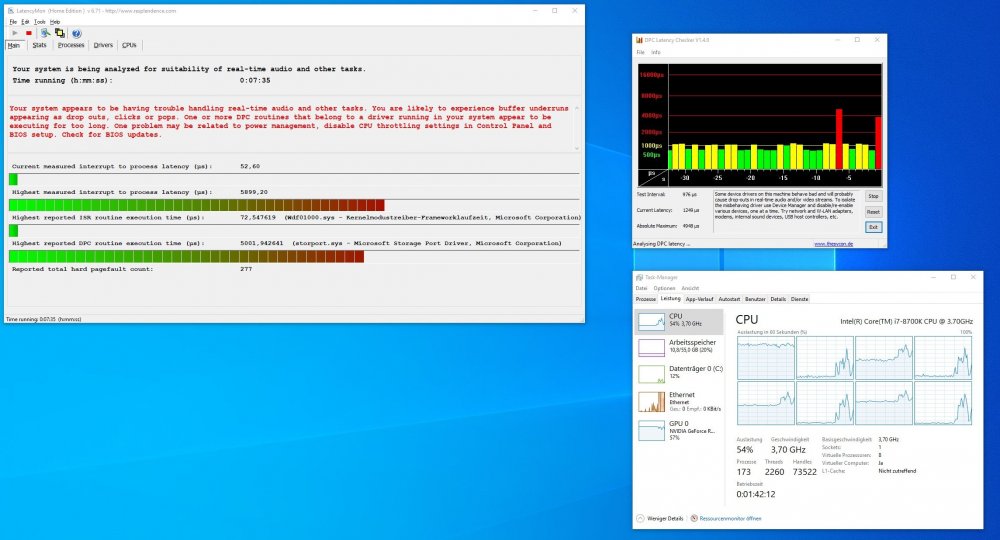
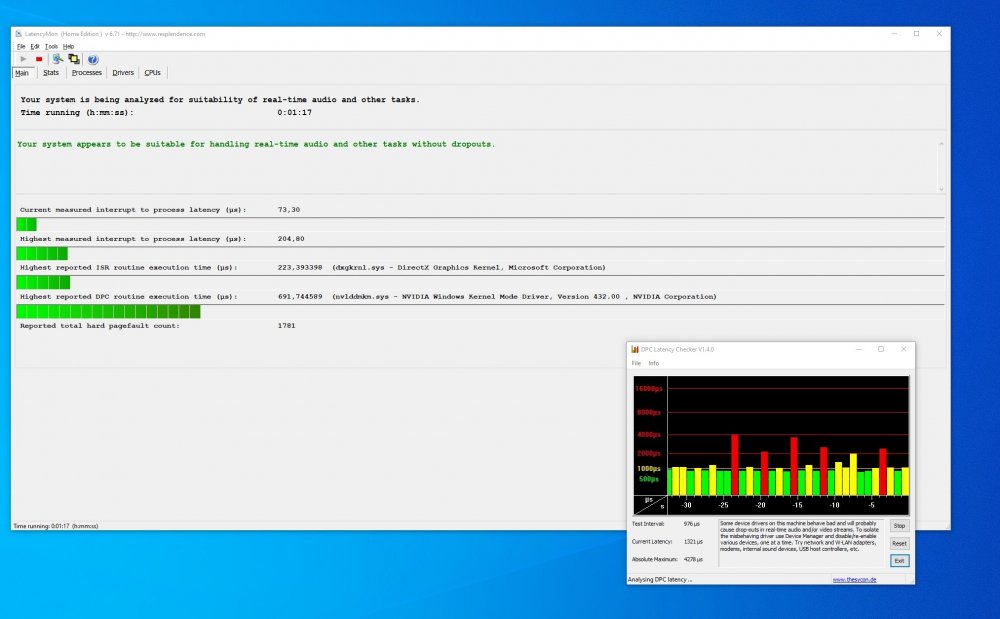
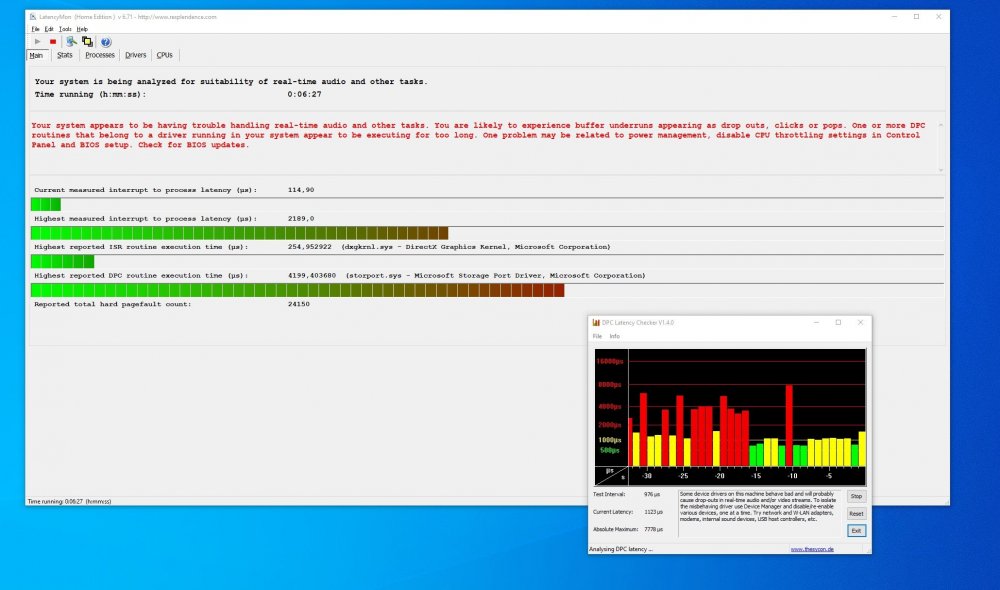
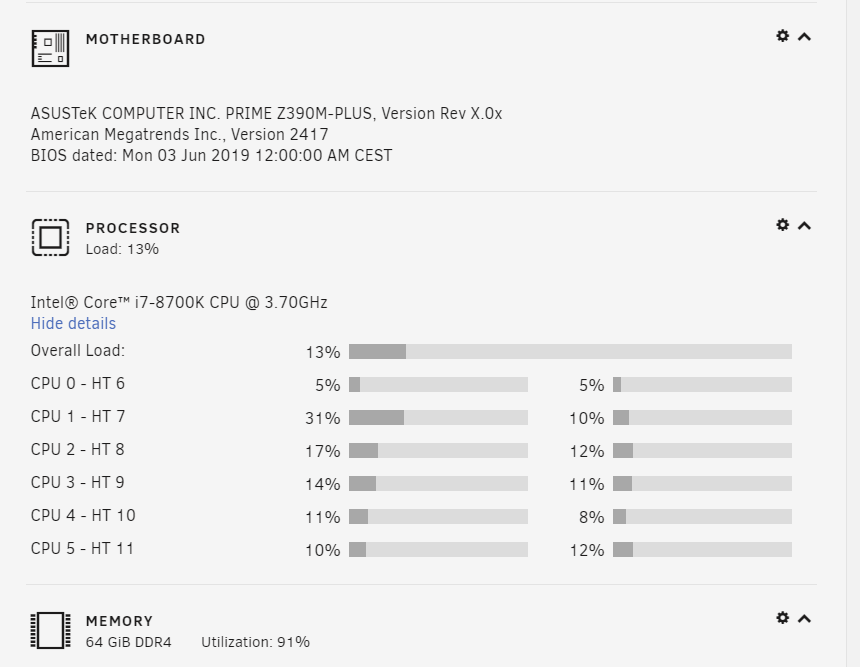
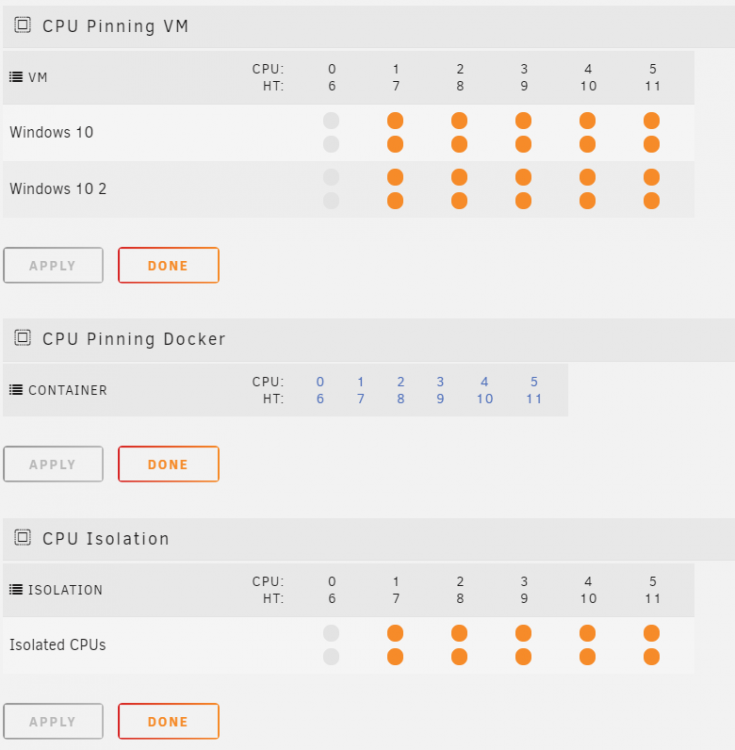
Hey, i successfully created a Windows 10 gaming vm with gpu passthrough but im experiencing microstutters in games compared to bare metal gameplay. I think the issue could be related to bad DPC latency's. One screenshot is while im gaming and the other is while im copying some huge files from an other unraid server to my vm. Does somebody know how i can fix the high DPC latencies or whats causing them? Bootparameter: append initrd=/bzroot pcie_acs_override=downstream,multifunction isolcpus=1-5,7-11 vfio-pci.ids=10de:1e87,10de:10f8,10de:1ad8,10de:1ad9 Devices of the system: IOMMU group 0: [8086:3ec2] 00:00.0 Host bridge: Intel Corporation 8th Gen Core Processor Host Bridge/DRAM Registers (rev 07) IOMMU group 1: [8086:1901] 00:01.0 PCI bridge: Intel Corporation Xeon E3-1200 v5/E3-1500 v5/6th Gen Core Processor PCIe Controller (x16) (rev 07) IOMMU group 2: [8086:a36d] 00:14.0 USB controller: Intel Corporation Cannon Lake PCH USB 3.1 xHCI Host Controller (rev 10) [8086:a36f] 00:14.2 RAM memory: Intel Corporation Cannon Lake PCH Shared SRAM (rev 10) IOMMU group 3: [8086:a360] 00:16.0 Communication controller: Intel Corporation Cannon Lake PCH HECI Controller (rev 10) IOMMU group 4: [8086:a352] 00:17.0 SATA controller: Intel Corporation Cannon Lake PCH SATA AHCI Controller (rev 10) IOMMU group 5: [8086:a340] 00:1b.0 PCI bridge: Intel Corporation Cannon Lake PCH PCI Express Root Port #17 (rev f0) IOMMU group 6: [8086:a338] 00:1c.0 PCI bridge: Intel Corporation Cannon Lake PCH PCI Express Root Port #1 (rev f0) IOMMU group 7: [8086:a330] 00:1d.0 PCI bridge: Intel Corporation Cannon Lake PCH PCI Express Root Port #9 (rev f0) IOMMU group 8: [8086:a305] 00:1f.0 ISA bridge: Intel Corporation Z390 Chipset LPC/eSPI Controller (rev 10) [8086:a348] 00:1f.3 Audio device: Intel Corporation Cannon Lake PCH cAVS (rev 10) [8086:a323] 00:1f.4 SMBus: Intel Corporation Cannon Lake PCH SMBus Controller (rev 10) [8086:a324] 00:1f.5 Serial bus controller [0c80]: Intel Corporation Cannon Lake PCH SPI Controller (rev 10) [8086:15bc] 00:1f.6 Ethernet controller: Intel Corporation Ethernet Connection (7) I219-V (rev 10) IOMMU group 9: [10de:1e87] 01:00.0 VGA compatible controller: NVIDIA Corporation TU104 [GeForce RTX 2080 Rev. A] (rev a1) IOMMU group 10: [10de:10f8] 01:00.1 Audio device: NVIDIA Corporation TU104 HD Audio Controller (rev a1) IOMMU group 11: [10de:1ad8] 01:00.2 USB controller: NVIDIA Corporation TU104 USB 3.1 Host Controller (rev a1) IOMMU group 12: [10de:1ad9] 01:00.3 Serial bus controller [0c80]: NVIDIA Corporation TU104 USB Type-C UCSI Controller (rev a1) IOMMU group 13: [1987:5016] 02:00.0 Non-Volatile memory controller: Phison Electronics Corporation E16 PCIe4 NVMe Controller (rev 01) IOMMU group 14: [144d:a808] 04:00.0 Non-Volatile memory controller: Samsung Electronics Co Ltd NVMe SSD Controller SM981/PM981/PM983 CPU Thread Pairings Pair 1: cpu 0 / cpu 6 Pair 2: cpu 1 / cpu 7 Pair 3: cpu 2 / cpu 8 Pair 4: cpu 3 / cpu 9 Pair 5: cpu 4 / cpu 10 Pair 6: cpu 5 / cpu 11 USB Devices Bus 001 Device 001: ID 1d6b:0002 Linux Foundation 2.0 root hub Bus 001 Device 002: ID 1e71:170e NZXT NZXT USB Device Bus 002 Device 001: ID 1d6b:0003 Linux Foundation 3.0 root hub Bus 002 Device 002: ID 0781:5583 SanDisk Corp. Ultra Fit SCSI Devices [0:0:0:0] disk SanDisk Ultra Fit 1.00 /dev/sda 15.3GB [N:0:1:1] disk Force MP600__1 /dev/nvme0n1 2.00TB [N:1:4:1] disk Samsung SSD 970 EVO 1TB__1 /dev/nvme1n1 1.00TB This is the xml of the vm: <?xml version='1.0' encoding='UTF-8'?> <domain type='kvm' id='3'> <name>Windows 10</name> <uuid>ee1750e8-629d-9ca9-860f-d590e2b60e77</uuid> <metadata> <vmtemplate xmlns="unraid" name="Windows 10" icon="windows.png" os="windows10"/> </metadata> <memory unit='KiB'>57671680</memory> <currentMemory unit='KiB'>57671680</currentMemory> <memoryBacking> <nosharepages/> </memoryBacking> <vcpu placement='static'>10</vcpu> <cputune> <vcpupin vcpu='0' cpuset='1'/> <vcpupin vcpu='1' cpuset='7'/> <vcpupin vcpu='2' cpuset='2'/> <vcpupin vcpu='3' cpuset='8'/> <vcpupin vcpu='4' cpuset='3'/> <vcpupin vcpu='5' cpuset='9'/> <vcpupin vcpu='6' cpuset='4'/> <vcpupin vcpu='7' cpuset='10'/> <vcpupin vcpu='8' cpuset='5'/> <vcpupin vcpu='9' cpuset='11'/> <emulatorpin cpuset='0,6'/> </cputune> <resource> <partition>/machine</partition> </resource> <os> <type arch='x86_64' machine='pc-i440fx-4.2'>hvm</type> <loader readonly='yes' type='pflash'>/usr/share/qemu/ovmf-x64/OVMF_CODE-pure-efi.fd</loader> <nvram>/etc/libvirt/qemu/nvram/ee1750e8-629d-9ca9-860f-d590e2b60e56_VARS-pure-efi.fd</nvram> </os> <features> <acpi/> <apic/> <hyperv> <relaxed state='on'/> <vapic state='on'/> <spinlocks state='on' retries='8191'/> <vendor_id state='on' value='none'/> </hyperv> </features> <cpu mode='host-passthrough' check='none'> <topology sockets='1' cores='5' threads='2'/> </cpu> <clock offset='localtime'> <timer name='hypervclock' present='yes'/> <timer name='hpet' present='no'/> </clock> <on_poweroff>destroy</on_poweroff> <on_reboot>restart</on_reboot> <on_crash>restart</on_crash> <devices> <emulator>/usr/local/sbin/qemu</emulator> <disk type='file' device='disk'> <driver name='qemu' type='raw' cache='none' io='native'/> <source file='/mnt/disks/Force_MP600_19288230000128565326/Windows 10/vdisk1.img' index='3'/> <backingStore/> <target dev='hdc' bus='virtio'/> <boot order='1'/> <alias name='virtio-disk2'/> <address type='pci' domain='0x0000' bus='0x00' slot='0x05' function='0x0'/> </disk> <controller type='usb' index='0' model='qemu-xhci' ports='15'> <alias name='usb'/> <address type='pci' domain='0x0000' bus='0x00' slot='0x07' function='0x0' multifunction='on'/> </controller> <controller type='pci' index='0' model='pci-root'> <alias name='pci.0'/> </controller> <controller type='sata' index='0'> <alias name='sata0'/> <address type='pci' domain='0x0000' bus='0x00' slot='0x03' function='0x0'/> </controller> <controller type='virtio-serial' index='0'> <alias name='virtio-serial0'/> <address type='pci' domain='0x0000' bus='0x00' slot='0x04' function='0x0'/> </controller> <interface type='bridge'> <mac address='52:54:00:c2:44:ce'/> <source bridge='br0'/> <target dev='vnet0'/> <model type='virtio'/> <alias name='net0'/> <address type='pci' domain='0x0000' bus='0x00' slot='0x02' function='0x0'/> </interface> <serial type='pty'> <source path='/dev/pts/0'/> <target type='isa-serial' port='0'> <model name='isa-serial'/> </target> <alias name='serial0'/> </serial> <console type='pty' tty='/dev/pts/0'> <source path='/dev/pts/0'/> <target type='serial' port='0'/> <alias name='serial0'/> </console> <channel type='unix'> <source mode='bind' path='/var/lib/libvirt/qemu/channel/target/domain-3-Windows 10/org.qemu.guest_agent.0'/> <target type='virtio' name='org.qemu.guest_agent.0' state='disconnected'/> <alias name='channel0'/> <address type='virtio-serial' controller='0' bus='0' port='1'/> </channel> <input type='mouse' bus='ps2'> <alias name='input0'/> </input> <input type='keyboard' bus='ps2'> <alias name='input1'/> </input> <hostdev mode='subsystem' type='pci' managed='yes'> <driver name='vfio'/> <source> <address domain='0x0000' bus='0x01' slot='0x00' function='0x0'/> </source> <alias name='hostdev0'/> <rom file='/mnt/disk1/isos/Gigabyte.RTX2080.8192.190116_EDIT.rom'/> <address type='pci' domain='0x0000' bus='0x00' slot='0x06' function='0x0' multifunction='on'/> </hostdev> <hostdev mode='subsystem' type='pci' managed='yes'> <driver name='vfio'/> <source> <address domain='0x0000' bus='0x01' slot='0x00' function='0x1'/> </source> <alias name='hostdev1'/> <address type='pci' domain='0x0000' bus='0x00' slot='0x06' function='0x1'/> </hostdev> <hostdev mode='subsystem' type='pci' managed='yes'> <driver name='vfio'/> <source> <address domain='0x0000' bus='0x01' slot='0x00' function='0x2'/> </source> <alias name='hostdev2'/> <address type='pci' domain='0x0000' bus='0x00' slot='0x06' function='0x2'/> </hostdev> <hostdev mode='subsystem' type='pci' managed='yes'> <driver name='vfio'/> <source> <address domain='0x0000' bus='0x01' slot='0x00' function='0x3'/> </source> <alias name='hostdev3'/> <address type='pci' domain='0x0000' bus='0x00' slot='0x07' function='0x3'/> </hostdev> <memballoon model='none'/> </devices> <seclabel type='dynamic' model='dac' relabel='yes'> <label>+0:+100</label> <imagelabel>+0:+100</imagelabel> </seclabel> </domain>
-
Well very strange. Does your phpinfo also list "ImageMagick number of supported formats" with 0? Maybe @linuxserver.io can you help me? With this 90-config: apk add --no-cache htop apk add --no-cache php7-pecl-imagick apk add --no-cache libmagic I get an output like: [cont-init.d] 90-config: executing... fetch http://dl-cdn.alpinelinux.org/alpine/v3.11/main/x86_64/APKINDEX.tar.gz fetch http://dl-cdn.alpinelinux.org/alpine/v3.11/community/x86_64/APKINDEX.tar.gz (1/1) Installing htop (2.2.0-r0) Executing busybox-1.31.1-r8.trigger OK: 170 MiB in 163 packages fetch http://dl-cdn.alpinelinux.org/alpine/v3.11/main/x86_64/APKINDEX.tar.gz fetch http://dl-cdn.alpinelinux.org/alpine/v3.11/community/x86_64/APKINDEX.tar.gz OK: 170 MiB in 163 packages fetch http://dl-cdn.alpinelinux.org/alpine/v3.11/main/x86_64/APKINDEX.tar.gz fetch http://dl-cdn.alpinelinux.org/alpine/v3.11/community/x86_64/APKINDEX.tar.gz OK: 170 MiB in 163 packages [cont-init.d] 90-config: exited 0. So my config seems to work - but im still stuck with ImageMagick number of supported formats: 0 Final edit: I manged to fix it. 90-config: apk add --no-cache php7-pecl-imagick apk add --no-cache imagemagick ImageMagick number of supported formats: 233
-
Thank you for the fast reply! You are right, i recreated the file with nano via SSH and the container is now starting. But im still getting 0 supported formats. This is the new console output: Edit: @ich777 is this still working for you/do you know whats wrong with my container?