floepie05
Members
-
Joined
-
Last visited
-
Hi, I'm going to replace my networking gear this weekend and will create a 10.x.x.x subnet for my trusted network. Must I disable the SSL access before moving to the new subnet? The current URL has the local IP embedded in the URL, so I don't think it will resolve on the new subnet if the Unraid gets a new IP?
-
Many thanks for the great explanations. I think it makes sense to check on my containers then once a year or so for a couple things: a.) whether the template still exists on CA, and b.) if it does exist, compare my current template with the latest template (as well as the repo link or tag for any changes).
-
Hi, sorry to resurrect this, but aside from pointing the container to the host's /dev/dri , what arguments would be needed on the Intel side? Must one specifically use the 'openvino' tag to retrieve an Intel-specific image from Imagegenius's repo, or does the 'latest' tag include all versions (cuda, openvino, noml)? My preferred hardware device appears to be set correctly: --runtime=nvidia --hostname immich.home.arpa --device=/dev/dri:/dev/dri EDIT: I think I've found the solution for Intel and openvino: These are the parameters: --device=/dev/dri --device-cgroup-rule='c 189:* rmw' -v /dev/bus/usb:/dev/bus/usb And, the repo should have the latest openvino tag: ghcr.io/imagegenius/immich:openvino

-
I've come to realize that an app or docker update has more to do with retrieving the latest image in the repository than it does with updating an XML template from the Community Apps. I noticed this with beryju's repo for Authentik (which is no longer maintained). So, I've simply edited the repo line to point to a later stable version to update the docker image. This got me thinking - if I continue to simply use the XML created by this "beryju" which isn't even in Community Apps any longer, what happens when later versions' images require additional variables, paths, ports, etc? Is it wise to grab an existing Authentik (in this case) app and have the new one point to my existing appdata folder, paths, ports, etc., so that I know that the XML will be updated? Does an update to an app even involve updating the XML template ever? As a follow-up question, when an update is shown on the docker page, is this an update only for the image from the repo?
-
So, I'm setting up Wireguard with the built-in VPN tool in settings. In the tunnel settings, the peer endpoint is pre-populated with the WAN IP address, so I assume this gets updated when my ISP hands out a new IP in the future. However, what about the client side? I have a domain whose DNS is managed by and with Cloudflare. The A entry is updated several times per day by a Cloudflare DDNS docker container. So, which domain can I make use of in the client peer endpoint setting, such that the client always points to my Unraid server? (Simply entering my domainname.org:<port> doesn't work, as the domain name resolves to a Cloudflare IP address.) EDIT: Just figured out after posting, a new CNAME (arbitrarily called DDNS) can be added in the Cloudflare DNS settings which is NOT proxied (DNS only) works perfectly in the client settings. I'm only wondering if this is somehow a less-than-secure way of accomplishing this.
-
The latest is now up and running without issue. Thank you!!
-
I have performed a 'force update' and the issue persists, even with public DNS for NAME_SERVERS.
-
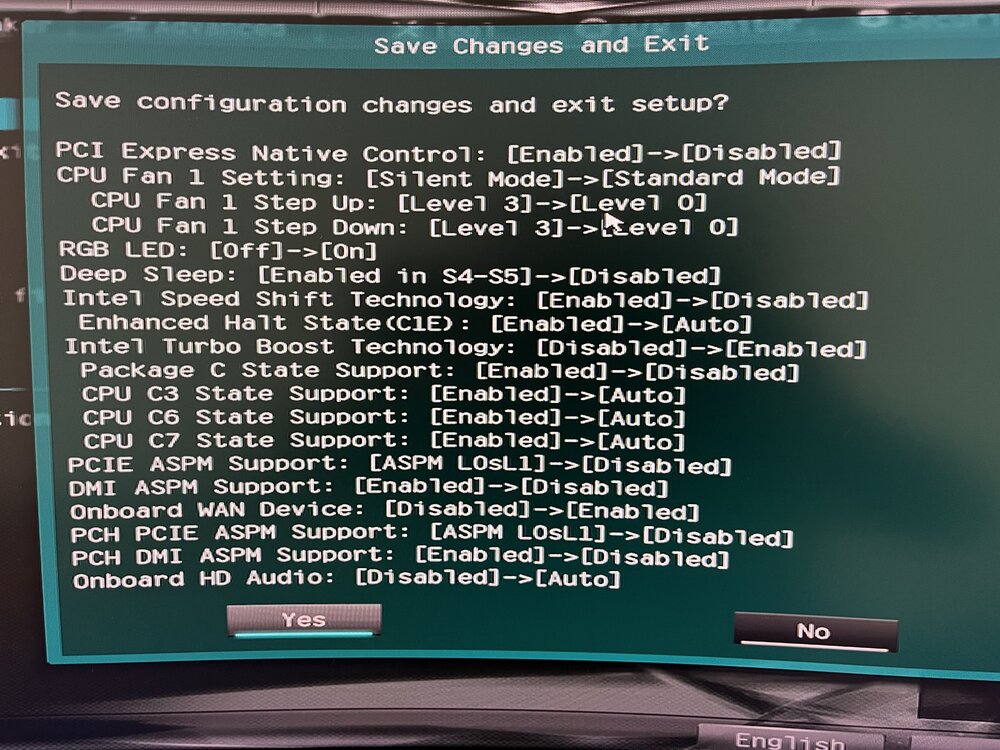
So, if anyone is still tuning into this thread and for that future somebody, the one bad apple setting was "DMI ASPM Support". For my setup, I must have this set to Disabled to restore full upload speeds. Curiously, I could keep the "PCH DMI ASPM Support" set to Auto (not disabled). All others were tested by process of elimination.
-
Thanks for trying to dig up what was causing the issue. Turns out there is a setting in the BIOS which was the culprit. I've resorted to loading optimized defaults and speeds are now as expected. From the pic, one of those settings created the less than desirable upload speeds. I will further test to determine which one exactly the network adapter didn't like.
-
No, no other MTU settings on the network have been changed from the default. I was just playing around with MTU values on Unraid to troubleshoot. I've seen other reports of moving MTU to 9000 helped.
-
No, upload, as in from the server to LAN/internet. This is too slow @ 35 MB (iperf/speedtests/SMB transfers). LAN to server is fast and expected. Yes, nvme drive as cache. As I mentioned above, moving the MTU from 1500 to 9000 almost doubles the upload speed, still not the full gig. So, likely something wonky with the driver or adapter or unraid, not sure.
-
Yeah, everything's wired up with cat5e on gigabit LAN. Live by myself, so no real congestion at all. Speeds tested across LAN (iperf and SMB transfer large file) and internet with docker speedtests, and all agree I'm seeing only ~35-40% of expected upload speeds on gigabit LAN, but downloads are at 100%. FWIW, internet is via fiber at 2 Gbit down and up. There is only one ethernet adapter on my server and have tried also with bonding turned off.
-
Perf3 over the LAN and various docker speedtests (over the internet) are aligned at an average of 350 Mb/s. A transfer from an SMB share over the LAN with a very large file fares a bit better at 45 MB/s. There's an upload bottleneck somewhere. Downloads are rock solid at about 940-950 Mb/s.
-
Thanks a lot - that did the trick. So you would suggest I'm asking for trouble moving MTU up to 9000? With that setting I'm able to almost double my upload speed. This begs the question as to why I receive only 1/3 the expected upload speed with MTU 1500. I've tried with multiple cat5e cables and testing them with a Windows machine. Ethernet hardware on Unraid: Intel Corporation Ethernet Connection (12) I219-V The following related drivers are in use e1000eIntel(R) PRO/1000 Network Driver In use net/ethernet/intel/e1000e e100Intel(R) PRO/100 Network Driver In use net/ethernet/intel e1000Intel(R) PRO/1000 Network Driver In use net/ethernet/intel/e1000
-
Hi all, was playing around with perf3 in order to diagnose issues with upload speeds and found that an MTU of 9000 (@600 Mb/s) works better than 1500 (@350 Mb/s), but still not quite the expected 950 Mb/s. So I decided to max out the MTU. Now, the server is no longer reachable. Is it safe to pull the USB and modify the network config on a Windows machine? And where could I find the value to modify? Thanks!