





DeltaAlphaOscar
Members
-
Joined
-
Last visited
-
I don't recall when the error counts started accumulating or at what rate. I've restarted the parity check to and will keep track now. Is it possible to see in the logs instances of when (and maybe where) the scan finds an error? (Live update as I'm writing this. The error count has increase by 1 in the last 40 minutes). No. Unraid has no idea which drive caused the problem. This is interesting that the sector location of errors isn't logged. What do people normally do when sync errors are detected? Do they just go on faith and let it Unraid correct what it thinks is out of sync? This is a small tangent but for data recovery purposes, HDDSCViewer (a data recovery program) can identify bad drive sectors and then output the files names that occupy those bad sectors. I know bad sectors and out-of-sync errors aren't the same and the HDDSCViewer is an advanced program (for which I'm also a novice at) for scanning a singular drive, but I'm ultimately curious what people do if they don't know what files might be bad. Thank you for this (especially). This puts me a little more at ease as I'm more certain my data drives are more correct (and current) than what's on my parity drive. Is the only time Unraid would write to a data drive is if it was rebuilding a drive? I read that a "small" amount of errors was normal, but I'm not sure the scale of "small" is. Before I determined my boot usb was dying, it had probably a dozen unclean shutdowns from when the last full/good (0 error) parity check/sync was done. So I'm not sure if every one of those instances cause a number of "small" errors to occur.
-
I booted up my server for the first time in a long while and it started by running a parity check. After about 12ish hours, I returned and noticed that there was 2894 for Sync errors corrected. This is after getting through 7.9TB / 14TB. The parity check is now paused. Is there a way to see where the errors occurred and what files were "corrected"? In my parity check scheduler, I have the "write corrections to parity disk" set to No, yet the manual trigger must've automatically set it to correct errors. Does this update parity data, or does it change the data to match the parity? Can someone point me to documentation for what the "correction" process is? I know/understand that the ideal error count is 0, but what should I do at this point when (1) the parity check has already started, found, and corrected many errors (2) general what next question? Additional Background Info: Running Unraid 7.1.4, my array is 6x14TB drives (5 disk + 1 parity). My cache is a 500GB Samsung SSD. My boot USB is a 16GB DataTraveler. I built my server mostly as a set-it-and-forget-it system. Parity checks run every 3 months. To date, looking the the Parity Operation History, it has turned up 0 errors. After a move to a new home, my server sat powered for a couple of years. I started up my server earlier this year, and with seldom access/use noticed it was having issues almost every time I needed to use it. The issues leas to many unclean shutdowns. Recently I've diagnosed that the usb boot drive (was previously dying) is now dead. I've gone through the process of getting Unraid back up and running (posted on reddit actually cause I forgot this forum existed). The config files that I was able to recover are from January, but as I said, I haven't really used it much this year so there shouldn't have been much (or any) config changes. I've attached my diagnostics file in case that is useful. If there's something specific you're seeing, please do let me know so I can learn where to look and what to look for. Thanks in advanced! diagnostics-20251015-2213.zip
-
I posted this over at the Plex forums but I'm fairly new to both Unraid and Plex, so I'm not sure where I'll find better technical support. Unraid Version#: 6.8.2 Plex Server Version#: 1.18.6.2368 Docker: plexinc/pms-docker I’m trying to figure out why I have such huge disk reads ~180MB/s for several hours at a time. See image below for the large orange rectangle. Here are some of my observations. I’m 99% sure it’s Plex/Docker related because that dip in the right side of the disk usage and processor usage (~16h30) was when I ‘paused’ the docker. When I restart the docker, it starts to behave normally again. I’m pretty sure that it’s not related to scheduled tasks as my setting are fairly minimal AND only suppose to occur between 02h00 and 05h00. It’s not a parity check, I haven’t even set up my parity drive yet. No one is using it at that time (no one is home), and I’ve checked with current activity through plex as well as active streams through Unraid. Could this have something to do with the amount of RAM cached at that time? The time frame for when it reaches it’s max appears to be the same. Please help. I would really like to avoid undue wear on my HDDs and heat from the extra CPU usage. TIA!
-
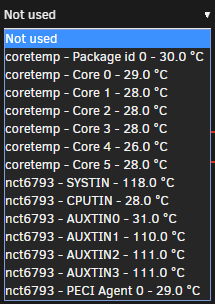
I've got a question to which I think that answer is a faulty sensor but thought I'd post here to see if anyone has other suggestions. I followed SpaceInvader One's guide for installing everything and this is what I'm seeing. Which ones should I be selecting for the CPU and motherboard temperatures? The CPU ones are close enough that it seems I should just be using "coretemp - Package id 0," right? The other values for the values for the motherboard temperature is where I'm more confused. I used to think that SYSTIN was the motherboard temperature but it's showing as 118 degrees. That can't be right. Pretty sure my rig wouldn't be running for a long as it has it's at 118 degrees. Also AUXTIN is my power supply right? There's something weird going on there right? There are 3 values over 100 and AUXTIN0 at 31 degrees. This may or not be related but of my three fan headers (1 cpu & 2 case), one of the fans is highly erratic. The CPU fan 1 governed but the CPU temp, and the other two fans are governed but the motherboard temp. The profiles (quiet, perfomance,...) are the same for all of them. One of the motherboard fans runs pretty steady at ~950rpm, but the other ranges anywhere from 1,400rpm to 70,000+rpm (I did not mistype this number). Any help would be greatly appreciated. My build on PCPP. Unraid v6.8.2 Dynamix System Temperature v2019.11.03
-
@Frank1940, In these forums, is there anymore to it than just adding [SOLVED] to the title, or is there way to tag/flair it as solved.
-
Thanks to everyone that tried to help out. I tried many other flash drive to finally find one that works. 2 out of 11 flash drives worked. I could've stopped after the first one worked, but was curious so I tested all I had access to. None of the Unraid recommended ones worked on my new build. All of them worked on my on my off-the-shelf Dell Inspiron. What I've learned is that even if a drive boots on one computer, that it won't necessarily work in others. If a mod wouldn't mind tagging this as resolved, that'd be great!
-
@limetech, 99.9% the volume is named "UNRAID" I've used both manual method and the installer, and in all instances, the volume is labeled correctly when I looking in disk management. Hard to believe that the installer would incorrectly label it. I'll try that command when I get home. I'm also going to stop by Best Buy and get a few of the recommended drives to try out.
-
@limetech, I get this below: mount: /boot: special device /dev/disk/by-label/UNRAID does not exist.
-
@Frank1940, I tried all ports both USB2.0 & USB3.0.
-
@Frank1940, I tried to run the diagnostics and this time, I didn't get the invalid command comment because I remembered the "s". It seemingly did it's thing. BUT there wasn't a log folder created... @limetech, I mentioned in my post that I tried using both the installer as well as doing it manually. It's always "UNRAID" and is always formatted FAT32. The USB (DTSE9-G2) worked on the Dell I mentioned. This is what makes me think it should be fine(?). But alas I did manage to find another spare no-name USB last night and I got the same issues. Thoughts?
-
Upon reading some other posts to try to troubleshoot this myself, I can access the GUI after logging in as root. This isn't my image, but it's what comes up after logging in. In the 'start' menu, I had access to the console/terminal/command line but when typing in diagnostics, it says something along the lines of it not being a valid command. I'm not at (home) my server at the moment so I might not have the exact phraseology. After rereading your post @Frank1940, I may not have had the 's' at the end of diagnostics when I was troubleshooting last night...
-
TL:DR: I can't get assigned a valid IP when starting UNRAID This is my server build: PCPP link. I'm trying to run v6.8.1 (Trial version if that matters) My issues: I'm not getting a valid IP, the only thing I'm getting is "IPv4 address: 169.254.222.203" and "IPv6 address: not set" I'm getting the "FATAL: Module bonding not found in directory /lib/modules/4.19.94-unRAID Cannot find device "bond0" " I was also getting some issues about finding directories, something something "/dev/disk/by-label/UNRAID" Things I've done: I've used the installer, so it should name and format my drive correctly. "UNRAID" and FAT32 Prior to trying to run Unraid on Node 304 (before I got all my components) I was able to run Unraid successfully on an old Dell Inspiron. I got a head-start pre-clearing some 12TB Easystores. Same USB Same installer Same network cable and router I haven't booted up anything else on the Node 304 but I was able to successfully check for BIOS update with the Ethernet plugged in to make sure I had up to date BIOS and that the internet was working. I've tried every USB port (2.0 and 3.0) I don't have any USB drives not in use, so I haven't been able to try others yet. But the one I using should work because it working on my Dell. On thing that is weird is that it's a USB3.0 drive but it's only recognized on USB 2.0 port. Not just during boot, I'm talking through the Window's Explorer I'm a major noob just getting into the server world.
