ilium007
Members
-
Joined
-
Last visited
Everything posted by ilium007
-
I feel like such an idiot. Chased my tail, installed TrueNAS and got exactly the same transfer speed. Went looking at router and found an incorrectly configured fqcodel queue (to limit Australian NBN upload speeds) that was limiting to 48mbps. I’ll reinstall unRaid now. 🤦♂️
-
I was testing with the one file here to maintain like for like conditions.
-
Diagnostics generated while copying a single 2.44GB file. This is the only file operation at present. Going to nuke the system after this test and install TrueNAS and see what that experience is like. Hopefully I can sort Unraid out because I like its feature set but can't pay for 5.95MB/sec file copies. unraid01-diagnostics-20251027-2130.zip
-
rsync -avh --progress /tank/backup/media/ [email protected]:/mnt/user/MEDIA
-
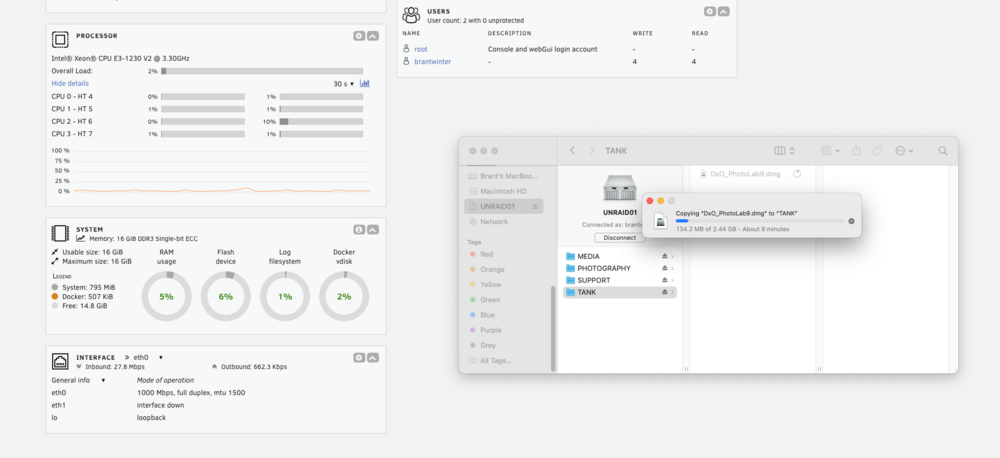
Single file copy via SMB when I saw 5.9MB/sec This was the only file operation at the time The MACOSX is there because when I downloaded the diagnostics.zip Safari automatically unzipped it, I just zipped it back up to post here Yes, running Unraid on bare metal
-
But 5.9MB/sec?? Even on this old hardware? I'll do another file copy and generate the diagnostics. Cheers.
-
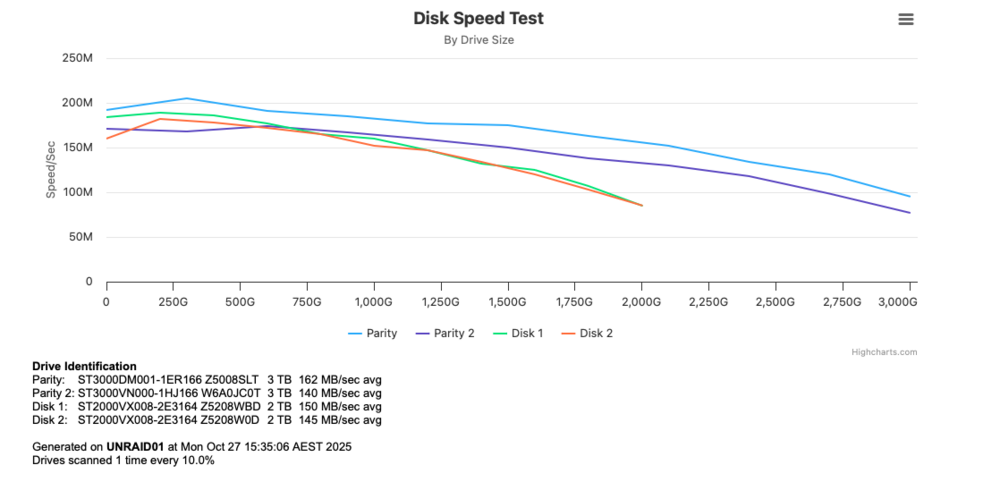
I ran the disk speed shell script (found on this forum) and got the following: I am about to wipe the machine and install TrueNAS to see if I c an get more than 5.9MB/sec across the network.
-
So parity sync finished overnight and I have attempted to copy the same 2.44GB file, same as with the SMR parity drives, 7min. Thats 5.9MB/sec across 1Gb wired connection via SMB.
-
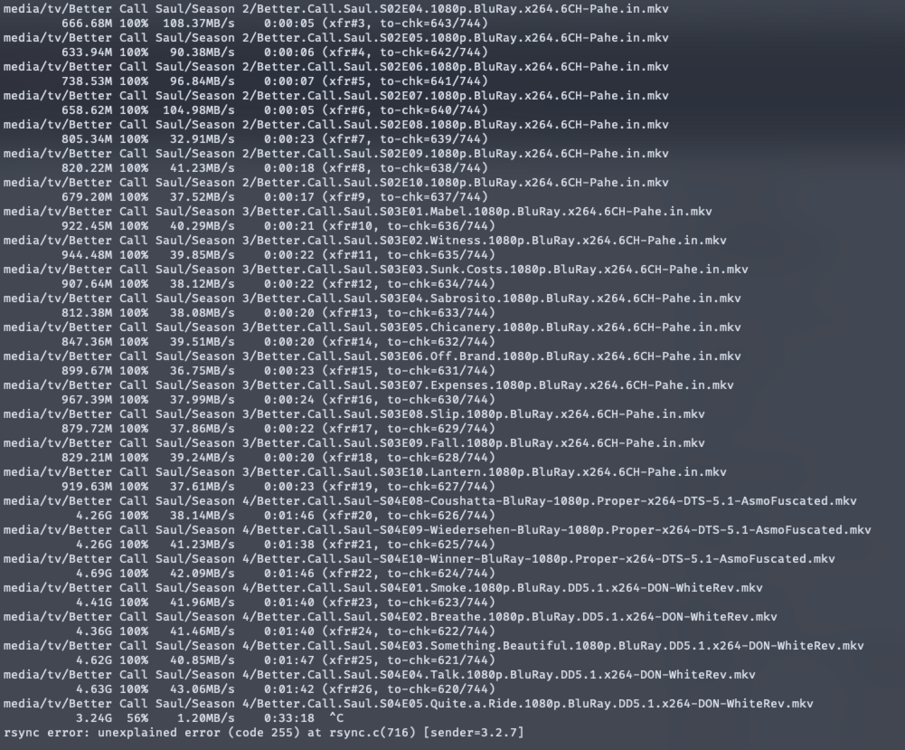
I'm currently waiting for the parity to re-sync but I tried a SMB file copy during the re-sync and it was just as slow. I then tried rsync (during parity re-sync) and it maintained 110MB/s transfer initially and then dropped to 38MB/s for a 50G file.
-
I meant I've got it on with the CMR drives I put in.
-
Is that "Tunable (md_write_method): reconstruct write"? I have that enabled already.
-
I found a couple of 3TB CMR drives and replaced the 4TB SMR parity drives, I'll see if this makes any difference.
-
Do you think 4 x matching CMR drives such as the Seagate Ironwolfs or WD RED's would make this perform at 1GB wire speed? I am thinking of keeping 2 x parity and have the other 2 in a mirror. I have the HBA card so was going to add 2 x 1TB SSD's in a cache mirror.
-
Drives: root@UNRAID01:~# lsblk NAME MAJ:MIN RM SIZE RO TYPE MOUNTPOINTS loop0 7:0 0 579.8M 1 loop /usr loop1 7:1 0 169.8M 1 loop /lib sda 8:0 1 14.8G 0 disk └─sda1 8:1 1 14.8G 0 part /boot sdb 8:16 0 1.8T 0 disk sdc 8:32 0 1.8T 0 disk sdd 8:48 0 3.6T 0 disk └─sdd1 8:49 0 3.6T 0 part sde 8:64 0 3.6T 0 disk └─sde1 8:65 0 3.6T 0 part md1p1 9:1 0 1.8T 0 md /mnt/disk1 md2p1 9:2 0 1.8T 0 md /mnt/disk2 root@UNRAID01:~# Drive tests: /dev/sdb root@UNRAID01:~# for ((i=0;i<12;i++)); do hdparm -tT /dev/sdb; done /dev/sdb: Timing cached reads: 23112 MB in 1.99 seconds = 11610.38 MB/sec Timing buffered disk reads: 508 MB in 3.08 seconds = 164.89 MB/sec /dev/sdb: Timing cached reads: 22932 MB in 1.99 seconds = 11521.78 MB/sec Timing buffered disk reads: 516 MB in 3.03 seconds = 170.25 MB/sec /dev/sdb: Timing cached reads: 23642 MB in 1.99 seconds = 11877.73 MB/sec Timing buffered disk reads: 476 MB in 3.05 seconds = 155.89 MB/sec /dev/sdb: Timing cached reads: 22258 MB in 1.99 seconds = 11179.74 MB/sec Timing buffered disk reads: 508 MB in 3.03 seconds = 167.58 MB/sec /dev/sdb: Timing cached reads: 21108 MB in 1.98 seconds = 10643.01 MB/sec Timing buffered disk reads: 508 MB in 3.02 seconds = 168.05 MB/sec /dev/sdb: Timing cached reads: 21766 MB in 1.99 seconds = 10931.32 MB/sec Timing buffered disk reads: 508 MB in 3.02 seconds = 168.14 MB/sec /dev/sdb: Timing cached reads: 18950 MB in 1.99 seconds = 9512.16 MB/sec Timing buffered disk reads: 510 MB in 3.03 seconds = 168.19 MB/sec /dev/sdb: Timing cached reads: 23106 MB in 1.99 seconds = 11607.62 MB/sec Timing buffered disk reads: 508 MB in 3.03 seconds = 167.61 MB/sec /dev/sdb: Timing cached reads: 23374 MB in 1.99 seconds = 11742.88 MB/sec Timing buffered disk reads: 508 MB in 3.03 seconds = 167.65 MB/sec /dev/sdb: Timing cached reads: 20226 MB in 1.99 seconds = 10183.63 MB/sec Timing buffered disk reads: 476 MB in 3.07 seconds = 155.11 MB/sec /dev/sdb: Timing cached reads: 22636 MB in 1.99 seconds = 11371.44 MB/sec Timing buffered disk reads: 508 MB in 3.03 seconds = 167.61 MB/sec /dev/sdb: Timing cached reads: 23186 MB in 1.99 seconds = 11649.15 MB/sec Timing buffered disk reads: 508 MB in 3.03 seconds = 167.62 MB/sec /dev/sdc root@UNRAID01:~# for ((i=0;i<12;i++)); do hdparm -tT /dev/sdc; done /dev/sdc: Timing cached reads: 19922 MB in 1.99 seconds = 10001.89 MB/sec Timing buffered disk reads: 476 MB in 3.18 seconds = 149.52 MB/sec /dev/sdc: Timing cached reads: 23178 MB in 1.99 seconds = 11643.34 MB/sec Timing buffered disk reads: 476 MB in 3.03 seconds = 156.99 MB/sec /dev/sdc: Timing cached reads: 23110 MB in 1.99 seconds = 11609.70 MB/sec Timing buffered disk reads: 476 MB in 3.03 seconds = 156.99 MB/sec /dev/sdc: Timing cached reads: 21958 MB in 1.98 seconds = 11095.45 MB/sec Timing buffered disk reads: 476 MB in 3.01 seconds = 157.90 MB/sec /dev/sdc: Timing cached reads: 18694 MB in 1.99 seconds = 9384.57 MB/sec Timing buffered disk reads: 476 MB in 3.04 seconds = 156.43 MB/sec /dev/sdc: Timing cached reads: 19246 MB in 1.99 seconds = 9661.22 MB/sec Timing buffered disk reads: 476 MB in 3.07 seconds = 154.85 MB/sec /dev/sdc: Timing cached reads: 22628 MB in 1.99 seconds = 11367.02 MB/sec Timing buffered disk reads: 476 MB in 3.03 seconds = 157.01 MB/sec /dev/sdc: Timing cached reads: 23352 MB in 1.99 seconds = 11735.59 MB/sec Timing buffered disk reads: 476 MB in 3.03 seconds = 157.02 MB/sec /dev/sdc: Timing cached reads: 21758 MB in 1.99 seconds = 10927.31 MB/sec Timing buffered disk reads: 476 MB in 3.03 seconds = 156.96 MB/sec /dev/sdc: Timing cached reads: 23116 MB in 1.99 seconds = 11613.29 MB/sec Timing buffered disk reads: 476 MB in 3.03 seconds = 157.03 MB/sec /dev/sdc: Timing cached reads: 22242 MB in 1.99 seconds = 11172.90 MB/sec Timing buffered disk reads: 476 MB in 3.03 seconds = 157.00 MB/sec /dev/sdc: Timing cached reads: 22696 MB in 1.99 seconds = 11402.18 MB/sec Timing buffered disk reads: 476 MB in 3.02 seconds = 157.51 MB/sec /dev/sdd root@UNRAID01:~# for ((i=0;i<12;i++)); do hdparm -tT /dev/sdd; done /dev/sdd: Timing cached reads: 22292 MB in 1.99 seconds = 11196.88 MB/sec Timing buffered disk reads: 508 MB in 3.17 seconds = 160.48 MB/sec /dev/sdd: Timing cached reads: 23088 MB in 1.99 seconds = 11601.30 MB/sec Timing buffered disk reads: 508 MB in 3.05 seconds = 166.51 MB/sec /dev/sdd: Timing cached reads: 19742 MB in 1.99 seconds = 9942.95 MB/sec Timing buffered disk reads: 516 MB in 3.00 seconds = 171.99 MB/sec /dev/sdd: Timing cached reads: 23042 MB in 1.99 seconds = 11579.69 MB/sec Timing buffered disk reads: 508 MB in 3.01 seconds = 168.93 MB/sec /dev/sdd: Timing cached reads: 22818 MB in 1.99 seconds = 11462.93 MB/sec Timing buffered disk reads: 508 MB in 3.00 seconds = 169.06 MB/sec /dev/sdd: Timing cached reads: 22794 MB in 1.99 seconds = 11449.93 MB/sec Timing buffered disk reads: 508 MB in 3.03 seconds = 167.51 MB/sec /dev/sdd: Timing cached reads: 23666 MB in 1.99 seconds = 11890.17 MB/sec Timing buffered disk reads: 508 MB in 3.02 seconds = 168.43 MB/sec /dev/sdd: Timing cached reads: 22786 MB in 1.99 seconds = 11447.08 MB/sec Timing buffered disk reads: 508 MB in 3.16 seconds = 160.72 MB/sec /dev/sdd: Timing cached reads: 23010 MB in 1.99 seconds = 11559.23 MB/sec Timing buffered disk reads: 508 MB in 3.01 seconds = 169.04 MB/sec /dev/sdd: Timing cached reads: 23348 MB in 1.99 seconds = 11729.61 MB/sec Timing buffered disk reads: 508 MB in 3.01 seconds = 168.60 MB/sec /dev/sdd: Timing cached reads: 22870 MB in 1.99 seconds = 11488.35 MB/sec Timing buffered disk reads: 508 MB in 3.01 seconds = 169.02 MB/sec /dev/sdd: Timing cached reads: 22928 MB in 1.99 seconds = 11517.88 MB/sec Timing buffered disk reads: 508 MB in 3.01 seconds = 169.02 MB/sec /dev/sde root@UNRAID01:~# for ((i=0;i<12;i++)); do hdparm -tT /dev/sde; done /dev/sde: Timing cached reads: 22814 MB in 1.99 seconds = 11462.22 MB/sec Timing buffered disk reads: 540 MB in 3.03 seconds = 178.45 MB/sec /dev/sde: Timing cached reads: 22130 MB in 1.99 seconds = 11115.49 MB/sec Timing buffered disk reads: 540 MB in 3.03 seconds = 178.03 MB/sec /dev/sde: Timing cached reads: 22838 MB in 1.99 seconds = 11472.04 MB/sec Timing buffered disk reads: 540 MB in 3.02 seconds = 178.56 MB/sec /dev/sde: Timing cached reads: 23022 MB in 1.99 seconds = 11564.79 MB/sec Timing buffered disk reads: 508 MB in 3.01 seconds = 168.95 MB/sec /dev/sde: Timing cached reads: 14982 MB in 1.99 seconds = 7520.68 MB/sec Timing buffered disk reads: 564 MB in 3.04 seconds = 185.81 MB/sec /dev/sde: Timing cached reads: 23094 MB in 1.99 seconds = 11602.13 MB/sec Timing buffered disk reads: 540 MB in 3.00 seconds = 179.88 MB/sec /dev/sde: Timing cached reads: 22848 MB in 1.99 seconds = 11478.10 MB/sec Timing buffered disk reads: 540 MB in 3.01 seconds = 179.33 MB/sec /dev/sde: Timing cached reads: 21562 MB in 1.98 seconds = 10892.19 MB/sec Timing buffered disk reads: 558 MB in 3.00 seconds = 185.98 MB/sec /dev/sde: Timing cached reads: 22582 MB in 1.98 seconds = 11413.69 MB/sec Timing buffered disk reads: 540 MB in 3.04 seconds = 177.39 MB/sec /dev/sde: Timing cached reads: 21492 MB in 1.99 seconds = 10794.66 MB/sec Timing buffered disk reads: 540 MB in 3.01 seconds = 179.35 MB/sec /dev/sde: Timing cached reads: 23360 MB in 1.99 seconds = 11738.00 MB/sec Timing buffered disk reads: 532 MB in 3.00 seconds = 177.31 MB/sec /dev/sde: Timing cached reads: 22986 MB in 1.99 seconds = 11547.01 MB/sec Timing buffered disk reads: 540 MB in 3.03 seconds = 177.97 MB/sec root@UNRAID01:~#
-
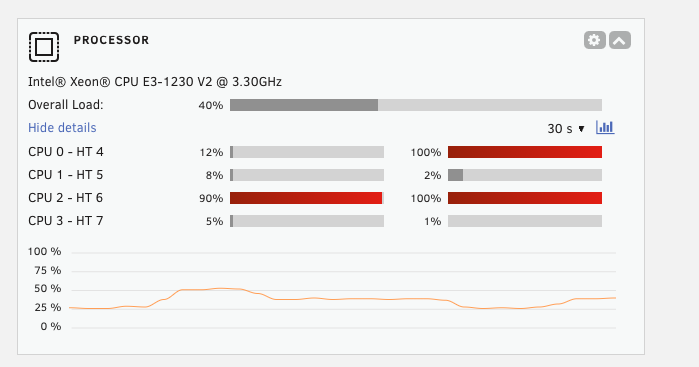
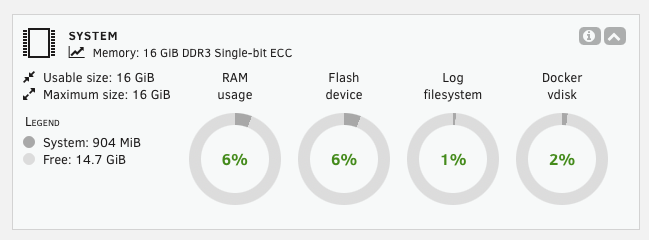
I have a HP Microserver Gen 8 with a Xeon E3-1230 V2 CPU & 12GB RAM. 2 x 4TB parity drives and 2 x 2TB array drives all connected to a LSI 9205-8i with active cooling. No cache yet, I am just trying to get a copy of my data on to the box so I can start testing Unraid again. Diagnostics zip attached. I have enabled "reconstruct write" as mentioned in some of the forum posts but I don't think it has made a difference. I am copying from my backup box via rsync: rsync -avh --progress /tank/backup/media/ [email protected]:/mnt/user/MEDIA I see the transfer speeds from over 100MB/sec to 1MB/sec - nothing else is happing on the system part from the remote file copy. CPU is also spiking: Heaps of free RAM: unraid01-diagnostics-20251026-1309.zip
-
Not sure what’s going on but when I click the purchase licence button off the main website I see it attempt to visit a long url then I get this:

-
Disregard - setting an ENV variable TZ=Australia/Brisbane fixed it.
-
How do we set the timezone? You Dockerfile installs tzdata but it does not seem to be installed in the docker container? I want to schedule using local time.
-
Got it - thanks. I was having issue bind mounting the file in Unraid but after I removed and recreated the container it worked.
-
Is /mnt/user/appdata/resticprofile/crontab supposed to be a bind mounted directory with crontab files inside or is /mnt/user/appdata/resticprofile/crontab a crontab file mounted at /crontab inside the container?
-
Perfect - thanks!
-
Do you have some examples on how to configure this? I have used resticprofile for a long time but always use its builtin scheduling. The dockerfile seems to override the normal entrypoint and just runs crond. I have resticprofile running fine inside the container with the passed in profiles.yaml and my key so no issues with restic / resticprofile. How do I schedule resticprofile to run daily?
-
It seems to be working now. Changes: Re-instated the br0.50 custom bridge Added Unraid br0.50 shim address (192.168.50.2) to the Caddy reverse proxy upstream Allocated all Docker containers unique 192.168.50.0/24 IPs Unraid UI via reverse proxy now seems to be fine. I had really hoped to be able to use the default bridge so I didn't have to expose all ports on every container but the default bridge (for some reason) does not allow internal Docker DNS so I couldn't use container names in the Caddy reverse proxy upstreams config. I tested Caddy reverse proxy to Unraid UI using default bridge and that worked fine as well, it seems the issue was when setting the reverse proxy upstream to an IP in a different subnet.
-
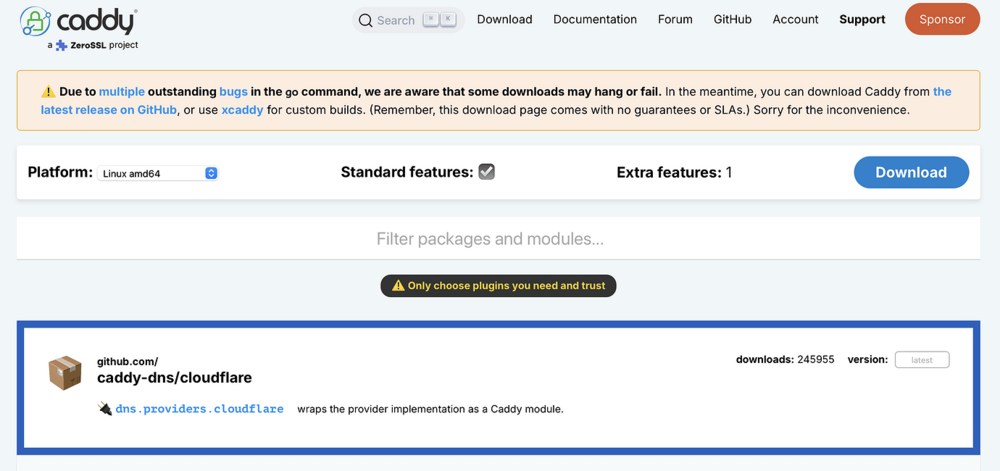
I am a few days into my Unraid trial and have moved all my containers and VM's from Proxmox into my Unraid server. I have never had an issue with network performance or computer power out of the Xeon Dell host (32GB ECC RAM, 6 x 1TB NAS HDD for the array and 2 x 2TB enterprise SSD cache). I moved all of my Docker containers that used to be hosted on a Debian VM on Proxmox to native containers on Unraid and they all work fine apart from one, my Caddy reverse proxy. I have configured Unraid with a VLAN (id 50) that I was going to use for Docker containers as I found out the hard way that the default Bridge configuration does not allow containers to look up each other by container name ie. Docker DNS. The Docker containers use the custom bridge (br0.50) and I assign them static IP's (192.168.50.0/24 subnet) - this seems to work fine and they can look each other up by container name. All the containers seem to work fine apart from Caddy but only the reverse proxy of the Unraid UI itself which I have set up in the container. The Caddy server UI is on another VLAN, VLAN10, and has the IP address 192.168.10.10. It can route traffic to the 192.268.50.0 app subnet fine and visa-versa. From the command line of the Caddy docker container I can access the Unraid UI via wget and ICMP ping. When I try to browse to the Unraid UI via the reverse proxy I get lag of between 15s and 45s on every wss:// call ie. the 'Main' page when web sockets is loading the array page or the Docker page when its loading containers. I assume there will be issue on any web sockets backend that Caddy is reverse proxying. Now.... I do not want to use SWAG or Nginx Proxy Manager. Been there, done that and I use Caddy for various reasons including the fact it is awesome. The Caddy Docker container is not an official 'App', it is a custom container using my packaged version of Caddy (https://github.com/ilium007/caddy-microtech) which is simply Caddy built with an extremely popular module (plugin) named github.com/caddy-dns/cloudflare. This enables Caddy to do auto SSL cert management via Cloudflare DNS verification. Its worked fine for me for years at multiple sites including customer sites I manage on Proxmox. As a test I shut down all Docker containers and disabled on the Unraid box and downloaded the Linux amd64 Caddy binary with the exact same Cloudflare module included (you can do this on the Caddy website) and ran it from the Unraid root home directory and pointed at the exact same Caddy config file (Caddyfile) that the Docker container was running and guess what? The Caddy reverse proxy worked perfectly with the Unraid UI. This tells me the Caddy and WSS / web sockets works fine out of the box. So where is the issue? My Caddy Docker container (https://github.com/ilium007/caddy-microtech/pkgs/container/caddy-cloudflare) or the custom bridge (br0.50) or somewhere totally unrelated. I really want Unraid to work for me but I need web sockets reverse proxy support out of the Caddy reverse proxy container. Caddy with the Cloudflare module downloaded from Caddy website that worked fine: