





bisk
Members
-
Joined
-
Thanks. I installed the three Next plugins from your GitHub and I was able to format the drives now. More out of curiosity, but will these Next plugins replace the Unassigned Devices plugins listed in Community Applications?
-
Thanks for looking into this. I’m assuming I just need to wait for the next version of the UD plugin to be published?
-
I have an Intel Optane drive that I just installed in my system, but when I tried to format it it failed saying to check the SYSLOG. I collected up a diagnostic before shutting down the system to try installing it in another and it worked perfectly fine in that one. I have tried a different M.2 slot on my motherboard as well as a PCI to NVME riser and it failed in both of those. I’ve attached the diagnostic file and hopefully something jumps out as the issue. homeserver-diagnostics-20260708-1529.zip
-
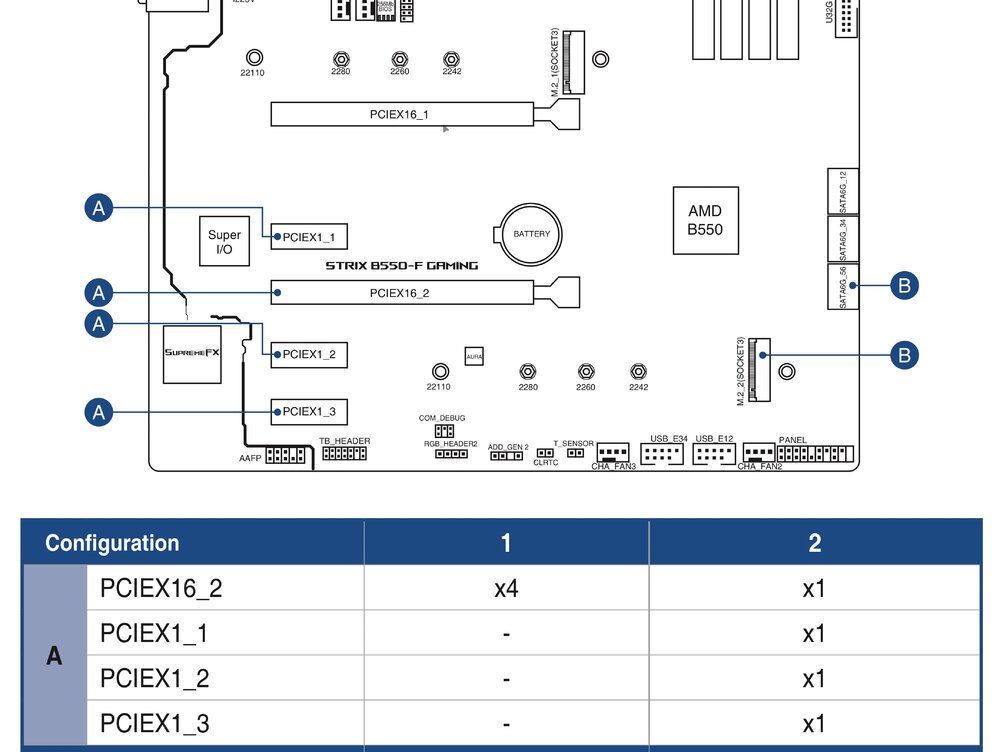
So I think I’ve got everything sorted out. I initially had the graphics card in PCIEX16_1 and the LSI HBA in PCIEX16_2. As soon as I added anything into any of the PCIEX1_x slots, then PCIEX16_2 will change from x4 to x1. Since I’m only using the video card for transcoding, I swapped the slots that it and the HBA are installed in and now my parity calculation is running nicely at about 170-180MB/s with the NVME risers in PCIEX1_1 and PCIEX1_3 (PCIEX1_2 is blocked since the video card is a double height card).
-
So none of the replacement cards have worked. I’ve tried putting the Optane drives in as well as NVME drives and they all kill the parity calculation speeds. I even installed the cards without a drive installed and that even had the same affect. I’m at a loss as to why this is happening. The BIOS on my motherboard has also been updated to the most recent version. Any other thoughts on what I can try or what might be causing the issue?
-
I’m leaning toward the issue being with the PCIe to NVME cards (https://www.amazon.ca/dp/B09P3HY3P3?ref=ppx_yo2ov_dt_b_fed_asin_title) since the performance improves when they’re no longer installed and as soon as I add even one the performance tanks. I’ve ordered different ones from Amazon to try. Fingers crossed they work. If they don’t, then I’ll try a SATA to NVME cards instead.
-
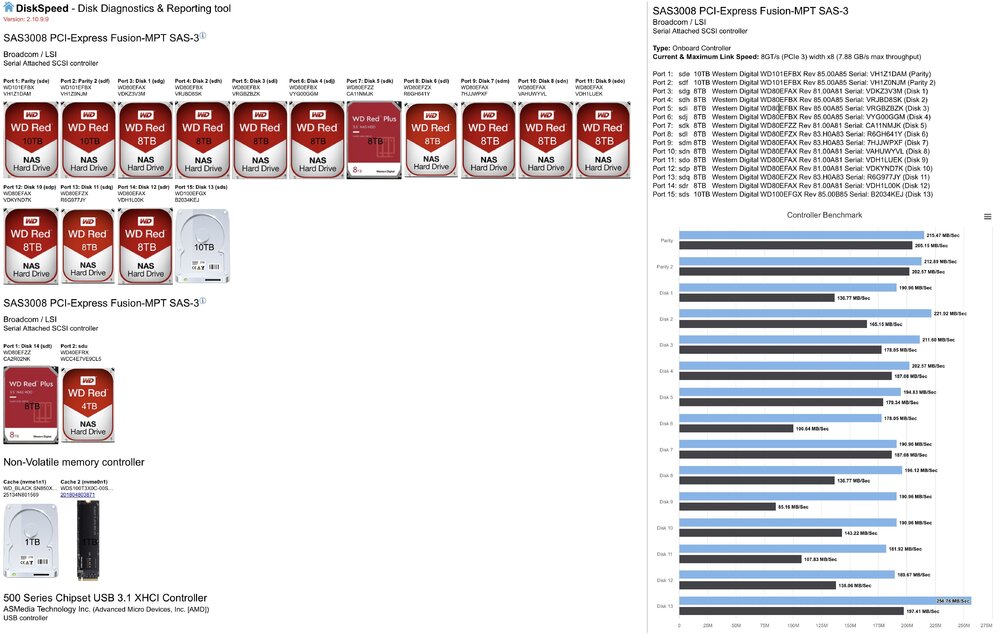
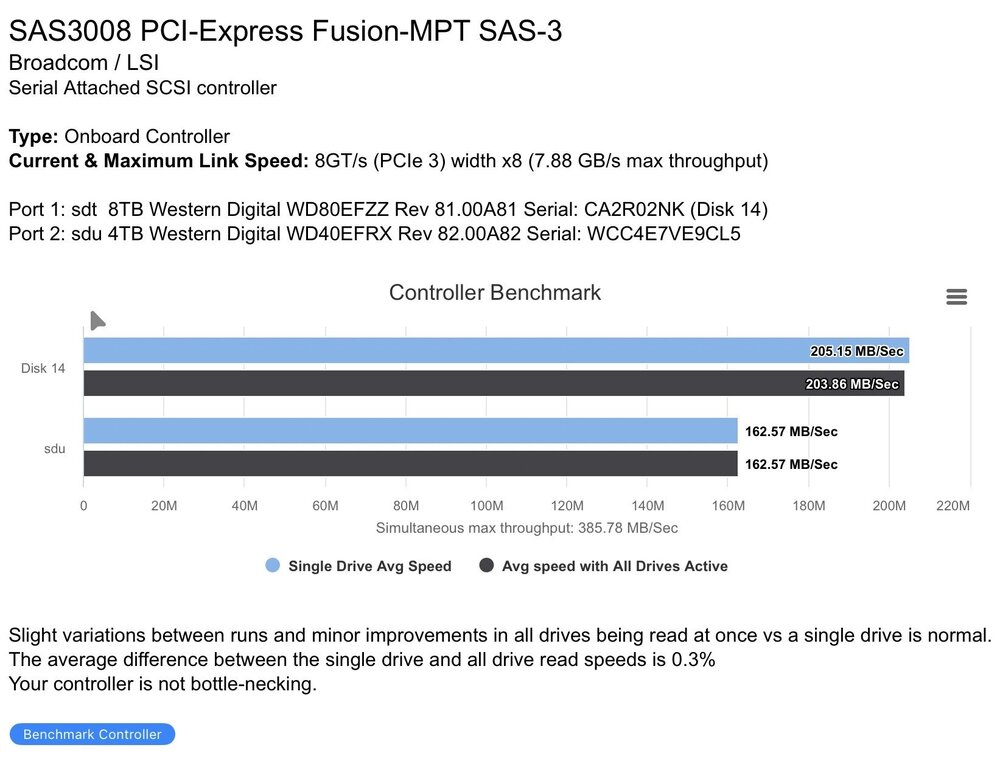
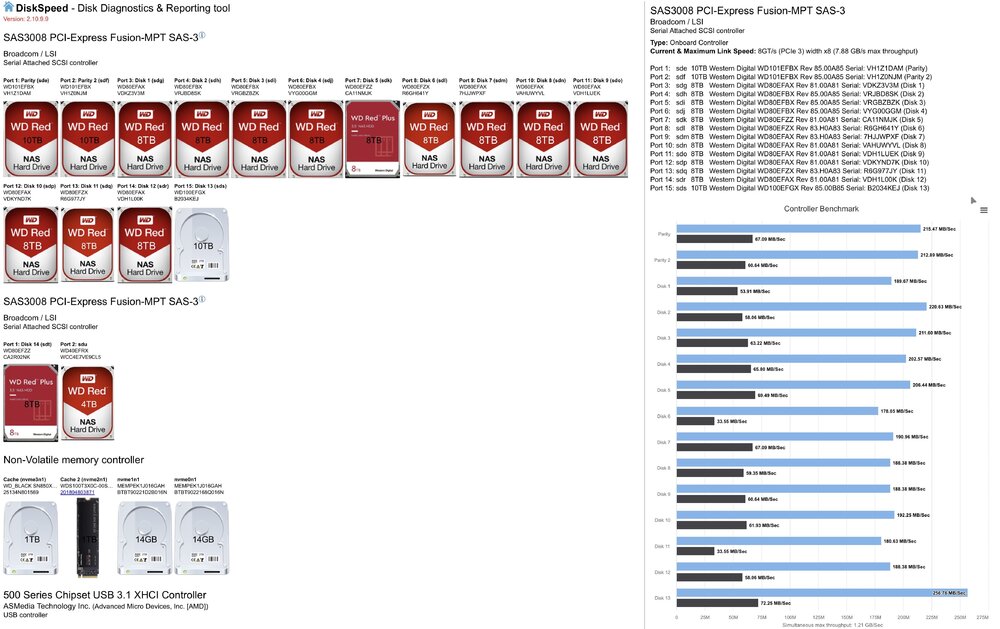
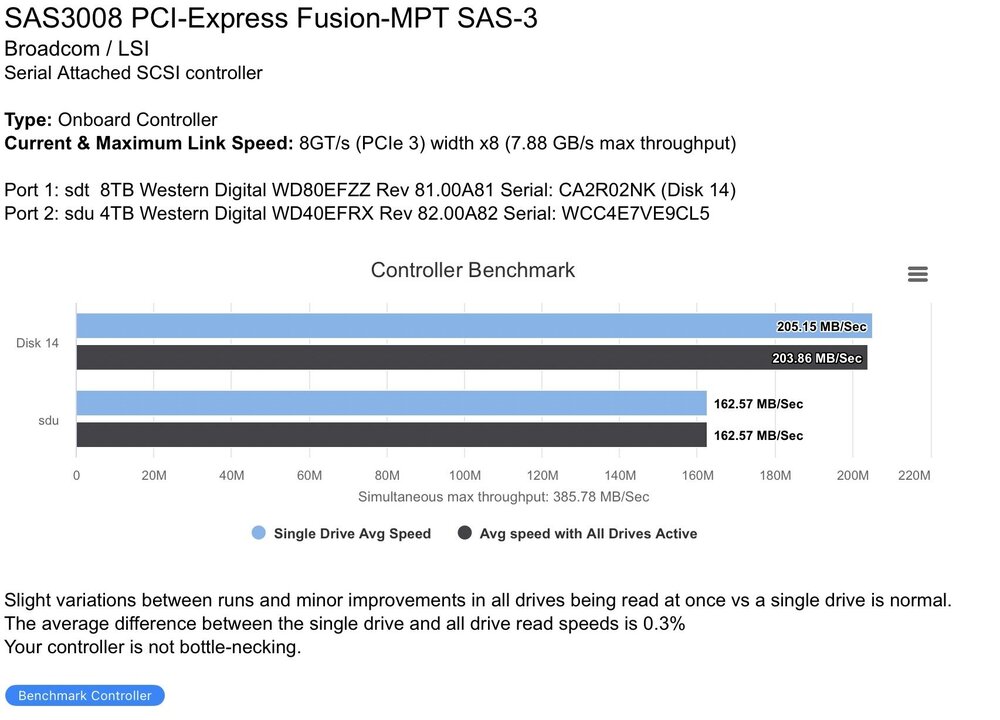
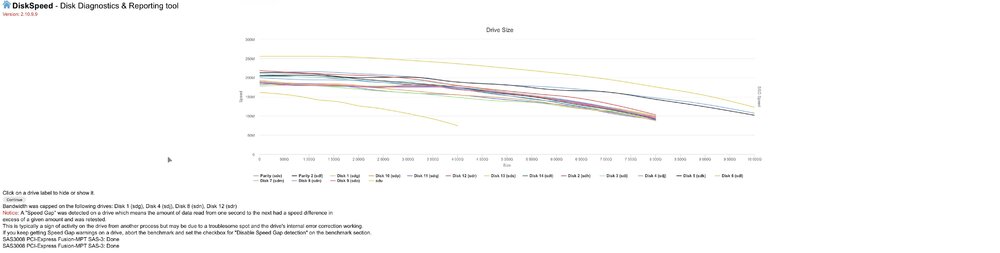
I’m finding it odd as well. I did some benchmarking on the controllers. The only difference between the two sets are with and without the Optane drives installed in the PCIe x1 cards. These first two screenshots are without the two Optane drives installed These next two screenshots are with the Optane drives installed
-
In the Docker configuration, change the Repository setting from jbartlett777/diskspeed to jbartlett777/diskspeed:2.10.9
-
I installed the Disk Speed docker and ran the benchmark on all of the drives and all reported the correct full speeds. So I decided to remove the two Optane drives that are on PCIe x1 to NVME cards and now the parity calculation runs at the 140MB/s speed that I was previously seeing. So I’m assuming this means that I don’t have sufficient PCIe lanes to support all of the devices at full speeds?
-
I just installed this docker, but when I click on Benchmark Drives or if I try to benchmark a single drive I’m receiving the error below. I tried removing the docker, the data folder and reinstalling, but that didn’t resolve the issue. I forced the docker to use 2.10.9 and I am able to benchmark the drives now, so this looks like an issue with 2.10.10. Lucee 6.1.1.75-SNAPSHOT Error (expression) Message key [ISSSD] doesn't exist Stacktrace The Error Occurred in /var/www/Benchmark.cfm: line 106 104: <CFSET PortNo=Ref.DriveID[DriveID].PortNo> 105: <!--- Check to see if the drive is the first in the pool (no number at end of unraid slot src), and leave in if so ---> 106: <CFIF HW[Key].Ports[PortNo].IsSSD EQ 1 AND IsNumeric(Right(HW[Key].Ports[PortNo].UnraidSlotSrc,1))> 107: <CFSET PoolSSDChildren=ListAppend(PoolSSDChildren,DriveID)> 108: </CFIF> Java Stacktrace lucee.runtime.exp.ExpressionException: key [ISSSD] doesn't exist at lucee.runtime.type.util.StructSupport.invalidKey(StructSupport.java:70) at lucee.runtime.type.StructImpl.get(StructImpl.java:179) at lucee.runtime.util.VariableUtilImpl.get(VariableUtilImpl.java:279) at lucee.runtime.PageContextImpl.us(PageContextImpl.java:1253) at benchmark_cfm$cf.call(/Benchmark.cfm:106) at lucee.runtime.PageContextImpl._doInclude(PageContextImpl.java:1046) at lucee.runtime.PageContextImpl._doInclude(PageContextImpl.java:940) at lucee.runtime.listener.ClassicAppListener._onRequest(ClassicAppListener.java:63) at lucee.runtime.listener.MixedAppListener.onRequest(MixedAppListener.java:42) at lucee.runtime.PageContextImpl.execute(PageContextImpl.java:2725) at lucee.runtime.PageContextImpl._execute(PageContextImpl.java:2712) at lucee.runtime.PageContextImpl.executeCFML(PageContextImpl.java:2683) at lucee.runtime.engine.Request.exe(Request.java:45) at lucee.runtime.engine.CFMLEngineImpl._service(CFMLEngineImpl.java:1160) at lucee.runtime.engine.CFMLEngineImpl.serviceCFML(CFMLEngineImpl.java:1117) at lucee.loader.engine.CFMLEngineWrapper.serviceCFML(CFMLEngineWrapper.java:97) at lucee.loader.servlet.CFMLServlet.service(CFMLServlet.java:42) at javax.servlet.http.HttpServlet.service(HttpServlet.java:623) at org.apache.catalina.core.ApplicationFilterChain.internalDoFilter(ApplicationFilterChain.java:199) at org.apache.catalina.core.ApplicationFilterChain.doFilter(ApplicationFilterChain.java:144) at org.apache.tomcat.websocket.server.WsFilter.doFilter(WsFilter.java:51) at org.apache.catalina.core.ApplicationFilterChain.internalDoFilter(ApplicationFilterChain.java:168) at org.apache.catalina.core.ApplicationFilterChain.doFilter(ApplicationFilterChain.java:144) at org.apache.catalina.core.StandardWrapperValve.invoke(StandardWrapperValve.java:168) at org.apache.catalina.core.StandardContextValve.invoke(StandardContextValve.java:90) at org.apache.catalina.authenticator.AuthenticatorBase.invoke(AuthenticatorBase.java:482) at org.apache.catalina.core.StandardHostValve.invoke(StandardHostValve.java:130) at org.apache.catalina.valves.AbstractAccessLogValve.invoke(AbstractAccessLogValve.java:660) at org.apache.catalina.valves.ErrorReportValve.invoke(ErrorReportValve.java:93) at org.apache.catalina.valves.RemoteIpValve.invoke(RemoteIpValve.java:761) at org.apache.catalina.core.StandardEngineValve.invoke(StandardEngineValve.java:74) at org.apache.catalina.connector.CoyoteAdapter.service(CoyoteAdapter.java:346) at org.apache.coyote.http11.Http11Processor.service(Http11Processor.java:383) at org.apache.coyote.AbstractProcessorLight.process(AbstractProcessorLight.java:63) at org.apache.coyote.AbstractProtocol$ConnectionHandler.process(AbstractProtocol.java:936) at org.apache.tomcat.util.net.NioEndpoint$SocketProcessor.doRun(NioEndpoint.java:1791) at org.apache.tomcat.util.net.SocketProcessorBase.run(SocketProcessorBase.java:52) at org.apache.tomcat.util.threads.ThreadPoolExecutor.runWorker(ThreadPoolExecutor.java:1190) at org.apache.tomcat.util.threads.ThreadPoolExecutor$Worker.run(ThreadPoolExecutor.java:659) at org.apache.tomcat.util.threads.TaskThread$WrappingRunnable.run(TaskThread.java:63) at java.base/java.lang.Thread.run(Unknown Source)
-
Thanks. I’lll give that a try once the parity check completes over night.
-
Looks like Disk 14 has 36 CRC errors. I believe those are from a little while ago when I had a bad power connection to the drive.
-
My monthly Parity Check started yesterday morning and is running at nearly a third or its regular speed (55MB/s vs 140MB/s). The only real change that I can think of is that over the weekend I added a 2nd NVME drive so that I could covert my cache drive to a pool to avoid any issues if a drive died. Not sure if this could be related to running out of PCIe lanes and causing the slower performance or unrelated. I have attached a diagnostic report as well. Parity is still running and has about 17 hours to go, so I haven’t had a chance to go into the BIOS and look around or pull the extra NVME drive out to see if that fixes the problem either. homeserver-diagnostics-20260203-0934.zip
-
Looks like the issue was with the molex to 5xSATA power splitters. I bought new SATA to 5xSATA splitters and now I was able to recover the two drives and they’re no longer being emulated. Thanks for the assistance JorgeB!
-
Thanks. I’ll have a look at all of the cables. Pretty sure I’ve got some spares, so I’ll replace everything and cross my fingers. Now I need to figure out how to recover the data off of the drives if at all possible. I’m assuming I shouldn’t let the drive rebuild onto itself if I want to try and preserve any data that was wiped after formatting. Time to purchase new 8 or 10TB drives to replace them, right?



