





Congles
Members
-
Joined
-
Last visited
-
Thanks @JorgeB, that seems to have fixed the issue. I was using a docker image until a few years ago, don't fully recall why I changed to the folder structure - it might have been so I had more flexibility in the size, or maybe corruption (ironically). Anyway, seems to be happy to install dockers again for now.
-
Hi Guys, I've exhausted all avenues of troubleshooting and need some help. I noticed today that most of my dockers were no longer responding correctly despite the docker UI area showing they were running. I decided to prune the docker and noticed that 80% of my dockers disappeared. Okay no problem, I'll just reinstall. Unfortunately that's where I've run into this issue. This is the end of the log printout from the attempted install docker: Error response from daemon: layer does not exist. See 'docker run --help'. The command failed. I've tried recreating the docker image and that also didn't help. I also have a mongoDB docker which did reinstall but won't run. Attached are my diagnostics, I'd greatly appreciate any understanding of what's going on. diagnostics-20250305-2139.zip
-
perfect, thanks!
-
Much appreciated insight. If I delete my domains share and recreate it with the correct settings and copy files back. Will that be sufficient to fix this issue going forward?
-
Thanks @JorgeB, a short time ago I realised the data on the pool was lost. Thankfully I did actually have recent backups. I've just finished restoring everything, sans one of the nvme's which I think is dead. It is my "Domains" share that is set to NOCOW because, as per the Unraid GUI help it says "We recommend this setting for shares used to store vdisk images, including the Docker loopback image file. This setting has no effect on non-btrfs file systems." As my domains share is used solely for vdisks, I presumed this was the right approach? Should I set it back to Auto? And if so, would I need to empty the share, recreate it and copy files back so they inherit the COW attribute?
-
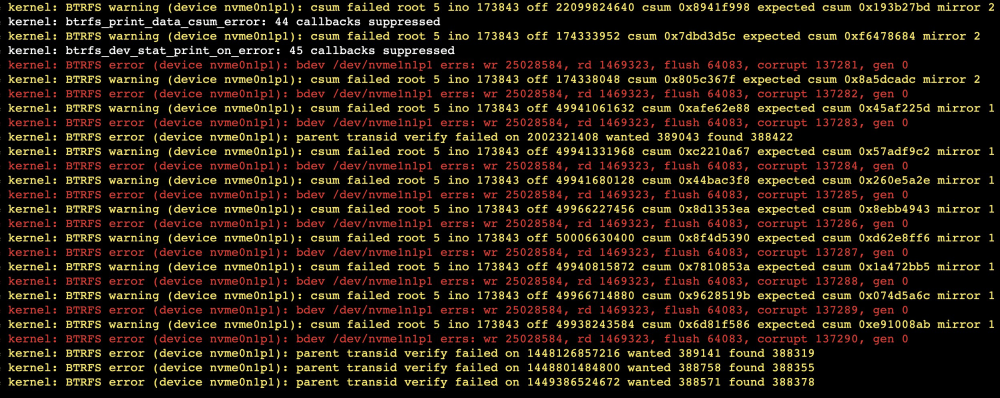
Hey All, I have two 2TB nvme drives in a RAID1 btrfs and am getting errors. I've tried doing a scrub but it seems to immediately be aborted. Since I have a RAID1 setup, can I simply remove the problematic drive and replace it later this week when a new one arrives? Diagnostics are attached. diagnostics-20230506-1013.zip
-
We just moved to TrueNAS Core (virtualised on Unraid) in September to support our bandwidth needs... Looking like it won't be long before we move back (Core sucks for the unfamiliar). As a side note, having support for 30+ drives would be nice for us. Our ZFS pool is 24 drives and we have a JBOD case to add another 36 drives over the next 12 months. We can manage otherwise though.

