Pillendreher
Members
-
Joined
-
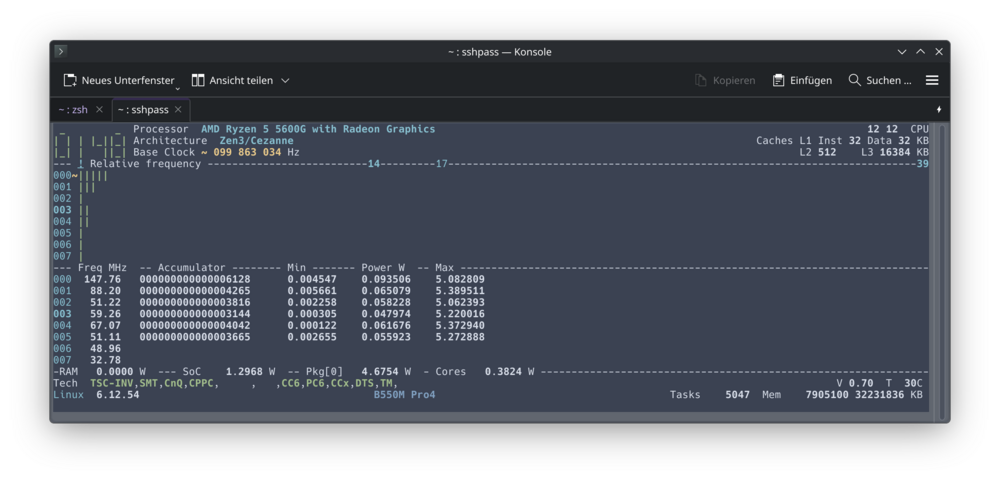
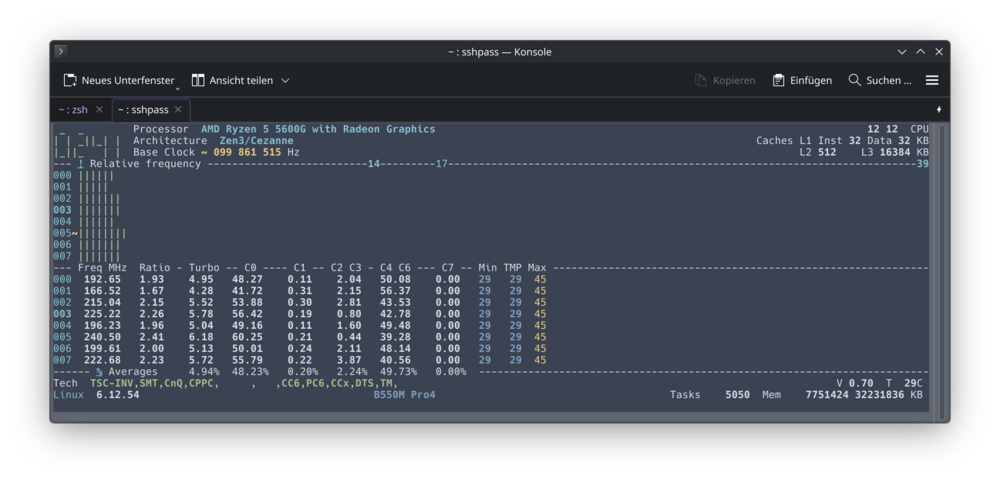
So, alle Jahre wieder probiere ich es noch einmal Alles im BIOS meines Asrock B550M Pro aktiviert, was irgendwie nach Stromsparen aussieht (+Voltage offset -62 und Curve Optimizer -10). Anhand diesen Anleitungen bei Corefreq selber vorgegangen: GitHubCoreFreq as the Clock Source, CPU Freq and CPU Idle driverCoreFreq : CPU monitoring and tuning software designed for the 64-bit processors. - cyring/CoreFreqGitHubGitHub - cyring/CoreFreq at f9d1e2446ae6a6f22e24aaf9c3961...CoreFreq : CPU monitoring and tuning software designed for the 64-bit processors. - GitHub - cyring/CoreFreq at f9d1e2446ae6a6f22e24aaf9c3961e1aa0da5e6c Und das zeigt mir Corefreq im Leerlauf an: Wirklich nach unten geht der Gesamtverbrauch des System dabei aber nicht. Ich glaube mit meiner Konfiguration sind weniger als 25-30W im idle nicht drinnen.
-
Was sollte denn dort drinnen stecken, welches solche Veränderungen bedingen könnte? In den Changelogs sehe ich nichts aufsehenerregendes.
-
Hab nun gestern noch einmal im UEFI gestöbert und alles aktiviert, was danach aussah, als könnte es relevant werden. Lustigerweise waren die C-States deaktiviert. Darüber hinaus hab ich noch die ASPM Einstellungen (PM L1 SS) aktiviert. Nun komme ich im Idle nicht mehr auf 33W, sondern auf 25W. Corefreq zeigt folgende Werte an: Vorher: 1,3 W SoC | 11,8 W Pkg | 7,6 W Core Jetzt: 0,6 W SoC | 5,9 W Pkg | 2,1 W Core Nach diesen Werten müsste die Einsparung eigentlich noch größer sein, aber nun gut, man nimmt was man kriegen kann
-
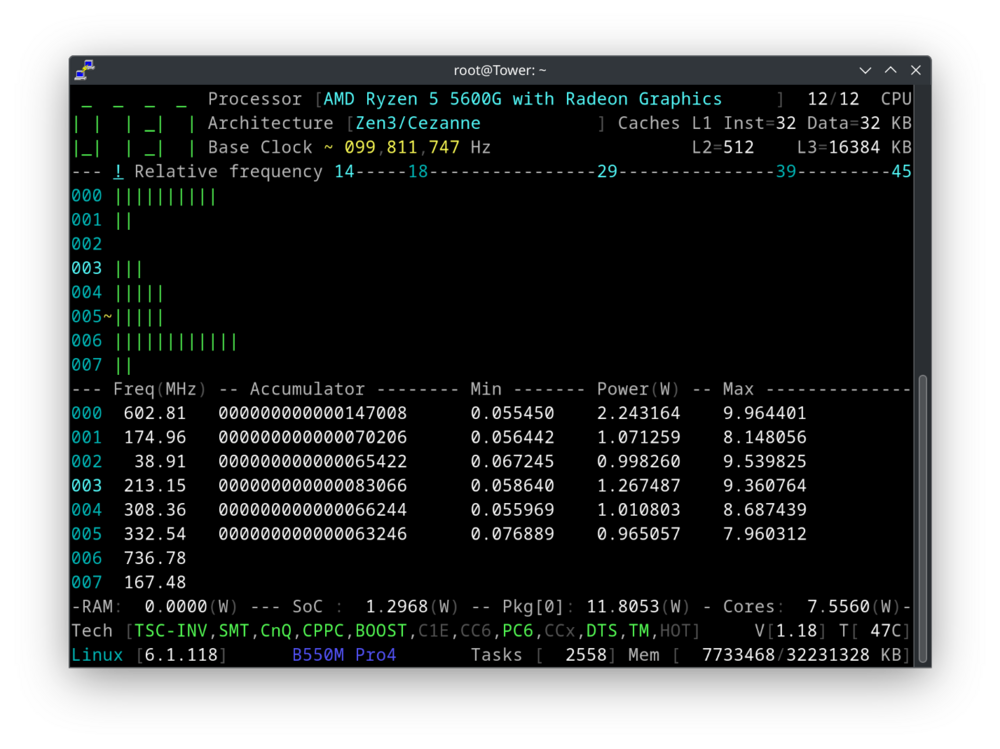
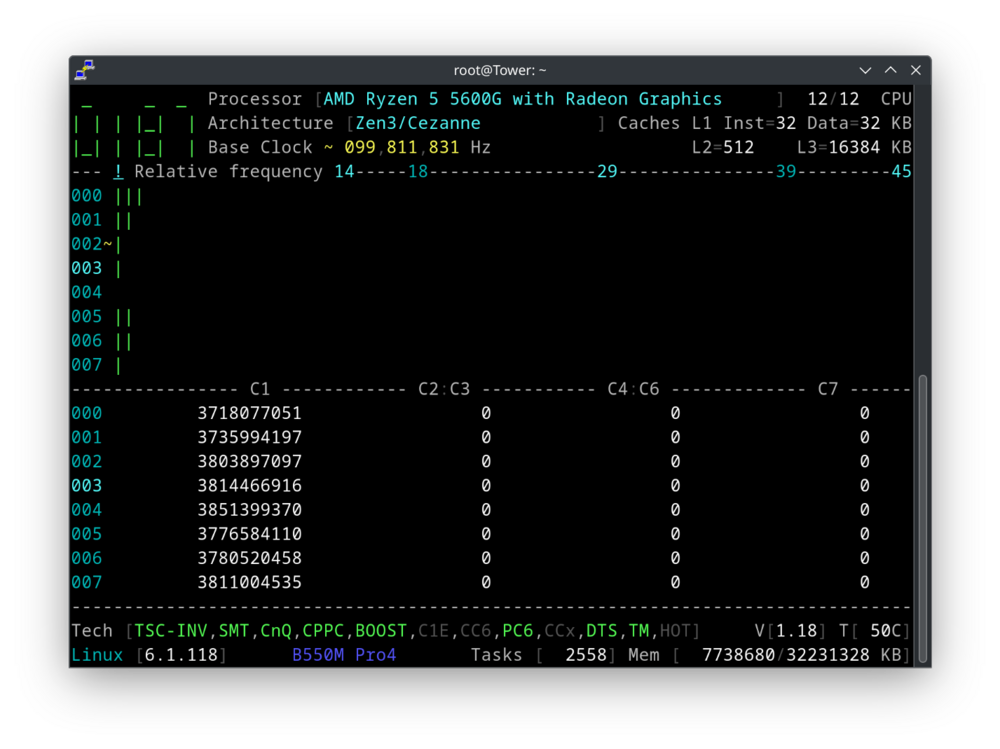
Greif das jetzt auch noch mal auf, da ich von zwei SSDs für den Cache auf eine reduziert und meinen Dell PERC H310 Raid-Controller ausgebaut. Komme im Idle mit einem 5600G auf einem ASRock B550M Pro4 auf ca. 34 W mit schlafenden Platten, was mir immer noch hoch vorkommt. Corefreq spuckt mir folgendes aus: Gleichzeitig bleibt wohl alles im C1 stecken: Zum Vergleich mein 5800X im Desktop Betrieb unter EndeavourOS: Ich werd mich jetzt noch einmal in die Thematik einlesen, denn fast 20 W insgesamt erscheint mir doch recht hoch nur für den Prozessor.
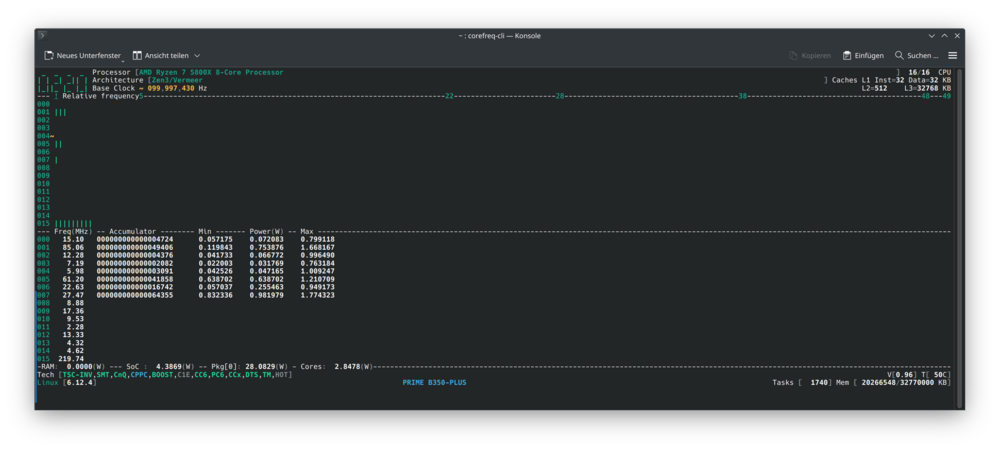
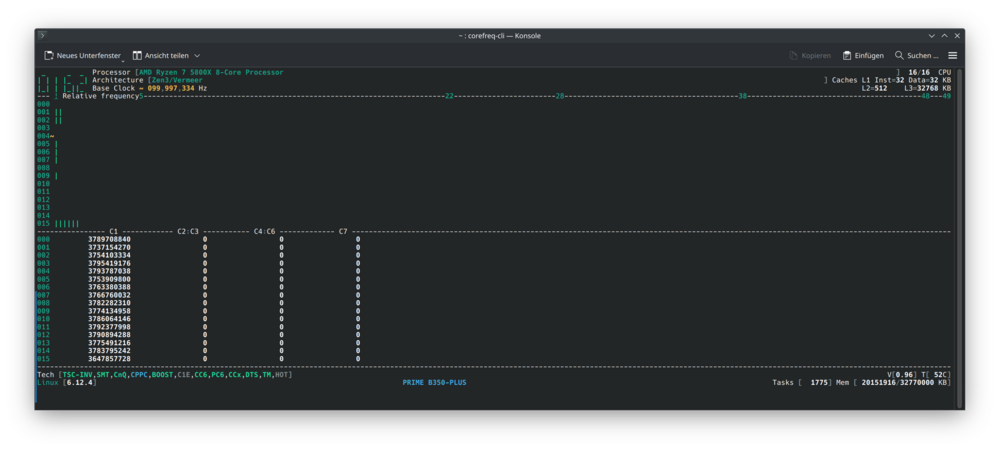
-
Quick question: Is this kind of GPU passthrough only for those that want to game with the VM and/or want to attach a display to their Server and get VM GPU output? Or can I accelerate graphics on my Windows VM as well? I do feel like it's a bit slow and sluggish with just the emulated Redhat graphics...
-
Die C-States in Corefreq sind wohl übrigens softwarebasiert, sofern ich diesen Beitrag richtig verstehe: https://github.com/cyring/CoreFreq/discussions/320#discussioncomment-8117677
-
Ich hab diese bisher nur in Corefreq gesehen Da hast du dann aber die seltsame Situation, dass eigentlich Corefreq alles übernimmt und nicht der P-State-Treiber.
-
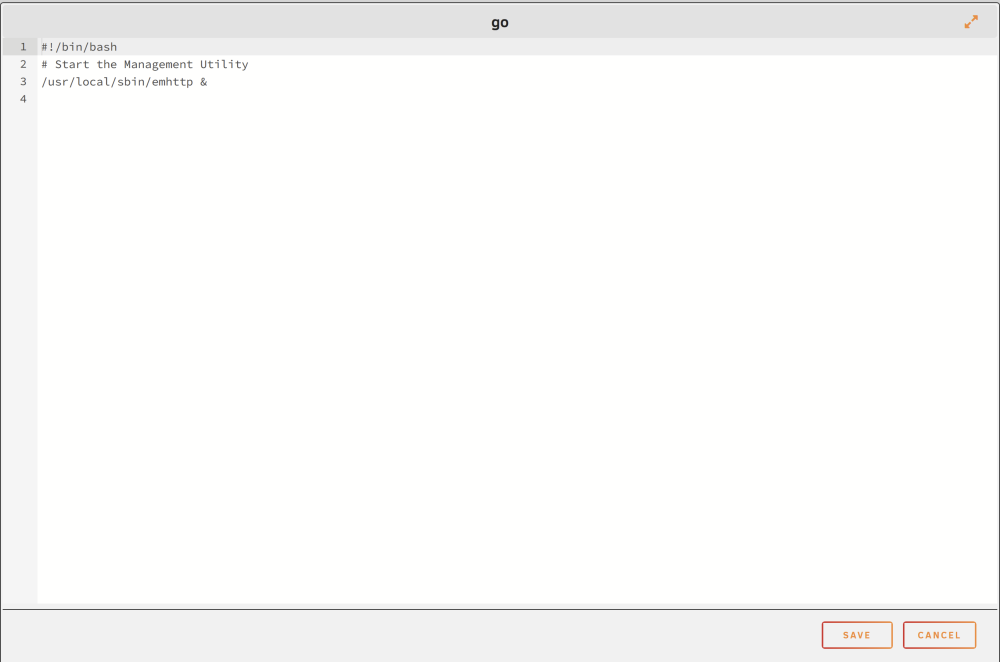
Steht nichts besonderes drinnen.
-
Worin äußert sich das denn bei dir? Was zeigt er bei "cpufreq-info" an?
-
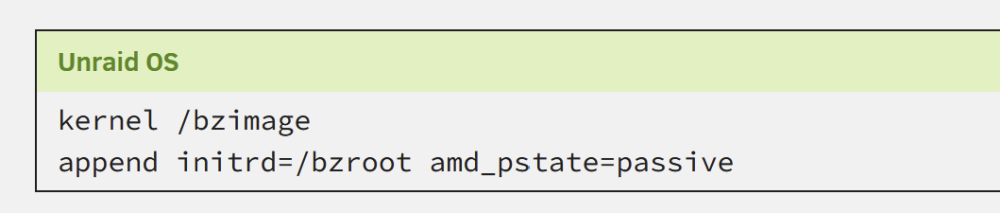
Kann bestätigen, dass "amd_pstate=passive" über cpufreq-info als angewandter Treiber angezeigt wird: root@Tower:~# cpufreq-info cpufrequtils 008: cpufreq-info (C) Dominik Brodowski 2004-2009 Report errors and bugs to [email protected], please. analyzing CPU 0: driver: amd-pstate CPUs which run at the same hardware frequency: 0 CPUs which need to have their frequency coordinated by software: 0 maximum transition latency: 20.0 us. hardware limits: 400 MHz - 4.46 GHz available cpufreq governors: conservative, ondemand, userspace, powersave, per formance, schedutil current policy: frequency should be within 400 MHz and 4.46 GHz. The governor "ondemand" may decide which speed to use within this range. current CPU frequency is 2.88 GHz. analyzing CPU 1: driver: amd-pstate CPUs which run at the same hardware frequency: 1 CPUs which need to have their frequency coordinated by software: 1 maximum transition latency: 20.0 us. hardware limits: 400 MHz - 4.46 GHz available cpufreq governors: conservative, ondemand, userspace, powersave, per formance, schedutil current policy: frequency should be within 400 MHz and 4.46 GHz. The governor "ondemand" may decide which speed to use within this range. current CPU frequency is 563 MHz. analyzing CPU 2: driver: amd-pstate CPUs which run at the same hardware frequency: 2 CPUs which need to have their frequency coordinated by software: 2 maximum transition latency: 20.0 us. hardware limits: 400 MHz - 4.46 GHz available cpufreq governors: conservative, ondemand, userspace, powersave, per formance, schedutil current policy: frequency should be within 400 MHz and 4.46 GHz. The governor "ondemand" may decide which speed to use within this range. current CPU frequency is 2.14 GHz. analyzing CPU 3: driver: amd-pstate CPUs which run at the same hardware frequency: 3 CPUs which need to have their frequency coordinated by software: 3 maximum transition latency: 20.0 us. hardware limits: 400 MHz - 4.46 GHz available cpufreq governors: conservative, ondemand, userspace, powersave, per formance, schedutil current policy: frequency should be within 400 MHz and 4.46 GHz. The governor "ondemand" may decide which speed to use within this range. current CPU frequency is 2.02 GHz. analyzing CPU 4: driver: amd-pstate CPUs which run at the same hardware frequency: 4 CPUs which need to have their frequency coordinated by software: 4 maximum transition latency: 20.0 us. hardware limits: 400 MHz - 4.46 GHz available cpufreq governors: conservative, ondemand, userspace, powersave, per formance, schedutil current policy: frequency should be within 400 MHz and 4.46 GHz. The governor "ondemand" may decide which speed to use within this range. current CPU frequency is 4.44 GHz. analyzing CPU 5: driver: amd-pstate CPUs which run at the same hardware frequency: 5 CPUs which need to have their frequency coordinated by software: 5 maximum transition latency: 20.0 us. hardware limits: 400 MHz - 4.46 GHz available cpufreq governors: conservative, ondemand, userspace, powersave, per formance, schedutil current policy: frequency should be within 400 MHz and 4.46 GHz. The governor "ondemand" may decide which speed to use within this range. current CPU frequency is 1.45 GHz. analyzing CPU 6: driver: amd-pstate CPUs which run at the same hardware frequency: 6 CPUs which need to have their frequency coordinated by software: 6 maximum transition latency: 20.0 us. hardware limits: 400 MHz - 4.46 GHz available cpufreq governors: conservative, ondemand, userspace, powersave, per formance, schedutil current policy: frequency should be within 400 MHz and 4.46 GHz. The governor "ondemand" may decide which speed to use within this range. current CPU frequency is 3.21 GHz. analyzing CPU 7: driver: amd-pstate CPUs which run at the same hardware frequency: 7 CPUs which need to have their frequency coordinated by software: 7 maximum transition latency: 20.0 us. hardware limits: 400 MHz - 4.46 GHz available cpufreq governors: conservative, ondemand, userspace, powersave, per formance, schedutil current policy: frequency should be within 400 MHz and 4.46 GHz. The governor "ondemand" may decide which speed to use within this range. current CPU frequency is 3.55 GHz. analyzing CPU 8: driver: amd-pstate CPUs which run at the same hardware frequency: 8 CPUs which need to have their frequency coordinated by software: 8 maximum transition latency: 20.0 us. hardware limits: 400 MHz - 4.46 GHz available cpufreq governors: conservative, ondemand, userspace, powersave, per formance, schedutil current policy: frequency should be within 400 MHz and 4.46 GHz. The governor "ondemand" may decide which speed to use within this range. current CPU frequency is 3.55 GHz. analyzing CPU 9: driver: amd-pstate CPUs which run at the same hardware frequency: 9 CPUs which need to have their frequency coordinated by software: 9 maximum transition latency: 20.0 us. hardware limits: 400 MHz - 4.46 GHz available cpufreq governors: conservative, ondemand, userspace, powersave, per formance, schedutil current policy: frequency should be within 400 MHz and 4.46 GHz. The governor "ondemand" may decide which speed to use within this range. current CPU frequency is 1.75 GHz. analyzing CPU 10: driver: amd-pstate CPUs which run at the same hardware frequency: 10 CPUs which need to have their frequency coordinated by software: 10 maximum transition latency: 20.0 us. hardware limits: 400 MHz - 4.46 GHz available cpufreq governors: conservative, ondemand, userspace, powersave, per formance, schedutil current policy: frequency should be within 400 MHz and 4.46 GHz. The governor "ondemand" may decide which speed to use within this range. current CPU frequency is 4.44 GHz. analyzing CPU 11: driver: amd-pstate CPUs which run at the same hardware frequency: 11 CPUs which need to have their frequency coordinated by software: 11 maximum transition latency: 20.0 us. hardware limits: 400 MHz - 4.46 GHz available cpufreq governors: conservative, ondemand, userspace, powersave, per formance, schedutil current policy: frequency should be within 400 MHz and 4.46 GHz. The governor "ondemand" may decide which speed to use within this range. current CPU frequency is 3.55 GHz. root@Tower:~# Mit allen Festplatten runtergefahren, zwei BD-Brennern (keiner aktiv) und zwei SSDs, einem 5600G, zwei RAM-Riegeln, einer Dell PERC H310 und 3x 140mm Lüftern komme ich so im Leerlauf auf ca. 35 W. Nicht so schlecht, aber auch nichts besonderes m.E.
-
admin:password
-
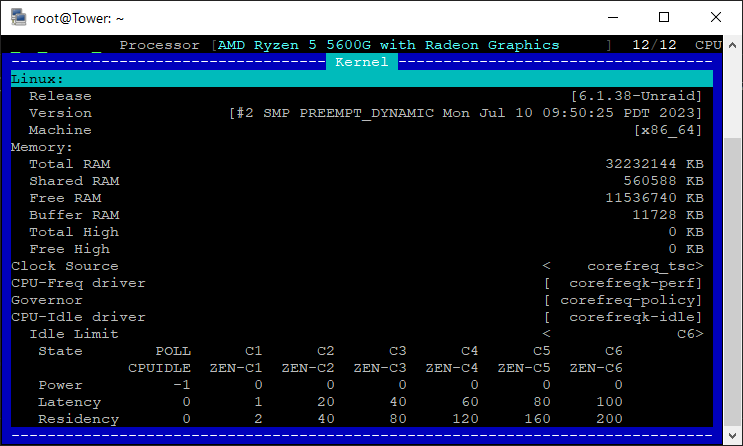
Got ya, now it looks like everything's fine in that regard: Is this the way it should be though? As of right now, the CPU is not run by pstate but rather by corefreq itself. I thought the whole point of this was to run pstate?
-
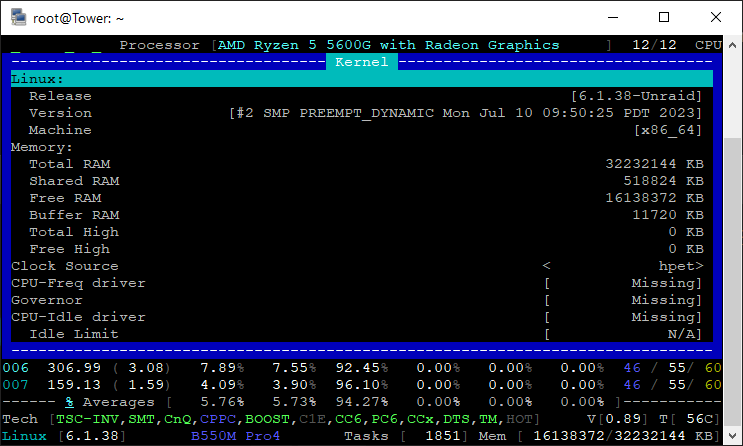
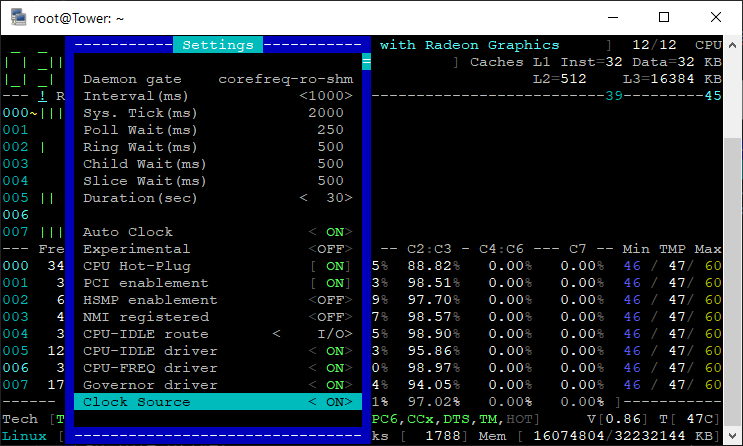
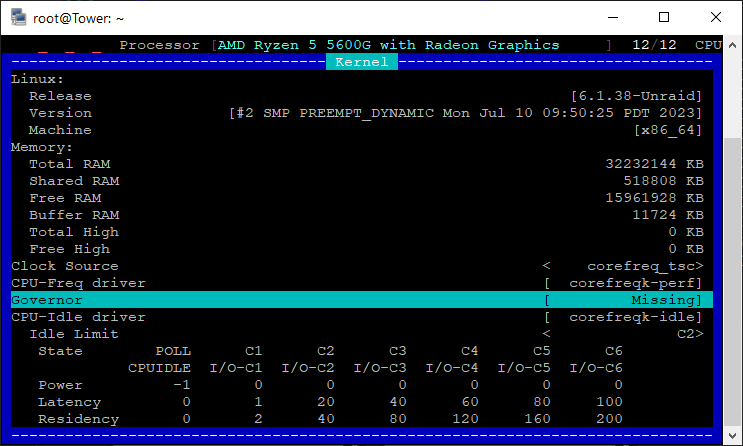
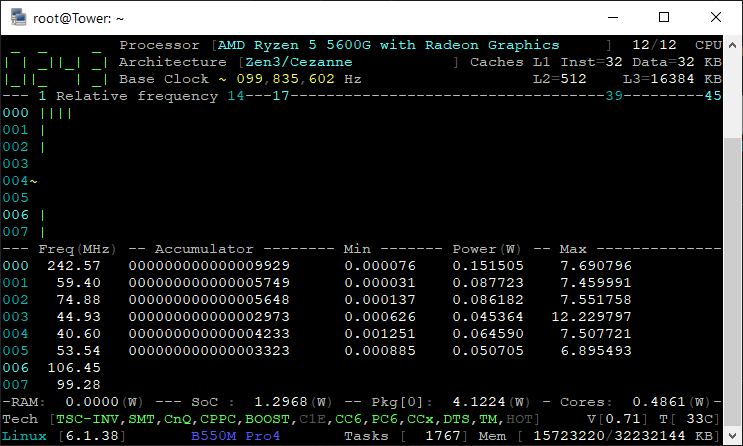
Thanks. The main culprit was "amd_pstate=passive". After removing that from syslinux.cfg, everything's missing: I can register everything now: But now the governor is missing: CPPC needs to be enabled manually and appears "green" afterwards. Seems like I'm getting slightly lower power consumption stats: Btw: How do I make all of these things persistent after reboots? I've created a corefreqk.conf in /boot/config/modprobe.d/, yet nothing changes. This is what it looks like as of right now: Idle_Route=1 Register_ClockSource=1 Register_CPU_Freq=1 Register_Governor=1 Register_CPU_Idle=1[/CODE]
-
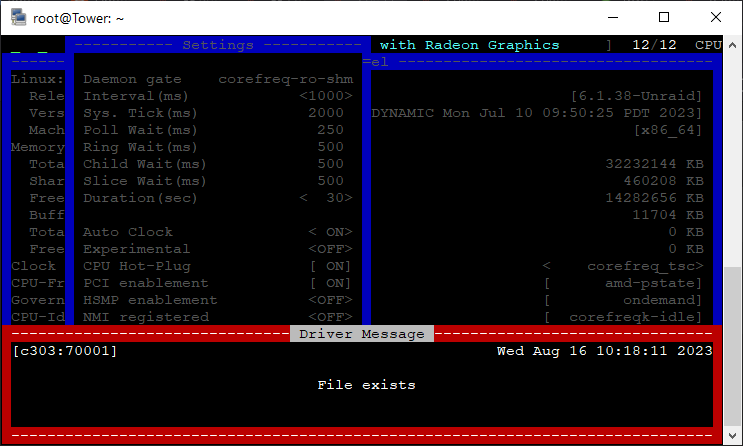
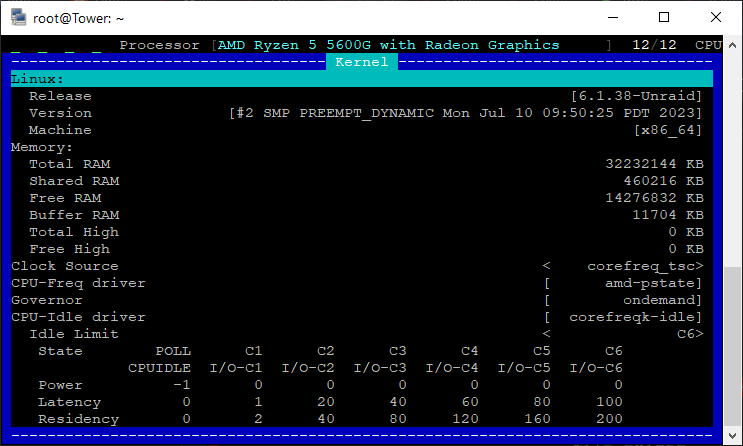
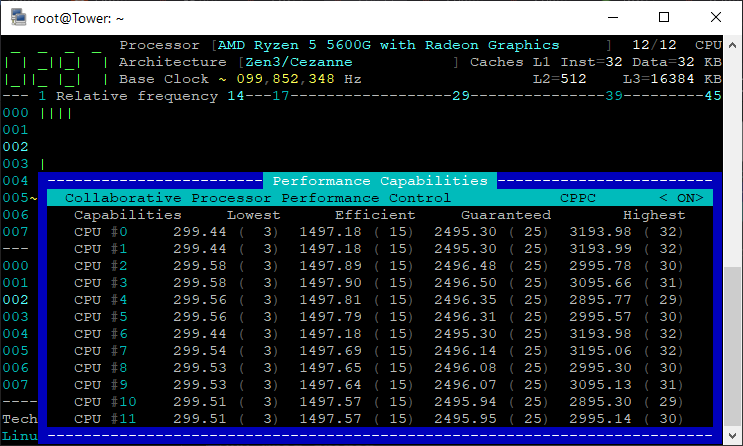
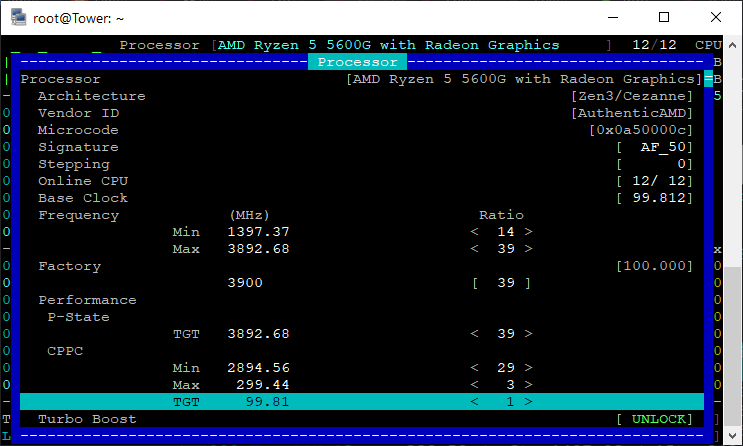
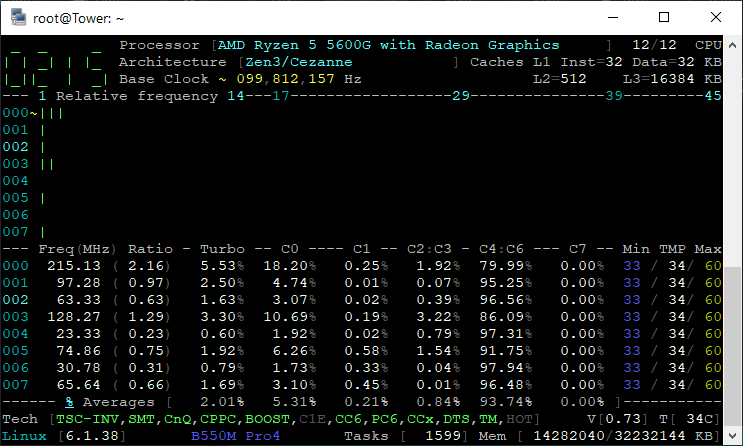
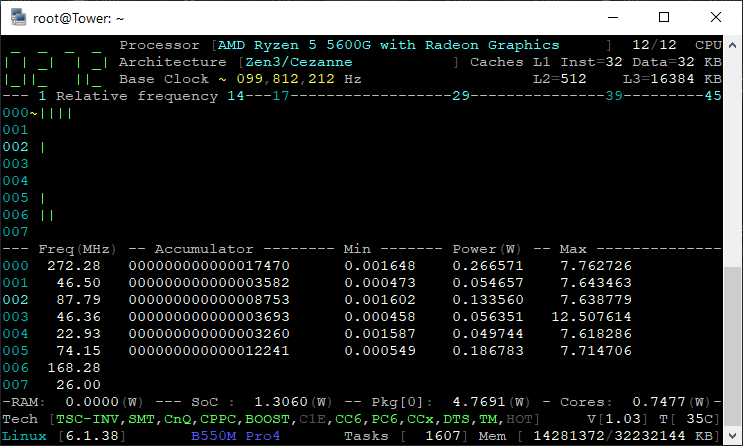
So, ich greife das Thema nochmal auf nach langer Zeit Unraid-Version 6.12.3 Folgendes steht in der syslinux drinnen: nmi_watchdog=0 modprobe.blacklist=k10temp,sp5100_tco,acpi_cpufreq idle=halt nowatchdog amd_pstate=passive[/CODE] Der P-State-Treiber muss nicht mehr gesondert geladen werden. In Corefreq alles registriert bis auf den cpu-freq Treiber, der will weiterhin mit folgender Fehlermeldung nicht: Im Kernel-Fenster wird er mir mit "amd-pstate" angezeigt, was ich jetzt mal nicht als Problem ansehe: CPPC wurde ja mittlerweile in ein eigenes Fenster ausgelagert und ist aktiviert: Das TGT habe ich auf den kleinstmöglichen Wert "1" gesetzt: Die Kerne gehen mit diesen Einstellungen laut Corefreq auch in C4:C6: Die Leistungsaufnahme zeigt mir Corefreq damit im Leerlauf wie folgt an: Muss mal mein Stromverbrauchsmessgerät suchen, keine Ahnung in welcher Umzugskiste sich das versteckt hält. Vielleicht mag mal jemand seine Coreqfreq Power-Werte reinstellen um vergleichen zu können
-
Sicherlich, nur ist das ja immer eine Frage des konkreten Einzelfalles. Ob das Teil z.B. Schlafzustände verhindert, kann man ja so aus der Ferne nicht wirklich beurteilen/vorhersagen.