bthoven
Members
-
Joined
-
Last visited
Everything posted by bthoven
-
here it is. bthoven-unraid-diagnostics-20230825-0911_log_100percent.zip
-
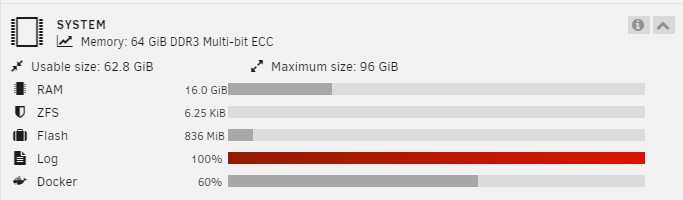
Hi, I just noticed the log bar on the dashboard shows 100% with red color. I tried to check the log content by pressing the log icon on the upper right cornor on the dashboard. It showed a popup box with blank content (all white). I also went into the Tools-->System Log, it was displaying unraid wave logo forever and not showing any content. I also used Filezilla to view the content in /var/log folder; the syslog file itself size has 0 byte and the syslog.1 file size is around 130MB. I viewed it and didn't see any things wrong or any repeated errors. What should I do next? or What is the proper way to clear the log?
-
Thanks for this solution. It works. After upgrading Unraid to the latest version, the first boot after upgrading was ok, but I need to reboot it because my UPS battery needed replacement. Unraid docker definition menu can no longer see my br0. After performing the above two commands, the br0 is back and those dockers are now working with just restarting them again.
-
Great advice. My debian vm storage was full and can't display desktop gui after login. As I already have a debian testing VM in place, I just installed gparted, stop the problematic vm, run gparted to extend the debian partition (I need to delete the existing swap partition first before extending because it was placed between the main partition and the additional storage) and create a new swap partition at the end of the enlarged storage; then everything is now working smoothly as usual. First reboot on the larger storage took longer time because it seems to check or initial something extra on the expanded disk.
-
Thanks. The procedure on the link page works great. I had to run it 4-5 times to get to the latest version. Along the way, if you found some errors or inadvertently say No to the occ upgrade, just re-run the "docker exec -it nextcloud updater.phar", it will resolve the problem by itself. The latest version as of now is 25.0.4.
-
You can create and schedule the following bash script with User Script plugin. #!/bin/bash # run in background docker exec -d GooglePhotosSync gphotos-sync /storage # run interactively for testing #docker exec -it GooglePhotosSync gphotos-sync /storage
-
It is No. I understand that I can't simply change it to Yes?
-
My cache drive COW is set to Auto. Is it supposed to allow me to cp --reflink?
-
Thanks. I opened Unraid console, created a new folder in domains folder and I used the following command. It didn't work. My cache is brtfs. What I did wrong?

-
Thanks. Will the changes in the new VM also change the original vdisk1?
-
I've created a new Debian VM and installed some basic setup on it, e.g. making user as a sudoer, x11vnc, etc. I want to back it up as my own customized image so that I may need to create another VM like this in the future without having to setup those things again. What should be the right process to backing up the said vdisk1.img and use it later for creating another VM with different VM name and hostname?
-
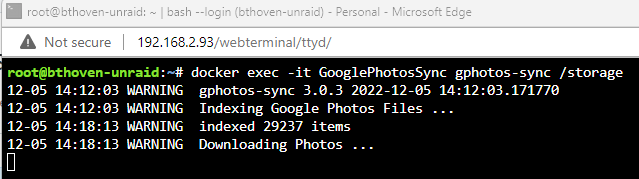
As eventually I want to run it headless on Unraid server, the only way to get the Google authorized token is by installing gphotos-sync app on my Windows (or Linex/Mac) first, and then follow the whole process on Windows until I get the similar link as above. Now clicking the link on Windows can complete the authorization process and a token was created inside my Windows storage folder. I then copied the token file to my Unraid GooglePhotosSync storage folder (the folder where all the photos will be downloaded to). It's now working.
-
I've just installed and run GooglePhotosSync docker. When I ran my first sync with command inside Unraid console: docker exec -it GooglePhotosSync gphotos-sync /storage I got the authorize link that brought me to choosing my gmail account, got the "Google hasn’t verified this app" page, but I proceed with it anyway, then checking access to Google Photos. After that, it brought me to a url that can't be reached: http://localhost:8080/?state=MRSMyRUIBAl2ZyClPdyR3krdYbKcSe&code=4/0AfgeXvu9VuPnkzwbsQiMWjY2vMGu2xYsCXFdCDzkCxzx_GVWYOVWq96X10ajzCwU9dC5jA&scope=https://www.googleapis.com/auth/photoslibrary.sharing https://www.googleapis.com/auth/photoslibrary.readonly and nothing was going on after this point on my Unraid console. I performed this process on my Windows 11. Trying it on my Debian also produced the same results. Did I do something wrong?
-
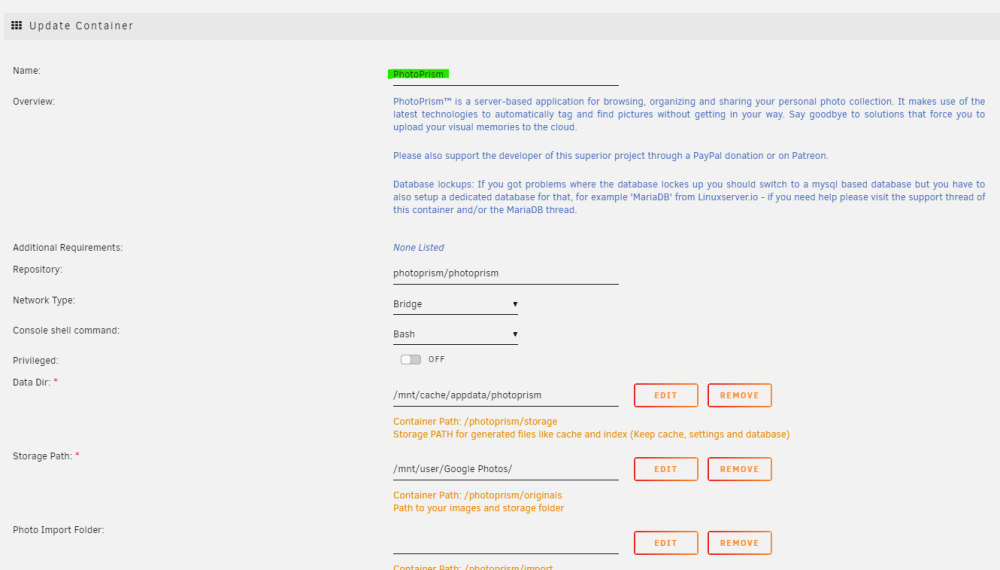
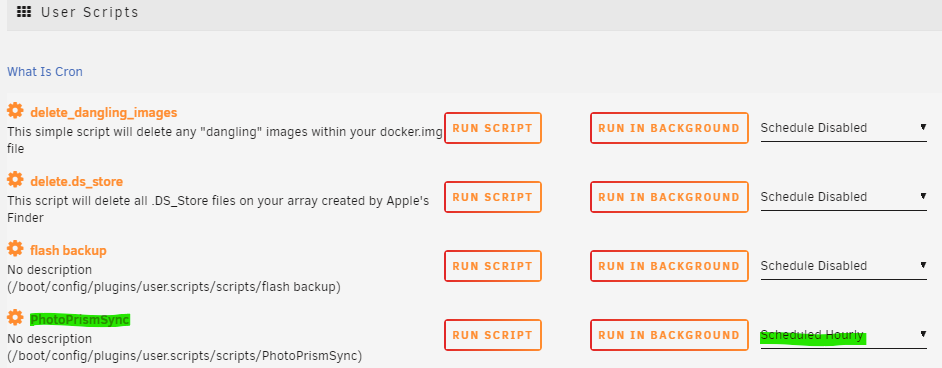
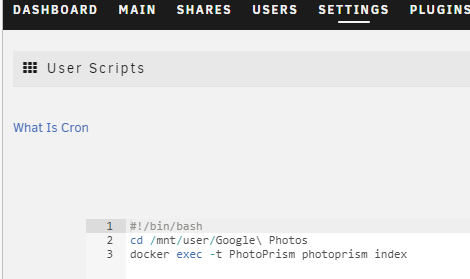
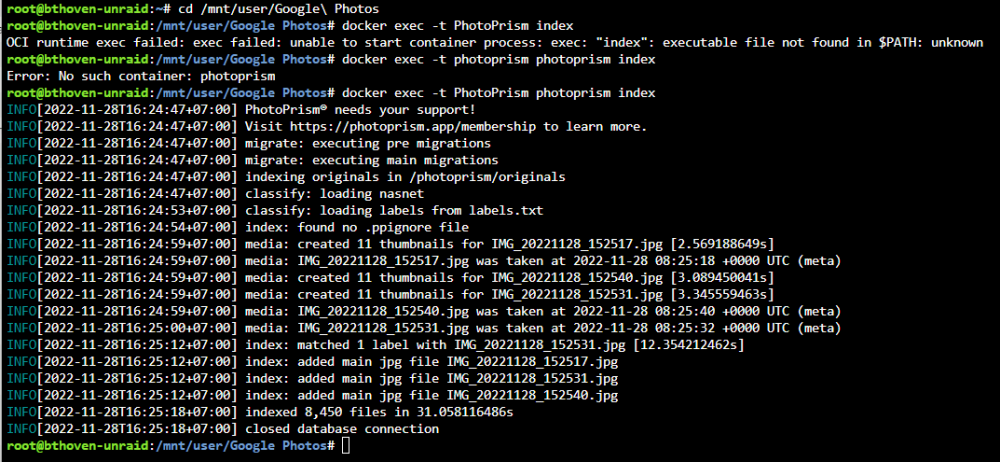
Objective: to automatically perform indexing, every hour, for new photos in my PhotoPrism original folder, without using an import folder or WebDAV in PhotoPrism. I already have a shared folder on my Unraid, name 'Google Photos', which allows SMB share. I'm using a FolderSync app on my Android phone to sync, one way, photos on my phone every hour to 'Google Photos' folder on my Unraid. I also have another phone which also runs Foldersync app which also syncs, one way, to the same 'Google Photos' folder on my Unraid. So basically, my 'Google Photos' contains all photos originated from my mobile phones. After I started using PhotoPrism by specifying 'Google Photos' as its original folder (or 'Storage Path' on Unraid docker webui), I had a 'complete Rescan' once to index all the existing photos/videos. Since then, I've been struggling to find a way to automate a scheduled rescan for only changes in my 'Google Photos' folder. As PhotoPrism only supports such feature with WebDAV sharing folder only, and Unraid does not support WebDAV share, I can only do it manually on it webui (Libraray sidebar --> Index tab --> Start button). So I need to find another way. The solution is to run 'photoprism index' command in the PhotoStream container and scheduling its run with a cron job. The command is basically the same as when you manually rescan the folder with PhotoPrism webui (Libraray sidebar --> Index tab --> Start button) If you don't have a 'User Scripts', you have to install it first from Unraid APPs repositories, and we will have a webui to create a bash script and a new schedule. It's just a webui for easy bash script and cron job creation. Pls see the attached screenshots For my PhotoPrism container, the bash script will be: #bin/sh cd /mnt/user/Google\ Photos docker exec -t PhotoPrism photoprism index where '/mnt/user/Google\ Photos' is my 'Google Photos' shared folder containing all photos/videos (need back slash behind 'Google' because I have a space in my folder name 'Google Photos'. I should rename it to 'Google_Photos') 'PhotoPrism' is my PhotoPrism container name (what you input as 'Name:' when you define the docker via Unraid Webui, see the attached screenshot) 'photoprism index' is a PhotoPrism known command to perform the indexing again. Or what the bash script does is performing indexing of photos/videos inside /mnt/user/Google Photos/ folder, by looking for only the changes in the folder. Note: your PhotoPrism docker must be running/started for this to work. If you have only a few new photos added to 'Google Photos' folder, it took only less than a minute to sync/index. Hope this helps. Screenshot: Docker parameter User Scripts 'PhotoPrismSync' How it works behind the scene:
-
My Krusader always pops up a KdeWallet box asking for a password. How do I disable it?...thanks.
-
I've operated Unraid for almost a year now without problem. Now I run Unraid latest version, 6.11.3. I have one user share folder, named "unraid_shared", which I defined parameter "Use Cache Pool=Prefer" when I created it. Since its creation, I believe the same folder are in both the Cache drive and Disk1 drive, which is normal because when I create a new file/subfolder inside the unraid_shared folder, it will be stored in Cache first, and it will be automatically moved to Disk1 later, if necessary? Since the day before, my unraid_shared folder on Disk1 became just a flat file named unraid_shared (size 517b), while the unraid_shared folder on Cache drive is still intact and seems to contain all subfolders/files. I don't know what has happened. Is there any way to have the unraid_shared as a folder on my Disk1 again? Can I simply delete the flat file unraid_shared from Disk1, and Unraid OS will re-create the same folder in Disk1 automatically? The reason I found this problem because I have a user script scheduled to run every day. It's supposed to create a new file every day in unraid_shared folder. In the script I refer to the folder location as /mnt/user/unraid_shared, which is located is on Disk1. As now such folder on Disk1 became just a flat file named user_shared, so the script can't find such folder, thus terminated.
-
Just installed Openbooks docker. It connects properly, but no book can be found. It keeps on spinning/searching without showing any result. I reported in the newest issue in github.
-
Thanks for taking time looking into the log files. I really don't know when. When it happened, I knew because VMBackup plugin, which was scheduled to run daily, reported it can't backup my VMs. Sent from my M2007J3SG using Tapatalk
-
I've attached the diagnostics files in the OP.
-
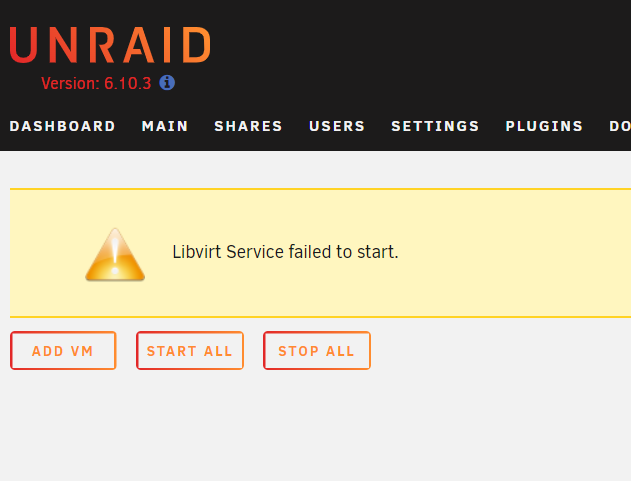
Since upgraded to 6.10.3, from time to time, all my VMs disappear from the dashboard, though all of them are still running. The VM tab shows like this. I've never shutdown my unraid. I therefore can't maintain my VM config and can't backup with my scheduled VMbackup. I have to reboot my unraid to get it back properly. Anyone has the same problem? Any permanent or workaround solution without having to reboot my unraid? Thanks. bthoven-unraid-diagnostics-20220721-1003.zip
-
no, just one webui.
-
When that incident happened, the webui took forever to load. I'll try the diagnostics function when it happens again. Do you know where the diagnostics log is actually kept, in case the webui won't respond and I still can ssh to my unraid server to view it.
-
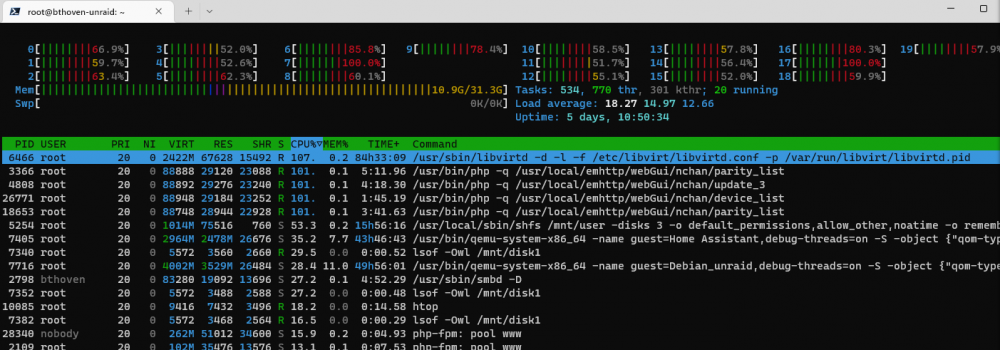
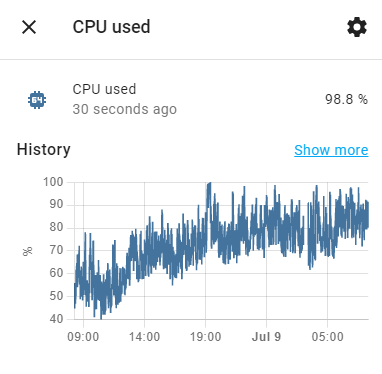
After upgrading Unraid Basic to the latest stable version (6.10.3), I found after running it for a while, the CPU load jumps to 80-99% continuously. Usually my CPU load should hovering around 20%+/-. I did not touch my applications since updating my unraid; only updated my dockers from time to time. I usually have to restart my Unraid to solve the problem; but it will saturate my CPU again and again. When I use htop command, I found these /usr/bin/php -q ..... processes uses over 100% CPU. In normal circumstance, I do not see these processes in the top ten list. What are these processes? /usr/bin/php -q /usr/local/emhttp/webGui/nchan/device_list /usr/bin/php -q /usr/local/emhttp/webGui/nchan/parity_list /usr/bin/......
-
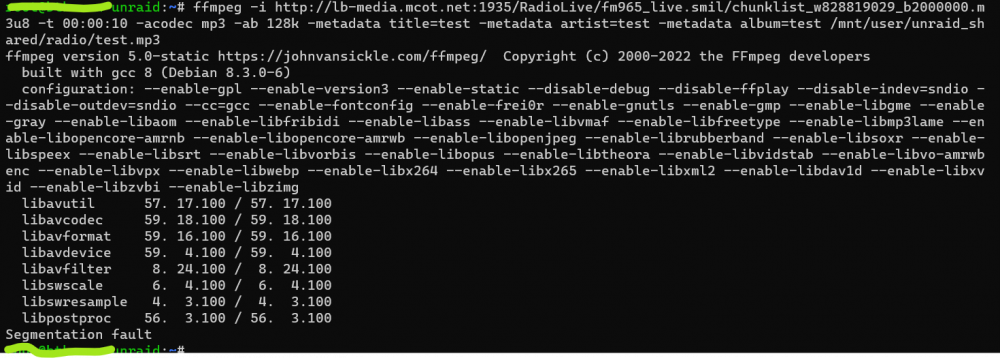
Thanks a lot. Running it as a disposable docker container with docker run cli in my User Scripts has solved the problem. Just for future reference as to how I change the ffmpeg command line to make it work: # native installed ffmpeg no longer works after unraid upgrade, then use docker instead #ffmpeg -i http://lb-media.mcot.net:1935/RadioLive/fm965_live.smil/chunklist_w828819029_b2000000.m3u8 -t 00:$1:00 -acodec mp3 -ab 128k -metadata title=$2 -metadata artist=$3 -metadata album=$4 /mnt/user/unraid_shared/radio/$FILENAME.mp3 docker run --rm -v /mnt/user/unraid_shared/radio:/config linuxserver/ffmpeg -i http://lb-media.mcot.net:1935/RadioLive/fm965_live.smil/chunklist_w828819029_b2000000.m3u8 -t 00:$1:00 -acodec mp3 -ab 128k -metadata title=$2 -metadata artist=$3 -metadata album=$4 /config/$FILENAME.mp3
-
I installed ffmpeg in my Unraid as a native app (wget https://johnvansickle.com/ffmpeg/releases/ffmpeg-release-amd64-static.tar.xz ) a while back in order to create a script to record fm online radio with user script plugin. It has been working fine until after I upgraded my Unraid to the newest version. As soon as the script run the ffmpeg command, it stops immediately with "segmentation fault" error, without any other error information. Anyone has experienced the same and has any solution to this? Thank you.