





Nuuki
Members
-
Joined
-
Last visited
Everything posted by Nuuki
-
I've swapped it out so I'll see if that makes any difference. As you say even if its not the root cause its clearly a problem.
-
Ah right - so should I just pickup a new drive? Easy enough fix if that's the issue, and clearly want to address it before it gets any worse.
-
@JorgeB No significant progress on this issue - I did cut back on plug-ins, but today I've had back to back system instability, even after a reboot. Checking the logs at the time these errors stood out as potentially problematic, and not something I'd seen before (hence the post): May 15 01:02:44 Server kernel: traps: lsof[6947] general protection fault ip:1486821704ee sp:a468894e97de6910 error:0 in libc-2.36.so[148682158000+16b000] May 15 11:39:30 Server kernel: nvme0: Admin Cmd(0x2), I/O Error (sct 0x0 / sc 0x13) May 15 11:39:30 Server kernel: nvme0: Admin Cmd(0x2), I/O Error (sct 0x0 / sc 0x13) After the reboot I see these errors: May 15 12:12:17 Server kernel: serial 0000:00:16.3: Couldn't register serial port 30a0, irq 17, type 0, error -28 May 15 12:13:20 Server kernel: I/O error, dev sda, sector 4251598 op 0x0:(READ) flags 0x84700 phys_seg 2 prio class 0 May 15 12:15:32 Server root: error: /webGui/include/InitCharts.php: wrong csrf_token I've since enabled a remote syslog server which will hopefully help. Both cache drives are new, but is it possible they're causing the problem? server-diagnostics-20230515-1249.zip
-
Thanks. I run nginx proxy manager as a docker container - do the errors relate to that, or something else running natively on the host? I have a bunch of plug-ins running though nothing that isn't pretty popular. What are the implications of running in Safe Mode? Happy to give it a go, though as its quite an intermittent problem I'd likely need to leave it for a week or so to have a sense for whether it helped. So whether that's viable mainly depends on what's disabled in Safe Mode.
-
I'm continuing to get this issue intermittently. Yesterday I rebooted due to the server going into this partial failure state, and this morning I'm getting the same issue. Although the server is stable other than this, I'm clearly anxious that there's an underlying fault which will only get worse. Given that I was having similar issues last year, my suspicion is that maybe the USB drive running as the array is failing - the two cache drives have both been replaced recently along with the server, so the USB drives used to boot Unraid and ru the array are the only elements that remain. Any ideas on what I can try? server-diagnostics-20230502-1621.zip
-
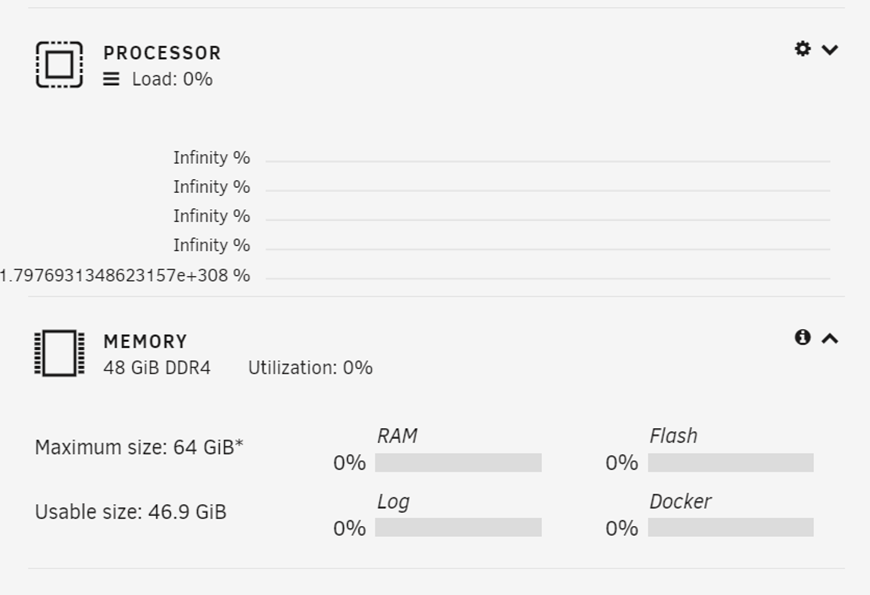
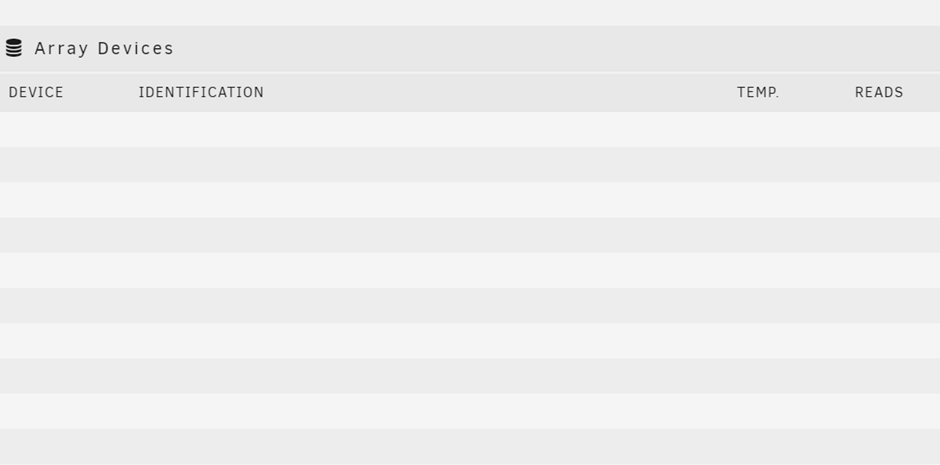
I've been having some stability issues with my Unraid setup lately. I actually upgraded the server recently which I assumed would probably resolve it, but its not, so I'm keen to get to the bottom of it, as I replaced pretty much everything in the process. I use the server purely to run containers - all my storage is on an external Synology, accessed via NFS shared using Unassigned Devices. I run a pair of SSDs (replaced during the migration) in a RAID1 cache pool using UD, and I have a USB drive running an array, purely to allow things like Docker to actually run. The obvious symptoms I get are: The Dashboard stops show certain data - notably Processor and Memory info is blank: The Main screen is blank: I'm unable to launch the command line terminal - when I press the button a window appears but remains blank. Other things accessed via the UI don't necesararily work. For instance whilst I can generate a Diagnostic file, it won't download within the UI. Despite this, containers continue to run and I'm able to SSH in. Generally I reboot it via SSH and all is good for a while. I'm getting this intermittently - maybe once a week? So tricky to pin down. I'm wondering if this could relate to the USB drive running the array, as that and the boot USB are the only items that carried over from the previous server. I've attahced diags so hoping that may provide some clues. I won't reboot the server in case there's anything I can try, as once I reboot it'll probably be fine for a while. server-diagnostics-20230224-1626.zip
-
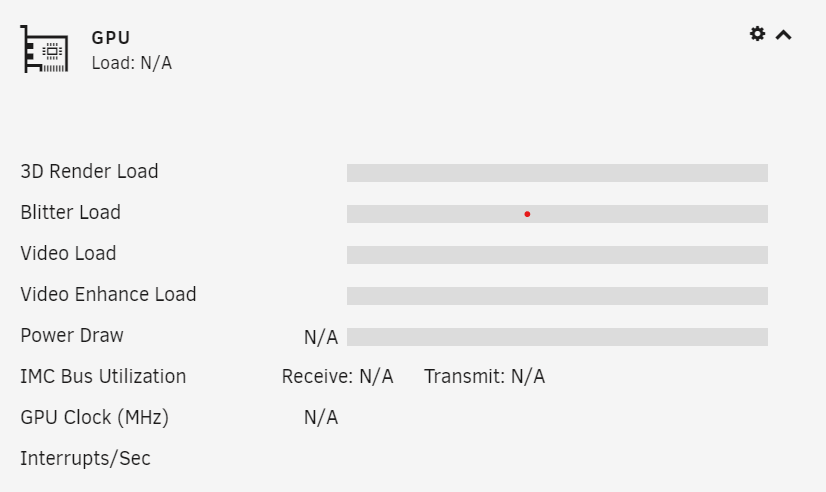
I'm also seeing N/A running the latest version. Running intel_gpu_top from the command line I am seeing expected results. gpustat.txt intel_gpu_top.txt gpustat.cfg
-
OK - the new drive showed up at my door at the perfect moment, and I was able to swap it into the pool without issues. Its just finished balancing so I'm now back in business with two brand new drives in the pool. I had some errors related to the new pool having a different name, but easy enough to delete the original pool and rename the new one to match, which seems to have resolved that. So I'm now done (properly this time). That you so much for handholding me through this - I had all the important data backed up, but starting from a blank cache and copying it seemed like it was likely to throw up some unexpected issues, so let me know where I can go to send you something to say thanks.
-
OK I'm running the scrub now. So I can add the Lexar to the pool - do I need to do anything to enable redundancy on the pool, as that's what I'm after rather than pooled capacity. Also a replacement SATA drive should be with me in the next couple of hours. I assume that once the Lexar is in the pool and mirrored, that I can then simply remove the 850 from the pool, swap the drives and add the new drive? EDIT: OK I've added the drive, and though it initially showed a 1Tb pool that has now dropped to 500Gb, so I assume it is indeed RAID1. The balance is running, so I was planning to let that finish, and then remove the 850 from the pool, freeing up space for the new SATA. If that's not correct let me know, but feels like I'm almost there...
-
Done. I created a new pool with the 850, so the old pool is still listed (though empty). I did get a SMART warning when I added the 850, so fingers crossed its useable enough to get he data onto the new Lexar. EDIT: My Docker containers have all fired up, so it seems to have read the pool data without issue... server-diagnostics-20230203-0924.zip
-
warning, device 1 is missing using SB copy 1, bytenr 67108864 Label: none uuid: 6ce62ad6-66d5-4b0e-b758-9dcf26483095 Total devices 1 FS bytes used 1.29GiB devid 1 size 28.64GiB used 2.52GiB path /dev/md1 warning, device 1 is missing Label: none uuid: b5041f3c-3118-401e-8673-8b11b6547171 Total devices 2 FS bytes used 179.86GiB devid 2 size 465.76GiB used 238.03GiB path /dev/sdc1 *** Some devices missing To confirm, the 850 and (new) Lexar are both installed, but neither are added to the pool - both show up under Unnassigned devices.
-
OK - the 850 is conected but unassigned. I realise I left the M.2 in (also unassigned) - if you need me to remove it I can do so. server-diagnostics-20230202-2032.zip
-
That would be amazing. Thanks so much for your support!
-
Thanks for confirming. I'll go order a new SATA drive... I unassigned the 850, following the instructions here. I've not touched it since , so if that will still have the cache data on it I could swap that in any try again? I do have my appdata folder fully backed up so if I do end up losing both drives I should be able to recover, though obviously be ideal not to have to go that route.
-
Find attached the updated diags. The output from the command is: Label: none uuid: 6ce62ad6-66d5-4b0e-b758-9dcf26483095 Total devices 1 FS bytes used 1.29GiB devid 1 size 28.64GiB used 2.52GiB path /dev/md1 warning, device 2 is missing Label: none uuid: b5041f3c-3118-401e-8673-8b11b6547171 Total devices 3 FS bytes used 179.74GiB devid 1 size 465.76GiB used 184.03GiB path /dev/sdc1 *** Some devices missing The Samsung 870 is only about 18 months old so annoying if its failed, but I guess they're cheap enough. To clarify, I previously had a RAID1 cache pool made up of two SATA SSDs. I broke the pool and removed the older drive (a Samsung 850), leaving just 1 (the Samsung 870). I migrated that to the new server and installed a new M.2 drive (Lexar), which I intended to add to the pool to get it back to RAID1. If the 870 looks to be failing I'd be happy to just use the Lexar for now, and to pickup a new SATA SSD. server-diagnostics-20230202-1709.zip
-
Understood - its been a while since I created the original pool so don't recall how I got it to run as RAID1, but I should have double checked. Anyway I've tried adding them back in, and then generated the attach diags. server-diagnostics-20230202-1645.zip
-
@JorgeBLooks like I may have spoken too soon... It looks like when I added the second drive, it added it as RAID0 - I should have double checked that. I stopped the array and now its staying "Unmountable: too many missing/misplaced drives". Seeing a response you provided in another thread I stopped the array, removed both drives from the pool, restarted the array to clear the pool config, then stopped it, added the drives back and restarted it, but no luck. I see you can usually convert from RAID0 to RAID1, so if I can get the pool back then I can do that. Worst case if its not salvageable I can fall back on the manual copy.
-
I realised I hadn't tried your solution - I've just done so and it worked perfectly - many thanks!
-
From what I can tell its a 0 device pool now - I split the RAID1 cache pool on the old server and confirmed it was working on the single drive, but for some reason having moved everything over the cache pool isn't coming up and its instead offering to let me add the original drive back, but wiping it in the process. Worst case maybe I could mount it as an Unassigned device and copy everything over to a newly created pool using the new M.2 drive, but that seems like it might add some complexity, so if there's a way to re-add the old drive without wiping it that would be my preference.
-
OK - some progress. It loosk like the SATA drive wasn't deated properly. I've done that, though now it won't auto boot via USB. I'll come back to that as I can manually select USB. Unraid is now showing me the original SATA cache drive, but its not mounting it, and it says "Add existing data on this device will be overwritten when array is Started". Is there a way I can have it mount it as the existing cache without touching it?
-
So it looks like my cache drive isn't showing up. I previously had a RAID1 pool made up to dual SATA SSDs - I split that pool (as I only have a single SATA in the 7060) and confirmed it was booting fine in the old server - I intended to recreate the pool using an M.2 drive as the secondary. I'll check whether I'm seeing the SATA SSD in the BIOS, though I'm pretty sure I was. If that's the case, not sure why Unraid isn't seeing it now.
-
I've just migrated to a new server (an Optiplex 7060 Micro). All has gone well so far in terms of getting Unraid booted up, but I can't run Docker. When I look in Docker settings, I'm seeing "Path does not exist" for /mnt/user/appdata/ and /mnt/user/system/docker/docker/. I'm wondering if its an issue with the Flash drive, though I can see its online. Any ideas? server-diagnostics-20230202-1342.zip
-
Thanks so much - that's a relief.
-
That's good to hear. Find attached my currenly diagnistics - if you can help confirm if I'll be safe to break the pool then that will be a big reassurance. server-diagnostics-20230116-2113.zip
-
I have an existing Unraid server that I'm looking to migrate to new hardware. Unlike most, I'm using it purely for containers, so I don't have any array related issues to worry about. I have a blank USB stick in there just so I can spin up the array, but I'm not using it. I then have a pair of SATA SSDs setup as a BTRFS mirrored cache pool, which contains all my data (I do take daily backups). The new hardware only has space for a single SATA and an M.2, so I can't simply move both cache drives over. From my understanding (from the FAQ) I think I can break the pool without losing the data in it, migrate the remaining cache drive over to the new server, and finally rebuild the mirrored pool by adding a new M.2 drive. That guide is 6 years old so just checking if there have been any changes that would affect this, and that my overall understanding is correct. Aside from that, should I be able to boot the new server up with the same Unraid boot USB and array USB and it should mostly work, accepting there may be some things that need adjusting?
