






Andrea P.
Members
-
Joined
-
Last visited
Everything posted by Andrea P.
-
Yeah, I inadvertently copypasted from the bash terminal, along with the disk ID. Also, when I removed that @, Unraid removed those two options I was baffled with. However, it was interesting to know what are used for.
-
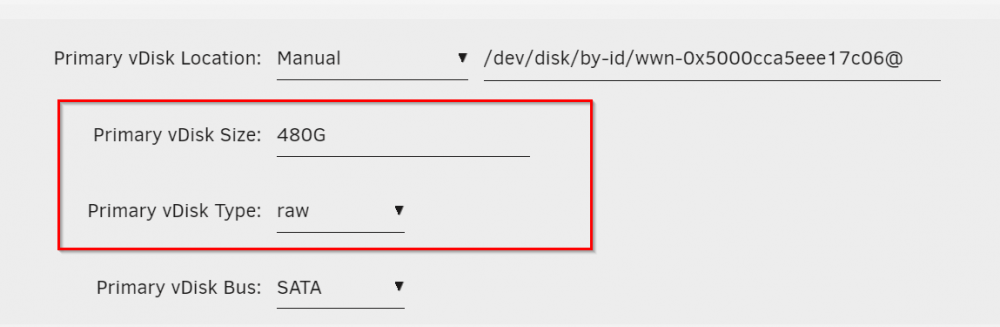
Hallo everybody. As the title suggests, I'm trying to boot my already installed Windows 10, occupying a single SSD, using it as a drive in a Unraid VM. I'm trying to follow those instructions, very useful so far: On this menu, however, I have a couple of settings that in the video are missing: Of course, they scares me out of my pants! What I should choose? In the primary Vdisk Size MAYBE I could put the actual size of my SSD (as in the picture I did), but I don't know what that Type means (raw/qcow2). I don't want to go on, 'cause I'm scared of Unraid erase the SSD when I create the VM. Can you help me with those settings? Thanks in advance, and have a great new year!
-
I'd love to insert me into this topic. I'm trying to make a change, substituting an old Qnap NAS with a different solution. I'm reading about Unraid, and hopefully could be a great choice. However, there's a single thing that I really need to be sure to have (or to emulate quite well): something similar to their QSync application. In short, it synchronizes (in almost real-time) all/some folder between the NAS and the client PC (so I see them as local folders and files); also, a very useful behavior (similar to the new OneDrive / Google Drive app installed on the client) is that I can sync all my 10Tb of data to my client PC, even in the PC I just have a 256Gb SSD, 'cause the folders and files are visible, but not physically occupying my local SSD until I click on them the first time; the application make a sort of transparent on demand "download", and now that file is actually even in the SSD. If I create new files in those folders, obviously I create them both in my SSD and in the NAS (it sync them as soon as possible, almost in real-time). Ok, I hope I was pretty clear in the exposition, and I hope you expert Unraid guys can suggest me if there's some combination of Unraid App + client app to emulate that QSync.

