





chaosclarity
Members
-
Joined
-
Last visited
-
I have a ZFS pool for my cache drives (not the standard BTRFS), is this supported from an upgrade from 6.12.14 -> 7.0 ? Thanks
-
Interesting observation! Thanks!
-
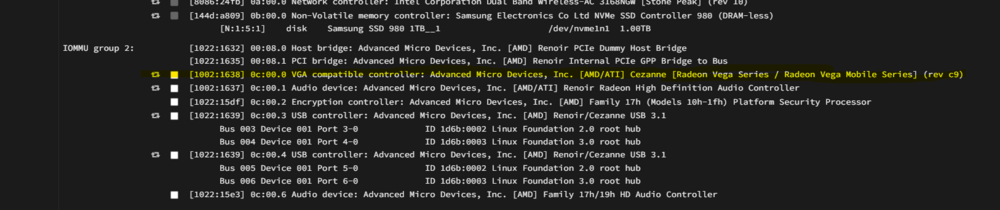
You shouldn't need to add that last part in the boot config - I'd remove that. As far as IOMMU goes, you only need to disable that if you've ever enabled it. Go to Tools -> System Devices, UNCHECK the GPU if it's got a checkmark next to it. You will need to reboot for that to take effect.
-
I've been trying to get this to work but not successful. I'm running a 5600G and when I edit the Plex docker to add the AMG GPU device I get this after saving it: docker: Error response from daemon: error gathering device information while adding custom device "/dev/dri": no such file or directory. Any ideas? Update: I fixed it - I had IOMMU enabled for the GPU, just needed to disable that.
-
Nice utility! I just tested a system of mine which has exhibited corrupt cache drives over the course of the last year and i've just been limping it along. Failures right at the start of testing! Thanks for making this plugin so easy to use.
-
Ahh thank you! But I thought this issue was resolved? I will check it.
-
I have an unraid server that was stable on (I think 6.10.x?) prior and after ugprading to 6.12.4 I can't keep it up for more than maybe 5-7 days give or take. It's completely unresponsive, no ping, no ssh access. Looking for some insight before I decide to roll it back to the previous version. I've attached my diagnostic logs for review if that helps. Thanks! jupiter-diagnostics-20231128-0753.zip
-
@JorgeB Should I be regularly scrubbing the cache drive pool? I just wonder how I got in to this situation. But it is a good exercise in knowing how to restore and keeping good backups.
-
Ok - I've re-added the original m.2 drive to the pool and formatted the drives, everything mounted now. I've gone ahead and started restoring a backup of all appdata content from back in June. From there I just need to re-add the docker apps from the Previous Apps section?
-
Hi Jorge, Thanks for your help - I've uploaded the latest diagnostics jupiter-diagnostics-20230706-0740.zip
-
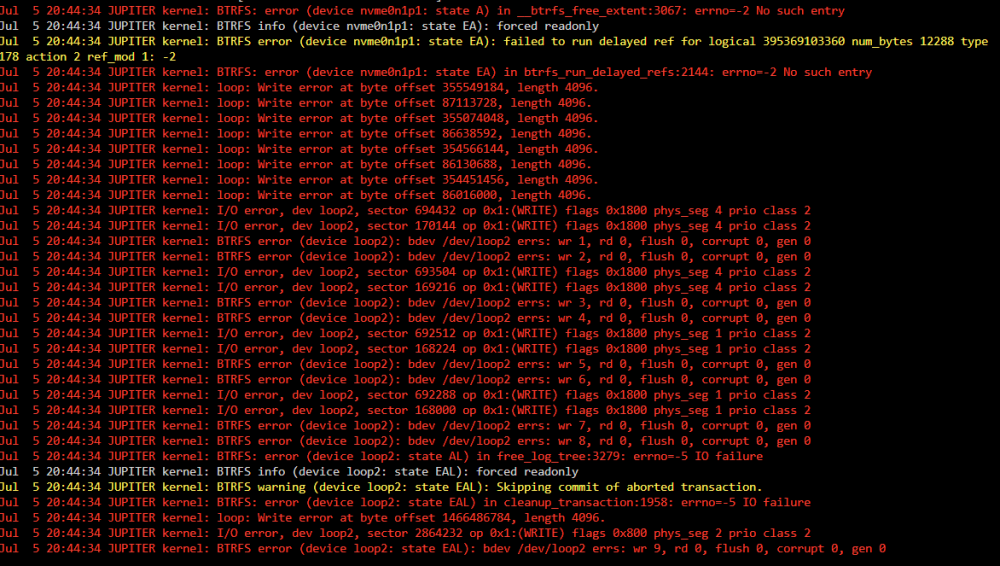
Well, new issue... I replaced the drive with a Samsung 980 PRO and had intermittent issues getting this drive to show up in Unraid. Initially it did, and I added it to the cache pool, started the array but again I received these BTRFS errors and the cache pool went to a Read Only state. I can't really tell if this is a hardware issue or a software issue in Unraid that's causing the issue. My real concern is that if I restore, this issue will come right back. I replaced back to the original m.2 drive, but if I start the array, my docker/vm's are all gone. Is there some way to recover what was on there? Sadly, my Veeam backup license expired 30 days ago and now all backups are about 30 days old. Better than nothing, but am I really SOL here? I was backing up the appdata folder - if I want to restore from my backup, do I just dump all that in to the appdata folder? And what's the best way of going about restoring the dockers?
-
Hi, Over the the past couple days I discovered an issue which prevented my cache drive pool (2x 1TB nvme ssd's) from working - it was on a read-only state. After rebooting it said there was no file system found. I was able to remedy this and get it going by performing this command: btrfs rescue zero-log /dev/nvme1n1p1 After performing this command and rebooting, it works for maybe 10min and goes back in to a faulty state. I then removed the drive nvme1n1 thinking it was faulty - ran the rescue command above, rebooted and all was well - albeit I only have 1 cache drive in my raid1 pool so I wanted to replace it with a new drive. I inserted a brand new Samsung 980 PRO in to that slot, booted up, added the Samsung drive to the cache pool, and now I'm back to having a faulty cache pool again. So... I guess the drive was never bad? But I'm not sure what is the issue here. I've attached diagnostic logs as well to the post. Appreciate any help and input! Thanks jupiter-diagnostics-20230705-2052.zip
-
Preface: Server 1 had a psu die, which took out the cpu. I replaced the psu and cpu (switched from a Ryzen 3700X -> 5600G).. ok boots up now and Unraid back in business. Server 2 was working perfectly fine during this whole time, no issues. Now, tonight I notice that both servers Active Directory Join Status is "Not Joined".. I have 2 domain controllers, 1 on each unraid server. Ok, simple enough, I type in the admin password and click "Join"... they both sit there waiting, waiting, waiting for several minutes.. then I noticed both Unraid servers not responding to web gui any more. I press the power button on both to gracefully shut them down to avoid a parity check. They both shut down, I bring them back up and now neither one of them will let me in to the VM tab without freezing the web gui input. The dashboard screen won't show and Docker or VM info. Albeit, the Docker tab works fine. I noticed Server 1 will eventually show VM and Docker info on Dashboard, some VM's are indeed running (from autostart), but when I click on one of them to start, it took FOREVER... eventually it did start. Server 2, haven't gotten any VM or Docker info on Dashboard to show. I attached my diagnostic logs for both servers if that helps. jupiter-diagnostics-20221015-2152.zip tower-diagnostics-20221015-2151.zip
-
I have one of my DNS servers down at the moment, which just so happens to be the 1st DNS server configured in Unraid's Network Settings. I have the 2nd and 3rd entries populated with working DNS servers, however I have noticed some Docker containers taking forever to resolve things and/or failing, then working later on. Is this normal behavior? Should I just stop the Unraid server and swap out the 1st (or just remove it) so Unraid doesn't attempt to use it? I also fail to see the point in having multiple if it cannot quickly failover to a 2nd or 3rd.
-
Can you post your XML?


