Kru-x
Community Developer
-
Joined
-
Last visited
Everything posted by Kru-x
-
Ill think you find it running much smoother in a container, instead having a full blown Operating system you use the minimal one in the container. The WP container is the the official container in the docker hub https://hub.docker.com/_/wordpress, very smart guys maintaining it. My site is getting high scores when bench-marking the site even thought my unraid server is a 10 year old HP micro server with 8MB ram. Ok my site is not a high traffic site but I am really impressed of the performance and love the setup, can fire up a copy or a new site in minutes and toss them away when I am done with them. Sold? Kru-x
-
Hi Sjored, Using a docker is less hassle then you think, it's dead easy to use and really versatile, like eating a cake with out have to make it first :-), might take a little bit to get your head around how to make a docker container if needed but it is not that complicated. This docker has PHP Version: 7.3.6 MySQL Version: 5.5.5 Web Server Info: Apache/2.4.25 (Debian) As for the libs, WP has all the libraries that it needs and most of them as per your list above. If you for some reason need another one you have to ad them and to your own container. Not often I have needed though, but I have used some external libraries and have both made my own docker container and used some in my plugin. WP updates just like normal, under the update tab! Hope it helps, Kru-x
-
Glad it worked, the username and password if you are talking about in the template is there for if you change the DB continers username and password, as you have it now it is using "root" and full access to the DB, not the safest approach in DB's. Sorry I don't follow your setup, you can access it from one VM but not the other on the same server? Dunno,
-
If you want to use different IP addresses then that is over my head, only had to worried about it ones myself. But if you are trying to bridge them on the same IP then it should work, And sorry, I told you to use wordpress as user and password but forget that, just leave them blank and they defaults to root with blank password. Make sure password in the MariaDB is set to 0 eg blank password, its only if you have changed it and the username you have to add it to the WP container. The problem with "Error establishing a database connection" means that WP is actually talking to the DB but can't login (the above problem). That it defaults to 8080 is probably a redirection from WordPress, have you ever managed to connect to the installation screen B4? Probably easiest to start from the begining again, delete both folders in your system and reinstall them again, The basic settings should be as easy as the attached photos. Hope it helps,
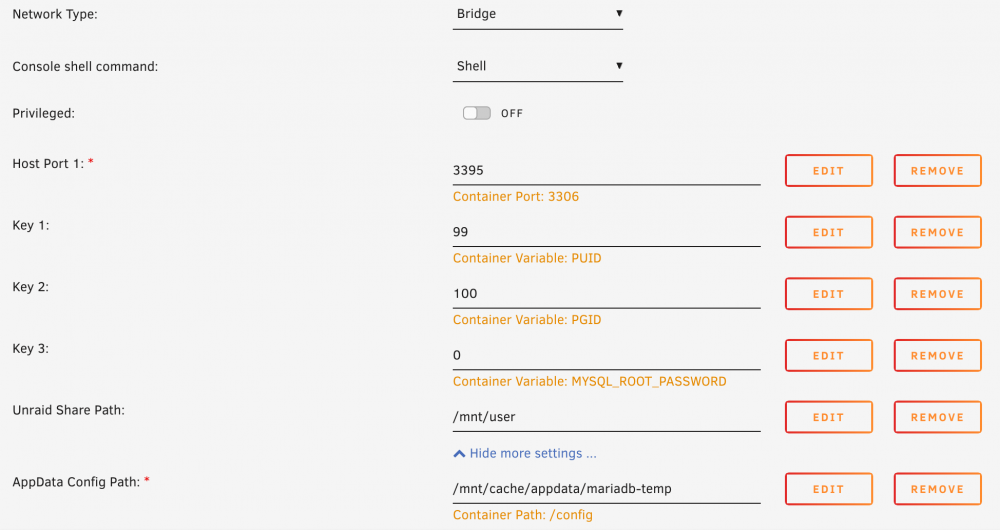
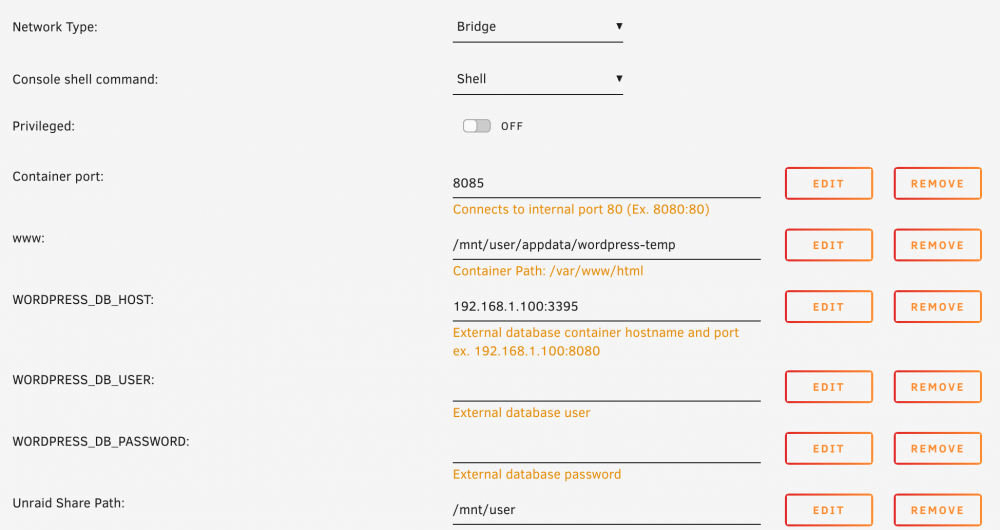
-
Hi lusitopp, There is a few issues and none of them is related to the container nor unraid, but we have all been there so don't be alarmed. First, the IP address is the physical address to the computer (server) and should not be changed as you have done, most docker containers should be on the same address as your server and should be in "bridged" mode. Only in certain advanced situations a containers IP address should be changed. To reach a container and if your servers IP address is as mine 192.168.1.100 you just add the :port number at the end for each container. So to reach the WordPress container you should ask for 192.168.1.100:8080 in your browser. All containers have to have different port numbers and that is when you change the 8080 if that is already in use of another container (or unraid), the unraid web interface is on port 80. If you have changed the port number unraid should pick that up when clicking on the Icon but that can also be changed in advanced settings WebUI: and by default it is "http://[IP]:[PORT:8080]/" to automatically be picked up. So install the MariaDB container with port 3306 (default port numbers for DB's in most cases) if not in use, then in the WordPress container where it says WORDPRESS_DB_HOST: add your "server IP":port eg 192.168.1.100:3306 and then WordPress can talk to the DB container. You also have to add DB_user and Password and if you have not changed it in the MariaDB container you can use "wordpress" as the user and the same for password. Then when clicking on the icon it should direct you to 192.168.1.100:8080 and WordPress can talk to the database in the background and you can continue installation and use it locally. PS. do not use 443 as the port, it is used as the SSL port (HTTPS) if you want to reach it from internet and should not be used internally. Remember the port is a internal pointer to a specific container/interface on your server (IP adress) all my containers is in the range of 8000 - 8099. Hope that answer your questions, Kru-x
-
Did it connect without problem B4 starting the WP installation? Eg did you see the trusted site icon when you came to the installation screen?
-
I'm running out of ideas, a 504 error is a slow "server" error or no response, might be Nginx, have you changed a lot in NPM? Else I don't know, all the ones I have done I have never run in to a 504 error. I use docker on my laptop as well and it works mint, so doubt that it would be docker slowing it down. Sorry I'm in the dark on that one! Reinstall???
-
Glad you figured it out, but I can't figure out how any one would need to upload more than that 128Mb at a time. 🙂 Kidding, assume you have your reasons, and I guess you changed the upload file size in httacess or something. I am not sure about that, if not WP it can only be Nginx, I know in NPM you can add directive directly in the form. MaxUploadFileSize maybe! Kru-x
-
Happens to us all ;-), you could fiddle around with wp-config but I find it easier to start from the beginning as it seems like u did. It should work when you can create a new cert, if not reach out again and ill try to help. kru-x
-
Hi, Have you forwarded the port 433 in you router to the https port in NPM? Did you do a clean install of WP where it uses your HTTPS address? Kru-x
-
Hi Epodox, Sorry for the long delay in answer, The message you see is a normal message as WordPress is working in an enclosed environment of docker, as it says you can suppress the message by global directives (google it). You can disregard it an not worry about it as it has no affect on how WP is working. You say that you can't load the setup anyway but it has nothing to do with the above, just try to delete the both folders (WordPress & mariaDB) and start from the beginning making sure you have the right address and ports. Hope it helps, Kru-x
-
I'm not sure about MySQL as I never used it myself but it should work similar, guess you have a reason for it? Else I would recommend the mariaDB. It is usually a permission problem as this links suggests: https://stackoverflow.com/questions/50026939/php-mysqli-connect-authentication-method-unknown-to-the-client-caching-sha2-pa . Are you adding the MySQL DB container in the template? Is the Database in MySQL named 'wordpress"? Have WordPress full read and write access? I would try to leave the all the DB parameters blank in the template, then login to MYSQL manually and create the DB, Username, password & permission manually. If the parameters are blank in the template the WordrPess installation would ask for the connection parameters. Hope it helps, Kru-x
-
Hi Ingarb, This is a common problem and not a specific problem to docker or unraid, it is tons of information online how to rectify this problem. There is several solutions, an easy one upload the plugin manually (just unzip the plugin and toss the folder in to your wp-content/plugin folder). You should keep away from change anything in the container as any changes will be deleted each time you update it and even if you could "link" the file to the outside you are in for trouble. Don't even know if the file is in the container, but you could always poke around by ssh in to it. You are looking for a solution in the wrong place, it is an easy one and several of them, one i think I have used is to add command in to the .htaccess file. Kru-x
-
-
With containers it is dead easy, just fire one up or as many as you like, if you don't want to have it anymore just toss it away and make another one. As for the DB question: There is a few ways, just create a new MariDB container and name it differently, then start a new WP container with another name in the template. Eg just do the same as the first one you did but both container with different names (and off course with different :port). You technically could use the same DB for all different WP instances but I would not recommend it if you don't have a good reason for it. To do, just leave the DB field blank in the WP container template, then at startup you would be presented with WP installation guide, there you can choose where the DB is going to be and what name of the DB you would like. The default is the catching name "wordpress" 🙂 Hope it explains!
-
In that case it should take you to the wordpress install, guess it is the DB so in appdata/ delete the folder "wordpress" and the folder "MariaDB" or whatever you named your db installation to. Reinstall all and when you have it working to connect to it internally try yo connect as per above (NginxProxyManager). Don't even bother to do the wordpress installation until your external connection is working, so when you can connect to WP externally then start the WP installation and use your DuckDNS address
-
Do you mean when you are clicking on the icon? What ip address is unraid on?
-
Smart man your dad :-), download the docker NginxProxyManager and try it from there first, if you can connect internally you should easily connect to it from within NPM, you add your external domain and proxy it to your internal IP address by add a new proxyhost. And remember that most data added to WP is saved in the database, so if settings like your domain you added is still causing problem also delete the MariaDB files when reinstalling.
-
Are you using "Unraid" as a server?
-
That can be changed in wp.config, if it is a site you have worked on, if not just remove the appdata/wordpress and restart the container it again = new install. And are you using 80 as a port, you have that in your .conf file? It is usually used by unraid UI
-
Make life easy for you, use "NginxProxyManager", search for it in "Apps (Community Applications). I guess you have an https://myaddress.com, then in NginxProxyManager just point to the WordPress container's internal ip adress. Just read your .conf file, have you got WP working internally? Eg. can you connect to it by the internal ip address:port?
-
"WordPress is an open source software you can use to create a website, blog, or app." Used it on unraid for years for development, but also works fine in production, The only "flaw" that I have found is that the WP instances only see the internal IP address, not the external ones eg. WP can not see the ip address of the remote computer. I know it is a solution but have not found a good one yet (IF anyone do, please let me know) Please use this support for unraid/docker issues/questions only, WordPress itself have a huge community to answer all WordPress related questions.
-
Sorry, I'm away from my computer 4 a few days. But read the previous threads, most likely you got the new version of wekan and docker that don't support the "-link". It changed, but all of that is discussed in the last few threads. Let me know if you figure it out, else I step you thorough it in a few days time. Kru-x
-
What have I done wrong Sir??? 🤣 Fixed, tahnks
-
Bugger, forgot to put in the support start tag, thanks for pointing this out. I moved your post to the right forum and answered you there @ https://forums.unraid.net/topic/86922-support-kru-x-godaddy-ddns/ R Kru-x