





TristanP
Members
-
Joined
-
Last visited
-
unRAID has the ability to send system notifications via email. However my SMTP service provider requires SASL to be able to authenticate. How do I go about setting up SASL so unRAID can use my provider to be able to send email?
-
Finally got time and puled the LSI SAS controller with no change. I them pulled the SAS Expander card (HP 468405-002) and disconnected it from the MB. Now I get a new error: That's after I redid the original USB with the latest unRAID writer (See above). Gotta admit....This is a new error for me.
-
Thanks for the suggestion. Now off to trial and error
-
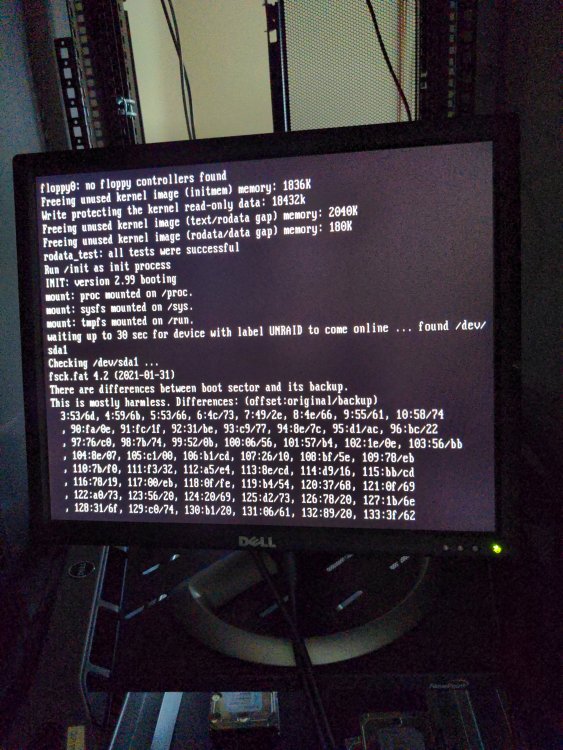
Did the above. No change from the new one. Here's a screen shot of the console (Wish I could get the entire output):
-
Just to make sure: - Copy the /config directory off the flash drive - Use the unRAID USB creator to rewrite the 6.11.5 version back on the stick - Copy the /config directory back Sorry for being dense but before I do destructive operations I want to make sure I understand the process.
-
I'll give it a shot. I thought the license was tied to some unique id on the USB stick though, So I downloaded the USB creator, created a new flash drive with the correct version (6.11.5) and copied the old /config folder onto the USB /config. Unfortunately it seems to have gotten worse. There are now dozens of listings after this text: instead of just the one prior. And there it sits. It's wondering what is going on that annoys me. Sigh
-
I shutdown my unRAID machine to remove two unneeded disks and reroute cables. That went smoothly and the SAS controllers showed the right drives on the right interface. While booting it spit out the following: And there it sits. Pushing 30 minutes now. Any ideas what may be going on? Do I interrupt it or let it run. I am using unRAID v6.11.5. Thanks.
-
You're not kidding that the documentation is crappy. But I did as you suggested. Now off to see if I can tweak the api docker. EDIT: Once I did this and restarted the API docker it created /app/vikunja/files/[config|data] directories and created the default config.yml file. Now I have two But which one gets precedence? I wonder if I can unmount /etc/vikunja and it'll use the files and directories it just created.
-
I have two questions about the vikunja-api container. Thanks to LTM I have the front end and API dockers working and talking to each other. The first is: how does one create an admin account? I can create normal users but not an admin account The second is: There's no config.yml anywhere in the api docker image. If I create a new one where does the docker image expect it to be?
-
It doesn't unfortunately. All it does is demand a server location, even if none are listed (Even after a restart of the docker container).
-
Running unRAID 6.9.2 I goofed up my Jellyfin docker config (Linixserver version) so I uninstalled the docker and deleted the directory in appdata. However on reinstall the docker container said there was an existing server on unRAID and would not kick of the first time install script. I repeated the above process and used a different jellyfin docker image (Jellyfin's direct official image) and now I have two. Each instance is using an unique string (I'd say GUID but it's not the official MS format) that doesn't seem to exist anywhere on disk. What can I do to convince the docker engine to remove these "ghost" servers? I tried rebooting unRAID to no effect.
-
Running unRAID 6.9.2 I have removed the Jellyfin docker image and the directory in /mnt/user/appdata. However after reinstalling the image instead of going through the usual initialization process it asks for a server. I give it the IP and port of itself and shockingly it is unable to log in. What am I missing to convince Jellyfin to go through it's initialization process?
-
Can someone tell me where the Nextcloud error logs are located? This latest version reports that the "Community Document Server" and "Talk" fail to install when the docker image is installed. However after login I see both listed under Apps but when I click on "Remove" Nextcloud reports "an error occured". Can't diagnose when the error message is "It's broken".
-
I've installed the latest docker image and attached it to a mariadb but when I go to apps I do not see the openoffice app. Isn't that installed by default? EDIT:I have two unRAID servers (Both 6.8.2 and have the local mariadb set up for Nextcloud as per SpaceInvader One's video) and I got different installation results after some testing. On machine #1 (GIGABYTE GA-7PESH2 w/2 E5-2630L v2 @ 2.40GHz and 128G Memory) the docker downloads, I put in the mariadb info, I can see some spinning as it works through to the document server, and the the web page throws a timeout. Refreshing the page I can log in with the admin account, but there's no sign of openoffice On machine #2 (ASUSTeK COMPUTER INC. P8Z77-V PRO w/i5-2500K CPU @ 3.30GHz and 16G Memory) the docker downloads, i put in the mariadb info, it spins through all the apps but complains that the Community Document Server and Talk fail to download/install. In this case OpenOffice can be seen. Any ideas why I'm seeing different install issues (Neither are error free)
-
Has anyone else noticed that if you create a second VM share the "Updating" button stays grayed out and never updates the VM config? The first share works fine but the second one just sits and hangs...
