





bryce2113
Members
-
Joined
-
Last visited
Everything posted by bryce2113
-
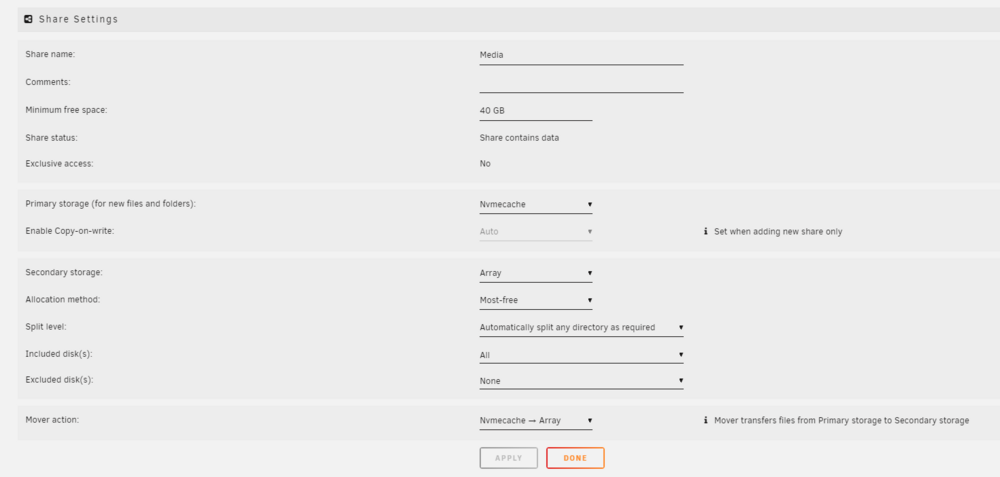
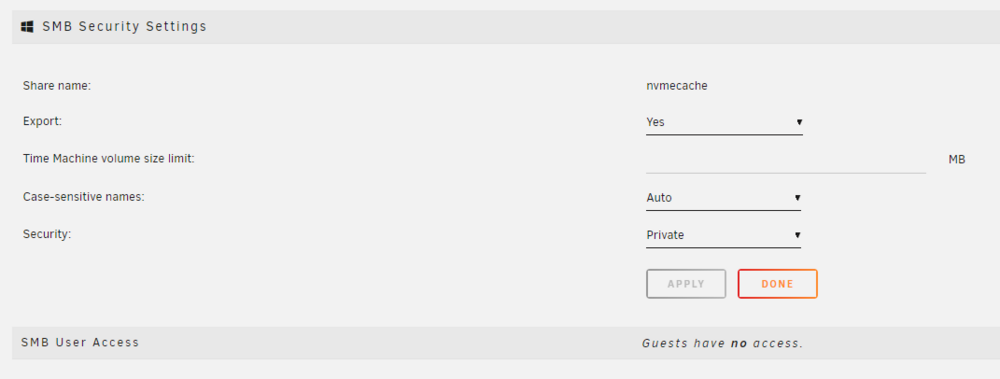
Thanks but I'm not following. I have disk shares enabled. In Shares, under "Disk Shares" I've opened the correct Pool (named Nvmecache), set Export to Yes, and granted appropriate permissions under SMB User Access. I'm able to map the Pool in Windows but once the mover runs the folder structure from my User Share (FUSE) I need to use in order to copy the files without FUSE onto the User Share disappears. That was the issue I was describing above. I've tried creating a User Share where the Pool (Nvmecache) is set for Primary Storage, with nothing in secondary storage. This does not yield anything-- - which I expected. I'm not sure what you are suggesting for sharing a Disk Share via SMB such that when mover runs the folder structure used on the normal User Share is preserved. I'm not sure how to share the Nvmecache pool in a manner that does not delete the top level folder for the User Share when the mover runs. When I copy a file to the User Share via SMB using FUSE the Disk Share via SMB will have the correct top level folder for the User Share naming. But once the Mover runs that disappears. For added context, the User Share (FUSE) I'm trying to bypass here is a User Share named Media. It has the Nvmecache as Primary Storage and the Array as teh Secondary Storage. Mover action is Nvmecache --> Array. I was thinking that to avoid the top level folder (for the FUSE / User Share) from disappearing on Mover, there would be a way to add a file to the User Share that the mover ignores. Adding photos below. Here is the User Share Settings: Here is the Disk Share Settings:
-
Is there a way to force the drive (in my case the NvmeCache) to keep the folder with the name of the User share present so I can copy directly to the disk? For example, my ultimate target destination is a user share named BluRay. Plex uses this folder in the User Share for my media library. So long as I first copy a file to the User Share (location BluRay) I can see the folder in NvmeCache (disk share) and the files I've copied to the User Share so far. But once the mover runs the BluRay folder on the NvmeCache disk share is deleted. I'm guessing I could create the folder on the NvmeCache disk share each time I need it, but I run the risk of misnaming it or something else such that the files are not ultimately routed to the Array when Mover runs. Is there a way to correct this? Perhaps by having a file added to the user share that the mover does not move? Such that NvmeCache disk share always has the correct folder structure I need to copy files directly to the disk share but know they will ultimately land on the Array like I want.
-
Thanks. I already had it set to Performance.
-
I played around some more and am certain this is likely a FUSE issue. I enabled Exclusive Shares in Global Share Settings. I then created a share using only my NVME Pool has the Primary Storage, Secondary Storage set to None. SMB transfer was ~700MB/s. On the same share I selected the Array as the Secondary Storage, which skips Exclusive Shares option (i.e. uses FUSE again). Transfer speeds ~400MB/s. Not sure there is a great permanent way to avoid FUSE with a share that uses an NVME as primary but relies on Mover and the HDD array for storage.
-
Nope, still having the same issue.
-
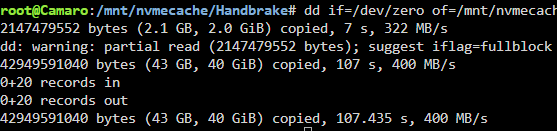
Picking this back up again. I ran this command, but changed to use a 16GB .mkv file. Max transfer was right around 400MB/s, which is coincidentally the max speed I'm seeing over SMB. No clue what's going on other than this likely points to some internal issue within Unraid. Which I pretty much already knew since iPerf results are right around ~9gbs. After 10+ years on Unraid I'm seriously consider switching to TrueNAS to get speed back.
-
Thanks. This sent me down a whole rabbit whole of tweaking & testing different settings, both in Unraid and in the Bios. TLDR--I'm not getting almost 400MB/s transfer speed. I think most/all of this was from Bios tweaks to Cstate, ACPI, HSMP support, etc. settings in my board's BIOS. I can confirm with grep that the CPU's cores are not boosting up and down as expected. I did not test with grep before but have a suspicion that the BIOS/board was controlling the the Cstates and boosting. Interestingly disabling NIC offload in the TipsAndTweaks settings halved my transfer limit to about 200MB/s. At this point I'm going to leave it alone until I get the itch to dig deeper. Something is still up since I should be able to match the 700MB/s transfer I get on the test server which has slower and much older hardware overall.
-
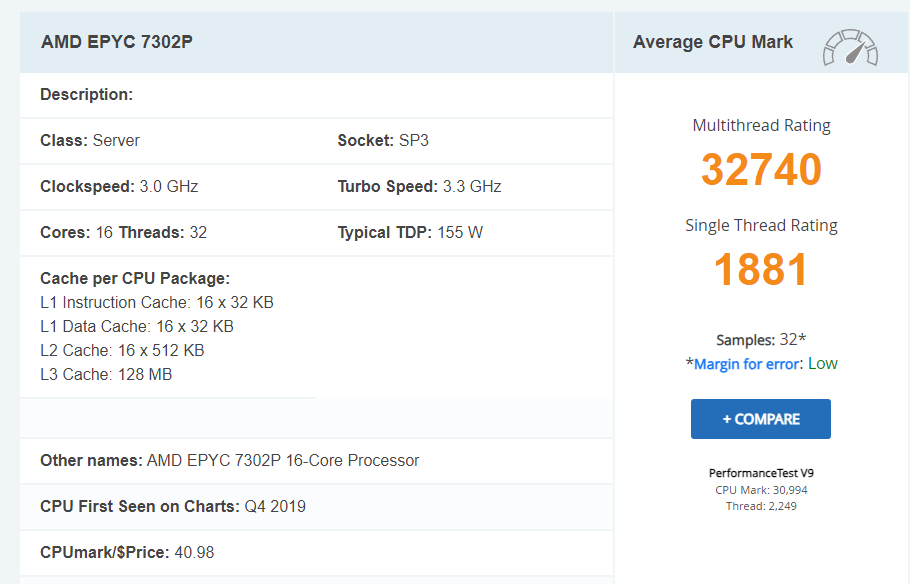
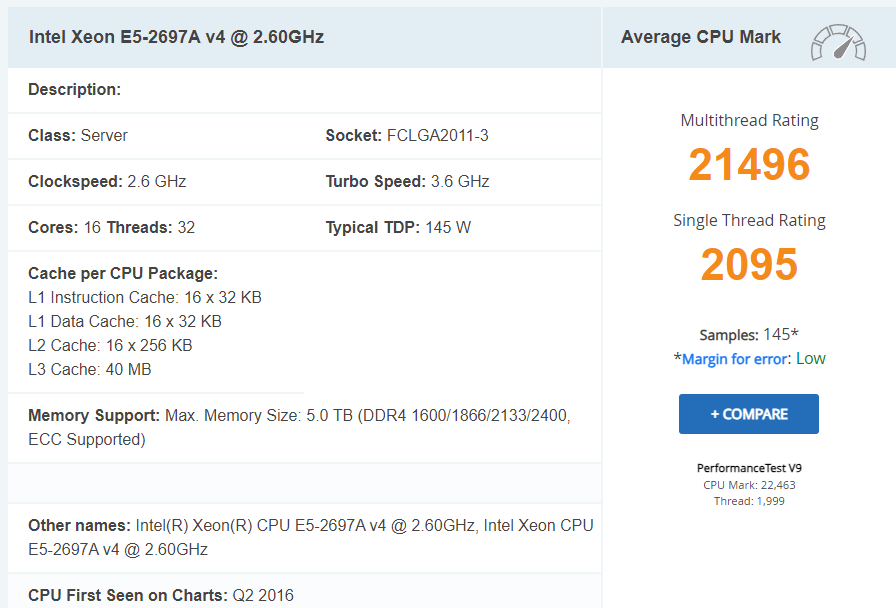
It's not even pinning one CPU core though during the transfer. That and the single threaded performance of the EPYC 7302P is only slightly lower than the single threaded performance of the Xenon 2697A v4. The performance difference in single thread IPC should not equate to a more than 50% decrease in transfer speed?
-
It looks like I have a hardware issue of some kind. On the main server I unplugged the HDD array and used the Unraid USB from the test server. Essentially re-created the test I did with my other server but on my main server. I had the same ~300MB/s transfer speed whereas on the test server I got ~700MB/s. I can't explain it either. The BIOS on the main server is up to date and I've even reset all BIOS settings to Optimized Defaults through this process. The issue has also persisted when I moved Unraid from a dual Xenon 2997 V2 setup to the current AMD EPYC 7302P. I'm wondering if there is something within Unraid that's not utilizing the EPYC CPU properly?
-
Yes and the CPU looks to be barely doing anything. Its AMD EPYC 7302P. The test server is running dual Xenon 2697A v4. Much higher core count in the test server but the IPC on the EPYC trounces it.
-
Why does the test transfer on the other server using user shares achieve the expected ~700MB/s but my main server does not?
-
As noted, I've run same transfer with VM and Docker services off with the the same exact results. And I'm the only user and no other services run on the server when VM/Dockers are off.
-
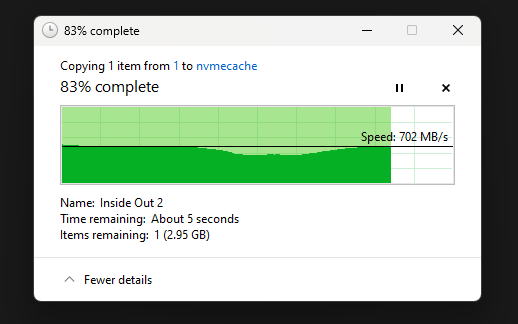
I just turned on Disk shares and copied same file to the main NVME cache and achieved ~700MB/s. See below image. What does this point to as the issue? I've created user shares on the main server that only have the same NVME drive for the share and get get the same slow speeds.
-
As title suggest, I'm having a really annoying issue where I cannot get my Windows to Unraid transfers via SMB above 300MB/s using an NVME cache and NVME drive on Windows. This issue has been going on for quite awhile now and across multiple hardware changes (incl. full CPU/Mobo/RAM change). But I finally have some time to dig in and fix it. I've spent the better part of a day troubleshooting. Log/Diagnostic file is attached. I've tried all the usual tweaking on Windows and Unraid with no difference. See more details on that below. The most odd thing here is I have a spare (well lots of spare) server that I created a brand new Unraid USB on and booted it up with a single 256GB nvme drive and standard Mellanox ConnectX3 card. I did absolutely no tweaks on the Unraid system. Just simply created an array using the single NVME drive, created and export a share using that array, and did the same 18GB MKV file transfer from Windows. I immediately hit ~700MB/s on the transfer and it stayed consistent. I moved that same NVME drive (which is in a PCIE to NVME adapter) to my main server, created a new pool with it, and created a new share that only uses that new pool. Same transfer capped out at 300MB/s---the same speed as the other transfers. Another oddity here is transferring to a share that uses a SATA SSD as cache has the same exact transfer limit. Oh and its not the network cards because the card that I used in the new server setup came from my main server. I figured the NIC could be bad so I replaced with a dual SFP+ ConnectX3 card. Also used different SFP+ direc cables with no luck. Tried swapping to different ports on my Unifi switch, same results. All three devices (windows PC, main Unraid server, and test server) are connected to the same Unifi pro switch. Based on the above and below testing, I've concluded it is some sort of configuration error in my main Unraid server. I've look at all settings in the main Unraid server and made sure they matched up to the new test server that had the normal speed. The server's config has been the same since like 2013/14 when I first started using Unraid. It's transferred from/to multiple USB drives and at least three prior system overhauls. At this point I'm hoping someone has a saving grace idea. Otherwise the only other option I see is to reset Unraid to factory (while hopefully preserving my Docker and VM items). Main server details: Tyan S8030GM2NE Board AMD EPYC 7302P 64GB DDR4 ECC RAM Mellanox dual ConnectX3 10G SFP+ NIC Main array with 6 data and 2 parity drives WD Red 500GB SSD -- Cache -- Used for docker, appdata, VMs, etc. Two 1TB nvme drives in RAID 0 (I've tried each on their own)--Samsung 980 (non-pro) and Corsair P3 (non-plus) Silicon Valley Gen3 256GB NVME (installed for testing purposes) Other troubleshooting I've tried: iPerf3 -- I've tested this six ways from sunday and all my network tests look normal Windows to main Server -- Normal test shows ~9.45 gig transfers Windows to main Server -- 4 parallel connections total about the same 9.45 gig Windows to main server -- reverse test has same results Windows to main server -- Bdir has same results Windows to test server -- Running all the same tests as above I get practically the same results (test server is fractionally faster) I've done all the normal network tweaking MTU all on devices and Unifi network set to 9014. Interestingly I did not change the MTU on the test server when it hit ~700MB/s. Changed all the settings on Windows NIC (flow control disabled, RSS enabled, enabled all the offload options, etc.). These settings worked for the 700MB/s test transfer. I've ran the transfers on the main server with all Docker contains stopped, VMs stopped, and then disabling both Docker and VM services. Made absolutely no difference. Transfers to the SSD Cache, NVME Cache, and test NVME drive all have the same transfer speeds (270-300MB/s) for the same file coming from the same location on Windows nvme drive. Transferring between the NVME cache and the test NVME drive using Krusader (using shares that use the two caches as primary) I get 500-600 MiB/s which seems plenty normal. camaro-diagnostics-20240823-2308.zip
-
I'm having the same exact issue, but with a custom weekly schedule 06**0 -- weekly rsync to run every Sunday at 6AM. I've tested with some other custom date configurations and no luck.
-
Try typing in "coretemp" in the "available drivers" field. That should fix it. I had a similar issue happen when I updated to the latest plugin version.
-
Is there anyway for Dynamix System Temp to monitor dual Xeon CPUs? In the System Temp menu under "Processor Temperature" I see all 24 cores and the "CPU Temp". I tried to change the "Mainboard Temperature" to read one of the Cores off the second CPU but after clicking apply it always reverts back to the "MB Temp"--which makes sense in a way but is annoying. Is there a way to add a second "Processor Temperature" so I can see the temps on both CPUs? I did a search and did not find any solutions. Sounds like it was added as a request back in 2017 but no word on implementation.


