





jugaadkabaap
Members
-
Joined
-
Last visited
-
Got my Monterey running with HD7950 - all is well so far. Working Graphics Sound Wifi Bluetooth iMessage Biggest issue Whenever the OSX goes to sleep (esp deep sleep) thereby making the VM goes to paused state - its impossible to get it resume. Even if I manually make the VM resume - no display and OSX isn't responding to keyboard / mouse. How can I optimize power controls? Other optimizations Continuity & Airdrop is not working - is there a way to make it work with onboard wifi / bluetooth adaptors (X570 AORUS Elite wifi with intel chipset) Natively pass 3700X to guest and enable all features? I went through Pavo's GitHub but kinda have hard time adapting my Macinabox install to that. Can someone lend me a helping hand ?
-
Is the guest OS running properly or is performing something like installation / deep sleep states etc ? If latter, the shutdown signals doesn't gets responded - I dunno why. But it had been my experience
-
Go through changelog and find the one corresponding to your EFI. If you installed macinabox (new version) very recently you will be at Opencore 0.79 and corresponding configurator should be 2.57
-
Happy to report that I could get everything working on Monterey. It took a solid week but at the end all is well. As of now, GPU (HD7950) running fine on Monterey with no reset bug. Onboard Wifi working Onboard Bluetooth working Onboard Audio working iMessage working Improvements to be worked on AirDrop & Continuity - not yet working Geekbench scores aren't great - need to fine tune them. But overall happy :)
-
Okay, sorry. I had no clue you were running High Sierra. To answer you (assuming you don't go into rants of swearing ) 1) You need to use the Open core configurator corresponding to your EFI version. You downloaded latest open core configurator - you need to go back and figure out which version matches your EFI. 2) Once you figure out your EFI situation, you need to remove your EFI Partition & Installer from your XML config so that it boots from your HDD (in your case 'Hackintosh') and then set time out to something like 1 or 2 seconds via OpenCore Configurator or ProperTree Misc -> Boot -> Timeout.
-
Don’t waste any more time 1050Ti Is not supported at all. you can continue with ONLY VNC or get an AMD or legacy (Kepler series) NVIDIA gpu
-
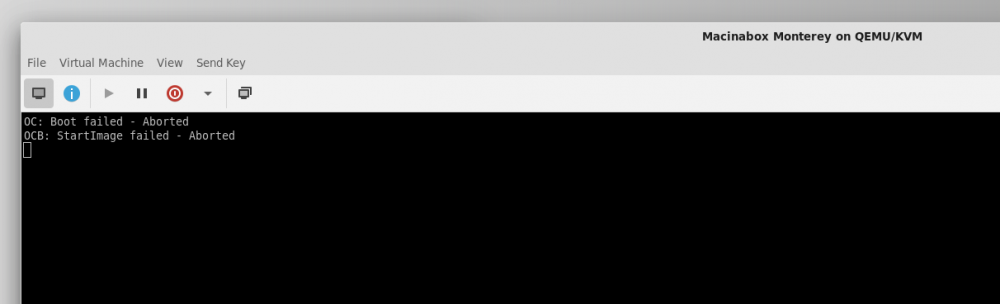
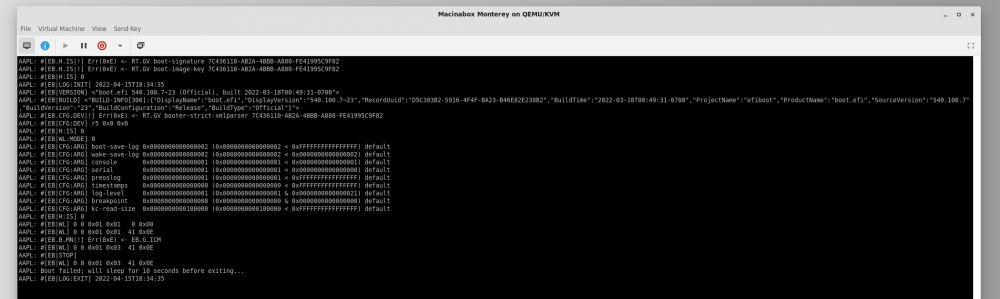
I had been dangling with a lot of issues with my GPU's - almost everything got sorted out. Still Hackintosh fails. I am able to install Monterey and access it with VNC as primary GPU. When I am passing through my HD7950 (flashed with UEFI supported rom) - I don't get any output. Troubleshooting with VirtManager VNC viewer shows this. XML is as follows <?xml version='1.0' encoding='UTF-8'?> <domain type='kvm' id='6' xmlns:qemu='http://libvirt.org/schemas/domain/qemu/1.0'> <name>Macinabox Monterey</name> <uuid>763cd8b0-212b-4190-88e1-5e130374054c</uuid> <description>MacOS Monterey</description> <metadata> <vmtemplate xmlns="unraid" name="Windows 10" icon="Monterey.png" os="osx"/> </metadata> <memory unit='KiB'>12582912</memory> <currentMemory unit='KiB'>12582912</currentMemory> <memoryBacking> <nosharepages/> </memoryBacking> <vcpu placement='static'>8</vcpu> <cputune> <vcpupin vcpu='0' cpuset='0'/> <vcpupin vcpu='1' cpuset='8'/> <vcpupin vcpu='2' cpuset='1'/> <vcpupin vcpu='3' cpuset='9'/> <vcpupin vcpu='4' cpuset='2'/> <vcpupin vcpu='5' cpuset='10'/> <vcpupin vcpu='6' cpuset='3'/> <vcpupin vcpu='7' cpuset='11'/> </cputune> <resource> <partition>/machine</partition> </resource> <os> <type arch='x86_64' machine='pc-q35-4.2'>hvm</type> <loader readonly='yes' type='pflash'>/mnt/user/system/custom_ovmf/Macinabox_CODE-pure-efi.fd</loader> <nvram>/etc/libvirt/qemu/nvram/763cd8b0-212b-4190-88e1-5e130374054c_VARS-pure-efi.fd</nvram> </os> <features> <acpi/> <apic/> </features> <cpu mode='host-passthrough' check='none' migratable='on'/> <clock offset='utc'> <timer name='rtc' tickpolicy='catchup'/> <timer name='pit' tickpolicy='delay'/> <timer name='hpet' present='no'/> </clock> <on_poweroff>destroy</on_poweroff> <on_reboot>restart</on_reboot> <on_crash>restart</on_crash> <devices> <emulator>/usr/local/sbin/qemu</emulator> <disk type='file' device='disk'> <driver name='qemu' type='qcow2' cache='writeback'/> <source file='/mnt/user/domains/Macinabox Monterey/macos_disk.img' index='1'/> <backingStore/> <target dev='hdc' bus='sata'/> <boot order='1'/> <alias name='sata0-0-2'/> <address type='drive' controller='0' bus='0' target='0' unit='2'/> </disk> <controller type='usb' index='0' model='qemu-xhci' ports='15'> <alias name='usb'/> <address type='pci' domain='0x0000' bus='0x00' slot='0x07' function='0x0'/> </controller> <controller type='pci' index='0' model='pcie-root'> <alias name='pcie.0'/> </controller> <controller type='pci' index='1' model='pcie-root-port'> <model name='pcie-root-port'/> <target chassis='1' port='0x8'/> <alias name='pci.1'/> <address type='pci' domain='0x0000' bus='0x00' slot='0x01' function='0x0' multifunction='on'/> </controller> <controller type='pci' index='2' model='pcie-root-port'> <model name='pcie-root-port'/> <target chassis='2' port='0x9'/> <alias name='pci.2'/> <address type='pci' domain='0x0000' bus='0x00' slot='0x01' function='0x1'/> </controller> <controller type='pci' index='3' model='pcie-root-port'> <model name='pcie-root-port'/> <target chassis='3' port='0xd'/> <alias name='pci.3'/> <address type='pci' domain='0x0000' bus='0x00' slot='0x01' function='0x5'/> </controller> <controller type='pci' index='4' model='pcie-root-port'> <model name='pcie-root-port'/> <target chassis='4' port='0x13'/> <alias name='pci.4'/> <address type='pci' domain='0x0000' bus='0x00' slot='0x02' function='0x3'/> </controller> <controller type='pci' index='5' model='pcie-root-port'> <model name='pcie-root-port'/> <target chassis='5' port='0xa'/> <alias name='pci.5'/> <address type='pci' domain='0x0000' bus='0x00' slot='0x01' function='0x2'/> </controller> <controller type='pci' index='6' model='pcie-root-port'> <model name='pcie-root-port'/> <target chassis='6' port='0xb'/> <alias name='pci.6'/> <address type='pci' domain='0x0000' bus='0x00' slot='0x01' function='0x3'/> </controller> <controller type='pci' index='7' model='pcie-to-pci-bridge'> <model name='pcie-pci-bridge'/> <alias name='pci.7'/> <address type='pci' domain='0x0000' bus='0x01' slot='0x00' function='0x0'/> </controller> <controller type='pci' index='8' model='pcie-root-port'> <model name='pcie-root-port'/> <target chassis='8' port='0xc'/> <alias name='pci.8'/> <address type='pci' domain='0x0000' bus='0x00' slot='0x01' function='0x4'/> </controller> <controller type='virtio-serial' index='0'> <alias name='virtio-serial0'/> <address type='pci' domain='0x0000' bus='0x02' slot='0x00' function='0x0'/> </controller> <controller type='sata' index='0'> <alias name='ide'/> <address type='pci' domain='0x0000' bus='0x00' slot='0x1f' function='0x2'/> </controller> <interface type='bridge'> <mac address='52:54:00:54:e6:36'/> <source bridge='br0'/> <target dev='vnet5'/> <model type='virtio'/> <alias name='net0'/> <address type='pci' domain='0x0000' bus='0x03' slot='0x00' function='0x0'/> </interface> <serial type='pty'> <source path='/dev/pts/0'/> <target type='isa-serial' port='0'> <model name='isa-serial'/> </target> <alias name='serial0'/> </serial> <console type='pty' tty='/dev/pts/0'> <source path='/dev/pts/0'/> <target type='serial' port='0'/> <alias name='serial0'/> </console> <channel type='unix'> <source mode='bind' path='/var/lib/libvirt/qemu/channel/target/domain-6-Macinabox Monterey/org.qemu.guest_agent.0'/> <target type='virtio' name='org.qemu.guest_agent.0' state='disconnected'/> <alias name='channel0'/> <address type='virtio-serial' controller='0' bus='0' port='1'/> </channel> <input type='tablet' bus='usb'> <alias name='input0'/> <address type='usb' bus='0' port='1'/> </input> <input type='mouse' bus='ps2'> <alias name='input1'/> </input> <input type='keyboard' bus='ps2'> <alias name='input2'/> </input> <audio id='1' type='none'/> <hostdev mode='subsystem' type='pci' managed='yes'> <driver name='vfio'/> <source> <address domain='0x0000' bus='0x04' slot='0x00' function='0x0'/> </source> <alias name='hostdev0'/> <rom file='/mnt/cache/domains/vbios/Sapphire.HD7950.3072.140108.rom'/> <address type='pci' domain='0x0000' bus='0x04' slot='0x00' function='0x0' multifunction='on'/> </hostdev> <hostdev mode='subsystem' type='pci' managed='yes'> <driver name='vfio'/> <source> <address domain='0x0000' bus='0x04' slot='0x00' function='0x1'/> </source> <alias name='hostdev1'/> <address type='pci' domain='0x0000' bus='0x04' slot='0x00' function='0x1'/> </hostdev> <memballoon model='none'/> </devices> <seclabel type='dynamic' model='dac' relabel='yes'> <label>+0:+100</label> <imagelabel>+0:+100</imagelabel> </seclabel> <qemu:commandline> <qemu:arg value='-usb'/> <qemu:arg value='-device'/> <qemu:arg value='usb-kbd,bus=usb-bus.0'/> <qemu:arg value='-device'/> <qemu:arg value='************************'/> <qemu:arg value='-smbios'/> <qemu:arg value='type=2'/> <qemu:arg value='-cpu'/> <qemu:arg value='Penryn,kvm=on,vendor=GenuineIntel,+kvm_pv_unhalt,+kvm_pv_eoi,+hypervisor,+invtsc,+pcid,+ssse3,+sse4.2,+popcnt,+avx,+avx2,+aes,+fma,+fma4,+bmi1,+bmi2,+xsave,+xsaveopt,+rdrand,check'/> </qemu:commandline> </domain> Enabling Logging gives me this before throwing error I have no clue on how to read that log. Edit : Learned how to enable debugging in OC OCC: Missing compatible GOP - Not Found OCC: Missing GOP on ConOut - Unsupported OCUI: Failed to initialise output So it seems like my GPU is not read by the OS for some reason. I had already flashed the GPU (HD7950) with a compatible UEFI rom and passed the rom via QEMU properly - so unsure why its failing. I would like to know if i can fix it by spoofing or defining the GPU ID via SSDT or the kind ? I have limited knowledge about these but i read something of the kind in whatevergreen github page. Can someone help me resolve this?
-
Resolved almost all issues (except Hackintosh with HD7950 passthrough) Quick summary of solution. Booted into Windows with VNC as primary & Nvidia as secondary. Installed Nvidia drivers to Windows. Passed through rom file etc. Same steps was causing issues with AMD card - windows 11 was giving code 43. Realized that for Win11 - Unraid needs OVMF as BIOS and my AMD card HD7950 doesn't have UEFI support. So flashed a custom UEFI patched rom into my GPU. Re-enabled and installed drivers. Played around with a lot of Bios settings For some reason, OSX is still throwing errors.
-
I am not really certain. Its almost 3 days and I am almost on the verge of giving up. I am unable to dump from HD7950, tried space invader script and it always gives cat error. I don't have a windows installation to run gpuz. I was able to dump the 1050Ti, but even that is not working - getting black screen. @ghost82 Wrt suggestions, changed to 6.0 and yes I am using Nvidia only with Win11 VM. I switched physical positions of GPU, tried running one gpu at a time. Every single thing leads to failure. Which makes me think if issue is something related to motherboard settings thats preventing gpu from being passed through. Motherboard is Aorus Elite Wifi X570 fwiw. Edit - updated MB bios to see if it helps - but no luck. Edit2 - Managed to boot into live windows and dumped rom (both HD7950 and 1050Ti) via GPUZ. Used the newly dumped rom's - still same issue. For AMD Card [ 435.549828] vfio-pci 0000:04:00.0: enabling device (0000 -> 0003) [ 435.550255] vfio-pci 0000:04:00.0: vfio_ecap_init: hiding ecap 0x19@0x270 [ 435.550270] vfio-pci 0000:04:00.0: vfio_ecap_init: hiding ecap 0x1b@0x2d0 For 1050Ti [ 259.863279] vfio-pci 0000:0a:00.0: vfio_ecap_init: hiding ecap 0x19@0x900 [ 259.865330] vfio-pci 0000:0a:00.0: No more image in the PCI ROM Edit 3 lspci -knn | grep -i -A 2 vga 04:00.0 VGA compatible controller [0300]: Advanced Micro Devices, Inc. [AMD/ATI] Tahiti PRO [Radeon HD 7950/8950 OEM / R9 280] [1002:679a] Subsystem: PC Partner Limited / Sapphire Technology Tahiti PRO [Radeon HD 7950/8950 OEM / R9 280] [174b:3000] Kernel driver in use: vfio-pci -- 0a:00.0 VGA compatible controller [0300]: NVIDIA Corporation GP107 [GeForce GTX 1050 Ti] [10de:1c82] (rev a1) Subsystem: Micro-Star International Co., Ltd. [MSI] GP107 [GeForce GTX 1050 Ti] [1462:8c96] Kernel driver in use: vfio-pci Both GPU's are binded to VFIO correctly. (Pls ignore if device id are opposite from earlier diasnostic file as I swapped the gpu positions) Can someone help me figure what exactly is causing issues with GPU pass through ?
-
Hi All, Had been trying to get this working for last 2 days and no luck so far. Ryzen 3700X, 1050 Ti 4GB GPU, HD7950 3GB GPU Aim is to run OSX Monterey & Windows 11 (non gaming). I followed guides and setup both VM's and both VM's show install prompt via VNC. However all attempts to do GPU passthrough is failing. Both VM's start properly but end up with black screen. Attempted options kernel /bzimage append pcie_acs_override=downstream,multifunction video=vesafb:off video=efifb:off initrd=/bzroot Bios set to Legacy Changing primary GPU via BIOS Changing both machine types (Q35 and i440) multifunction='on' etc. Tried 3-4 VBIOS from tech power up for HD7950, was able to dump 1050Ti bios using spaceinvader tutorial. dmesg output [ 2456.113928] br0: port 2(vnet6) entered forwarding state [ 2456.824483] vfio-pci 0000:0a:00.0: vfio_ecap_init: hiding ecap 0x19@0x270 [ 2456.824493] vfio-pci 0000:0a:00.0: vfio_ecap_init: hiding ecap 0x1b@0x2d0 lspci output https://pastebin.com/wg1Lt2XG t-diagnostics-20220411-2156.zip


