stebwen
Members
-
Joined
-
Last visited
-
@Espressomaticthank you so much for this game changing hint! I configured two of my shares like that. in the shares I put on exclusive, I (mostly) get the same performance now (compared to windows shares and my Lightroom test from above) but there are still some limitations: finder browsing into folders with >1000 files still takes some seconds of loading time further, finder is always collecting all the image thumbnails, which makes scrolling pretty laggy in the beginning. not sure if there is a solution for that. but, preview of images is instant upload and download saturates the gigabit network on an ssd raid. But, writing to the HDD RAID1 btrfs pool seems to be limited to 50MB/s most of the time. Sometimes it jumps to 100MB/s, then down to zero... (drives are definitely capable of >100MB/s, tested on windows) different smb-extra settings don't seem to make any changes to the speed. some further thoughts: luckily I already had my media share sitting on a pool (raid 1 hdds with btrfs), so I could quickly give that a try. but in general, so far as I understand, there is no chance to reach this performance with the ease of use of the unraid array. transferring files with the mover back and forth... we are bound to the pools, correct? the main disadvantage I see is: you have to think about the storage structure, space, performance and so on before adding files. this restricts the whole flexibility of the unraid system which actually makes it special and another question to @Nano: can you please explain the most important steps for your "UNRAID > TrueNAS VM > SMB" setup? (virtual disks on array?, passthrough of unraid shares?, zfs pool setup,...) thank you
-
thank you so much for your opinion. I think this true. let me add some tests and experiences from today: I mainly use MacOS and I am accessing SMB shares from UNRAID. The shares are mounted via Finder on the Mac. I usually have big problems with this access: Data transfer is slow. Finder takes a long time to load when opening folders. Preview of images loads slowly. Folders with many files (approx. 1000 - 5000) can hardly be scrolled through without the Finder having to “pause and load”. Performance in Adobe Lightroom Classic very poor. (all negligible if you just look at e.g. pdfs or similar, but all the worse with pictures or videos) How can it be that everyone has to find their own parameters for themselves and their setup to set the SMB connection? I have seen so many different combinations of smb settings in Unraid and tested a few. For me, they rarely made a significant difference. In between I found a configuration that was “ok”. When importing large amounts of data into Lightroom, I still have “endless” waiting times. Therefore two small but interesting tests: 1. Windows10 VM under UNRAID: I create a folder and share it via the Windows share in the network. 2. Ubuntu VM under UNRAID: Samba server installed and a shared folder created I mounted both shares under MacOS and copied some files and tested Lightroom imports. The shares perform perfectly: no waiting times when opening folders, the preview of images is practically instant, I achieve the full gigabit speed of my network and a Lightroom import with writing metadata and creating previews is super fast. Interesting: these shares are both displayed as “PC” under Mac, sometimes with an “old PC” as an icon. Unraid is displayed as “Mac Server”. The test setup also shows: this is not due to disks, other hardware, network, macOS, ... For this reason, I honestly don't think it makes sense to reconfigure SMB in MacOS... also recommended often Are we overseeing something? On all systems (windows, Mac, Ubuntu) nothing has been reconfigured, everything standard. Why doesn't this work with UNRAID? Happy to hear any recommendations Thanks in advance. Stefan
-
Ok, das ist interessant. Welche Einstellungen muss ich vornehmen?
-
Hallo deutsches Unraid Forum, ich nutze hauptsächlich MacOS und greife damit auf SMB-Shares von UNRAID zu. Die Shares werden über Finder am Mac eingehängt. Mit diesem Zugriff habe ich meist große Probleme: Datentransfer langsam. Finder lädt lange beim Öffnen von Ordnern. Vorschau von Bildern lädt langsam. Ordner mit vielen Dateien (ca. 1000 - 5000) lassen sich kaum durchschollen ohne das Finder "Zwischenladen" muss. Performance in Adobe Lightroom Classic sehr schlecht. (alles vernachlässigbar, wenn man einfach nur z.B. pdfs anschaut o.ä. aber umso schlimmer bei Bilder o.ä.) Es gibt bereits unzählige Foreneinträge zu diesem Thema, ich habe auch schon viel gelesen zu den SMB-Extra Einstellungen und Tuning von MacOS usw. Aber hier nochmal eine grundsätzliche Frage und Feststellung durch einen Test. Wie kann es sein, dass jeder für sich und sein Setup eigene Parameter finden muss um die SMB Verbindung einzustellen? Ich habe so viele verschiedene Kombinationen der smb-einstellungen in Unraid gesehen und einige getestet. Für mich haben die selten einen wesentlichen Unterschied gemacht. Ich hatte zwischendurch mal eine Konfiguration gefunden die "ok" war. Bei großen Datenmengen beim Import in Lightroom habe ich trotzdem "endlose" Wartezeiten. Deshalb zwei kleine aber interessante Tests: 1. Windows10 VM unter UNRAID: ich erstelle einen Ordner und gebe diesen über die Windows-Freigabe im Netzwerk frei. 2. Ubuntu VM unter UNRAID: Samba Server installiert und einen freigegebenen Ordner erstellt Beide Shares habe ich mir unter MacOS eingehängt und einige Dateien kopiert bzw. Lightroom Importe getestet. Die Shares performen perfekt: keine Wartezeiten beim Öffnen von Ordnern, die Vorschau von Bilder ist praktisch sofort da, ich erreiche die volle Gigabit Geschwindigkeit meines Netzwerks und ein Lightroom Import mit schreiben von Metadaten und der Erstellung von Vorschauen geht super schnell. Interessant: diese Shares werden unter Mac beide als "PC" angezeigt, teilweise mit einem "alten PC" als Icon. Unraid wird als "Mac Server" angezeigt. Der Testaufbau zeigt auch: es liegt nicht an den Festplatten, sonstige Hardware, Netzwerk, macOS, ... - bleibt nur SMB?! Aus diesem Grund halte ich es auch ehrlicherweise nicht für sinnvoll, in MacOS bzgl. SMB umzukonfigurieren... das wird auch immer wieder vorgeschlagen. Irgendwas wird doch hier übersehen? an allen Systemen (windows, Mac, Ubuntu) wurde nichts umkonfiguriert, alles Standard. Warum geht das mit UNRAID nicht? Ich bin froh über jeden Tipp. Danke vorab. Stefan
-
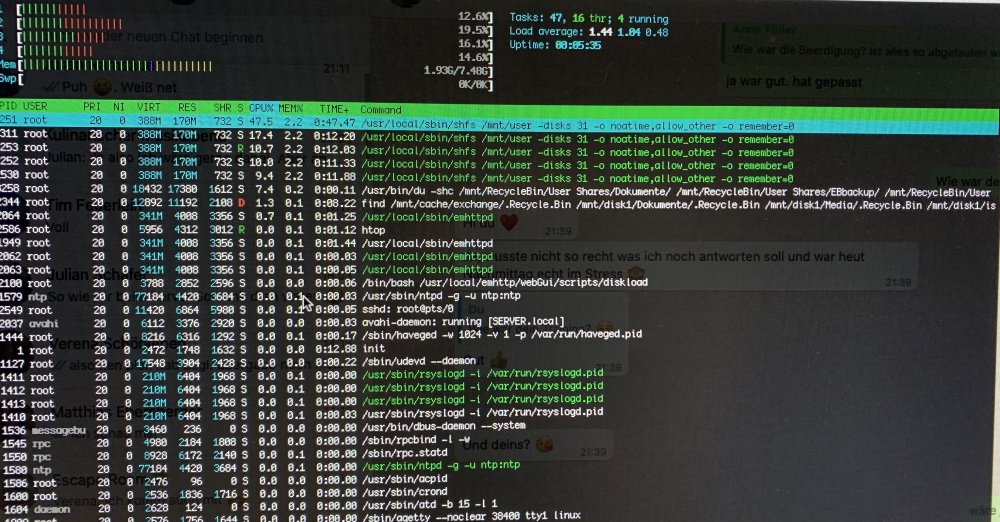
Hi everyone, unfortunately i had to spend the whole evening yesterday to figure out what the problem is. So hopefully, this post helps someone who is discovering the same issue. And maybe an expert can give a statement to this, because the problem is still there, i just know how to handle it for the moment. Here is the situation: I shut down my server yesterday after a long period of uptime (about 100 days) to insert a graphics card (Nvidia GTX 1060). After rebooting, the GUI (over LAN) was not available anymore. - that is basically the whole problem. SSH worked perfectly (important later). What i did not know at that time, the GUI (over LAN) returns to work, it just takes a long time (over night). - i already discovered this some time before, but there it was like 10 mins or sth, then the GUI was there again; this time it took too long in my opinion - So i startet to search for the issue: 1. GPU in and out - same problem 2. Localhost GUI - same problem (no networking issue) 3. all dockers off, all VMs off - same problem 4. boot in Safe Mode - everything fine (plugins?) - side note: GPU is perfectly detected in Safe mode, dockers working, VMs fine In safe mode i installed all plugins back in... everything fine - weird isn't it? Ok, all plugins deleted in /boot/config/plugins Normal startup - fine Result: it is the "Recycle Bin" plugin that causes the GUI to start up with a very long delay! System: 6.9.2 Recycle Bin: 2021.08.14 So, here are my questions to the whole thing: - in the plugins folder i discovered some files like: ._unassiged.devices.plg / ._recycle.bin.plg is that supposed to be like that or does the system need them? - there is a folder /boot/config/plugins-error - this one contained the unassigned.devices.plg, why is that? the Unassigned devices didn't cause any problems - is there a reason why the recycle bin plugin needs so much time to start up? - My first thought was the "Update Recycle Bin Size in Background" feature: but turning on/off makes no difference for startup - why does it prevent the GUI from responding? - what are those running tasks about? - /usr/bin/du -shc /mnt/..... AND find /mnt/cache/exchange/.Recycle.Bin I looked into "htop" over SSH while the GUI was not available and discovered some tasks (see screenshot) that seem "to work for the recycle bin" and causing a relatively high CPU load (nothing else started) Thanks in advance to experts for answering and i hope this documentation helps someone else.