




Veah
Members
-
Joined
-
Last visited
-
I always disable erp in bios. could be relevant
-
Tried a bunch of questions to ai and found this somewhat believable slop. ******* The most likely culprit is that ExpressVPN's WFP (Windows Filtering Platform) kernel driver and virtual network adapter (Wintun for Lightway, TAP for OpenVPN) interfere with your physical NIC's hardware offloads — specifically TSO/LSO (TCP Segmentation / Large Send Offload) and LRO (Large Receive Offload). Here's why it only shows up at 10Gbps: At 1Gbps, the CPU can handle per-packet segmentation and reassembly in software fast enough that losing offloads doesn't matter. At 10Gbps, those offloads are essential to sustain line rate. When the WFP callout driver intercepts every packet (which it does even when the VPN is disconnected, as long as it's installed), it can disable or break the offload path, forcing the CPU to do the work in software — and it can't keep up at 10Gbps. A Technet forum post confirms this class of issue: "Simply installing Hyper-V caused the physical adapters to exhibit this behavior and removing Hyper-V does not fix the issue" — same mechanism, a virtual adapter / WFP filter degrading the physical NIC. Things to check/try (in order): Device Manager → your 10Gb NIC → Advanced tab — verify that Large Send Offload v2 (IPv4/IPv6), Large Receive Offload, and TCP/UDP Checksum Offload are still Enabled with ExpressVPN installed. If they've been flipped to Disabled, that's your answer. Test with ExpressVPN fully uninstalled (not just disconnected) — if speeds return to 10Gbps, the WFP driver is confirmed as the cause. If the offloads are disabled and won't stay enabled while ExpressVPN is installed, you can try manually re-enabling them via PowerShell: Set-NetAdapterAdvancedProperty -Name "Your10GbNIC" -DisplayName "Large Send Offload Version 2 (IPv4)" -DisplayValue "Enabled" Set-NetAdapterAdvancedProperty -Name "Your10GbNIC" -DisplayName "Large Receive Offload" -DisplayValue "Enabled"If that doesn't help, the WFP callout itself is adding per-packet overhead that becomes a bottleneck at 10Gbps line rate — in that case the only real fix is to run the VPN on a separate machine or router so the WFP driver isn't in the hot path of your 10Gb NIC
-
Was reading more on Fedora. Looks like is supports ARM. Is unraid going to finally support ARM?
-
Never got into Fedora but excited also. What I know of it seems like a good choice.
-
Google search shows problems with that mb nic. Heres some listed things to check: -Disable Energy-Efficient Ethernet (EEE): In Windows Device Manager, right-click the Marvell AQtion 10Gbit Network Adapter, select Properties, go to the Advanced tab, and set Energy-Efficient Ethernet to Disabled. This is the most common fix for link drops. -Address Overheating: The chipset can overheat under load, causing it to throttle or disconnect. Ensure the motherboard's I/O shield heatsink is properly seated and consider adding a thermal pad between the chip and the heatsink if one is missing. -Update Drivers and BIOS: Install the latest Marvell AQtion drivers (version 3.1.8.0 or newer) and update the motherboard BIOS to the latest version, as ASUS has released updates to improve stability for this specific NIC. -Disable Wake-on-LAN: Some users report that disabling Wake-on-LAN and Wake-on-Packet in both the adapter properties and BIOS prevents the adapter from failing to resume after sleep states.
-
I realize a ton of outdated videos out there. Have you tried the SpaceInvader One or IBRACORP vids? Look for the ones that are less than 2 years old and they should be pretty close to current Unraid.
-
Heres his general support section
-
Could disable that vm and make it again and pointing it to the vdisk. Might catch an unraid vm setting discrepancy that way. Somebody else passing by will have better ideas.
-
In the vm settings, is the graphics card correctly selected? I think it defaults to Virtual. Does it work on any other display? Could it be an input setting on the TV or the cable.
-
Had something similar. I had to disable vm and docker. Then enable vm first and docker second in that order. Then it worked.
-
Try binding 29.00.1 also. The built in audio on the gpu needs to be put to the same place as the video.
-
Dunno, dunno and great news.
-
If your settings match my screenshots and still not working, I do not know what else.
-
set the share to public to ensure its not a write permission thing
-
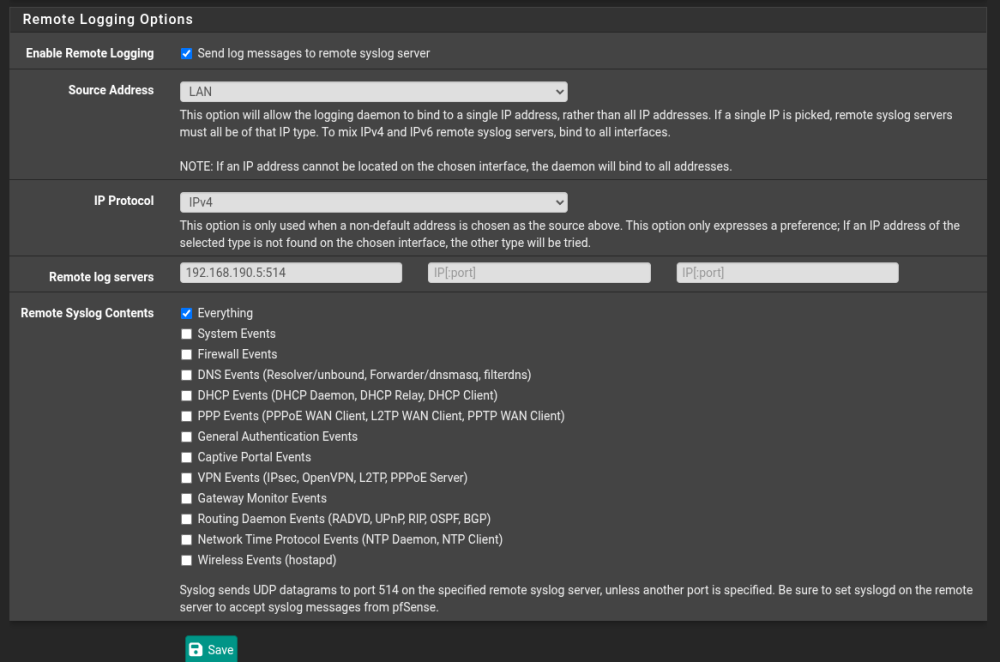
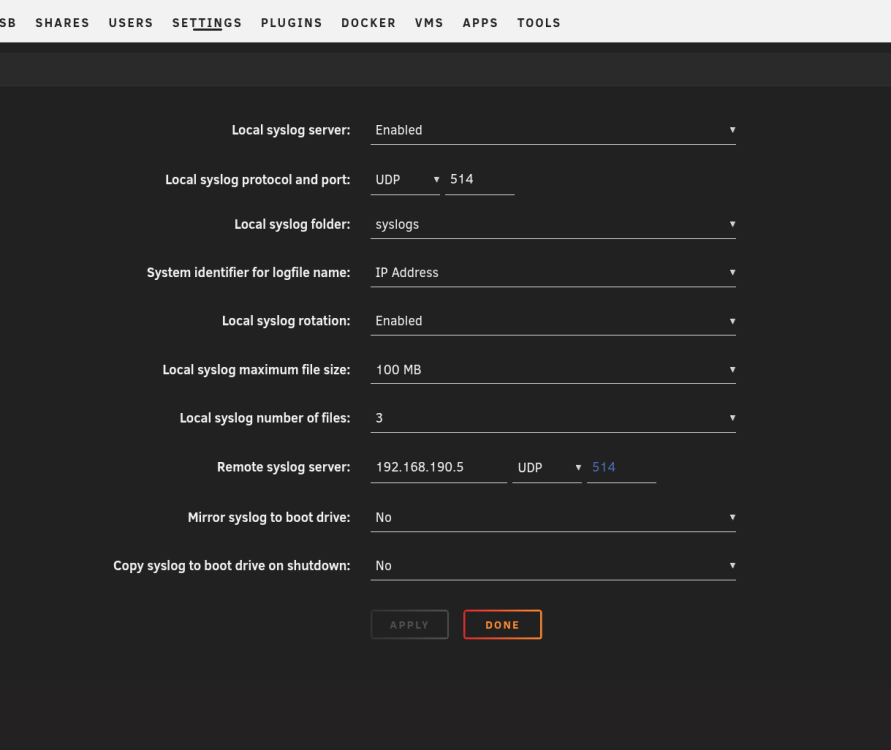
Just tested some stuff I found for this. What I have is not using the pfsense package. I created a share in Unraid called syslogs for this. It is writing logs to my syslogs share now. You will have to tinker with the setting in pfsense to get the filesize and rotation to a spot that you need, shouldn't be too tough. GL ******copied slop from www******** On pfSenseGo to Status → System Logs → Settings tab. Under Remote Logging Options, check "Send log messages to remote syslog server". Fill in: Source Address – usually "Default (any)" unless you're using a specific interface (e.g., a VPN tunnel). IP Protocol – IPv4 (or IPv6). Remote Log Servers – enter up to 3 servers in ip:port format (default port 514). Under Remote Syslog Contents, check the categories you want forwarded (Firewall, System, DNS, DHCP, VPN, etc.). Click Save. Logs will immediately start flowing to the remote server. ****My PFS Status>System Logs>Settings******** *********more copied slop******** On Unraid (receiving server)Unraid has a built-in syslog server — no extra packages needed. Go to Settings → Syslog Server in the Unraid web GUI. Set Local syslog server to Enabled (opens a UDP listener on port 514). Under Local syslog folder, select a share — ideally one that writes to an SSD/NVMe (cache drive) to avoid wear on spinning disks. Configure rotation (e.g., 50 MB max file size, 4–10 files). (Optional) Set Remote syslog server to the Unraid server's own IP — this "loopback trick" ensures Unraid's own system logs also get written to that share. Click Apply. Logs from remote devices will appear in the selected share, one file per remote host (named by hostname or IP depending on the System identifier setting). **********