kaedinger
Members
-
Joined
-
Last visited
-
Hi Mike, sorry for the late answer. I work on Unspin in my free time. Thanks for the detailed report (no worries on the AI write-up, the log you attached is what I needed). Good news: Unspin should work on ZFS as well. fanotify (the mechanism Unspin uses to watch file access) works at a level below the filesystem, so it doesn't actually care whether a disk is XFS, Btrfs, or ZFS, encrypted or not. Your log confirms this is working correctly: all four of your ZFS disks got watched successfully (Watching mount at: /mnt/disk1... etc.), and events are being picked up fine. So this isn't a ZFS compatibility issue. (Caveat: I don't have a ZFS array to test against myself, so this is reasoned from the fanotify docs and your log rather than something I've verified hands-on) So I think it looks like this: every one of the events in your log is for a file sitting directly at the top level of the disk (e.g. /mnt/disk1/757176000.tmp...) rather than inside one of your shares (e.g. /mnt/disk1/Movies/...). Unspin only promotes files that belong to a real user share, so anything living outside a share folder gets skipped - which is exactly what the [skip share] lines mean. That's working as intended, just maybe not obvious from the log wording. The interesting question is what's actually creating those .tmp files directly at the disk root, at the same second, across four disks at once. The numeric format (757176000.tmp) indicates they are auto-generated atomic write fallbacks or temporary file tests. So maybe: Unraid's management engine itself or an active Docker container trying to test disk capabilities or sync states. A backup, sync, or maintenance tool that's mapped directly to /mnt/diskX instead of a share path A Docker container or VM with a bind-mount pointed straight at the disk root Some other periodic Unraid/ZFS housekeeping process Could you check what's writing those files? If you can tell me what created them, I can figure out whether Unspin should be handling that case differently, or whether it's something worth pointing you to reconfigure on your end. Thanks again for reporting this with logs, that's exactly what makes it possible to track down. Oh, and regarding share monitoring: a user share in Unraid is a virtual, cross-disk pooling of folders that exist independently on each physical disk - there's no single mount point for "a share" the way there is for a disk. fanotify marks a mount, so watching at the share level isn't a smaller/simpler version of what Unspin does now, it's structurally backwards - you'd need to watch every disk anyway and then filter, which is exactly the current design. Best, kaedinger
-
Assuming I did not mess up terribly, it should not be possible for the plugin to keep the disks awake, as it's only accessing the disks directly after they actually have been accessed from somewhere else. As it does no live-switching (which is a thing best implemented by the Unraid team itself), it's suited best for frequently accessed files, like samples in an audio library, or pdfs holding data that you open every day, or the infamous desktop.ini files that windows creates, or drives holding original videos while editing, etc. If you want movies cached while they are playing, this is NOT what Unspin does. To me it's most helpful in audio and video editing projects: projects that I currently work on have their files moved to cache, despite having set the shares to "Cache -> Array". Kind of like the old "Prefer Cache" setting, but only for data that is actually being used. I think this plugin works best in conjunction with two other plugins: CA Mover Tuning and Dynamix Cache Directories. Since the goal is not spinning up disks unnecessarily, caching the directory content is the first thing you should do anyway. And Mover Tuning is used to move old/cold files back to the array where they belong - Unspin only moves to Cache. I have mover tuning set so that it only reacts to ATIME and moves files based on age, smart caching enabled (Auto setting in file age), fill up level 95%, free down to 50%, running every 4 hours. Disable the stock mover. This works perfect for me. Enable debug logging in Unspin to exactly see which files are being watched, moved, and why. Play around with the rules in Unspin to fine tune the behavior according to your needs. Use the File Activity plugin's filters to monitor and control Unspin if you are unsure. And pause Unspin automatically during backups, mover actions, and similar procedures - this is important, otherwise you have a lot of files moved back and forth unnecessarily. I hope this helps a bit. If you feel there's something wrong with the functionality, please open a Github issue. Thanks.
-
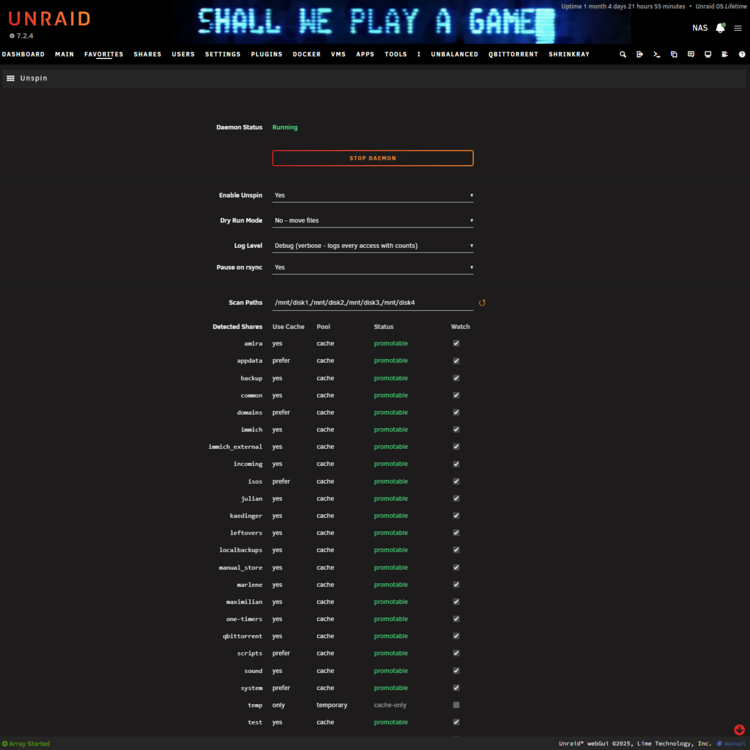
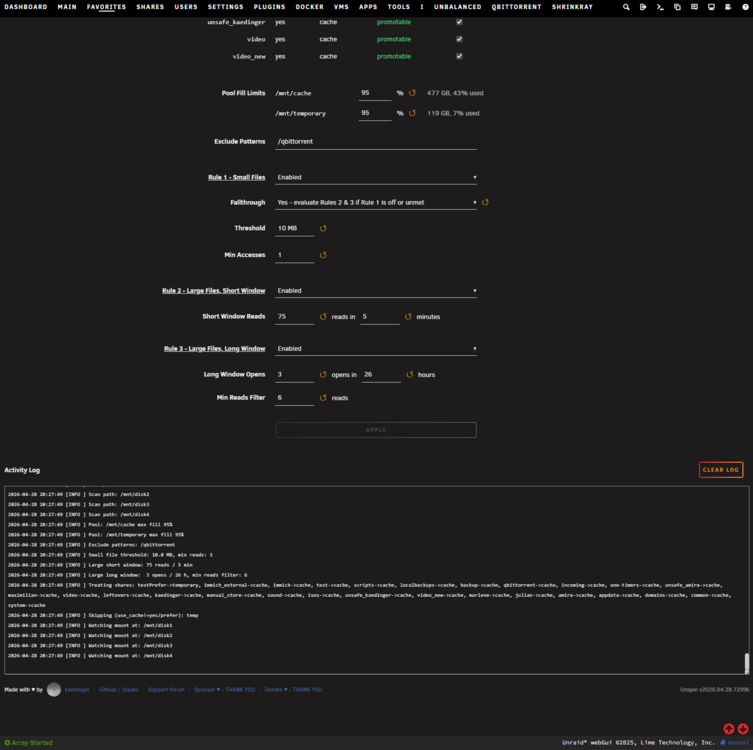
Unspin - Rudimentary Hot-File Tiering for UnraidUnspin automatically promotes your most-accessed files to faster storage (cache/NVMe) using a lightweight C++ daemon that monitors file access in real time. The main goal is to have fewer disk spin-ups (hence the name), but we'll take the faster access, too 😉 There's no explicit cold demotion (yet) - for now we rely on Unraid's mover. There is also no real hotfile-tiering as in: live switching to cache while your movie is playing. Make sure this does what you want! There's a dry-run mode; use it! How It WorksUnspin runs unspind, a daemon that uses Linux's fanotify interface to receive events every time a file is opened or read on your array disks. It applies three configurable promotion rules: Small file rule - files below a size threshold get promoted after N total reads (e.g. promote a config file on first access) Large file - short window - N reads within M minutes triggers promotion (e.g. 100 reads in 5 min = streaming video) Large file - long window - N opens within H hours triggers promotion (e.g. 3 opens in 24h = frequently consulted PDF) Promotion is always deferred until all open file handles are closed, so readers (SMB, NFS, local) never lose their file mid-stream. Why these rules? Under ideal circumstances we would cache everything - but we don't have the space. We can't have a huge Linux ISO using up precious cache space if it's just held open for a few bytes of torrent upload. But of course that changes if it's being constantly read, or accessed on a regular basis. You'll have to play around with the rule settings to best match your own use cases. FeaturesEvent-driven: reacts to each file read in real time via fanotify, no polling or cron Three-rule promotion: separate thresholds for small files and large files (streaming burst / periodic access) Deferred promotion: waits until all open handles are closed, so readers never lose their file Per-share cache pool routing: destinations follow each share's own [font=monospace]shareCachePool[/font] setting in Unraid, so different shares can promote to different pools. Shares with "Use Cache: No" or "only" are skipped automatically. Detected Shares table: the settings page lists every share with its current routing and a per-share Watch toggle to opt individual shares out Mover/rsync-aware: automatically pauses while Unraid's mover or rsync is running Per-pool fill guard: each pool gets its own fill % threshold; promotion to that pool stops once it's exceeded Dry-run mode: logs every decision without moving anything Exclude patterns: skip any path substring Rule toggles: each rule can be individually enabled/disabled Pause / unpause: stackable pause locks via rc.unspin pause <name> - also useful for backup scripts over SSH Live log viewer: auto-refreshing tail of the last 200 log lines in the settings page Screenshots Most of the settings provide help bubbles when clicking on the respective label. InstallationVia Community Applications (recommended): (Hopefully coming soon) Install the Community Applications plugin Search for Unspin Click Install Manual: Navigate to Plugins -> Install plugin and enter the following URL: https://raw.githubusercontent.com/kaedinger/unspin/main/unspin.plgOR: Open the terminal on your unraid server, make sure you're root, then use plugin install https://raw.githubusercontent.com/kaedinger/unspin/main/unspin.plgPause for BackupsWrap your backup jobs on remote machines or VMs with pause/unpause over SSH so Unspin doesn't inflate counters while the backup tool reads your files: ssh root@nas /etc/rc.d/rc.unspin pause borgbackup borg create ssh://root@nas/mnt/disk1/backups::daily /data ssh root@nas /etc/rc.d/rc.unspin unpause borgbackupLocks stack - multiple backup tools can pause independently without interfering with each other. RequirementsUnraid 7.0+ (probably even earlier, but tested with 7.2.3 onwards) No external dependencies LinksGitHub: https://github.com/kaedinger/unspin Issues / feature requests: https://github.com/kaedinger/unspin/issues AI disclaimer / HistoryClaude has been used to simplify refactoring, restructuring, commenting & documenting, cleaning up etc. It also helped immensely setting up the general structure of an Unraid plugin and with getting the settings page right. BUT: Every functional code line has been human written at some point by meticulously reordering bits on an old hard drive using a VERY small magnet. Jokes aside, this one started as a batch script a few years ago on my old Ubuntu machine Gregory (RIP) while trying out MergerFS, then turned into a C++ daemon for a proprietary project I did for a German car company (where it was called Hotfile and already using fanotify). As I started using Unraid this year and wanted to give something back to its fantastic community, I turned it into this plugin.
-
...but I can't because I am not allowed to start a topic in "Plugins". I wanted to publish this plugin: https://github.com/kaedinger/unspin I am relatively new to Unraid (so no other posts in the forum except one reply) but have been developing software for 30 years, and I want to give back something useful. If I understand correctly, someone has to just approve this one, and then I can post a new plugin? Keep up the good work, Florian
-
kaedinger changed their profile photo
-
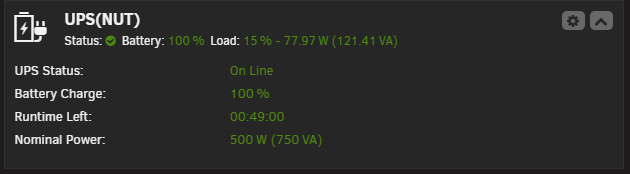
Just a heads up in 2026: The current Schneider Electric Firmware Update Wizard (v4.3.8v9a) did recognize my trusty old APC Smart-UPS 750I as upgradeable but did NOT contain a firmware file for it... In addition my UPS did not show any Firmware ID as described by Schneider, just Firmware Versions 1-4. I managed to track down a v4.2.1 which could update the UPS to Firmware ID 18. After that I could enable Modbus on the UPS, and - using nut-2.8.4 stable - I had to switch the UPS Driver to apc_modbus and voila: