





Socrates
Members
-
Joined
-
Last visited
-
I did some deepseek probing, and this was the suggestion. Does this align with your steps/strategy? To set up a MySQL database using Docker in Unraid, store it on the cache drive, and use it to store Kodi metadata, follow these detailed steps: --- ### **Step 1: Prepare Unraid and Cache Drive** 1. **Ensure Cache Drive is Set Up**: - Go to the Unraid web interface. - Navigate to **Main** > **Array Devices**. - Ensure you have a cache drive (e.g., SSD) assigned and formatted. 2. **Create a Directory for MySQL Data**: - Go to **Shares** and create a new share (e.g., `mysql_data`). - Set the **Use Cache Pool** option to **Only** to ensure the data is stored on the cache drive. - Note the path to this share (e.g., `/mnt/cache/mysql_data`). --- ### **Step 2: Install MySQL Docker Container** 1. **Install Docker in Unraid**: - If Docker is not already installed, go to **Apps** and search for "Docker" to install it. 2. **Install MySQL Container**: - Go to **Docker** > **Add Container**. - Configure the container as follows: - **Name**: `mysql-kodi` - **Repository**: `mysql:latest` (or a specific version like `mysql:8.0`) - **Network Type**: `bridge` (default) - **Extra Parameters**: Leave blank unless you need specific options. 3. **Configure Volume Mapping**: - Add a path for the MySQL data directory: - **Container Path**: `/var/lib/mysql` - **Host Path**: `/mnt/cache/mysql_data` - This ensures the database is stored on the cache drive. 4. **Set Environment Variables**: - Add the following environment variables: - `MYSQL_ROOT_PASSWORD`: Set a strong password for the root user. - `MYSQL_DATABASE`: `kodi` (or any name for the Kodi database). - `MYSQL_USER`: `kodi` (or any username for Kodi). - `MYSQL_PASSWORD`: Set a strong password for the Kodi user. 5. **Deploy the Container**: - Click **Apply** to create and start the MySQL container. --- ### **Step 3: Configure MySQL for Kodi** 1. **Access MySQL Container**: - Go to **Docker** > **mysql-kodi** > **Console**. - Open a shell in the container. 2. **Log in to MySQL**: ```bash mysql -u root -p ``` - Enter the root password you set earlier. 3. **Grant Permissions to Kodi User**: - Run the following SQL commands: ```sql GRANT ALL PRIVILEGES ON kodi.* TO 'kodi'@'%'; FLUSH PRIVILEGES; ``` - This allows the Kodi user to access the database from any host. 4. **Exit MySQL**: - Type `exit` to leave the MySQL shell. --- ### **Step 4: Configure Kodi to Use MySQL** 1. **Install Kodi**: - Install Kodi on your devices (e.g., Windows, Android, or another Docker container). 2. **Edit Kodi’s `advancedsettings.xml`**: - Locate the Kodi userdata directory: - Windows: `C:\Users\<Username>\AppData\Roaming\Kodi\userdata\` - Android: `/sdcard/Android/data/org.xbmc.kodi/files/.kodi/userdata/` - Linux: `~/.kodi/userdata/` - Create or edit the `advancedsettings.xml` file and add the following: ```xml <advancedsettings> <videodatabase> <type>mysql</type> <host><Unraid_IP></host> <port>3306</port> <user>kodi</user> <pass><Kodi_Password></pass> <name>kodi</name> </videodatabase> <musicdatabase> <type>mysql</type> <host><Unraid_IP></host> <port>3306</port> <user>kodi</user> <pass><Kodi_Password></pass> <name>kodi</name> </musicdatabase> </advancedsettings> ``` - Replace `<Unraid_IP>` with the IP address of your Unraid server. - Replace `<Kodi_Password>` with the password you set for the Kodi user. 3. **Restart Kodi**: - Restart Kodi to apply the changes. It will now use the MySQL database for metadata. --- ### **Step 5: Verify and Test** 1. **Check MySQL Database**: - Log in to the MySQL container and check if the Kodi database is being populated: ```bash mysql -u kodi -p USE kodi; SHOW TABLES; ``` - You should see tables like `files`, `movie`, `tvshow`, etc. 2. **Test Kodi**: - Add media to Kodi and verify that metadata is being stored in the MySQL database. - Check multiple Kodi devices to ensure they sync correctly. --- ### **Optional: Backup MySQL Database** 1. **Create a Backup Script**: - Create a script to back up the MySQL database to another location (e.g., `/mnt/user/backups`): ```bash mysqldump -u root -p<Root_Password> kodi > /mnt/user/backups/kodi_backup_$(date +%F).sql ``` - Replace `<Root_Password>` with your MySQL root password. 2. **Schedule Backups**: - Use the Unraid **User Scripts** plugin to schedule regular backups. --- ### **Conclusion** You now have a MySQL database running in Docker on Unraid, stored on the cache drive, and configured to store Kodi metadata. Kodi devices connected to this database will sync their libraries, allowing for a centralized media experience.
-
This is a great suggestion! Could you guide me on how to build the Kodi database, I mean just give me high level steps? Where can I find this option in Kodi settings? Do you install the docker container for mysql db in Unraid? How do you let kodi know that the metadata is in the mysql db? Is there a setting in Kodi to connect to mysql db with user/pass? Little bit more information will be extremely helpful. I have a cache drive, but I don't use it much because when I copy several GBs of movies to Unraid, it fills up quickly. I have to pause the transfer until the cache drive moves the files to the Unraid pool. How can I prevent the cache drive from transferring my MySQL Docker image to the Unraid pool? Isn't the cache drive supposed to move everything to the Unraid pool at a set time?
-
I use Unraid as my media server to store all my movies, with disk spin-down enabled when Unraid isn’t in use, for power efficiency have several disks. All my movie metadata—like NFO files, media art, and cover posters—are stored in their respective folders, When I open Kodi, the movie posters don’t show up immediately because the disks are still spinning up. The movie thumbnails show blank instead of the movie poster, becaue the disk is still waking up. Hence I’m thinking of installing Jellyfin to store the metadata so that Kodi can quickly pull movie details, posters, and artwork from the Jellyfin server. I still want to use Kodi as my preferred media player, but I’d prefer to use Jellyfin just for storing the metadata. So can i source jellyfin inside kodi to pull metadata into the Kodi media player? Is this possible? I recall reading a while back that someone suggested using Jellyfin for storing metadata while still being able to use Kodi to display it and play the movies.
-
Thank you for this, just had sent you a pm for your code. This helps.
-
I've been using Unraid for the past eight years, running it on an ESXi VM. Now, I'm looking to build a dedicated hardware server using server-grade parts. I already have an LGA 2011-based Supermicro motherboard in a 24-bay 4U Supermicro chassis, along with 128GB of RAM. However, I'm unsure about which CPU to choose. My plan is to use a lower TDP dual CPU setup. I won't be running many VMs—maybe 2 to 4, including one for a Plex server that will handle a single stream (mainly for my use when traveling). Given these requirements, is it better to go for a CPU with more cores or a higher base frequency for an Unraid server? I'm not interested in AMD or newer-generation CPU components, as I already have most of the parts. I just need to pick up a used server-grade Xeon E5-26xxV4 CPU from eBay, ideally one that's power-efficient with a TDP under 90W. Any advice on the best CPU for this setup would be greatly appreciated.
-
Thanks for your replies. This helps. Was able to setup the notification for serious alerts.
-
Perfect thank you, it worked. For anyone who cannot find the app password in their google security tabs, the options have changed. You can find it here. https://myaccount.google.com/apppasswords
-
Thanks for your replies, i have enabled the 2FA (2 step verification, text on phone) for my google account. It still fails. Do I need to change my gmail password to a 16 digit password?
-
Sorry to bump an old post, but what does Create & use app passwords? Will i not be able to use one of my existing gmail accounts? I need to create a gmail account using the gmail app on my phone, and use the default password that the app will generate? Is that what it is?
-
I have been using Unraid for almost 8 years now, and some of my disks are starting to show SMART errors or bad sectors. I didn't notice it for months, but today I saw it because I wanted to add a new disk to my growing array. Before Unraid, I used FlexRAID, which had a feature that sent email notifications if a disk was about to fail or bad sectors appeared, giving you a heads-up. Has Unraid incorporated something like this in its newer versions? The last time I checked, 8 years ago, this wasn't an option.
-
The issue has been resolved. Both the parity drives are online now after removing and readding and rebuilding (though unnessary as the mod mentioned).
-
Will do, right now the parity rebuild is at 40%, might complete in another 10-12 hrs, before i reboot i will grab the diags (just in case).
-
For now i have attempted the normal procedure to re-enable a drive, which is to start the array with it unassigned, stop the array, assign the drive back and let it rebuild parity. It shows both the parity drives are online, and rebuilding, i will let ya'll know if it fails and the parity goes back to disabled mode.
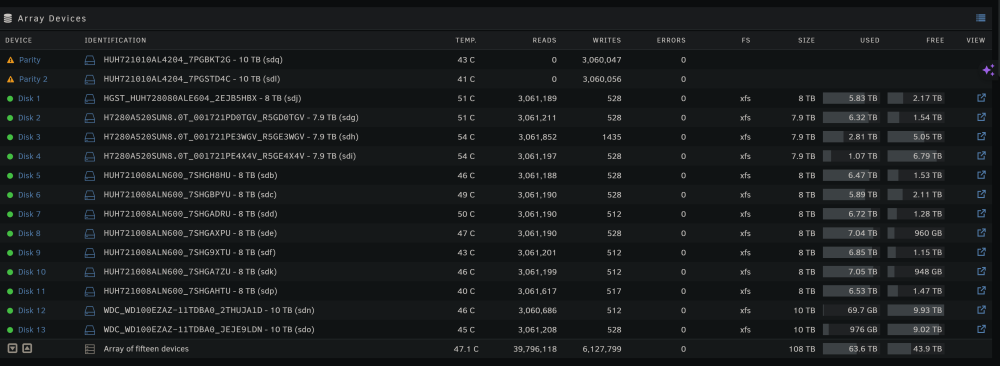
-
I have two parity drives, one of the drives shows that its disabled. However the disk is spinning and is warm when i pull the drive out from the hotswappable bay. I have a Supermicro 24Bay SAS3 based chassis, so its a sas3 card, no cables attached to the drives. attaching diagnostics and the screenshots. tower-diagnostics-20231018-2221.zip
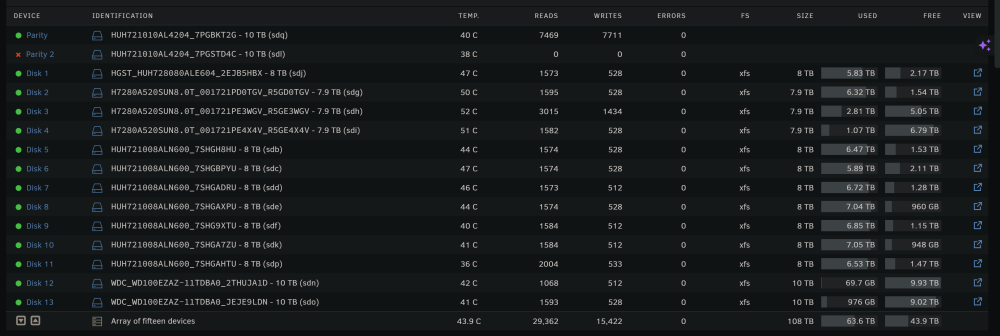
-
Will thanks for looking into it. ANy tips on disk cooling? I have a 4U supermicro chassis with 24 bay. The chassis has Norco Fans. Any suggestions, i would like to bring the heat down, some disks get hot upto 62 degs.

