Querzion
Members
-
Joined
-
Last visited
-
I'm in the process of getting really really irritated with my computer, I thought it was a good Idea to have my computer run unRAID, and it worked fine till the new hard drive just failed royally, and I can't take it out of the system, because then unRAID won't start up properly. I'm so tired of this, and it's going to cost 2000 € to get the data back MAYBE, so I'm not really super happy about anything atm. So instead of using my 2000+ € computer as a NAS, why not buy a NAS and then put unRAID on it. . . WHICH NAS THOUGH?! Can I just buy any existing NAS that has like 6/8 bays and then let that stand somewhere where it doesn't make much sound... I no longer want to sit in Linux through a VM, but I still want to have dockers and stuff going, but not on my main computer. I'm a bit tired of that, and not being able to use all hardware etc. Recommendations for commercial NAS devices that unRAID works on wouldn't really hurt, so please throw a bunch of names, nothing too expensive, and hopefully not something that is unknown.
-
Is it too late to save it? Or rather is it too late to save whats on it? Because most stuff on it is really important that I get my hands on again. I'm glad that my password database was accessible still, otherwise I would have probably died there and then.
-
What can I do about this? Is there anything I can do?

-
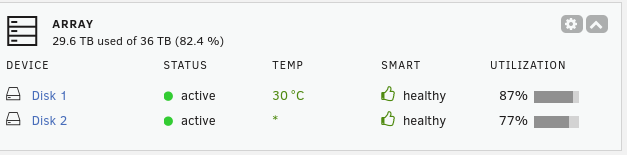
How can it be healthy if it just stopped reading from it?
-
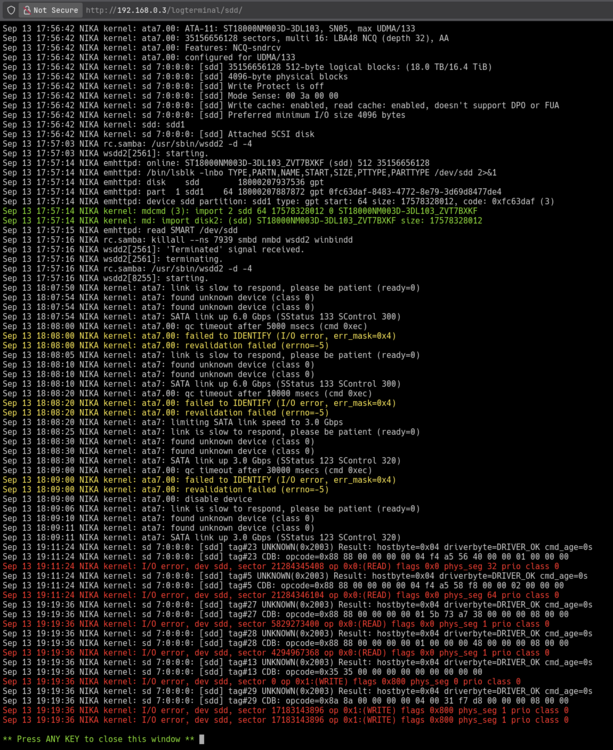
I was watching a movie, and in the middle of it I got an error message, then folders just vanished from the shares. What's going on here? Did one of my drives just die?


-
I know the current official kernel build was a great update, I however am not using 5 year old hardware, I had recently bought the AM5 platform ( AMD 7900X ) and that's what I have been using since, the 'newer' kernels that have been released from 6.10+ have to my comprehension better compatibility with newer hardware, and 6.14 got some interesting updated too. I have been a GNU/Linux user since about 24 years back, but I'm a casual user, I never dived into the whole switching to kernels or building my own, I started of using Slackware, and ended up using Debian based distro's, now I jump between Ubuntu Derivatives, Fedora or Arch. I have had lots of bad luck when it comes to tinkering with the Kernel myself, so I more or less stopped tinkering with Linux as a whole because of a lot of unwanted crashes etc, so nowadays I just wait for a stable release, It's easy to just install a new VM to sit in, but in the back of my head I'm still thinking, the host system has an old kernel, and everything goes through that kernel, regardless of if I have made passthroughs or not. So I'm wondering when unRAID will have their next big kernel update, is there a lot of work patching it to work with unRAID, or is there a guide that takes babysteps in how to not crash your unRAID install and upgrade your kernel to a newer? I haven't used Slackware in ages, and if I have comprehended it right, unRAID is based on Slack. I just don't think it's the most intelligent option for me to just try and update the kernel myself, if I want a stable and reliable system.
-
Nope, jag satt med det där, det mesta är översatt, det saknas några översättningar och sen är det några saker som ska ändras, hade gärna sett att det varit annorlunda filer dock, som en databas med ord istället för en massa text dokument. Spenderade ett dygn totalt på att översätta det mesta förra sommaren. Jag använde delvis ChatGPT, men man är tvungen att gå över varenda rad, och dubbelkolla översättningen, den ligger redan uppe, om det är något textstycke som anses vara fel i perspektivtycke eller annat så är det bara att skriva vart det är och vad som står där och vad som möjligen borde stå där. Så kanske jag kan ta och köra en ny revision på översättningen när det finns tid till övers. Pluggar Webutveckling så har inte jätte mycket tid till övers. Location: What it says: What the translation should state:
-
Noticed, but some are quite obvious though, named "migratable='on'", which can only be the cpu or gpu & audio, in the long xml, there's 2-4 of those.
-
I created a new VM, and didn't share anything else but the harddrive, so I'm using this VM through a browser window. <?xml version='1.0' encoding='UTF-8'?> <domain type='kvm' id='2'> <name>Windows 11</name> <uuid>4e2cb08a-01fd-ad6e-a62a-8e0f5195eb80</uuid> <metadata> <vmtemplate xmlns="unraid" name="Windows 11" icon="windows11.png" os="windowstpm" webui="" storage="default"/> </metadata> <memory unit='KiB'>33554432</memory> <currentMemory unit='KiB'>33554432</currentMemory> <memoryBacking> <nosharepages/> <source type='memfd'/> <access mode='shared'/> </memoryBacking> <vcpu placement='static'>16</vcpu> <cputune> <vcpupin vcpu='0' cpuset='4'/> <vcpupin vcpu='1' cpuset='16'/> <vcpupin vcpu='2' cpuset='5'/> <vcpupin vcpu='3' cpuset='17'/> <vcpupin vcpu='4' cpuset='6'/> <vcpupin vcpu='5' cpuset='18'/> <vcpupin vcpu='6' cpuset='7'/> <vcpupin vcpu='7' cpuset='19'/> <vcpupin vcpu='8' cpuset='8'/> <vcpupin vcpu='9' cpuset='20'/> <vcpupin vcpu='10' cpuset='9'/> <vcpupin vcpu='11' cpuset='21'/> <vcpupin vcpu='12' cpuset='10'/> <vcpupin vcpu='13' cpuset='22'/> <vcpupin vcpu='14' cpuset='11'/> <vcpupin vcpu='15' cpuset='23'/> </cputune> <resource> <partition>/machine</partition> </resource> <os> <type arch='x86_64' machine='pc-q35-9.1'>hvm</type> <loader readonly='yes' type='pflash'>/usr/share/qemu/ovmf-x64/OVMF_CODE-pure-efi-tpm.fd</loader> <nvram>/etc/libvirt/qemu/nvram/4e2cb08a-01fd-ad6e-a62a-8e0f5195eb80_VARS-pure-efi-tpm.fd</nvram> <boot dev='hd'/> </os> <features> <acpi/> <apic/> <hyperv mode='custom'> <relaxed state='on'/> <vapic state='on'/> <spinlocks state='on' retries='8191'/> <vpindex state='on'/> <synic state='on'/> <stimer state='on'/> <vendor_id state='on' value='none'/> </hyperv> </features> <cpu mode='host-passthrough' check='none' migratable='on'> <topology sockets='1' dies='1' clusters='1' cores='8' threads='2'/> <cache mode='passthrough'/> <feature policy='require' name='topoext'/> </cpu> <clock offset='localtime'> <timer name='hpet' present='no'/> <timer name='hypervclock' present='yes'/> </clock> <on_poweroff>destroy</on_poweroff> <on_reboot>restart</on_reboot> <on_crash>restart</on_crash> <devices> <emulator>/usr/local/sbin/qemu</emulator> <disk type='file' device='cdrom'> <driver name='qemu' type='raw'/> <source file='/mnt/user/archive.data/ISOs/virtio-win-0.1.262-2.iso' index='1'/> <backingStore/> <target dev='hdb' bus='sata'/> <readonly/> <alias name='sata0-0-1'/> <address type='drive' controller='0' bus='0' target='0' unit='1'/> </disk> <controller type='sata' index='0'> <alias name='ide'/> <address type='pci' domain='0x0000' bus='0x00' slot='0x1f' function='0x2'/> </controller> <controller type='pci' index='0' model='pcie-root'> <alias name='pcie.0'/> </controller> <controller type='pci' index='1' model='pcie-root-port'> <model name='pcie-root-port'/> <target chassis='1' port='0x8'/> <alias name='pci.1'/> <address type='pci' domain='0x0000' bus='0x00' slot='0x01' function='0x0' multifunction='on'/> </controller> <controller type='pci' index='2' model='pcie-root-port'> <model name='pcie-root-port'/> <target chassis='2' port='0x9'/> <alias name='pci.2'/> <address type='pci' domain='0x0000' bus='0x00' slot='0x01' function='0x1'/> </controller> <controller type='pci' index='3' model='pcie-root-port'> <model name='pcie-root-port'/> <target chassis='3' port='0xa'/> <alias name='pci.3'/> <address type='pci' domain='0x0000' bus='0x00' slot='0x01' function='0x2'/> </controller> <controller type='pci' index='4' model='pcie-root-port'> <model name='pcie-root-port'/> <target chassis='4' port='0xb'/> <alias name='pci.4'/> <address type='pci' domain='0x0000' bus='0x00' slot='0x01' function='0x3'/> </controller> <controller type='pci' index='5' model='pcie-root-port'> <model name='pcie-root-port'/> <target chassis='5' port='0xc'/> <alias name='pci.5'/> <address type='pci' domain='0x0000' bus='0x00' slot='0x01' function='0x4'/> </controller> <controller type='virtio-serial' index='0'> <alias name='virtio-serial0'/> <address type='pci' domain='0x0000' bus='0x03' slot='0x00' function='0x0'/> </controller> <controller type='usb' index='0' model='qemu-xhci' ports='15'> <alias name='usb'/> <address type='pci' domain='0x0000' bus='0x00' slot='0x07' function='0x0'/> </controller> <filesystem type='mount' accessmode='passthrough'> <driver type='virtiofs' queue='1024'/> <binary path='/usr/libexec/virtiofsd' xattr='on'> <cache mode='always'/> <sandbox mode='chroot'/> </binary> <source dir='/mnt/user/archive.vms'/> <target dir='archive.vms'/> <alias name='fs0'/> <address type='pci' domain='0x0000' bus='0x01' slot='0x00' function='0x0'/> </filesystem> <interface type='bridge'> <mac address='52:54:00:ba:2d:60'/> <source bridge='br0'/> <target dev='vnet1'/> <model type='virtio-net'/> <alias name='net0'/> <address type='pci' domain='0x0000' bus='0x02' slot='0x00' function='0x0'/> </interface> <serial type='pty'> <source path='/dev/pts/1'/> <target type='isa-serial' port='0'> <model name='isa-serial'/> </target> <alias name='serial0'/> </serial> <console type='pty' tty='/dev/pts/1'> <source path='/dev/pts/1'/> <target type='serial' port='0'/> <alias name='serial0'/> </console> <channel type='unix'> <source mode='bind' path='/run/libvirt/qemu/channel/2-Windows 11/org.qemu.guest_agent.0'/> <target type='virtio' name='org.qemu.guest_agent.0' state='connected'/> <alias name='channel0'/> <address type='virtio-serial' controller='0' bus='0' port='1'/> </channel> <input type='tablet' bus='usb'> <alias name='input0'/> <address type='usb' bus='0' port='1'/> </input> <input type='mouse' bus='ps2'> <alias name='input1'/> </input> <input type='keyboard' bus='ps2'> <alias name='input2'/> </input> <tpm model='tpm-tis'> <backend type='emulator' version='2.0' persistent_state='yes'/> <alias name='tpm0'/> </tpm> <graphics type='vnc' port='5901' autoport='yes' websocket='5701' listen='0.0.0.0' sharePolicy='ignore'> <listen type='address' address='0.0.0.0'/> </graphics> <audio id='1' type='none'/> <video> <model type='qxl' ram='65536' vram='65536' vgamem='16384' heads='1' primary='yes'/> <alias name='video0'/> <address type='pci' domain='0x0000' bus='0x00' slot='0x1e' function='0x0'/> </video> <hostdev mode='subsystem' type='pci' managed='yes'> <driver name='vfio'/> <source> <address domain='0x0000' bus='0x04' slot='0x00' function='0x0'/> </source> <alias name='hostdev0'/> <address type='pci' domain='0x0000' bus='0x04' slot='0x00' function='0x0'/> </hostdev> <watchdog model='itco' action='reset'> <alias name='watchdog0'/> </watchdog> <memballoon model='none'/> </devices> <seclabel type='dynamic' model='dac' relabel='yes'> <label>+0:+100</label> <imagelabel>+0:+100</imagelabel> </seclabel> </domain> I wonder, will the xml file add 35 pci inputs just by adding the gpu to it?
-
I made a copy of the XML on pastebin. It declares like 35 PCI ports, and I have no Idea which ones I can delete and not. https://pastebin.com/xUZiVEfN
-
Ohh. I will have to check on that when I got the time for it. I saw that there were a lot of such statements in the xml file and naturally wondered if it was right, but now it seems confirmed. Thanks for the hint.
-
I switched the drive with the 1TB one that is in group 1 in the picture, and it resulted in freedom. 😜 I'm currently using it for a POP!_OS VM.
-
It works again. "/ I have never had so much problems with the shares as I have had since switching to v7b4.
-
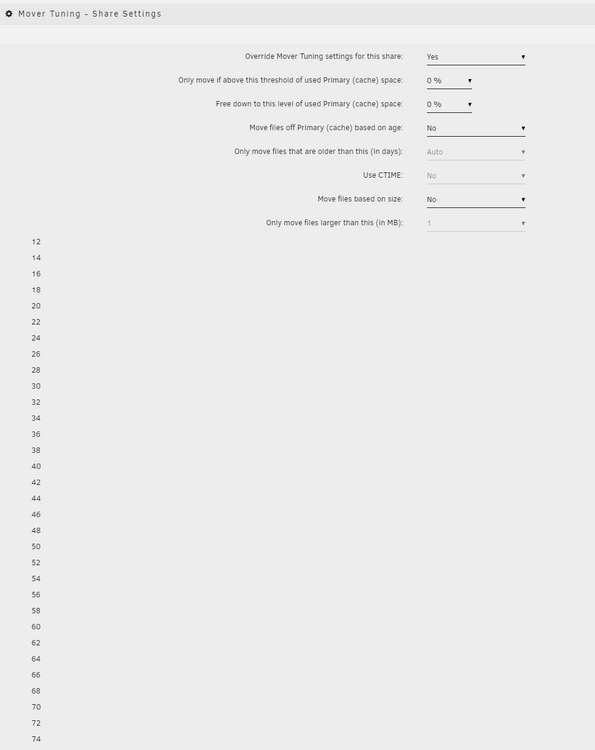
When I open a share and go down though, it looks like this for each and every one of them. 12-1024.
-
WHAT THE F IS WRONG WITH UNRAID?!? I gain access to the shares, and when I go one folder deeper into them, this happens, with some of them. It's not moved or deleted. I changed the case-sensitive setting from Auto to force-lower.