





steve1977
Members
-
Joined
-
Last visited
Everything posted by steve1977
-
They were greyed out. What eventually worked was to change “Set PCIe ACS Override to Both”. No or downstream didn’t do the trick. Now it’s working again.
-
Thanks. Plan was a mirrored ZFS pool for boot/docker. This should leave me protected unless both disks die. Besides losing 8gb from my “docker/scratch” disk, I don’t see any obvious disadvantages. Am I missing any? Advantage would be to have a cleaner setup rather than the need to work with usb disks, which historically have proven to be prone to failures.
-
Thanks for your help. What do you mean by "where things stand right now"? I have not yet pulled the triggered, but planned to change my setup to migrate from the usb boot flash disk to a mirroed zfs pool that keeps 8GB for the bootdisk and remainder for docker containers and download location for the *arrs. Separately, I'll a few array disks as well as an nvme for my virtual machine. Eventually, I'd like to install the VM bare-metal to allow dual-boot into Unraid (with VM accessing bare-metal) or optionally also boot into the VM directly, which will be better for occasional gaming.
-
Please see below. Do I need to tick these boxes? I don't think I did in the past and it still worked?

-
Not sure what updated. I upgraded to 7.3.1 and now can no longer start my VM. Getting the error message below. Any thoughts? Internal error: process exited while connecting to monitor: 2026-06-20T16:[removed] qemu-system-x86_64: -device {"driver":"vfio-pci","host":"0000:04:00.0","id":"hostdev0","bus":"pci.0","addr":"0x5"}: vfio 0000:04:00.0: group 0 is not viable Please ensure all devices within the iommu_group are bound to their vfio bus driver.
-
Is there a "how-to"? I had googled and found below that says that I need to vipe / use an empty ssd/nvme to use as my internal bootdisk?
-
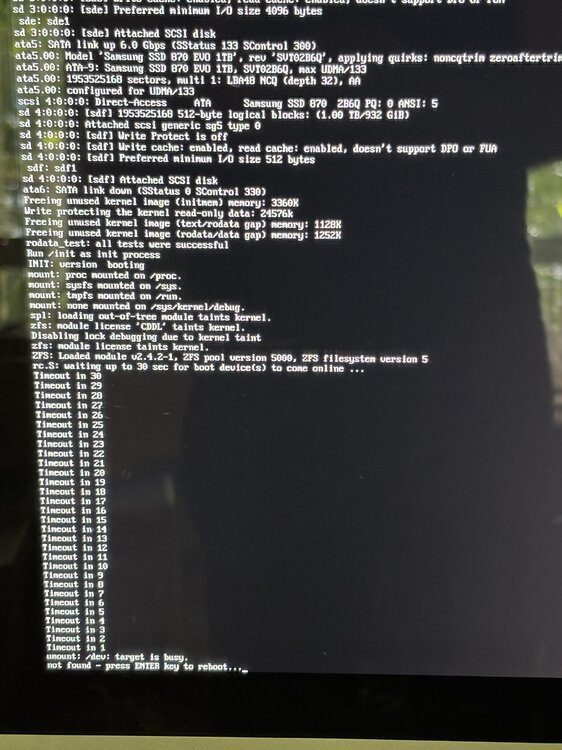
Tried to replace the flash disk with manual way. Formatted to fat32, extracted the zip in root folder. Manually copied over the config folder (select replace). At start-up, getting the error below. Thoughts?
-
And no negative impact of running dockers and boot files from the same disk? Wasn’t sure whether the new internal boot requires a dedicated internal disk for boot?
-
Title says it all. Will this be possible? Currently my boot/flash is on a dedicated USB disk. Can I move it to the cache disk (SSD in ZFS mirror) and will this give me mirrored protection for failure?
-
Wise words, indeed! Big thanks to @EDACerton to all he’s doing for the community. There are a few plugins like Tailscale, UD and mover tuner that would be best embraced as native part of unraid.
-
Thanks. You’re running Mihomo in an unraid docker?
-
Curious how you are using mihomo with Tailscale?
-
Trying to restart or stop docker container, but it does not work. Even disabled docker and reenabled it. Still same issue. When trying to do it through CLI, I can see below error message. Attached diagnostic log. root@Tower:~# docker kill 971e5bde1108 Error response from daemon: cannot kill container: 971e5bde1108: tried to kill container, but did not receive an exit event tower-diagnostics-20260428-0415.zip
-
So, basically zero risk of data loss as long as I don't mount a data disk by accident as parity disk? Even if I get something wrong, data will still be there?
-
That's the one here?
-
Yes, the parity was valid and should still be. The only thing is that I am not sure, which disk was array disk 1 vs 2. Does this matter? Or does this give me a 50/50 chance of messing things up?
-
I accidentally removed my array (new config). So, now my parity disk and 2 array disks show under UD. One way is to just add them back and recreate parity. Is there another option where I can just re-add the whole pool back without recreating parity? I haven't touched any of the three disks, so somehow would just need to get the array back "as is".
-
It worked now. But I am very worried. It feels that I just redid the same thing several times. And eventually it worked. Maybe there is some issue with cabling? Or a faulty disk? or a fake disk? or whatever else that could lead to this? Is there anyway that I can pressure-test whether this is now indeed functioning before I put data on the pool?
-
Now tried to format the disks as UD, which worked. But it gives me an error message when mounting. Diagnostic attached. tower-diagnostics-20260423-1314.zip
-
I still cannot get it to work... :-( Maybe an issue with my SSDs? I added two brand-new SSD disks to a pool. File system ZFS, Allocation Mirror, Compression On, Autotrim On, Enable User Disk assignment Yes. I am getting "Unmountable: wrong or no file system". Will share a diagnostic log shortly. Any thoughts?
-
Thanks. I've reached out to support to un-blacklist the device.
-
I added two new sd disks. Trying to add both together as ZFS pool. When starting the array, one sd disks shows up as pool. The second doesn't mirror, but instead just shows under UD and can be mounted there. Any help appreciate! Daniel tower-diagnostics-20260421-2206.zip
-
Hooray! I fixed the issue, which also fixed my other issue with not being able to access USB devices. The root cause must have been related to prior attempts to make wifi work. I deleted the wifi.cfg file and now things seem to be back working again. The only thing that is not working now is that my flash disk ID is blacklisted. But I guess support will be able to help on this to get it working again?
-
Tried in "safe mode" and same issue. It works with an old unraid flash, so it is not an hardware issue. In parallel, the usb error is still there and may be related. I can use keyboard & mouse to access bios and select safe mode. However, once it reaches the screen to enter user name for unraid, the keyboard no longer works. Somethind is borked in the settings?
-
Having some issue with accessing USB devices and made some changes of the iommu groups. Seems I bricked something. When I am now starting Unraid, it does not connect to the network. Getting "Eth0 Does Not Exist" and "IPv4 Not Set". Cannot provide diagnostic log as I cannot access the server. Tried to delete the network.cfg file, but no change. Changed the USB disk with fresh install (though copying over the config folder), but issue remains. I happened to have an old Unraid stick around, which seems to be working (but is totally outdated, so that's not an option to use). Any idea how I can troubleshoot this issue?

