axipher
Members
-
Joined
-
Last visited
-
There is a chance there is a database issue, there have been many in the past with so many different troubleshooting methods. Especially if you had a freeze/hang during a database task. I would just make sure you take a full backup of where you are now and take a look at some Plex database fixing threads to use when Plex is shutdown. It's annoying, tedious and can take a while to figure out.
-
So in the past, hanging Plex for me has been for a few reasons. First the user induced ones: - major library update or addition where the new library has Thumbnail Creation enabled which slows down the entire server - incorrect drive mapping for temp or transcode to a RAM drive or SSD share where I ran out of space - incorrect CPU pinning and a rogue VM was hogging all the CPU threads and Plex just couldn't do anything Second, some non-user ones: - failing SSD pool with NVME read errors in the logs preceding the crash; in the worst case this led to a corrupt database and had to recover from CABackup a month ago and lost some watch history. this one happened to me twice, once was because my second M.2 slow off the chipset was just not good, second was actually a bad aging SSD per the SMART settings - GPU driver lockup; happened on an older NVidia card and after a few failed transcodes, Plex just decided to freeze up in the running state - ISP issues; my ISP got stuck in a loop constantly renewing my WAN IP address with a new one and Plex just couldn't maintain a connection. This wasn't exactly Plex hanging, just no clients could connect unless it was my local PC in web-browser; local Chromecast would keep failing to connect
-
I've also had mine pinned on 1.20.2-alpine as well due to newer versions having issues, I can't remember them exactly though. I'll have to give 1.24.4-alpine on my secondary test server, thanks for that information.
-
I think App Passwords just require it to be a personal account and have 2FA enabled.
-
Transcoding should kick in if: - client can't play back the source file format (older phone without HEVC) - client wants a lower quality (quality preferences on client, remote connection at lower speed, manual quality override, etc.) - tone-mapping required (if enabled in settings) for playing HDR content on an SDR client So if a user with web browser has Hardware Acceleration in the browser disabled, or is trying to play back HDR (web only supports SDR if I recall correctly), then transcoding will kick in. As for your P2000, you can check here: https://developer.nvidia.com/video-encode-and-decode-gpu-support-matrix-new It looks like the P2000 does support Decoding H.265 (4:2:0) but not H.264 (4:4:4) and not AV1. Most HEVC content will likely be just 4:2:0 so your P2000 should work for that. It should be a pretty decent card for the majority of content. But if you have really high quality HEVC (4:4:4) or AV1 stuff, it won't do any decoding. It still might get used for the encoding portion though (I'm honestly not sure if Plex GPU transcoding required both decode and encode to be supported on the GPU or if it can do CPU decode and GPU encode) Also keep in mind certain Nvidia drivers will have "session limits" on how many simultaneous encode/decodes can happen at once before it just won't to more. This used to be limited to 2 streams per engine I think on the regular driver and there was an unofficial unlock script, but I think recent drivers or maybe just newer generations have dropped that, I'm not 100% on that either as I have switched to Intel Arc for a while now. Plex also has certain tasks it can't offload to the GPU. I think they are the following: - Anything Audio related - Certain Sub-titles processing or burn-in - Video Chapter Thumbnail Generation I would recommend installing Tautalli alongside Plec as it provides much better history of sessions and transcode details for clients.
-
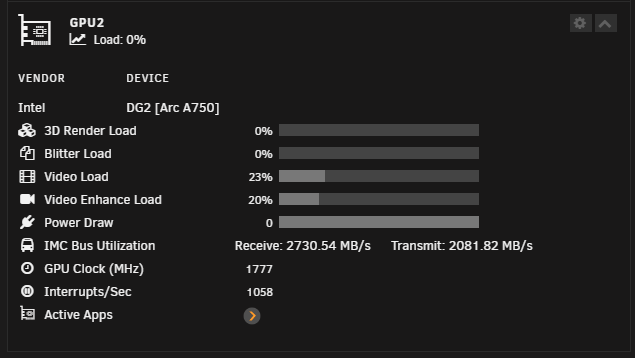
Can confirm latest GPU Stats from regular updates works on my Arc 750 as well in Plex.
-
Sorry for the delay, I hadn't been to the local pool in a month. To give a tiny update. I have WireGuard on Unraid setup to use port 51821 as the main Local Endpoint port on my WAN IP address. For testing, on my router, I have both external port 51821 forwarded to internal port 52821; AND external port 80 forwarded to internal port 52821. I did the QR code based setup from the WireGuard App on my phone to install the profile and tested that to make sure it works. Then edited the profile and changed the port from 51821 to 80 and tried again while on LTE and it worked. Then at the pool where most other ports I've tried seemingly get blocked, this time the VPN worked fine since. Now there are security concerns about using a well-known public port so I chose to ensure that Wireguard in this case is only being used for DNS to my local PiHole for ad-blocking and no network level access or tunnel is actually in place. And on the majority of days where I don't need that specific VPN access, I leave that port forwarding rule disabled on my router. I'm hoping someone else here can chime in any maybe offer a more elegant of safer solution. I'm not an IT expert, so I have no idea how safe the WireGuard endpoint port is being in the more common range of ports that attackers will typically try to go after.
-
The "No space left on device" look to point to either a bad mount, or a disk or vdisk or image is full with no free space for the log file and that is causing errors. Have you checked where stuff is mounting too, your docker image, and permissions of the appdata folder?
-
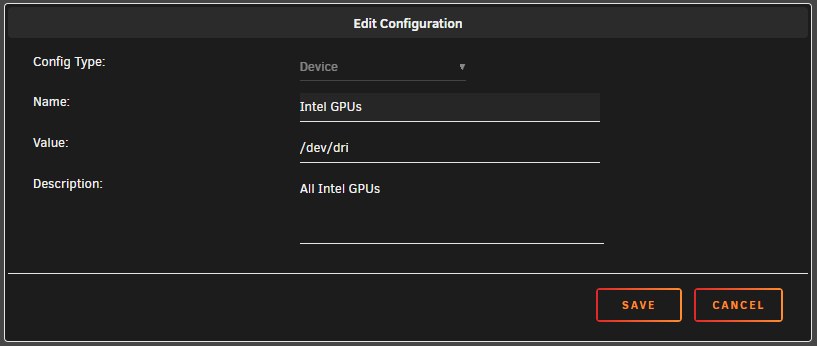
Yeah, I would first try just changing the Plex Device to /dev/dri and seeing what GPU's you can select in Plex and then testing again. Most reports I read indicated that the HDMI dummy plug is mostly needed for the iGPU to be used and not so much discrete GPU's, but also, does not hurt to have the dummy plug. I'm not sure how it affects power consumption though, I know just installing my Arc card increased my power draw by a little over 15 W on my server so I'm assuming it's the card's idle power draw. I can't see Linux kernel 6.9-rc3 breaking anything Arc related over 6.9-rc1, but if you can easily roll-back to the same version as me, at least it might be easier to troubleshoot.
-
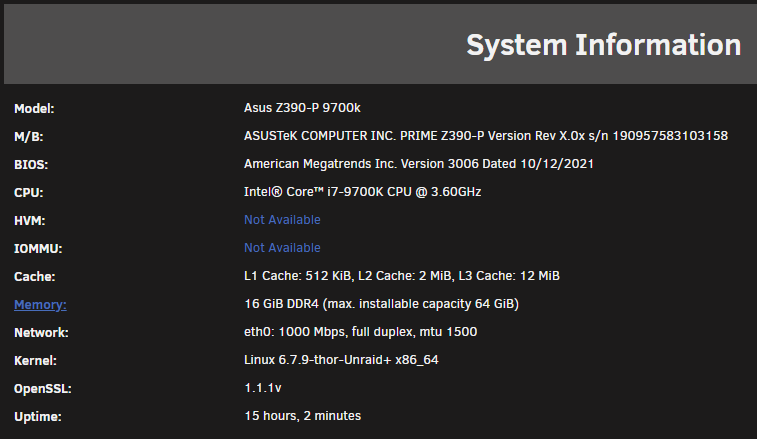
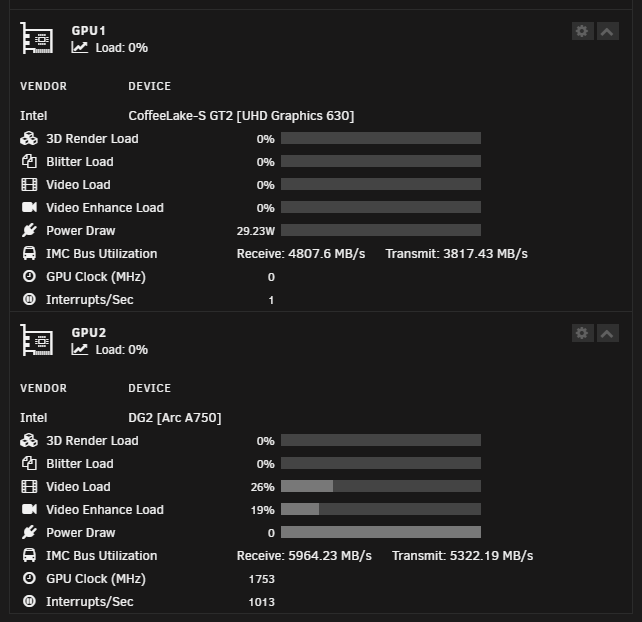
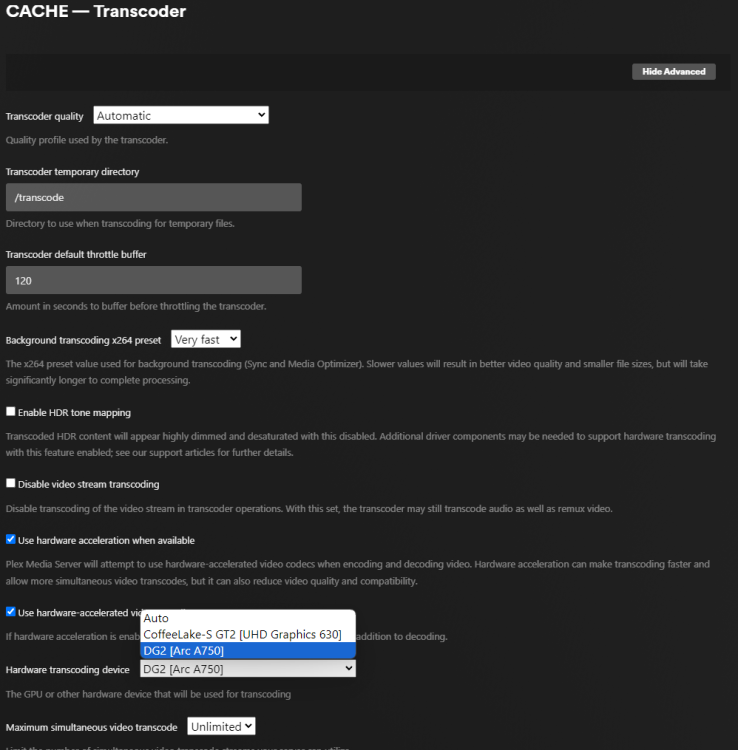
First off, I must point out that I'm not an expert on Plex, Unraid or Arc, but this is my experience. Also I can't remember if there are certain sub-title formats that will force CPU encoding, so make sure to try testing on something and turn off sub-titles just to make sure that isn't messing it up. Audio might get CPU transcoded still, but that is a tiny load and shouldn't affect a server, especially yours with that many threads. I'm currently Unraid 6.12.9 with this kernel from Thor2000: Linux 6.9.0-rc1-thor-Unraid+ x86_64. I believe it was from the 20240331 release: https://github.com/thor2002ro/unraid_kernel/releases/tag/20240331. I'm pretty sure it worked on 6.12.8 though with the 6.7.9 kernel as well from Thor2000. I had a 3-pack of HDMI dummy plugs from previous QuickSync stuff so I installed one in my ARC GPU from day one, so I have note tested without it installed. For my Plex config, I have a device setup as just /dev/dri. I believe I tried going direct to /dev/dri/renderD128 or /dev/dri/renderD129 but it sometimes wouldn't work so I just put in /dev/dri and then selected the card in Plex. But since my system has a Intel i7-9700k, I have two Intel GPU's installed: - Card0 is the 9700k iGPU and is linked to Render128 - Card1 is the Arc 750 DG2 and is linked to Render129 And inside Plex itself, under transcode settings, make sure to select the DG2, since I can select either Intel GPU there. Then a restart of Plex docker is likely required: Both show up in GPU Stats for me and while Transcoding, I see the proper DG2 get used:
-
Unraid's built-in Feedback Bug Reporter is not working for me, says it fails to generate bug report, so posting a forum thread instead using the format it suggests. Bug Description: - Notifier is sending the previous completed Parity Check results instead of the one that just finished. How to reproduce: - Have Parity Checks Schedule for beginning of month - Have Discord Notifier setup - Have Email Notifications setup Expected results: - When April Parity Check completes, get the April Results Actual results: - When April Parity Check finished, I got March's Parity Check results instead. Other information: - Discord Results: Duration: 1 day, 4 hours, 1 minute, 20 seconds. Average speed: 119.0 MB/s - Email Results: Duration: 1 day, 4 hours, 1 minute, 20 seconds. Average speed: 119.0 MB/s - History of Parity Checks: Action Date Size Duration Speed Status Errors Parity-Check 2024-04-02, 00:59:39 (Tuesday) 12 TB 21 hr, 59 min, 38 sec 151.6 MB/s OK 0 Parity-Check 2024-03-05, 07:01:21 (Tuesday) 12 TB 1 day, 4 hr, 1 min, 20 sec 119.0 MB/s OK 0 Parity-Check 2024-02-06, 01:41:06 (Tuesday) 12 TB 22 hr, 41 min, 5 sec 146.9 MB/s OK 0 Parity-Check 2024-01-21, 11:12:26 (Sunday) 12 TB 20 hr, 20 min, 19 sec 163.9 MB/s OK 0
-
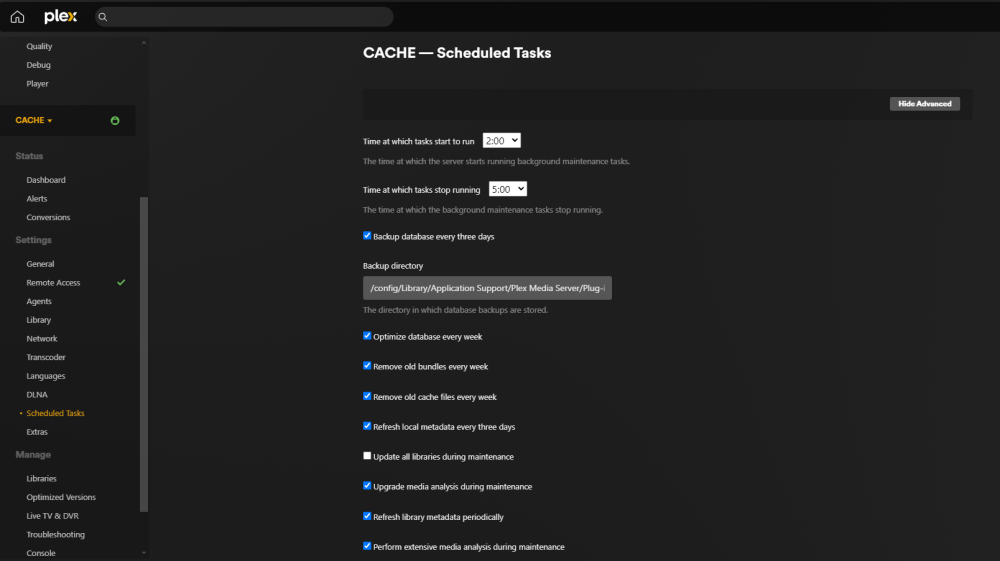
I'm no expert on all the other things Plex server does in the background, but if it starts pretty much on an hour mark, it is more than likely some automated task or clean-up happening. In Settings at the bottom, there is a Console Menu that lets you see the active logs of the server and you might be able to search through that to see what is using up your CPU in Plex.
-
Do you have any Scheduled Tasks in Plex? They have a section in server settings and a set time that you can compare to when you typically see CPU usage peg 1 core 100% This could be audio normalizing, video thumbnail generation, intro/credit detection, local metadata updates, database backups, etc. Some of those settings might be on libraries themselves.
-
I was more so just posting to note that what he has now does work with a different kernel, in case someone else might have wanted to see monitoring for an Arc GPU. My switchover from the Coffee Lake iGPU to the Arc GPU was for a few reasons: My library is starting to have more AV1 content in it The Coffee Lake iGPU had no AV1 decode, so and AV1 videos on my server would switch to software decode which at times cannot maintain even 1.0x transcode speed on a 1080p video with only 8 threads. This is especially a problem with 3 or more streams or if something else is using CPU on the server or audio transcoding is required. ARC is able to transcode faster than the iGPU on the same source files allowing for quicker skipping through media playback The 20W if extra idle power and bursts of power draw during transcoding is okay for me in my home server rack Arc GPU on sale was cheaper than a new motherboard and CPU or the similar Nvidia option I switched to the Thor2000 Custom Kernel because the current 6.12.8 Unraid Official Kernel doesn't support Arc for Plex Transcoding. Ideally staying on the Unraid included 6.1 kernel would have been best, but Arc wouldn't work without changing kernels. From my research, it seemed like the only main things I would lose from the custom kernel was being to use the Nvidia-plugin and an Nvidia GPU, and ZFS, both of which I'm not using at all in this Unraid box. This is also my secondary Unraid that runs Plex, redundant PiHole and some other redundant dockers, the main box with the media files is still on official kernel to avoid any chance of data corruption.
-
Just as confirmation here, the multi-gpu-stat does work with multiple Intel GPU's, in my case, using the Thor2000 6.7.9 custom kernel for my Arc A750 GPU alongside my 9700k iGPU. Both have HDMI Dummy Plugs.