





JonMikelV
Members
-
Joined
-
Last visited
-
I use SFTP connections for some backups and recently they ALL stopped working. Assuming this meant a server issue I reviewed my "Settings" -> "SSH" config and everything LOOKED fine but SFTP connections still return "inputstream is closed" and SSH connections result in: hostfile_replace_entries: link /root/.ssh/known_hosts to /root/.ssh/known_hosts.old: Operation not permitted update_known_hosts: hostfile_replace_entries failed for /root/.ssh/known_hosts: Operation not permitted I've tried the ssh-keyscan fix suggested elsewhere, but it doesn't seem to do anything (backup copy of known_hosts matches result of ssh-keyscan). ssh-keyscan -H TARGET_HOST >> ~/.ssh/known_hosts In all cases a `tail -f /var/log/syslog` shows "accepted password for <user> from <ip> port <numb> ssh2". I've tried enabling "Permit Root Login" in the SSH Settings page but that doesn't seem to make any difference. Thanks in advance for any suggestions on how to further debug / resolve this!
-
Wow - your patience with idiots like me is incredible! Turns out I've spent HOURS (days?) trying to find (or create) the "extra parameters" field in "Show more settings..." when I really just needed to toggle the "Basic View" / "Advanced View" switch in the upper right of the page. D'Oh! I wonder if I was confusing myself with the Docker overview page "Advanced View" (that shows the CPU & memory) thinking it was the the Docker *EDIT* page "Advanced View" that I needed. Either way, all resolved - thanks!
-
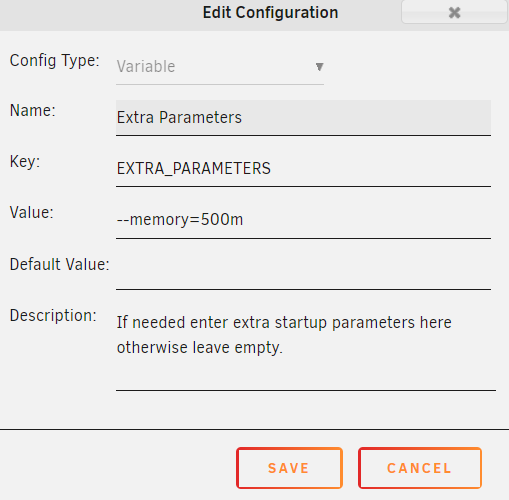
Hmm... I'm sure I'm not confusing the CPU percentage shown above the line with the memory usage shown below it. I guess trying to explain what I was thinking of just made my post more confusing, not less. 😞 I must be incorrectly using the --memory parameter from: I've tried this test as EXTRA_PARAMETERS and standalone Variable values with & without double-dashes but still see max memory in the usage column: Resulting in: Sorry for turning this into a standard Docker question - am I able to move the discussion out of Feature Requests?

-
On the Docker tab, the "Advanced View" helpfully shows memory load as "currently used" / "system memory". But if this is truly memory LOAD should it reflect usage of the "--memory" parameter? For example, if I have a container using 8G of memory on a 32G server it shows as "8.00 GiB / 32.00 GiB" which suggests 25% usage, but if the container were run with a "--memory=10G" parameter then the container would actually be at 80% usage. On a related note, it might be nice to include a total docker numbers - like the total CPU & memory used by ALL dockers.
-
I've played with a few VMs created from scratch without (much) issue, but in testing migrating a physical box to a VM I'm running into super slow disk IO (like 100-200 KB/s max). I'm wondering if because the .img file was created outside of my no-COW "domains" folder, maybe it "carried in" the C attribute when I moved it under "domains"? I tried lsattr on the file but end up getting an "lsattr: Inappropriate ioctl for device while reading flags" error. Does anybody have any suggestions on how to check Copy On Write attribute for a file in Unraid or know if it is removed when a file is moved (or copied) into a no-COW folder?
-
@Zudnic, did you create the `/mnt/user/ubuntudata` folders before running the `mount` command?
-
Thanks for sharing! I may give PrimeOS a try one of these days, but a while ago I gave in and picked up a cheap Chromebook at a holiday sale to play with. Figured it was cheaper than all the time I was spending fighting with the VM. :-)
-
Why the bashing? Just because I don't know Proxmox doesn't mean I don't know VMs. (Plus you confirmed it's not supported - seems a solid suggestion to me.) One person's "bullshit" is another's avoidance of technical details about drive exposure until sure the audience is ready for it. You shouldn't feel the need to apologise for your opinion, it's just as valid as anybody else's! Plus, thanks to you I know more about Proxmox use that I did before. 🙂
-
If you're planning to play with Unraid under Proxmox that should be fine but I wouldn't recommend it for long term use. I know little of Proxmox but I would guess that Unraid wouldn't have the right kind of drive access to safely "do it's thing" if running in a Proxmox VM.
-
Here's what ultimately worked for me. ~~~ VM Config: Unraid Share: /mnt/user Unraid Mount tag: user ~~~ Addition to /etc/fstab: #2020-04-14 Sample auto-mount via "Unraid Mount tag" user /mnt/user 9p trans=virtio,version=9p2000.L,_netdev,rw 0 0 I've read that 9p is actually pretty bad for performance but I've never been bothered enough to figure out an alternative. 🙂 Note that I got a pretty big speed boost by adding msize=262144: user /mnt/user 9p msize=262144,trans=virtio,version=9p2000.L,_netdev,rw 0 0 Of course I only tested with a simple dd command, so YMMV: dd if=/dev/zero of=/mnt/user/testfile bs=1G count=1 oflag=direct; rm ~/mnt/user/testfile
-
I'm a glutton for punishment so looked anyway - I can't get past "Booting 'local image A'".
-
Thanks for the link @sharpfork. I had read through that as well and decided it sounded like a lot more work than it probably needed to be - at least here 2 years later. 🙂 What I've tried so far is: - download the CloudReady image from https://www.neverware.com/freedownload - unzip the cloudready-free-74.4.57-32-bit.bin (or cloudready-free-74.4.58-64-bit.bin) file into my ISOs folder - Create a VM with: + Logical CPUs: 2 + Initial & Max Memoru: 2G [min. spec. for CloudReady] + Machine: Q35-2.1 + BIOS: OVMF + USB Controller: 3.0 (qemu XHCI) [boots faster than USB 2] + OS Install ISO: path to cloudready-free-74.4.58-64-bit.bin + OS Install CDRom Bus: USB + Primary vDisk Location: Auto [created as 16G drive - again min. spec. for CloudReady] + Primary vDisk Bus: SATA + Graphics Card: VNC + VNC Video Driver: Cirrus [If you left the default of QXL (best) I didn't see any of the boot screens mentioned below] + VNC Password: <blank> + VNC Keyboard: English-United States (en-us) + Sound Card: None + Network MAC: <whatever defaulted> + Network Bridget: br0 + USB Devices <none> + Other PIC Devices: <none> With those settings, I am able boot the VM and see: - the "TianoCore" logo screen for about 3 seconds - a blank screen for about 8 seconds - the CloudReady boot logo for about 1 second - the animated "Your system is repairing itself. Please wait." page for about 3 seconds - the whole process start over Eventually I have to force-stop the VM. Per the Neverware support pages, this sort of boot loop is usually indicative of unsupported hardware of some sort so I've decided there may be something about the specific hardware my Unraid is running on that CloudReady doesn't like. I might be wrong, but I haven't made time to play around with anything else (like the 27 partition process in the link you provided).
-
I doubt you'll hear much about actual ChromeOS. As far as I know Google doesn't provide any self-install type options (such as an ISO). That being said, ChromeOS is Google's customized version of the open source ChromiumOS (just like the Chrome browser is Google's customized version of the the Chromium browser). And just like how there are other customized versions of the Chromium browser (such as Brave, among others) there are other customized versions of ChromiumOS. This website has a nice comparison of the most common ones: - https://www.electromaker.io/blog/article/flint-os-vs-chromium-os-vs-cloudready-which-chrome-os-is-best To summarize it - as of Jan. 2019: - ChromiumOS - 'the original', open source, not necessarily the most polished or feature packed, - FydeOS (formerly FlintOS) - many variants (such as for RaspberryPi), supports Android apps, etc. - CloudReady (also formerly FlintOS) - more enterprise focused, supports CloudReady Linux apps, etc. So you might want to do some searching for ChromiumOS, FydeOS, or CloudReady and consider trying one or more of those as VMs on your Unraid box. If you, come on back and share your own experiences and thoughts! 🙂
-
I like shiny new things and haven't had any major issues with updates in the past so decided to try 6.6.7 -> 6.7.0 even though I'm not near the box right now.... Oops. 🙂 30 minutes later I'm still at the "System is rebooting" page and while the device replies to pings it won't accept (actively rejects?) connection requests to the GUI. I have SFTP access and one of my remotely visible auto-start Dockers is running but another isn't and my auto-start VMs aren't. I have remote access to other machines on that network and the Unraid SMB shares do seem to be visible. I'm fine waiting until I have physical access to the device but if people have suggestions for remotely (via SSH) debugging I could poke around a bit. 🙂 Edit: Thanks @moose, apparently it just got stuck shutting down - once I physically power cycled it everything (including the expected loss-of-power parity check) was fine - hello 6.7.0! 🙂
-
I'm glad you figured it out! I hadn't answered because I've not used privoxy before. In case in run into the same issues you had, what was the variable you needed to add?

