





Socrates
Members
-
Joined
-
Last visited
Everything posted by Socrates
-
Do u want me to go ahead with the fix? Please could u post the steps for fixing this? Or do u want to first run the xfs check again after converting the disk to unassign mode?
-
Steps i undertook 1. Stopped the array. 2. Started the Array in Maintenance mode. 3. Clicked on Disk 12 and then ran the check. No i did not unassign this disk. Do u want to unassign this and then run the xfs check with no -n switch?
-
Filesystem is not hardware curroption, right? Can't i format the drive, format it with XFS filesystem, this way it becomes a new drive, and then plug it in and resover using the 2 parities I have?
-
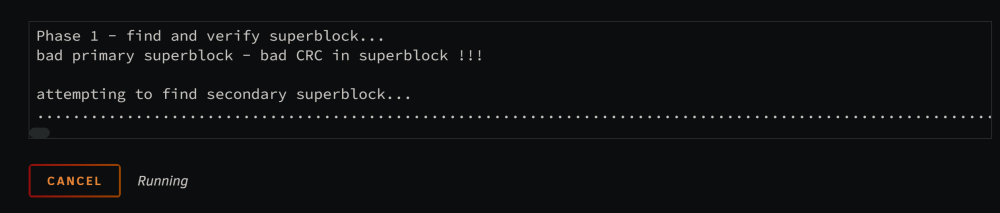
So here is the final result. FS: xfs Executing file system check: /sbin/xfs_repair -n /dev/sdi1 2>&1 Phase 1 - find and verify superblock... Phase 2 - using internal log - zero log... ALERT: The filesystem has valuable metadata changes in a log which is being ignored because the -n option was used. Expect spurious inconsistencies which may be resolved by first mounting the filesystem to replay the log. - scan filesystem freespace and inode maps... sb_fdblocks 1657832310, counted 1659752643 - found root inode chunk Phase 3 - for each AG... - scan (but don't clear) agi unlinked lists... - process known inodes and perform inode discovery... - agno = 0 - agno = 1 - agno = 2 - agno = 3 - agno = 4 - agno = 5 - agno = 6 - agno = 7 - process newly discovered inodes... Phase 4 - check for duplicate blocks... - setting up duplicate extent list... - check for inodes claiming duplicate blocks... - agno = 0 - agno = 1 - agno = 2 - agno = 3 - agno = 4 - agno = 5 - agno = 6 - agno = 7 No modify flag set, skipping phase 5 Phase 6 - check inode connectivity... - traversing filesystem ... - traversal finished ... - moving disconnected inodes to lost+found ... Phase 7 - verify link counts... No modify flag set, skipping filesystem flush and exiting. File system corruption detected! RUN WITH CORRECT FLAG DONE
-
Wait i am sorry i am failing to understand. you are saying i cannot treat these two drives as new drives and recover data from parity? I do have two parity drives in healthy state. WHy cant i treat them as two failed drives and recover the data from parity?
-
Its still running and nothing has changed. what does it mean? Do u think its better for me to format these drives using xfs and then rebuild it with the 2 parity drives i have?
-
I have initiated the check on Disk 12, its been running for a few hours, will report back tomorrow or when it completes.
-
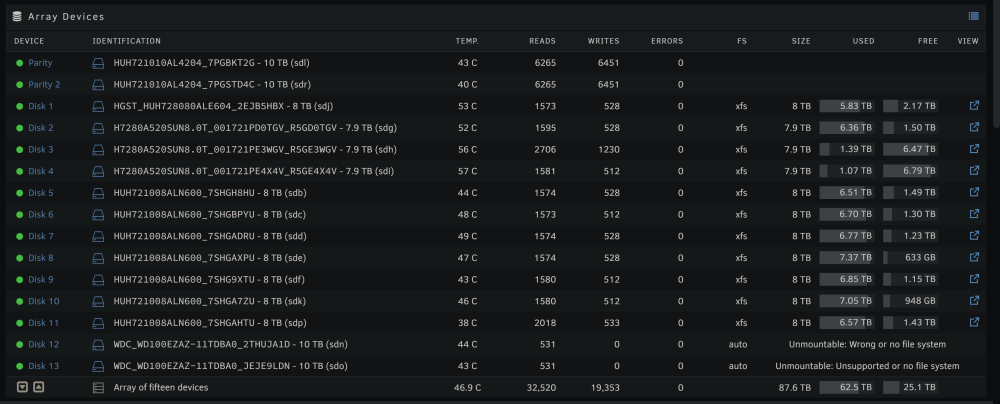
Thanks for looking into this. I've performed the operation you recommended on both the disks, made them xfs from auto and started the array again, and still it shows the same result Unmountable: Wrong or no Filesystem" and "Unmountable: Unsupported or Wrong filesystem" New logs from diags attached. tower-diagnostics-20221219-1101.zip
-
I have restarted my unraid after moving states, and during this move i had removed the drives from the server and put them in extremely well packed bubble wraps in a secure container. Now, after a few months i have finally setup my server rack and after installing the hdd's into my 24 supermicro bay, unraid has come back online but two of the drives show "Unmountable: Wrong or no Filesystem" and "Unmountable: Unsupported or Wrong filesystem" These drives were working before. They were a part of the unraid system, but now i get these. Diagnostic attached with this post. tower-diagnostics-20221218-2345.zip
-
I am using the latest release.. along with Dark Reader Chrome extension. with these settings for all my webpages.
-
Thanks this one looks fantastic with my unraid theme.
-
I am sorry I am late to the party, but can someone share their settings for this plugin? I have installed it, but would like to set it up the ideal way. I am would like to get notified for any file corruption through bitrot or related before hand.
-
Can someone share the screenshot of their settings page for this app? I'd like to set this up with the best possible configurations.
-
So I am new to this app, however I have installed the Dynamix Cache directories.. but I have not made any changes/edits to it. Are there changes, edits that you guys recommend that one should make to get the best out of it?
-
My installation of hddtemp throws an error in my telegraf logs. I am trying to setup a grafana dashboard.. most panels are showing data correctly except hdd tempratures are not... upon inspecting the logs i see the error... in my telegraf log files. Not sure how to go about fixing this. But i can seem to make it work. Please guide.
-
The disks are a combination of SAS and Sata drives, all HGST 8TB.. as for the HBA card. I have a combination of these cards... as well. HP LSI 8-PORT SAS 6GB Raid Card SAS9217-4i4e LSI Logic SAS9200-8E 2 X SFF-8088-Ports 8-Ports LSI Logic SAS9200-8E SFF-8088 LSI Logic SAS9200-8E 8PORT Ext 6GB
-
Thats correct.
-
Everything is working great so far. I have completed my 72TB media/data migration. Have been going really deep to make this migration worthwhile. So far i am loving everything about Unraid. I have been living in a cave, dont know why I have been meddling around with FlexRaid, Snapraid since years now. I am set for life now with Unraid, and i wont ever be looking back. I have setup Grafana, Telegraf and InfluxDB as well, and have created a custom dashboard as well. This is getting better and better, I have a quick question about various plugin's that interact with the server's hardware. HDDTemp plugin is not displaying hard drive tempratures, I have fiddled it with for an entire day today, and i cant seem to make it work. I am just wondering if there is any limitation on how various in unraid will get affected cos its running on a virtual machine and not a dedicated hardware? I have been trying to plug the the ESXI datasource to my grafana dashboard as well, and neither the cluster is showing up, nor the cpu or vmhost nor memory shows up. https://grafana.com/dashboards/8159 Please note I have setup a very basic looking dashboard displaying the memory, cpu, uptime, network up and down stream etc. But the HDDtemp and the esxi data store is not working. Is this cos of the limitation of using the vmdk in an ESXI virtual host?
-
@doron, @uldise, guys I am up and online now with v6.5.3 and now both the ip and the tower/ url is working just fine. I used @uldise's method using plopKexec. I guess the last time i was unsuccessful was because I was using Samsung flashdrives, then i tried another sandisk flashdrive that probably is abt to die. Ran down to the nearest Fry's Electronics, and brought Sandisk curzer, and used the UNRAID USB Creator. plugged it in, as per @doron's advice i removed the virtual hdd, added the plopKexec iso to the cd/dvd as as datastore and selected it, added a new usb device, and mapped it to the unraid boot drive... and followed your instructions.. and volia it worked. the ip was assigned, and i am now able to navigate right into Unraid dashboard using tower/ url. I will start migrating from my previous SnapRAID setup to Unraid, I have stood up a new vm, and brought equal size hdd's but higher capacity.. upgrading all to 8TB hgst enterprise disks. But before that, i am gonna sour youtube and install all the required plugins, and setup the server for proper unraid setup both for alert and notifications and robust operations. Thank you @doron, @uldise, you all here are so so awesome. Thanks for helping out through late nights, and random times during the day. Cant appreciate this effort enough. Thanks again folks. SO happyyyy!!!
-
Yes, i did execute that bat file.. Plus right now usb is presented to the vm, and that is why when we execute the emhttp command, and thats when i can see the dashboard with the ip address. I can try to format the flash, and re-create the bootable usb. Oh by the way, i remember when i copied all the binaries into the usb and execute the make bat file.. i got an error about syslinux not found. Though the syslinux was at the location, i had to right click and uncheck read only from the windows properties. Thats when i re-executed the bat file, it worked.. I can try and plug in the usb to a laptop and try to boot from it, to see if its working. Will report back in 2 hrs.
-
Thanks, i removed the hdd and rebooted... now i get this.. When i hit enter, it shows some msg, then goes back this screen. What am i missing?
-
Hi @uldise So I will confirm these steps, let me know where i get wrong. 1. Download the plopkexec.iso and upload it "INSIDE" the UNRAID VM datastore folder. This is the same folder where i had initially copied the vmdk from this thread. Check mark the box connect at start This is how it looks with the steps outlined by you. 2. Started the VM, and unRAID booted right away. But the version still shows v6.2.3 Is it because the original vm was created using the unraid 6.2.3? And the vmdk file sare still in the unraid vm folder? Should i delete this vm, and try to create a new vm without the 6.2.3 vmdk and try your steps again?
-
So i was reading @guruleenyc performing similar steps he mentioned about bz* files as well upon your instructions. Where do i copy the bz* files to? which location? I have winscp downloaded. You mentioned to unload the vmdk files to another vm (a dummy vm?)? I have mounted the usb drive under /boot/flash And when i search for *bz* files.. root@Tower:~# find / -iname '*bz*' /boot/flash/bzfirmware /boot/flash/bzimage /boot/flash/bzmodules /boot/flash/bzroot /boot/flash/bzroot-gui This is what shows up. So the bz files are already copied as i had created the usb flash drive wtih the latest binaries. This is the same usb that's currently attached to the vm. see below. Did u ask me to perform the steps in the plop method? The screenshot above is from the VMDK method, not plop. I am kinda confused... If you can just post in extremely simple steps i'd stay put, stay calm and go into the wilderness with my fantastic upgraded setup..
-
So here are the updates. I have used the vmdk method. 1. Downloaded the unRAID version v6.2.3 from the first page on this thread. 2. Created the bootable USB with v6.5.3 (latest version), as i could not find the old version anywhere. 3. Booted the VM, and unRAID fired right up in seconds. 4. Tried to log into the IP addressed provided, it did not work.. tried tower/ it did not work. 5. Used the command @doron provided with the flash drive in the server (with the current version of unraid still in it).. the command was... /usr/local/sbin/emhttp & 6. Tried to log again after the first failed attempt with the ip address, and volia it worked. I am logged into the unraid dashboard. 7. Tried the tower/ url it did not work. 8. So right now only the ip address works not tower/ . If i shutdown putty, the ipaddress unraid dashboard does not work. How do i go about with the permanent fix that does not require the temp command and putty to be open at all the times. I was thinking about installing nginx, but i cant do that, as the partition size is only 1gb (due to the pre-created vmdk). Now here is my experience with Plop. 1. Downloaded Plop, and copied it to a windows filesystem. 2. Downloaded the latest unraid binaries, and copied it into the flash drive, and executed the .bat file to create a bootable file. 3. Created a VM, added 10gb for disk space, uploaded the plop ISO as the CD/DVD datastore. 4. Added a new USB drive, and that automatically displayed (label) my SanDisk drive. 5. Save and booted. Took about 5 mins to boot.. very slow. 6. The ip address assigned was not of my DHCP server assignment. rather some 169.254* assignment. 7. Plugged that IP address in, and got an error saying IP cannot be found. Used the temp command emhttp, did not work. 8. Checked DHCP server, it was working fine. Created another 2nd instance of unraid vm with the vmdk for testing to check if dhcp assigns a new ip.. and yes it did assign a new ip.. and that was working fine. Deleted the second instance.. (was for testing dhcp ip assignment hence). 10. Deleted the VM, and tried the whole plop thing again, and this time as well the ip address was messed up. Pls note, the bootable unraid usb is the same installation that i used for the vmdk method and plop as well. So.. few question.. 1. How do i go about upgrading unraid to the latest build from the current version i am on through vmdk (v6.2.3) 2. Is the plop method more stable, or vmdk? Eitherway, i understand that unraid recommends a standalone usb installation, and not through virtualization.. but are these methods safe? Say if my SSD (where the vm's are residing) or usb drive fails, can i spin a new ssd import all the vm's to the new esix host and be able to still see my data and parity drives? I mean to ask will the data and parity drives be safe and be able to easily import into a new esxi host and vm after the esxi host failure? 3. How do i go about with the permanent fix that does not require the temp command and putty to be open at all the times.? I am in the US time zone, and it looks like a lot of folks here helping me are in Euro time zone (day for you all). I will be heading to sleep in abt an hr after posting this. If you need me to run few commands for the fix and all, pls go ahead with your suggestions and post.. i will try them when i get back online in the morning. Thanks all so much in advance for all the help. I do know now I am in good hands, my data is in good hands.
-
I am in CST *Chicago time zone*, just woke up.. heading to work, I will post back more details from work, when i reach my desk. lol

