





MrAndyBurns
Members
-
Joined
-
Last visited
-
Thank you @Tomahawk51 . I have an old Xerox network laser printer which cups did not play nice with (no colour) BUT I do have a Windows VM running so I was able to follow your setup above and now have an AirPrinter for use from my phone! I may have a play to see if I can get the Linux version running in an UnRaid docker, but that's for a rainy day. Thanks again, Andy
-
Goodness me ... first thing is don't panic!! I am absolutely no expert with this, but the key thing is stay calm and work the problem. The information in the diagnostics is so limited has the USB enclosure has not passed any meaningful information, and now the drives appear to have been inadvertently shuffled. If I was in your position, I would look to establish what data is on what drive. Depending on how you have formatted the drives, the beauty an Unraid array is it simply saves data on the drive and then uses another drive to check the data. - Pull all your dives and put a sticker on them so you can make notes (Party, drive 1, other etc). - Make a Linux bootable USB (Ubuntu for example), boot your machine using the bootable drive - Put one drive in the caddy and plug into the machine - Check in linux what is on the disk and make notes - The parity should show nothing/unformatted If you are lucky, you will end up with an unreadable parity disk, a 12tb and 14tb drive from the array (as you will have need the files) and then 3 other (the WD disk that started your problems and the other disks which were in slot 1 and 2). Then if you really lucky, just put the parity, the 12tb and 14tb disks in and allocate them as disk 1 and 2 ... if it fails try allocating them the other way around. If all else fails, maybe try and backup/consolidate your data onto a single drive and completely rebuild your array/Unraid getting a better way to connect your drives. For example get a cheap HBA card (I paid £30 on ebay for an LSI copy and so for it works well (for now)). Yes, your enclosure is very good but I feel pushing all those drives over USB is not a good way to go. Above all - best of luck!! (ps - it looks like the Yottamaster just passes tray position regardless of what's in it, where a proper drive connection would pass your drive same and serial number which is why your disk assignment is FUBAR)
-
Thanks @spl147, I did put it in the /boot/config/plugins/dynamix.system.autofan PWM config file, it didn't work and then got overwritten when I restated the service to see if this fixed it... just checked a few hours later and it did work, but then it has litterally just picked up the excluded drive again ... I'll continue to monitor 🤪
-
That's true, I was possibly expecting a full stop at 0% as the drives were off. I've also noticed that I'm not actually able to exclude Unassigned drives as they are not in the list ... just looking at options to see if I can include those
-
SYSTEM AUTOFAN I've been using this for a while, following a MOBO change, I have been diving more into its operation. I have 2 Fans on drives. The top is on a block of 5 array drives, the bottom is on a block of 5 drives the parity, a passed drive and an SSD pool. The MOBO has 2xNVME Drives on it. I was expecting the plugin to: check the top fan PWM3 drives as set in the 'exclude drives' and set that fan THEN check the bottom fan on PWM4 drives again as set in 'exclude drives' and set that fan. The script seams to check all the drives not excluded and then set both fans. For example in my have SDH and SDK are at the bottom so should only be on PWM4 ... PWM3 drives are all spun down so should be at 0% Note: I have modified the script to report the max temp drive and fan controller to find this Question : should the plugin separately control each fan based on the drives included in that PWM group?

-
"Insufficent Storage for Snapshot" Can I tell it to Exclude a Passed Disk Hello All, I'm moving to using VM snapshots as opposed to ZFS. Really pleased with the UI so far and Windows/Debian have gone well BUT I could not run it on a Linux VM is use for my CCTV as there is Insufficent Storage for Snapshot. The VM's run on an NVME pool with 300+gb of free space so I am assuming its trying to include a 1TB drive I have passed through to the VM in the snapshot. Is there a way to exclude the passed drive?
-
GPU is significantly better for Transcode than CPU. GPU's primary role in life is to process graphics where a CPU is more of an all round number cruncher
-
So I would absolutely look at getting a system with an older Nvidia 1050 included as you will enjoy a power hungry more powerful CPU for transcoding. When not transcoding the GPU power draw is minimal. The i5 11600 CPU is a great CPU, also consider 5700x for more cores from 65w TDP. As you mention power, I have a 400w GOLD PSU which ended up drawing about 20% power from the socket than my 650w BRONZE so think about that side too.
-
Any NVME or SSD?
-
For what it's worth, I have enjoyed running Unraid on some great hand me down PC's ... started with Intel i5 2400 running 4 drives in an old Dell Optiplex system, then to an HP system with an i5-4570 which I upgraded to i7-4790, both with 16GB. Now I'm running an AMD system with a 3600x and 64GB ram with 12 drives, a mix of NVME, SSD and HDD's and an Nvidea 1650 for Plex transcoding. All systems worked well and as my use of Dockers and then VM's grew, the more cores and memory helped. The old i5 and i7's work absolutely fine for light docker use, including Plex (not transcoding). Even Windows 10 on the i7 was reasonably good BUT I did notice an improvement on the 3600x which I put down to more cores etc. I'm now running Win11 as a remote desktop VM as a daily driver, leaving my gaming machine just that!! Really depends on that you want to do but I have always been impressed with old kit and how well it performs.
-
I have a ZFS NVMe cache of 2 drives, 1x WD_BLUE SN550 rated for 2,400MB/s read and 1x Crucial P3 1TB PCIe Gen3 3D NAND 2,500MB/s read. If I expand with a quicker SN770 for example or slower Intel P660 what will happen to overall pool read speed and when for example the 3D nand fills up, what about the write speed? (Assuming all in NVMe/PCIe 3.0 with x4 speeds on an okay 3600x CPU)
-
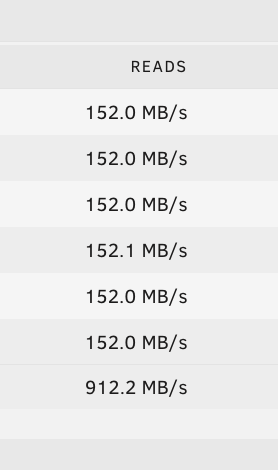
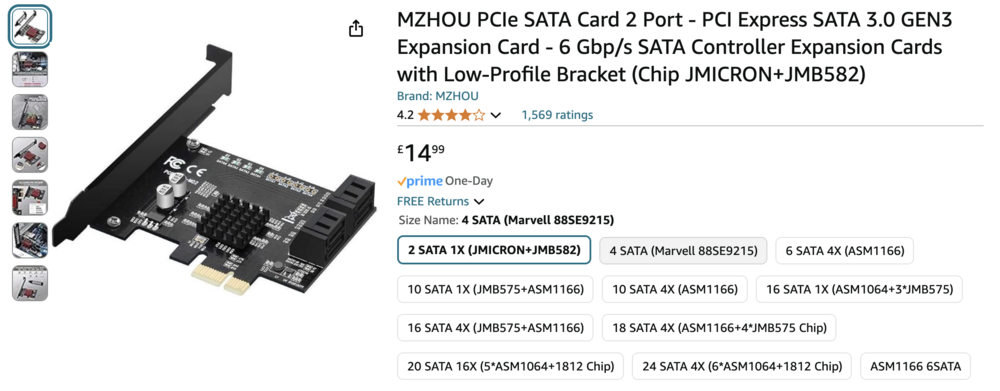
If it's of interest, I had to get 2 extra sata ports (Mobo/CPU upgrade with less ports then to find dead sata port) and was looking for a quick fix. I can't afford a nice HBA card so I went for an 'KALEA-INFORMATIQUE PCI Express PCIe x1 2 port controller card for SATA hard drives. Compact format, with ASM1061' as I believed the ASM1061 chip was okay ... sadly the card was not recognised by the system so I returned it and got a 'MZHOU PCIe SATA Card 2 Port - PCI Express SATA 3.0 GEN3 Expansion Card - 6 Gbp/s SATA Controller Expansion Cards with Low-Profile Bracket (Chip JMICRON+JMB582)' So far so good with parity check running well for all drives and a drive passed through to a VM.
-
MrAndyBurns changed their profile photo
-
Well that sounds just terrible!! !!
-
Thanks @binhex ... followed your advice on GitHub and switched to Wireguard ... the container is now working for me. Not entirely sure what the impact of this will be but it connects and works!

-
did you find a solution to this Nathan?


