





truetype
Members
-
Joined
-
Last visited
Everything posted by truetype
-
Anyone got a working config for getting Tautulli behind the let'sencrypt Reverse Proxy? I want to be able to connect it to https://tautulli.mydomain.com but it doesn't work, I've tried multiple different configs. Please help me out if you got a working config
-
Thanks CHBMB. Could you please help a fellow out how to update via command line (SSH)? I found this, but it says apache so I suppose that wont work https://docs.nextcloud.com/server/12/admin_manual/configuration_server/occ_command.html#command-line-upgrade-label EDIT: Sorry, saw the link now in the first post!! Now on version 13.0.0 all working good so far
-
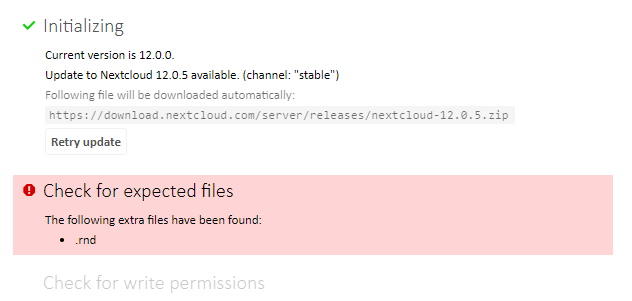
I'm on version 12.0.0 and tried to update to 12.0.5 but got .rnd error. - See error in picture below. Can I delete the .rnd file and try again or how could I overcome this error? Install the update manually is O.K ? Thanks in advance
-
I did that too, and I cannot see why that would not be a good solution. So stick to it until you encounter a problem or someone else tells us why this would not be a good solution.
-
@Living Legend After you've uninstalled it you need to delete it from "previous apps" in CA too. Otherwise the old stored template will remain and reinstall when you are installing again. That's my qualified guess.
-
Dope..... Thanks, tried with 442 and now running at least!
-
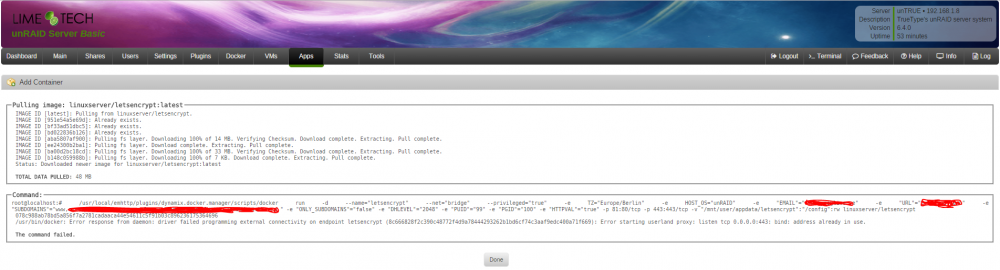
I see the last update made it though for most of us... I've read about the last 5 pages and I seem to be the first with this issue "port already in use". I get "Execution Error" which means I cannot even start the docker. I've updated to unraid 6.4.0, does it have something to do with it? See below in box and/or screenshot. I've tried to change the 443 port to like 445 but same error then... Command: root@localhost:# /usr/local/emhttp/plugins/dynamix.docker.manager/scripts/docker run -d --name="letsencrypt" --net="bridge" --privileged="true" -e TZ="Europe/Berlin" -e HOST_OS="unRAID" -e "EMAIL"="*****@******.***" -e "URL"="********" -e "SUBDOMAINS"="www,*******," -e "ONLY_SUBDOMAINS"="false" -e "DHLEVEL"="2048" -e "PUID"="99" -e "PGID"="100" -e "HTTPVAL"="true" -p 81:80/tcp -p 443:443/tcp -v "/mnt/user/appdata/letsencrypt":"/config":rw linuxserver/letsencrypt 078c988ab78bd5a856f7a2781cadaaca44e54611c5f91b03c896236175364696 /usr/bin/docker: Error response from daemon: driver failed programming external connectivity on endpoint letsencrypt (8c666828f2c390c48772f4d9a78444293262b1bd6cf74c3aaf9edc400a71f669): Error starting userland proxy: listen tcp 0.0.0.0:443: bind: address already in use. The command failed.
-
How's it going with this? I'd be needing that too... +1
-
If anyone else out there sees this. CHBMB and I tried alot of different approaches and finally solved it by reinstalling it completely.
-
Nope, no Cloudflare, just straight to the domain.
-
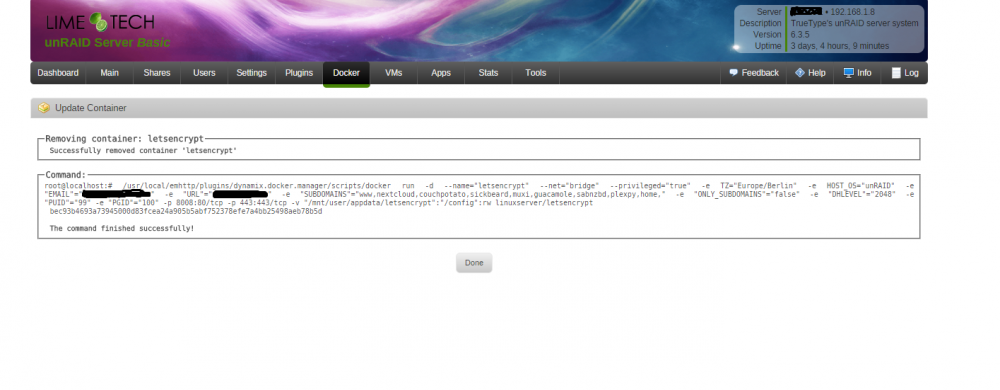
Please look at the screenshot I took before.
-
Ok, but that's really strange because my other subdomains are configured all the same with A-records at my domain provider, and it gave no errors when I did it for the first time yesterday. You think I should just delete the A-records and readd them again and see if that solves it?
-
I am sorry, here comes the log for docker. Notice that every subdomain worked before, until I added home.domain.com. ------------------------------------- _ _ _ | |___| (_) ___ | / __| | |/ _ \ | \__ \ | | (_) | |_|___/ |_|\___/ |_| Brought to you by linuxserver.io We gratefully accept donations at: https://www.linuxserver.io/donations/ ------------------------------------- GID/UID ------------------------------------- User uid: 99 User gid: 100 ------------------------------------- [cont-init.d] 10-adduser: exited 0. [cont-init.d] 20-config: executing... [cont-init.d] 20-config: exited 0. [cont-init.d] 30-keygen: executing... using keys found in /config/keys [cont-init.d] 30-keygen: exited 0. [cont-init.d] 50-config: executing... 2048 bit DH parameters present SUBDOMAINS entered, processing Sub-domains processed are: -d www.domain.com -d nextcloud.domain.com -d couchpotato.domain.com -d sickbeard.domain.com -d muxi.domain.com -d guacamole.domain.com -d sabnzbd.domain.com -d plexpy.domain.com -d home.domain.com Different sub/domains entered than what was used before. Revoking and deleting existing certificate, and an updated one will be created Saving debug log to /var/log/letsencrypt/letsencrypt.log An unexpected error occurred: The request message was malformed :: Certificate already revoked Please see the logfiles in /var/log/letsencrypt for more details. Generating new certificate WARNING: The standalone specific supported challenges flag is deprecated. Please use the --preferred-challenges flag instead. Saving debug log to /var/log/letsencrypt/letsencrypt.log Obtaining a new certificate Performing the following challenges: tls-sni-01 challenge for domain.com tls-sni-01 challenge for www.domain.com tls-sni-01 challenge for nextcloud.domain.com tls-sni-01 challenge for couchpotato.domain.com tls-sni-01 challenge for sickbeard.domain.com tls-sni-01 challenge for muxi.domain.com tls-sni-01 challenge for guacamole.domain.com tls-sni-01 challenge for sabnzbd.domain.com tls-sni-01 challenge for plexpy.domain.com tls-sni-01 challenge for home.domain.com Waiting for verification... Cleaning up challenges Failed authorization procedure. guacamole.domain.com (tls-sni-01): urn:acme:error:connection :: The server could not connect to the client to verify the domain :: Failed to connect to XX.XXX.XXX.XXX:443 for tls-sni-01 challenge IMPORTANT NOTES: - The following errors were reported by the server: Domain: guacamole.domain.com Type: connection Detail: Failed to connect to XX.XXX.XXX.XXX:443 for tls-sni-01 challenge To fix these errors, please make sure that your domain name was entered correctly and the DNS A record(s) for that domain contain(s) the right IP address. Additionally, please check that your computer has a publicly routable IP address and that no firewalls are preventing the server from communicating with the client. If you're using the webroot plugin, you should also verify that you are serving files from the webroot path you provided. - Your account credentials have been saved in your Certbot configuration directory at /etc/letsencrypt. You should make a secure backup of this folder now. This configuration directory will also contain certificates and private keys obtained by Certbot so making regular backups of this folder is ideal. /var/run/s6/etc/cont-init.d/50-config: line 108: cd: /config/keys/letsencrypt: No such file or directory [cont-init.d] 50-config: exited 1. [cont-finish.d] executing container finish scripts... [cont-finish.d] done. [s6-finish] syncing disks. [s6-finish] sending all processes the TERM signal. [s6-finish] sending all processes the KILL signal and exiting. And after this I try to go back to the template and delete "home" in order to get back to as it were. But then the log looks like this. ------------------------------------- _ _ _ | |___| (_) ___ | / __| | |/ _ \ | \__ \ | | (_) | |_|___/ |_|\___/ |_| Brought to you by linuxserver.io We gratefully accept donations at: https://www.linuxserver.io/donations/ ------------------------------------- GID/UID ------------------------------------- User uid: 99 User gid: 100 ------------------------------------- [cont-init.d] 10-adduser: exited 0. [cont-init.d] 20-config: executing... [cont-init.d] 20-config: exited 0. [cont-init.d] 30-keygen: executing... using keys found in /config/keys [cont-init.d] 30-keygen: exited 0. [cont-init.d] 50-config: executing... 2048 bit DH parameters present SUBDOMAINS entered, processing Sub-domains processed are: -d www.domain.com -d nextcloud.domain.com -d couchpotato.domain.com -d sickbeard.domain.com -d muxi.domain.com -d guacamole.domain.com -d sabnzbd.domain.com -d plexpy.domain.com Generating new certificate WARNING: The standalone specific supported challenges flag is deprecated. Please use the --preferred-challenges flag instead. Saving debug log to /var/log/letsencrypt/letsencrypt.log Obtaining a new certificate Performing the following challenges: tls-sni-01 challenge for domain.com tls-sni-01 challenge for www.domain.com tls-sni-01 challenge for nextcloud.domain.com tls-sni-01 challenge for couchpotato.domain.com tls-sni-01 challenge for sickbeard.domain.com tls-sni-01 challenge for muxi.domain.com tls-sni-01 challenge for guacamole.domain.com tls-sni-01 challenge for sabnzbd.domain.com tls-sni-01 challenge for plexpy.domain.com Waiting for verification... Cleaning up challenges Failed authorization procedure. plexpy.domain.com (tls-sni-01): urn:acme:error:connection :: The server could not connect to the client to verify the domain :: Failed to connect to XX.XXX.XXX.XXX:443 for tls-sni-01 challenge IMPORTANT NOTES: - The following errors were reported by the server: Domain: plexpy.domain.com Type: connection Detail: Failed to connect to XX.XXX.XXX.XXX:443 for tls-sni-01 challenge To fix these errors, please make sure that your domain name was entered correctly and the DNS A record(s) for that domain contain(s) the right IP address. Additionally, please check that your computer has a publicly routable IP address and that no firewalls are preventing the server from communicating with the client. If you're using the webroot plugin, you should also verify that you are serving files from the webroot path you provided. /var/run/s6/etc/cont-init.d/50-config: line 108: cd: /config/keys/letsencrypt: No such file or directory [cont-init.d] 50-config: exited 1. [cont-finish.d] executing container finish scripts... [cont-finish.d] done. [s6-finish] syncing disks. [s6-finish] sending all processes the TERM signal. [s6-finish] sending all processes the KILL signal and exiting. In order to get it working as it was before, I have to delete the letsencrypt folder in Appdata and replace it with my backup which I luckily did right before I tried to add home in the template.
-
I tried that but got a lot of errors in the log and the docker shutdown itself.
-
I have a complete working setup today with my domain.com, and I got nextcloud.domain.com. How do I add another subdomain? Like foobar.domain.com? Can I do this with a certbot command? ~TrueType
-
Wow, really took me too long to find that the username in MineOS is "minecraft". Can't you add it to the template info? For future users. Thanks. Now I am trying to figure out how to login as root, or change "minecraft" user to root access...
-
Now there's something I never would have thought of doing... Glad you got what you needed And without you I wouldn't find the domain.img! Though now I am going to read more about CA backups, how to use it and what's good to back up.
-
HOLY GUACAMOLE! I managed to solve it! I went to my domain.img that I backed up from my old Unraid USB. Opened it with Notepad++ and there at line 1500-something I found the complete XML Domain configs!! Looked like this for me: <domain type='kvm'> <name>Windows 10 Virtual Desktop</name> <uuid>621b4448-c2b5-4d85-409b-281282f0aa69</uuid> <metadata> <vmtemplate name="Custom" icon="windows.png" os="windows"/> </metadata> <memory unit='KiB'>4194304</memory> <currentMemory unit='KiB'>4194304</currentMemory> <memoryBacking> <nosharepages/> <locked/> </memoryBacking> <vcpu placement='static'>4</vcpu> <cputune> <vcpupin vcpu='0' cpuset='4'/> <vcpupin vcpu='1' cpuset='5'/> <vcpupin vcpu='2' cpuset='6'/> <vcpupin vcpu='3' cpuset='7'/> </cputune> <os> <type arch='x86_64' machine='pc-i440fx-2.3'>hvm</type> </os> <features> <acpi/> <apic/> <hyperv> <relaxed state='on'/> <vapic state='on'/> <spinlocks state='on' retries='8191'/> </hyperv> </features> <cpu mode='host-passthrough'> <topology sockets='1' cores='4' threads='1'/> </cpu> <clock offset='localtime'> <timer name='hypervclock' present='yes'/> <timer name='hpet' present='no'/> </clock> <on_poweroff>destroy</on_poweroff> <on_reboot>restart</on_reboot> <on_crash>restart</on_crash> <devices> <emulator>/usr/bin/qemu-system-x86_64</emulator> <disk type='file' device='disk'> <driver name='qemu' type='raw' cache='writeback'/> <source file='/mnt/user/vdisks/Windows 10 Virtual Desktop/vdisk1.img'/> <target dev='hdc' bus='virtio'/> <boot order='1'/> <address type='pci' domain='0x0000' bus='0x00' slot='0x05' function='0x0'/> </disk> <disk type='file' device='cdrom'> <driver name='qemu' type='raw'/> <source file='/mnt/user/ISOs/Windows 10.iso'/> <target dev='hda' bus='ide'/> <readonly/> <boot order='2'/> <address type='drive' controller='0' bus='0' target='0' unit='0'/> </disk> <disk type='file' device='cdrom'> <driver name='qemu' type='raw'/> <source file='/mnt/user/ISOs/virtio-win-0.1.110.iso'/> <target dev='hdb' bus='ide'/> <readonly/> <address type='drive' controller='0' bus='0' target='0' unit='1'/> </disk> <controller type='usb' index='0'> <address type='pci' domain='0x0000' bus='0x00' slot='0x01' function='0x2'/> </controller> <controller type='pci' index='0' model='pci-root'/> <controller type='ide' index='0'> <address type='pci' domain='0x0000' bus='0x00' slot='0x01' function='0x1'/> </controller> <controller type='virtio-serial' index='0'> <address type='pci' domain='0x0000' bus='0x00' slot='0x04' function='0x0'/> </controller> <interface type='bridge'> <mac address='52:54:00:06:5b:93'/> <source bridge='br0'/> <model type='virtio'/> <address type='pci' domain='0x0000' bus='0x00' slot='0x03' function='0x0'/> </interface> <serial type='pty'> <target port='0'/> </serial> <console type='pty'> <target type='serial' port='0'/> </console> <channel type='unix'> <source mode='bind' path='/var/lib/libvirt/qemu/channel/target/Windows 10 Virtual Desktop.org.qemu.guest_agent.0'/> <target type='virtio' name='org.qemu.guest_agent.0'/> <address type='virtio-serial' controller='0' bus='0' port='1'/> </channel> <input type='tablet' bus='usb'/> <input type='mouse' bus='ps2'/> <input type='keyboard' bus='ps2'/> <graphics type='vnc' port='-1' autoport='yes' websocket='-1' listen='0.0.0.0' keymap='sv'> <listen type='address' address='0.0.0.0'/> </graphics> <video> <model type='vmvga' vram='16384' heads='1'/> <address type='pci' domain='0x0000' bus='0x00' slot='0x02' function='0x0'/> </video> <hostdev mode='subsystem' type='usb' managed='yes'> <source> <vendor id='0x1781'/> <product id='0x0c31'/> </source> </hostdev> <memballoon model='virtio'> <address type='pci' domain='0x0000' bus='0x00' slot='0x06' function='0x0'/> </memballoon> </devices> </domain> So all I did was changing: <source file='/mnt/user/vdisks/Windows 10 Virtual Desktop/vdisk1.img'/> to <source file='/mnt/user/domains/Windows 10 Virtual Desktop/vdisk1.img'/> As it is named to in unraid 6.2 and above. Paste everything into a custom VM XML Gui and then it booted all like it used to before, no more configurations needed.
-
Hey Squid! Ok, thanks, so if we pretend they are inside domain.img, how do you think we could open the iso and extract the files? Do you think I can pull it to my Windows PC and use a ISO-Mount program like Deamon Tools or something and mount it here and then extract the files? Ok, yeah you're right. That won't help me now. But maybe in the future! How does the backup work, I've never used it before? What's your backup-settings?
-
Did you find this? I am in the same boat right now.
-
Ok, now there's really strange. I just restarted the my unraid-server after adding alot of movies to wanted in Couchpotato. Now I cannot reach the Couchpotato WebUI.. The only red ERROR I can see in the log is the first line and the last line in this attached log. 10-02 19:18:23 ERROR [31m[ couchpotato.core.event] Error in event "app.load", that wasn't caught: Traceback (most recent call last): File "/app/couchpotato/couchpotato/core/event.py", line 15, in runHandler return handler(*args, **kwargs) File "/app/couchpotato/couchpotato/core/media/movie/providers/info/themoviedb.py", line 57, in config languages.remove(self.default_language) ValueError: list.remove(x): x not in list encoding=UTF-8 debug=False args=['--config_file=/config/config.ini', '--data_dir=/config/data'] app_dir=/app/couchpotato data_dir=/config/data desktop=None options=Namespace(config_file='/config/config.ini', console_log=False, daemon=False, data_dir='/config/data', debug=False, pid_file='/config/data/couchpotato.pid', quiet=False) [0m 10-02 19:18:23 INFO [0m[tato.core._base.scheduler] Scheduling updater.check, interval: hours = 24, minutes = 0, seconds = 0[0m 10-02 19:18:23 INFO [0m[otato.core.plugins.manage] Updating manage library: /movies[0m 10-02 19:18:23 INFO [0m[tato.core._base.scheduler] Scheduling "movie.searcher.all", cron: day = *, hour = 1, minute = 8[0m 10-02 19:18:23 ERROR [31m[tato.core.plugins.renamer] The from folder "" doesn't exist. Please create it.[0m *EDIT* Ok! I fixed this too... I had missed filling in "/movies/" in the from folder when I installed the app. All of these boxes must be filled in properly in the install, otherwise the app will fail after restart.
-
Hey! I am trying to migrate from PhAzE's Couchpotato plugin to this docker. I've encountered my first problem. In Couchpotato WebUI: Movie -> Manage I cannot see my existing movies. It tells me to goto "Settings > Manage" and point where I have my movies located. But when I am at the Settings > Manage I cannot see my Movies going to "/mnt/user/Movies" it's like Couchpotato docker cannot read that folder. And I cannot see the entire box that let me choose. This wasn't a problem I had with the Couchpotato plugin. *EDIT* Sorry, me being noobish. It's called movies now, at which I pointed to when I installed the docker. And the problem not seeing the entire box is working in internet explorer, I used chrome. Though I wonder if there's a file I can copy from my old Couchpotato install so I can reuse my config such as "Wanted" movie list? And quality search settings? Anyone know what file keeps these settings?
-
Docker is the way forward for these kinds of applications. lol I think by posting that question in the lsio docker thread the answer is going to be self-evident... Docker's have significant advantages over plugins in terms of maintainability, security, etc but setting them up (in particular, understanding how host volume mapping works) has a small learning curve. Peruse the docker FAQ and hopefully it'll get you there. Hehe, well, yeah. But that was kind of what I was hoping for. I feel like the plugins part in Unraid is not for these types of applications in the future, plugins is more like CA and PreClear etc. But I dunno I've used unraid in a year now and the dockers have never struggled, but now after the auto 6.2 update the normal plugins were affected (except Plex plugin, no offense to PhAzE, his work is awesome!). So I think I will try all docker this time.
-
Hey! I just reinstalled my unraid and now I wonder if there's any advantages going plex in a docker? Last time I had plex running as plugin and had no problems with it, should I continue with that you think or should I go with this docker instead? Thanks, TrueType
-
And I'm wondering how to change the file inside the container without accessing it through my smb share. Can someone help me here please? Have you tried deleting your database and users in MariaDB and tried again? Can easily be done via MySQL Workbench. Just connect to your MariaDB and type "DROP DATABASE nextcloud" or whatever you named your database to. Then goto users and delete everyone except root (if you don't have any other users running another database). Then try again. Also try using the same password as you have to your MariaDB root user to your nextcloud admin user you are creating.


