





swiss01
Members
-
Joined
-
Last visited
Everything posted by swiss01
-
Hi N¿¿B This forum is the wrong place to ask about the tool's features and scope. Please reach out to the developers directly. GitHubGitHub - oss-apps/split-pro: Open source alternative to S...Open source alternative to Splitwise. Contribute to oss-apps/split-pro development by creating an account on GitHub.
-
This is the support thread for the docker templates I have added to community apps. You can find my templates on GitHub at - swiss01 eas3-mqtt-gateway Application: eas3-mqtt Docker Hub: https://hub.docker.com/repository/docker/swiss01/eas3-mqtt/general GitHub: https://github.com/sr258/eas3-mqtt GitHub: https://github.com/swiss01/eas3-mqtt-Dockerfile Documentation: https://github.com/sr258/eas3-mqtt/blob/main/README.md

-
Danke fürs richtig stellen. In früheren Diskussionen habe ich es in dem fall falsch verstanden und meinte, das die Parity ein Raid 1 machen. Mit einem Raid 6 macht das ganze aber mehr Sinn.
-
Also ich glaube Unraid unterstützt zwei Array's gar nicht. Zwei Parity platten bringt nicht viel, denn wenn zwei Datenplatten aussteigen, sind die daten auch weg. Ausser du hast glück und es steigt eine Parity und eine Datenplatte aus. Ein Backup ist zudem recht unsinnig, dies auf dem selben Rechner zu machen. Bei Diebstahl, Feuer- Wasser- Stromschaden sind auch alle daten weg. Falls es aber nur Sicherung für "dumm gelaufen" sein soll, also "ups ich habe die daten aus versehen gelöscht" und will es widerherstellen, kannst du auch gut alles auf einem Array machen. Sprich eine Parity und 7 Datenplatten. Ich würde das aber bedenken, dass z.B. 3x 10TB Platten stromsparender sind als 8x 3TB Platten.
-
Ja habe das Board genommen. Mein Setup ist ASUS TUF GAMING B760M-PLUS Intel i5 14500 Samsung 970 EVO Plus 2x Corsair Vengeance 2 x 16GB, 7200 MHz, DDR5-RAM, DIMM (nicht übertakt) Seagate Exos X20 20TB 3x Das ganze braucht im idle so zwischen 22-27w wobei an dem USV noch der Router und ein Glasfaser zu RJ45 konverter hangen. Die brauchen glaub so 7w. Wenn ich das recht im kopf habe. Wie genau die messung ist kann ich nicht sagen. Die daten kommen vom USV selbst Kann zum Board eigendlich nicht viel sagen. Es lauft und ich habe keine Probleme damit.
-
I'm not familiar with Tailscale. I just see that it's supposed to be based on Wireguard. So my first question is, why not use Wireguard directly, since it's already integrated into Unraid? But since Tailscale is just a VPN, SplitPro, if configured correctly, should be accessible and working on the home network. If not, I assume you've entered the NEXTAUTH_URL variable incorrectly. Since you're not accessing it via a domain, you should actually specify the IP address and probably also the port of the container. Give it a try.
-
Thank you very much, I have 7.1.0-beta.3 installed and have had no problems for 29 days. In a week the 7.1.0 will be installed 🙂
-
I found this in the instructions. POSTGRES_USER="postgres" POSTGRES_PASSWORD="strong-password" POSTGRES_DB="splitpro" DATABASE_URL="postgresql://postgres:strong-password@splitpro-db-prod:5432/splitpro" I think the URL should look like this. DATABASE_URL="postgresql://splitpro-db-prod:5432" I tested it and it doesn't work for me. It could be a bug in the repository. Since I only created the Unraid template, I can't help you any further. I suggest changing the password or reporting it on GitHub. https://github.com/oss-apps/split-pro
-
Thanks for your reply. I just implemented the excessive-flash-drive-activity-slows-the-system-down thing. Today, two days after a reboot, I had the problem again. I was just able to restart the server normally. Shutting down Docker or the VM didn't help this time. I couldn't download the diagnostics. The syslogs were flooded, even when Docker and the VM Manager were shut down. These few lines were written repeatedly. The syslog is now larger than 100MB and only contains data from March 14-29, 2025. Mar 29 18:56:31 Tower nginx: 2025/03/29 18:56:31 [alert] 1980817#1980817: *827646 header already sent while keepalive, client: 192.168.1.10, server: 192.168.1.21:443 Mar 29 18:56:31 Tower kernel: nginx[1980817]: segfault at 0 ip 0000000000000000 sp 00007ffe4356a588 error 14 in nginx[400000+24000] likely on CPU 2 (core 4, socket 0) Mar 29 18:56:31 Tower kernel: Code: Unable to access opcode bytes at 0xffffffffffffffd6. Mar 29 18:56:31 Tower nginx: 2025/03/29 18:56:31 [alert] 10793#10793: worker process 1980817 exited on signal 11 Mar 29 18:56:31 Tower nginx: 2025/03/29 18:56:31 [crit] 1980818#1980818: ngx_slab_alloc() failed: no memory Mar 29 18:56:31 Tower nginx: 2025/03/29 18:56:31 [error] 1980818#1980818: shpool alloc failed Mar 29 18:56:31 Tower nginx: 2025/03/29 18:56:31 [error] 1980818#1980818: nchan: Out of shared memory while allocating channel /dockerload. Increase nchan_max_reserved_memory. Mar 29 18:56:31 Tower nginx: 2025/03/29 18:56:31 [alert] 1980818#1980818: *827649 header already sent while keepalive, client: 192.168.1.10, server: 192.168.1.21:443 Mar 29 18:56:31 Tower kernel: nginx[1980818]: segfault at 0 ip 0000000000000000 sp 00007ffe4356a588 error 14 in nginx[400000+24000] likely on CPU 2 (core 4, socket 0) Mar 29 18:56:31 Tower kernel: Code: Unable to access opcode bytes at 0xffffffffffffffd6. Mar 29 18:56:31 Tower nginx: 2025/03/29 18:56:31 [alert] 10793#10793: worker process 1980818 exited on signal 11 Mar 29 18:56:31 Tower nginx: 2025/03/29 18:56:31 [crit] 1980819#1980819: ngx_slab_alloc() failed: no memory Mar 29 18:56:31 Tower nginx: 2025/03/29 18:56:31 [error] 1980819#1980819: shpool alloc failed Mar 29 18:56:31 Tower nginx: 2025/03/29 18:56:31 [error] 1980819#1980819: nchan: Out of shared memory while allocating channel m/ I have 32 GB of RAM, and it should work. Memtest ran for a good 18 hours without any errors. Latest BIOS installed, and the CPU is oversized. My System Title Information System Overview Unraid system: Unraid server Pro, version 7.0.1 Model: Custom Motherboard: ASUSTeK COMPUTER INC. TUF GAMING B760M-PLUS, Version: Rev 1.xx, s/n: 230926644903196 Processor: Intel® Core™ i5-14500 @ 2574 MHz HVM: Enabled IOMMU: Enabled Cache: L1 Cache = 288 KiB (max. capacity 288 KiB) L1 Cache = 192 KiB (max. capacity 192 KiB) L2 Cache = 7680 KiB (max. capacity 7680 KiB) L3 Cache = 24 MiB (max. capacity 24 MiB) L1 Cache = 256 KiB (max. capacity 256 KiB) L1 Cache = 512 KiB (max. capacity 512 KiB) L2 Cache = 4 MiB (max. capacity 4 MiB) L3 Cache = 24 MiB (max. capacity 24 MiB) Memory: 32 GiB DDR5 (max. installable capacity 256 GiB) Controller0-DIMM1: Corsair CMK32GX5M2X7200C34, 16 GiB DDR5 @ 4800 MT/s Controller1-DIMM1: Corsair CMK32GX5M2X7200C34, 16 GiB DDR5 @ 4800 MT/s Network: eth0: 1000 Mbps, full duplex, mtu 1500 Kernel: Linux 6.6.78-Unraid x86_64 OpenSSL: 3.4.1 P + Q algorithm: 25872 MB/s + 46949 MB/s
-
Good evening. It's that time again. After a good 15 days and 7 hours, I can still access the web GUI, but I have to wait about 30-60 seconds each time for the page to load. It's especially slow when I switch tabs in the menu, but it's still OK. I then turned off the VM Manager. Since then, it's been running smoothly again. Only now I can't turn on the VM Manager anymore. I then turned off the Dockers, and I can start them again. Okay, now things are getting weird. I wanted to restart the server and went back to the VM tab. They're running again. The VM Manager started again after I turned off the Dockers. Well, I'll restart the server, then hopefully I'll have another 15 days of peace. Below is the diagnostic data. tower-diagnostics-20250326-2140.zip
-
thank you. then we'll wait until the server crashes next time I'll get back in a few weeks
-
Hello everyone I've had the problem for a while that my server becomes extremely sluggish after a certain amount of time. It can take a week or 2-3 weeks for it to occur. Last Thursday, February 27, 2025, it happened again. I could no longer access Docker or a VM. The WebUI could no longer be accessed either. Nothing worked via SSH either. Everything I tried seemed as if it was still there but the server was completely overloaded, so that at some point it would time out. The HDDs were all off according to my girlfriend (i wasn't at home) and the server couldn't be turned off using the power button. So the only option was to kill the server. I've had this problem about 4 times now, although I was still able to access the WebUI somehow and restart the server properly. I had this problem once before with 6.12.14. I thought the problem might be solved with 7.0.0 but unfortunately not. Unfortunately I couldn't find anything in the logs either, as some of them get lost when you restart? Anyway, I've attached the logs. Does anyone know the problem or can help me? tower-diagnostics-20250302-2217.zip
-
That's not the problem. I have a separate email address that only covers things like that, but with that I can send emails myself via Splitpro. I've just tested it.
-
I suspect that Google is blocking itself for security reasons. Go to your Google account and look for "app password", create one for SplitPro and then use the password to send an email via Docker.
-
I also use gmail and it works for me with EMAIL_SERVER_HOST = smtp.gmail.com EMAIL_SERVER_PORT = 465
-
ah, sorry. I thought you were already logged in. That's right, with splitpro you say "add expense" to log in. I think I had that error once too. did you enter the right address for "NEXTAUTH_URL"? So either the IP of the Docker or, if it should be accessible from outside, your domain
-
Did I understand correctly that you can log in (login via email and you get a magic link) but you can't make any add expenses afterwards?
-
I tested it, but neither works for me. But in the description it must be the other way round. Many thanks, I have adapted the template
-
This is the support thread for the docker templates I have added to community apps. You can find my templates on GitHub at - swiss01 SplitPro Application: splitPro https://splitpro.app/ Docker Hub: https://hub.docker.com/r/ossapps/splitpro GitHub: https://github.com/oss-apps/split-pro Documentation: https://github.com/oss-apps/split-pro/blob/main/docker/README.md Login Options and Configuration: https://github.com/swiss01/unraid-templates/blob/main/splitpro/README.md SplitPro V2 requires a PostgreSQL database with pg_cron enabled. I integrated the OSS Apps version into the Community App Store. Name is PostgreSQL_pg_corn

-
I've been trying to get obico to work with this Docker for a while. When I still had Octoprint running on the RP, it worked without any problems. Unfortunately, the RP no longer worked and I wanted to get the whole thing to work in Unraid with Docker. Unfortunately, that doesn't really work. Apparently the Janus gateway that Obico needs is missing. Can this be integrated into Docker? Or does anyone have a solution to the problem?
-
Ich will das gerne ergänzen oder besser erläutern. Die PARITY Plate wird immer beim schreiben auf eine Platte im ARRAY angepasst und nicht erst beim Checksummentest. Daher ist diese immer aktuell. ganz schlechter Einfall ... Array und USB ... aber du wirst deine Erfahrungen machen (hoffentlich nicht, wahrscheinlich lieder schon ...) Da bin ich voll bei Alturismo. Das ist eine seeeeeehr schlechte idee. da muss nur mal Powertop die USB anschlüsse ausschalten und vorbei ist es mit dem ARRAY. ABER deine USB Festplatte ist ja ne Festplatte und meistens kann man das Gehäuse einfach aufschrauben und die HDD herausnehmen. Dann kannst du diese über SATA ganz normal einbinden. Kleiner Tipp von mir, Mach ein XFS Pool, da kannst du einfach erweitern, falls nachträglich noch HDD's einbauen willst. Dann noch was mit dem Cache. Ich hatte lange einfach nur eine Cache SSD. Dadurch habe ich alles (sehr viel) auf dem ARRAY gehabt wegen der Ausfallsicherheit. Wenn man beim Cache ein einen Pool macht und dieser so einstellt, das man eine Spiegelung hat, hat man auch da eine Ausfallsicherheit, und kann zum beilspiel auch daten welche man gesichert haben will aber oft drauf zugreift dort lagern. So lauft die HDD nicht wegen jedem schrott an. Und wichtiger Tipp noch bevor du anfängst deine HDD zu Formatieren und einzubinden. überlege gut ob die die HDD und Cache Passwortgeschützt haben willst oder nicht. im nachhinein ändern ist mit viel aufwand und viel freiem Speicherplatz verbunden. Ich weiss von was ich spreche 😅
-
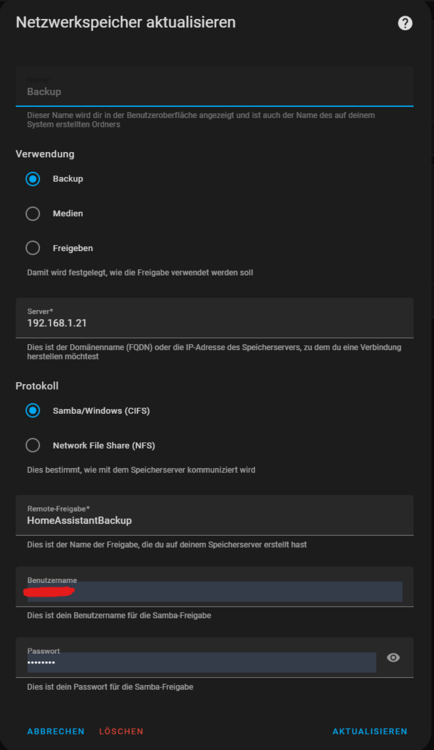
wenn ich das Richtig verstanden habe, hast du noch nie mit Shares ausserhalb von Unraid gearbeitet? wenn du alles richtig eingerichtet hast, kannst du auf die Shares mittels \\Unraid_IP\Backups auf dein Backup Shares zugreifen. Dazu musst du nach den erstellen des Shares auch freigeben. Wenn du es wie hir unten als Private einrichtest, kannst du nach dem du Applay geklickt hast noch die User hinzufügen, welche darauf zugreifen dürfen. Wenn jeder darauf zugreifen darf, kannst du auch die Security auf Public stellen. Bei HA unter Einstellunge/system/speicher dann das gewünschte netzlaufwerk hinzufügen in meinem fall heisst der freigegebene Shares HomeAssistantBackup

-
mal ne blöde frage. Hast du im swag Docker unter SUBDOMAINS: deine subdomain eingetragen? Wichtig nach dem subdomain anschliessend ein "," eintragen zB. "cloud,"
-
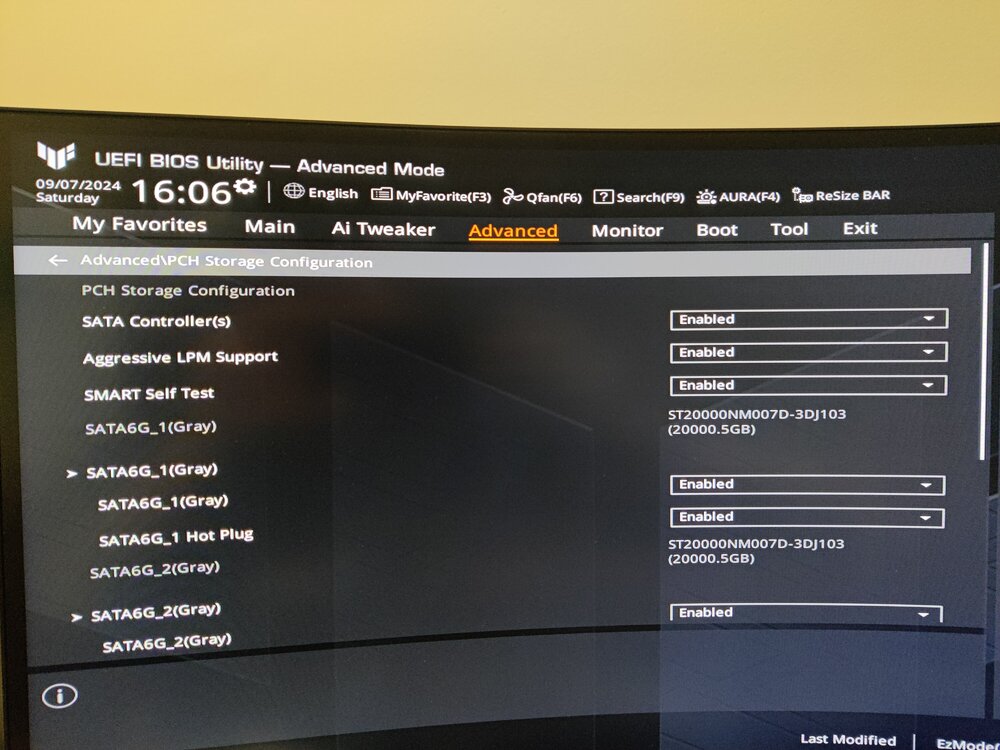
This?
-
yes





