ben-nl
Members
-
Joined
-
Last visited
-
I can easily live without it. 😀 That is good news, thanks. 👍
-
I'm just started playing with the LXC-plugin and it's fantastic. Now that I'm here I have one question. It would be easy if you could rename or add a description to the snapshots. It's not super important, can easily live without it. Thanks for making this plugin.
-
Take a look at NocoDB, maybe this is something. Template is available in the Community Applications. https://www.nocodb.com/
-
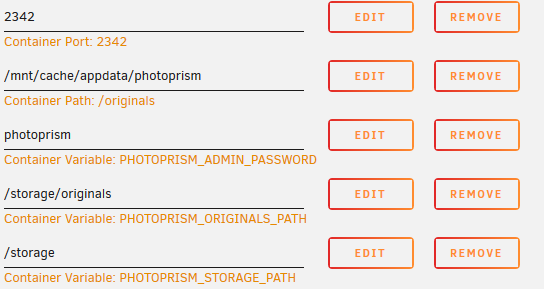
I think this is a nice app. I changed the variables and the path a little bit and now it save the data. Photos take a lot of space so it is maybe better to put originals not on the cache drive. I got variables from: https://github.com/photoprism/photoprism/blob/develop/docker-compose.yml
-
First you have to run the Spotweb installer: 'http://yourhost/install.php'. This will create the necessary database tables and users (create 'dbsettings.inc.php'). You can also add 'dbsettings.inc.php' manually, in /mnt/user/appdata/spotweb. My dbsettings.inc.php <?php $dbsettings['engine'] = 'pdo_mysql'; $dbsettings['host'] = 'Enter your host here'; $dbsettings['dbname'] = 'spotweb'; $dbsettings['user'] = 'spotweb'; $dbsettings['pass'] = 'Enter your password here'; My ownsettings.php (your personal preference, you have to create this manually) <?php # = /etc/default/spotweb/ownsettings.php =-=-=-=-=-=-=-=-=-=-=-=-=-=-=-=-=-=-=-=- # =-=-=-=-=-=-=-=-=-=-=-=-=-=-=-=-=-=-=-=-=-=-=-=-=-=-=-=-=-=-=-=-=-=-=-=-=-=-=- # = Hier kan je aangepaste settings opslaan =-=-=-=-=-=-=-=-=-=-=-=-=-=-=-=-=- # =-=-=-=-=-=-=-=-=-=-=-=-=-=-=-=-=-=-=-=-=-=-=-=-=-=-=-=-=-=-=-=-=-=-=-=-=-=-=- # = Deze lijstjes kan je dan aanvullen door de categoriën toe te voegen die je vind in /lib/SpotCategories.php # = Voorbeeld SABnzbd/NZBget: $settings['sabnzbd']['categories'][0]['d11'] = 'Series'; # =-=-=-=-=-=-=-=-=-=-=-=-=-=-=-=-=-=-=-=-=-=-=-=-=-=-=-=-=-=-=-=-=-=-=-=-=-=-=- $settings['sabnzbd']['categories'][0]['d11'] = 'tvseries'; $settings['sabnzbd']['categories'][0]['default'] = 'movies'; $settings['sabnzbd']['categories'][1]['default'] = 'music'; $settings['sabnzbd']['categories'][0]['a5'] = 'ebooks'; $settings['sabnzbd']['categories'][0]['a11'] = 'ebooks'; $settings['sabnzbd']['categories'][0]['d44'] = 'magazine'; $settings['sabnzbd']['categories'][0]['d31'] = 'comics'; $settings['sabnzbd']['categories'][2]['default'] = 'games'; ?>
-
No, this is not normal. Do you have dbsettings.inc.php file in /mnt/user/appdata/spotweb?
-
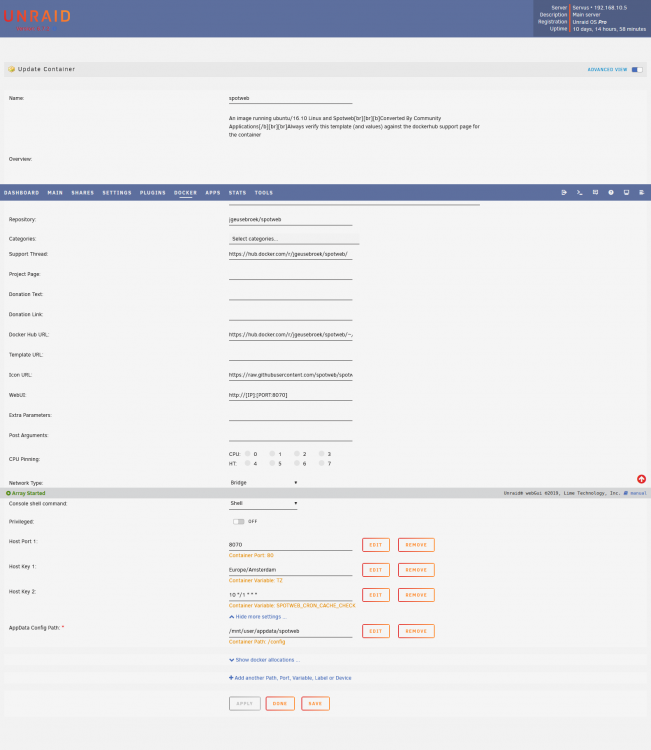
I use it as a indexer, not sure what aggregator of indexer means. When logged in, you have an API you can use with LazyLabrarian, Sonarr, etc. You need a usenet provider and a separate database , MySQL, MariaDB or PostgreSQL. I use MariaDB (linuxserver/docker-mariadb). To install Spotweb I add manually a container, see screenshot. After installation of the container, open 'install.php' in your browser until everything is 'OK'. Follow the wizard and perform the instructions as given by the wizard. I hope this is a little clearer.
-
I use Spotweb the most. https://github.com/spotweb/spotweb https://github.com/jgeusebroek/docker-spotweb
-
Read this. https://blog.linuxserver.io/2019/09/14/customizing-our-containers/
-
Maybe this help. Solution to Connecting remotely when you get Error 10060
-
Thanks Josh.5, for this app. This is a very useful app for me and I think I am not the only one.
-
Thanks Binhex, for this container. 👍 The project looks promising.
-
Yes, I use it.
-
Here is a how to, maybe it helps. https://emby.media/community/index.php?/topic/47508-how-to-nginx-reverse-proxy/