jbartlett
Community Developer
-
Joined
-
Last visited
Everything posted by jbartlett
-
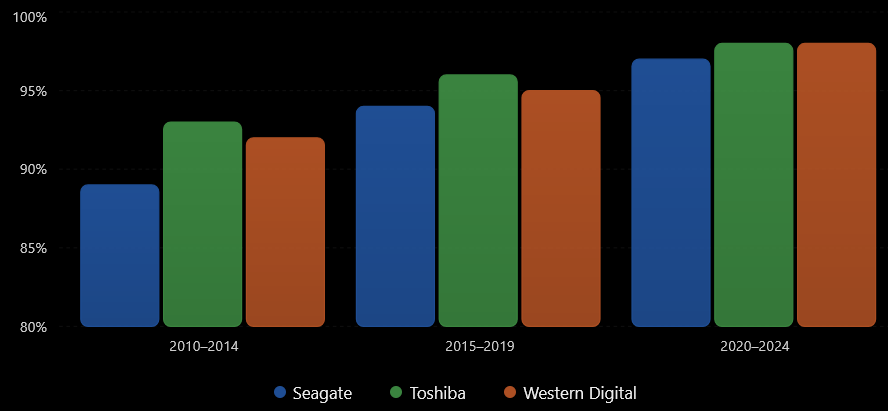
Updated the Backblaze data with 2026 Q2 data: https://strangejourney.net/hddb/BackblazeData.cfm After reading one of the Backblaze articles talking about how certain brands have increased in reliability over the years, it got me thinking of a way to come up with a percentage reliability score for a given model taking into account that all drives become less reliable over time but having less impact to the overall score if a drive fails at 8 years vs 2 years. Gonna call it the "Age-Weighted Reliability Score (AWRS)". The percentage of failures in the 1st year for a given model would count a full 100% towards the score but the drive percentage that fail in the 2nd year only counts 90% of that percentage and so on until drives that fail in the 9th year only counts 10% of the failure percentage and drives that last 10+ years before failing don't impact the score. ChatGPT came up with this formula after I described the process. N = total number of distinct drives in the fully observed population Fi = number of drives that failed during their i-th year Wi = (11- i) / 10 = weighting factor for that year. hypothetical scoring of 3 models of 10,000 drives Model History Failures Raw failure rate AWRS A 2 years 1,000 in year 1 10% 90% B 10 years 1,000 in year 8 10% 97% C 5 years 500 in year 2 5% 95.5% Then a AWRS percentage could be computed for a brand and then brands could be examined to see how their AWRS changes over time to account for different manufacturing processes / technologies. This would also allow different brands to be compared over time. Demo chart of AWRS scores over different time periods

-
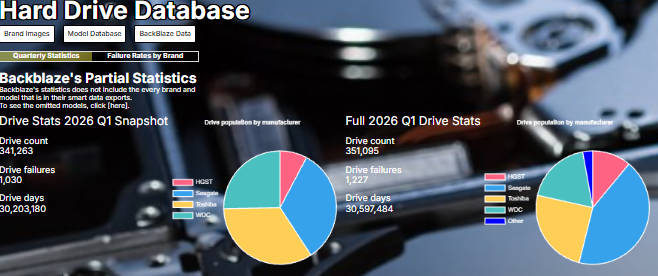
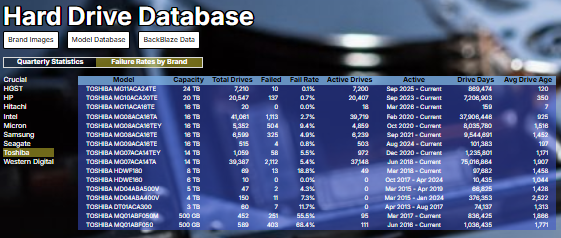
Added the initial Backblaze statistics to the HDDB site. https://strangejourney.net/hddb/BackblazeData.cfm After loading the Backblaze smart data files, I was able to duplicate their results but discovered that they had excluded data from several models which was broken down in a dialog window that you can view for yourself if you click on the "[hear]" link on the site. The right graph shows the same stats including all drives they collected smart data from which appears that they don't exclude any. I've also discovered that it seems some serial numbers have been repeated with newer drives, at least it appears that way with the smart data itself looking like it is from a new drive but using the same serial number as a much older drive. I plan on adding logic to treat the repeated serial numbers as a new drive but haven't done so yet. The "Failure Rate by Brand" tab lists every drive model ever hosted by Backblaze with detailed information. One note about the average age of drives is that it's the difference between the first date the drive was reported on and the date it was removed - it doesn't yet take into consideration if a drive was pulled and then added back at a later date. I only found a few drives impacted but fractions count. I plan on adding a new column representing the average active days. I plan on adding additional charts soon'ish detailing the data on each model showing it's activity and failure trends.
-
Version 2.10.10.4 pushed, fixes the issue with submitting drive images.
-
Attention:If you are getting errors scanning hardware or submitting benchmarks, please update the DiskSpeed docker app, it should reflect version 2.10.10.3. I updated the URL for the public site to strangejourney.net, removing the www prefix. I moved the domain to a new server and currently the www prefix is returning another one of my domains and as of this posting, it was quicker to update the Docker app than to figure out why the domains are serving incorrectly even though the config looks correct. Database ErrorsMoving from a Windows server to a Unix server and switching from MySQL to MariaDB also introduced forced lower case table names. I believe I caught them all but please let me know if you get any table not found errors.
-
@rerror @jrfbal @StylishQuoter Please update the DiskSpeed docker app, it should report version 2.10.10.2. I added logic to catch devices that report that it's mounted on the controller on port 0 (invalid) and skip them.
-
Nice, I am able to duplicate with that LCUS module
-
I've ordered one of these, should be here a couple days. Hopefully I'll be able to duplicate.
-
This is really odd. Historically, if the app server counts from one to zero, it just skips the loop entirely. I'll take a look....
-
I just ordered one to try to duplicate the issue. Need one for my main NAS box at any rate....
-
Do you mean with benchmarking? I've had some success with kicking off a Benchmark from the main page on version 2.10.10 and then manually selecting a much larger test file size.
-
From what I can tell so far, it may be related to a USB device that's detected as SDB with the description of "File-Stor Gadget". Do you have a phone or Quest or other USB device connected? If so, try disconnecting and restart the Docker app. i can add an exclusion for this like i have for an empty card reader but want to verify the cause first.
-
If you click on the "Rescan Controllers", your 10TB & 14TB drives will now have images. Also, if you want your other drives to have a uniform capacity overlay, you can edit just one of them and then set the checkbox to apply the same changes to all like-model drives. That typically happens from different people uploading the first image for the drive and they had differing opinions of the overlay text.
-
Have you tried changing the PCIe slots the cards are plugged into? I've ran into scenarios on my DiskSpeed dev box where a card wouldn't have the expected speeds if it was plugged in x slot vs y slot, even though the slots had enough PCI lanes for it and the bios hadn't changed the number of lanes utilized (that may also be an issue, check your MB docs). Awesome to see my DiskSpeed app being used to troubleshoot issues.
-
First, thank you for reporting this issue. I can't fix issues I don't know about. I'm not able to duplicate with my two setups but I added code to try to ensure the IsSSD flag exists. Please remove the version off the repo to download 2.10.10.1. Issues fixed: Catch rare spin up error Check for missing "IsSSD" flag during benchmarking Abort benchmarks on drives that work enough to be detected but fails to read
-
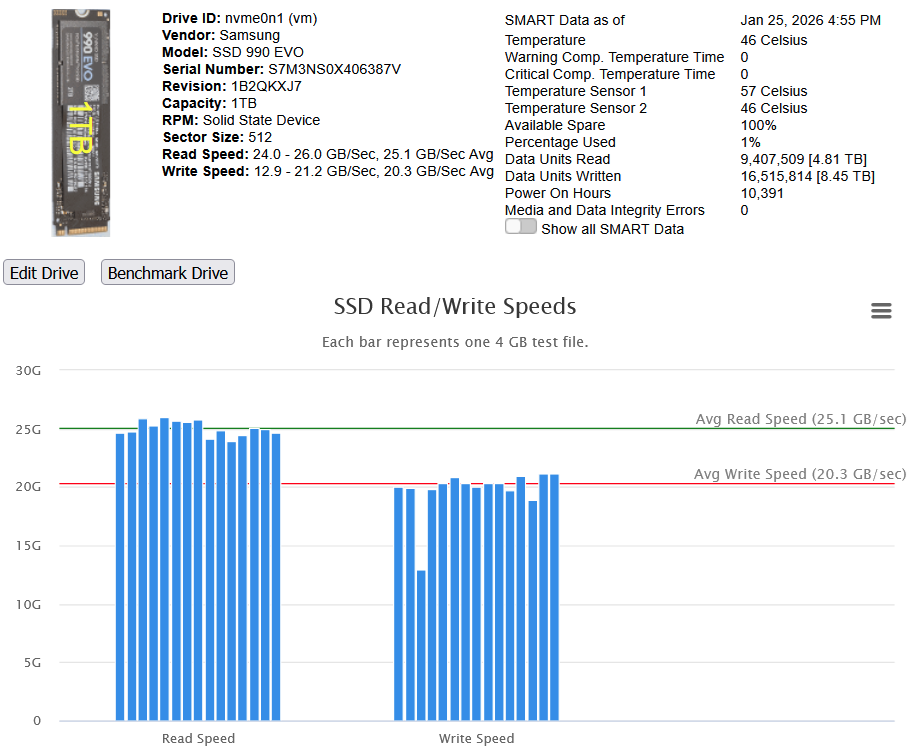
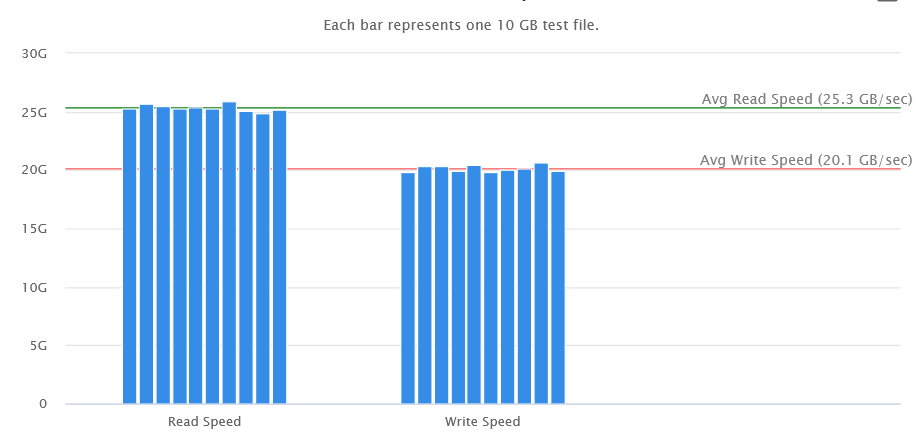
Version 2.10.10: USB & SSD Pool Benchmarking Catch rare error fetching platter info Allow benchmarking of SSD pools Allow benchmarking of USB devices Allow editing of USB devices Correct scaling of left side axis of SSD benchmarks Version 3 is taking awhile due to life stuff so I added into the version 2 branch the ability to benchmark SSD pools and USB devices. On fresh installs or reset, it'll try to identify images for any USB drives. You can now edit the image on existing USB devices. When benchmarking pools, select the first drive in the pool to see the benchmark button. If you click the "Benchmark" button on the home page, you can set the checkbox for the first drive in a pool but not for any other drives in the pool. Benchmark of three Samsung 990 EVO nvme's on the motherboard in a ZFS ZRAID1 pool with the default 4 GB test file size With ZFS pools, try a larger test file to see if it steadies out the benchmark.
-
Not yet on solid state devices. I haven't found a means to satisfactory bypass or mitigate ZFS's built in caching.
-
Click on the DiskSpeed icon on the UNRAID Plugin page and select "Console" At the command prompt, run the same command, it should come back instantaneously but for some reason, it doesn't for you. You may have to wait a bit to get the true error that's happening at the OS - DiskSpeed tosses out a timeout error here because it's waiting for the OS to respond - and since it shouldn't ever toss an error here, I didn't trap errors so I could see it happen and know how to code a specific catch for it. /bin/df -B 1KB
-
Out of curiosity, does your nvme drive also have a dash in the name?
-
I'd like it too, it's on my To Do list.
-
There's something caching the read/writes and isn't honoring the cache bypass. The program uses FIO to do the benchmarking, try using a larger file size in the benchmark scan.
-
Sorry, that is currently not available. It's on my To Do list but I haven't been able to spend much time programming of late, unfortunately.
-
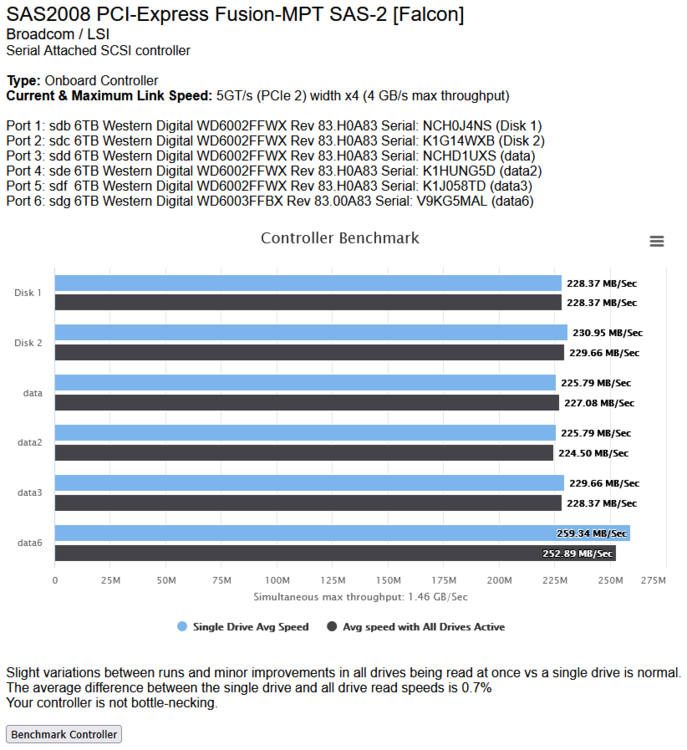
You can do this by clicking on the icon next to your controller. Then click on the "Benchmark Controller" button. It will then read all drives attached to the controller for 15 seconds each in sequence, then all of the drives on the controller at the same time for 15 seconds, then display a graph showing both the isolated speed and the speed the drives got when reading all at the same time.

-
The current version doesn't allow benchmarking USB attached drives. I do plan on adding support in the futureTM
-
Benchmarking ZFS solid state drives is not yet supported, but if you're using spinners, it doesn't matter what the file system is, or if there is one at all.
-
Please update, it should reflect version 2.10.9.9, and you should get your Kioxia love back