





Gizmotoy
Members
-
Joined
-
Last visited
Everything posted by Gizmotoy
-
I keep losing the webpage status while balancing operations are ongoing. I can see in the log ` /var/log/unbalanced.log` that move operations are still in progress, but it would be nice to be able to monitor progress on the web UI. I see lots of errors around web sockets, like these: 2024/12/11 09:05:51 unable to read websocket message: websocket: close 1006 (abnormal closure): unexpected EOF 2024/12/10 19:22:54 unable to read websocket message: websocket: close 1006 (abnormal closure): unexpected EOF Or is there a way to re-connect to an in-progress operation?
-
Rebuild finished successfully. I then formatted the drive I added. Then I stopped and started the array a few times to check that Disk1 mounts properly, and it did. I re-enabled Docker to get the server back to fully-operational, and kicked off a parity check just as final confirmation everything is good again (running without issue so far). I appreciate the help getting things back up and running!
-
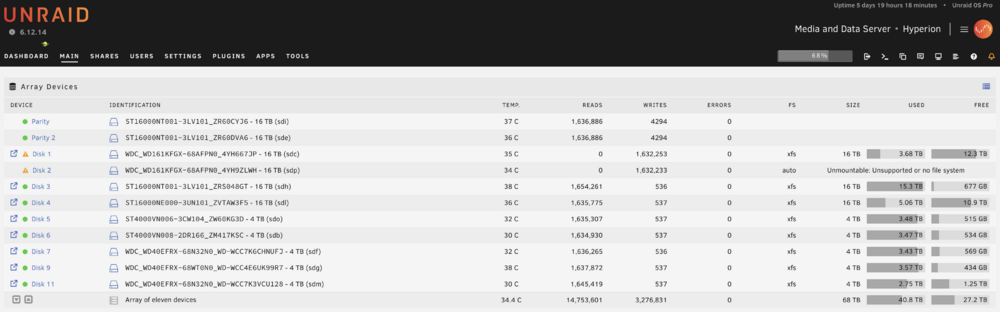
Ok, done, and disks are rebuilding. disk2 is the only unmountable disk. Before I format, figured I'd post one last diags Also, to be clear, I should probably be gentle with the server right now because I'm without parity protection, correct? Since 2x drives are rebuilding? hyperion-diagnostics-20241206-1101.zip
-
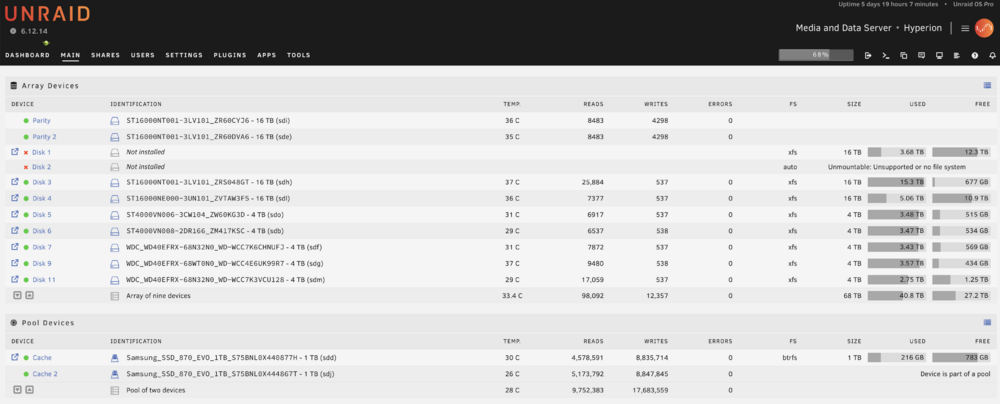
Done. disk1 emulated, but back to good state (mounted correctly). disk2 emulated and unformatted. No action taken beyond starting the array in this state and producing the diags. hyperion-diagnostics-20241206-1048.zip
-
Sure, no worries. Diag attached. Current state: disk1 - assigned, but somehow corrupted disk2 - unassigned (and "missing") hyperion-diagnostics-20241206-1025.zip
-
How do I actually trigger the rebuild of disk1? When I reassign disk2 I’m back at the initial state from my first post. Are the steps then actually: 1) Stop the array 2) reassign disk 2 3) start the array Now disk1 is still invalid/corrupted, and disk2 is back in unformatted state. 4) stop the array 5) unassign disk 1 6) start the array disk1 is now in emulated state and disk2 is unformatted 7) stop the array 8 reassign disk1 9) start the array disk1 is now emulated and rebuilding, disk2 is unformatted is that about right?
-
Sorry, I'm a little slow here and want to move cautiously. Just to confirm: Disk1 - Recently-rebuilt disk. Should have data on it, but has some kind of MBR issue and won't mount. Disk2 - Newly added disk (precleared, but unformatted) in a brand new, previously-unused slot. Was not a previous disk in the system, so would have no data and does not need to be rebuilt. Unfortunately I found out about the problem with Disk1 when I added Disk2 to the system and started the array, complicating the problem. Unfortunately it seems like I can't just go back to the state without Disk2 to deal with the problem with Disk1 on its own (if I remove the Disk2 assignment, Unraid complains it is missing as the most recent diagnostic logs show). I assume we're trying to get to a place where disk1 gets rebuilt again? I'm not sure how to do that with disk2 in its current state.
-
I see. Ok, I unassigned disk2, then started the array with disk2 missing. It did not change the error associated with disk1. Attached are the new diagnostics. I did not run the check filesystem step on disk1 yet. The link is not clear if it should be run in standard mode or in maintenance mode. Since the repair could change the contents (I think? Or maybe invalidate current parity?), I wanted to be really clear how to run it. So to clarify: start array in standard mode, run check filesystem from the webgui? hyperion-diagnostics-20241206-0658.zip
-
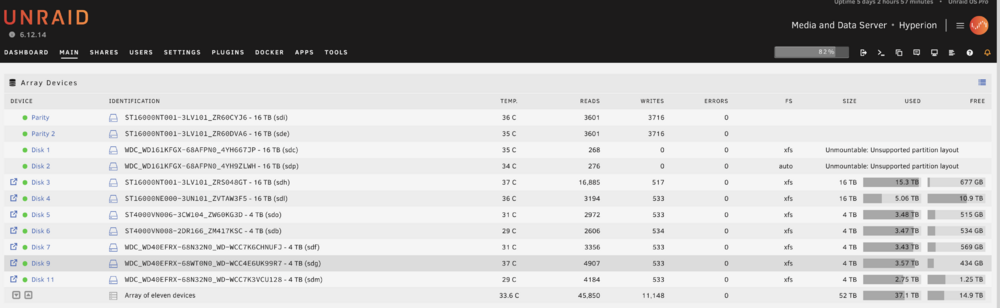
Hello, I recently got two drives to add to my system, which I first precleared. For the first drive, I replaced an existing drive in the system (Disk 1). I let data rebuild complete on the drive. All looked good and rebuild completed successfully. For the second drive, I stopped the array, added it as a new drive in an empty slot (Disk 2), and again started the array. Both the recently-rebuilt, and the newly added drive, now say "Unmountable: Unsupported partition layout". Disk 1 shows xfs (correct, that's what the prior drive was) and Disk 2 shows auto. But both show this unmountable error and a request to reformat the drives. I stopped the array without formatting. I'm not sure how to proceed. Formatting will delete all data on the rebuilt drive, but I do need to format the new drive. What do I do? Screenshot and diagnostic log attached. Here are the relevant fdisk entries: sdc is Disk 1, which was recently rebuilt. It shows a Linux Filesystem Disk /dev/sdc: 14.55 TiB, 16000900661248 bytes, 31251759104 sectors Disk model: WDC WD161KFGX-68 Units: sectors of 1 * 512 = 512 bytes Sector size (logical/physical): 512 bytes / 4096 bytes I/O size (minimum/optimal): 4096 bytes / 4096 bytes Disklabel type: gpt Disk identifier: 8249EC25-BC98-446C-BACF-B85E6F06A273 Device Start End Sectors Size Type /dev/sdc1 64 31251759070 31251759007 14.6T Linux filesystem sdp is Disk 2, the one I just added to an empty slot as a new drive. It shows unformatted. Disk /dev/sdp: 14.55 TiB, 16000900661248 bytes, 31251759104 sectors Disk model: WDC WD161KFGX-68 Units: sectors of 1 * 512 = 512 bytes Sector size (logical/physical): 512 bytes / 4096 bytes I/O size (minimum/optimal): 4096 bytes / 4096 bytes Disklabel type: dos Disk identifier: 0x00000000 Device Boot Start End Sectors Size Id Type /dev/sdp1 1 4294967295 4294967295 2T 0 Empty Partition 1 does not start on physical sector boundary. Perhaps worth mentioning that sdk is a precleared warm spare, so is not expected to have a filesystem. I saw a vaguely similar post where the output of lsblk was requested, so here that is (run without the array started). Seems like sdc1 being 2T is indicative of the problem here. Presumably that should be 14.6T. This conflicts with what fdisk says above for the same drive, though, so I am confused. root@Hyperion:~# lsblk NAME MAJ:MIN RM SIZE RO TYPE MOUNTPOINTS loop0 7:0 0 63.5M 1 loop /lib loop1 7:1 0 348.5M 1 loop /usr sda 8:0 1 3.7G 0 disk └─sda1 8:1 1 3.7G 0 part /boot sdb 8:16 0 3.6T 0 disk └─sdb1 8:17 0 3.6T 0 part sdc 8:32 0 14.6T 0 disk └─sdc1 8:33 0 2T 0 part sdd 8:48 0 931.5G 0 disk └─sdd1 8:49 0 931.5G 0 part sde 8:64 0 14.6T 0 disk └─sde1 8:65 0 14.6T 0 part sdf 8:80 0 3.6T 0 disk └─sdf1 8:81 0 3.6T 0 part sdg 8:96 0 3.6T 0 disk └─sdg1 8:97 0 3.6T 0 part sdh 8:112 0 14.6T 0 disk └─sdh1 8:113 0 14.6T 0 part sdi 8:128 0 14.6T 0 disk └─sdi1 8:129 0 14.6T 0 part sdj 8:144 0 931.5G 0 disk └─sdj1 8:145 0 931.5G 0 part sdk 8:160 0 14.6T 0 disk └─sdk1 8:161 0 2T 0 part sdl 8:176 0 14.6T 0 disk └─sdl1 8:177 0 14.6T 0 part sdm 8:192 0 3.6T 0 disk └─sdm1 8:193 0 3.6T 0 part sdn 8:208 0 3.6T 0 disk └─sdn1 8:209 0 3.6T 0 part sdo 8:224 0 3.6T 0 disk └─sdo1 8:225 0 3.6T 0 part sdp 8:240 0 14.6T 0 disk └─sdp1 8:241 0 2T 0 part sr0 11:0 1 1024M 0 rom hyperion-diagnostics-20241205-1842.zip

-
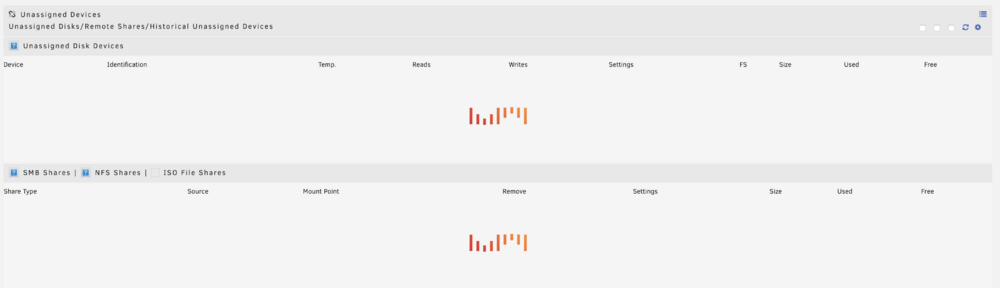
Update w/ Answer: This was a browser cache issue, somehow, simultaneously between both Safari and Chrome. Clearing website data for both browsers resolved the issue for both devices. Weird they would both become corrupted somehow at the same time. Recently my Unassigned Devices section on the Unraid main page simply display the "waiting"/"loading" animation and never populate. There was an update for the UD plugin so I installed that, but the behavior remains. I attached my diagnostics file after a clean boot. I hadn't even started the array yet and the behavior was already there. I use UD for easily tracking and pre clearing my warm spares, so I don't have any devices it's supposed to automatically mount to see if they're working or not. Any clues what is going on here? hyperion-diagnostics-20241110-1616.zip
-
I decided to give the mover path a try. It was trickier than I expected because was unfamiliar with the mover settings. For anyone finding this later, you can't just change the primary from Cache to Array and then run the mover. Nothing happens. You have to keep the Primary as Cache, then the secondary as Array. Then you need to set the mover direction to Cache -> Array. Then later when the new pool is ready you reverse the mover direction: Array -> Cache. Notably I had to run the mover two times each way even though there was nothing accessing the cache drive, nor was docker or any VMs running. Strange. In any case, it worked pretty well.
-
Got it. I figured it wasn't quite as easy as just replacing the drives, but was hopeful regardless. For the direct copy latter case you mentioned, what would that process look like? Install the new SSDs Create a new 2-drive cache pool Copy the files over (how would this work, just `cp` to `/mnt/driveX/` ?) Remove the original pool Remove the drives Something like that?
-
Hello, I recently upgraded the CPU, Motherboard, etc. in my Unraid server. Some things are super fast, but I believe I've uncovered a substantial bottleneck in the system: my spinning cache drives. I can frequently peg my Intel 12700k at 100%, as reported by Unraid Dashboard, just doing some docker tasks. If I view htop during that period, it shows CPU utilization under 10%. My understanding is that Unraid's CPU calculation includes IOWAITs while htop does not, so the processor is likely stalling waiting on drive access. During this period I can see my array drives are idle (no read/writes) and my cache drives are thrashing like crazy. So I'd like to replace my cache drives with SSDs. I currently have a pair of 4TB drives in a redundant pool as Cache and Cache 2. I only use about 256GB, I just had 4TB drives lying around. I don't want to buy 4TB SSDs to swap them out, so I assume I can't simply stop the array and assign one of the SSDs into the cache drive slot and have it work/rebuild. What is the best process to accomplish this? If it matters, I store appdata and system solely on the Cache. I do have a few shares set up as Cache -> Array.
-
Yes, with the right cable(s). I have only SATA drives in mine.
-
I populated with 3x Dell 4Y5H1 SAS3 (LSI SAS3008) cards from artofserver because they were super cheap on clearance. Works excellently. 2x train at full PCIe3 speed, all lanes (8). The last trains at full PCIe3 speed, but at 4x lanes. No BIOS modifications required. I use spinning drives so don't think I'd max out the controller even if I populate all 8 drives on it, which I do not plan to do. It's a little bit annoying because I should have just been able to use the built-in ports on the motherboard, but this just worked immediately with no fussing and I realized there's some value in having similar hardware in the path for all the drives. Bought a couple spare cards for later just in case.
-
Is anyone else having trouble running both this and the System Temp plugin? I'm having the exact same problem as this post: If my Corsair is plugged in and this plugin is running, it gets added to /etc/sensors.d/sensors.conf But System Temp chokes if the following lines are in that config file chip "corsairpsu-hid-3-1" ignore "fan1" I can remove the lines and everything works correctly, both this plugin and System Temp, but unfortunately the lines return after every reboot or power cycle. I'm out of ideas on how to fix this without modifying files every reboot.
-
Got it. Yeah, I'm sure that's it. I probably purchase the wrong direction of both of these cables. In the end I decided to sidestep the issue entirely and add a third HBA card. Two can run with the full 8x lines, but by my calculations the third downrated 8x Lane -> 4x Lane card is still fine for supporting 8 spinning drives. Realistically, I'm doubtful I'll ever fully populate them anyway, but this way every bay in my case will work. The HBA cards came up and worked just fine with the cabling that came with the case, plus since they're 100% the same connectivity across all ports I can keep spare cards and cables and quickly replace one in the event of a failure. Cards with 2x ports instead of 4 were massively less expensive, so while 3 cards feels a little silly it still seems like the economical solution. I got three of these plus a spare for less than a single 4 port card. I think I got to a good spot.
-
Thank you, but unfortunately that is the one that I did find and set. If it's not the BIOS I probably somehow picked incompatible or faulty cables. The drives from the backplane work fine if I connect to another MiniSAS controller, which is what I'm doing temporarily. Maybe I'll just make that permanent.
-
I'm having trouble getting my SATA ports on the mainboard up and running with my Supermicro BPN-SAS-846A backplane (SFF8087 connectors). It's not clear why they're not working. Are there BIOS settings I should check? I've ensured the ports are "Enabled" in the Advanced portion of the BIOS. I can't seem to get the SlimSAS connector working either, though that was a long shot with a MiniSAS to SFF8087 cable being rare. Here the SlimSAS is set to SATA mode. That said, I feel like the same problem might be impacting both and that I'm missing something obvious. Any ideas?
-
Thanks! I will check this one out. I might be able to make a 12 bay work. Since posting I’ve also found a source for the CSE-846 with the SQ power supplies installed, so it seems like that option is back on the table as well. I do like the large community those have, including a variety of 3D printable parts.
-
I have a Norco 4020 (4U rack mount, SATA backplane) that's been pretty good to me over the past 10 years. I'm about to overhaul my Unraid setup (keep data drives, replace everything else) and am thinking about whether to reuse or replace the chassis. I'd prefer to replace so I can clean break and migrate drives over after the system is up an operational, but I'm having trouble finding a good alternative. I'm currently using 14 drives if I count warm spares. I don't expect to increase number of drives from here, and may even shrink slightly as older smaller drives are replaced by newer ones. Still, I don't think 10 is in the cards and probably need to set 12x as a minimum. I've looked for the commonly-recommended Supermicro cs846, but it looks like they sell for upwards of $1000 now and I can't find a place that sells one (also none on eBay, looks like). The 847 is much cheaper, but I need some motherboard flexibility and the extra drives eat that all up. The Rosewill RSV-L4413 and its many variants seem ok but not great. I'd prefer not to lose hot-swap. It seems like Norco went out of business, and I don't really see anything else recommended. Some desires: 12x or more drive support, ideally at least 14x so I can port over painlessly My Norco 4020 is the SATA variant, so I have a lot of cables. A SAS backplane sounds nice (but not mandatory) Rackmount preferred, but not mandatory (a tower would have to sit on its side under a bed, which my 4U manages fine) I'm willing to replace fans to get it quiet, but it must be quiet (see bed comment) Hot-swappable preferred Are there other options? I'm kind of surprised there are so few good cases.
-
Ah, tricky. I did not see that in the log. I was hunting using the words "format" and "cache". This was exactly it, though, after a reboot everything is working correctly. Thank you!
-
I've been using Unraid for a very long time, but have never run a cache drive. As I was deprecating some old hard drives, I decided I wanted to give this a shot. I'm getting an error in the UI that says "Unmountable: Unsupported or no file system". I do see the section at the bottom of the main page that says "Unmountable disks present" and there is the "Yes I want to do this" box alongside the format button, which I tried, but even after that happens the drives still show the same error. It's not clear what I'm doing wrong. Does anything stick out? The process I followed: Got former array drives out of the array and got the array back in good shape Precleared former array drives (primarily as an integrity check) Stopped the array Increased the cache slot size to 2 to enable direct mirroring Added precleared drives to cache slots 1 and 2 Started the array At the bottom of the main page, clicked the "yes I want to do this" and the "Format button Verified the errors and state still exist I think I then repeated steps 3-8 a second time, with the same result. Running 6.12.6. hyperion-diagnostics-20240115-0949.zip


-
I had a set of 3 drives to remove. I followed the instructions laid out in the previous posts exactly and it worked very well for my first drive. I created a new config, and then as a follow-up confirmation ran a parity check and all was good. Then I started on the second drive. Unfortunately, after the zeroing completed I have noticed that creating a new config sets the md_write tunable back to Auto from Turbo. I'm wondering if this will break anything, or if the process will just take longer? I noticed that using Auto only the drive being zeroed and my two parity disks are being read during the operation. When on Turbo it was reading from all disks and writing to the drive being zeroed and the parity drives. I'm OK with it taking longer (it's done now). I just want to confirm I didn't irreparably break anything.
-
I thought I might start a fun thread for the holidays. So I have this hard drive that has been in service and in active use for 12 years and 6 months. It is horrifically slow compared to the modern drives, but it is a trooper. I really want to let it keep going and see when it will eventually fail, but it feels like too big a risk to keep in my main array. Plus, as noted, the performance is terrible. I'm going to pull it out of the array next week and let it live out its retirement some other way. Any ideas or suggestions? Anyone still running something older than this? Drive details: Hitachi Deskstar 5K3000 Model HDS5C3020ALA632 The drive's stats, according to SMART. Some of these are astonishing: Power on hours: 109250 Start/stop count: 5927 Load cycle count: 6071 Reallocated sector count: 0 Power Cycle Count: 116 Logical Sectors Written: 66,681,556,472 Number of Write Commands: 460,521,050 Logical Sectors Read: 4,704,534,865,919 (4 trillion sector reads?!? Can this be right?!?) Number of Read Commands: 7,586,319,622 A big salute to you, bulletproof Hitachi I purchased on a whim from MicroCenter in 2011. Hitachi_HDS5C3020ALA632_ML0220Fxxxxx-20231224-2107.txt



