Arcaeus
Members
-
Joined
-
Last visited
Everything posted by Arcaeus
-
So from the CLI, I restarted (what I assume is) the networking service with: sudo /etc/rc.d/rc.inet1 restart And it seemed to come back online. This is odd to me because about 2 weeks ago, my NFS service randomly turned off and once I restarted it, it's been fine. Could there be a connection here?
-
So I have 2 NICs in the system. One is the onboard mobo NIC which is not plugged in, and the other is a 10G PCIe card. I just restarted the server and booted into GUI mode to see if I could see anything. The system became available on the network, and I could access the WebGUI from my phone without a problem. So I rebooted back into regular headless mode and the webGUI is back to being inaccessible.
-
Hi all, I woke up this morning to my Unraid server offline from the network. I haven't made any config changes recently, and was just using it last night. I can't access the webGUI or ping it from my client PC. I restarted the server and it seems to boot just fine, but can't ping anything from the bare metal Unraid CLI. I see link lights on the NIC flashing, so it seems like something is happening and the NIC hasn't become unseated. Any ideas why it's not accessible on the network? Diags attached. mediavault-diagnostics-20240912-0551.zip
-
Here are the two log files you requested. I tried turning off the VPN when editing the container, and it worked, but when I turned it back on, I got the same error. The logs below are from when the VPN container variable was set to yes. I just tried it again and it's working?? Not sure what changed. DelugeVPN_command_execution.txt supervisord.log
-
Hey everyone. Just updated to the new version of DelugeVPN and now I can't open the webGUI. I use PIA as my VPN client. I personally haven't changed any of the settings, just clicked "Update Container" or whatever through the Docker tab. Now when I click on webUI, I just get a "Connection Refused" error. I opened the Docker logs and saw some SSL/TLS errors, but I'm not sure what they mean: 2024-06-05 09:19:37,831 DEBG 'start-script' stdout output: 2024-06-05 09:19:37 WARNING: file 'credentials.conf' is group or others accessible 2024-06-05 09:19:37 OpenVPN 2.6.10 [git:makepkg/ba0f62fb950c56a0+] x86_64-pc-linux-gnu [SSL (OpenSSL)] [LZO] [LZ4] [EPOLL] [PKCS11] [MH/PKTINFO] [AEAD] [DCO] built on Mar 20 2024 2024-06-05 09:19:37 library versions: OpenSSL 3.3.0 9 Apr 2024, LZO 2.10 2024-06-05 09:19:37 DCO version: N/A 2024-06-05 09:19:38,831 DEBG 'start-script' stdout output: 2024-06-05 09:19:38 NOTE: the current --script-security setting may allow this configuration to call user-defined scripts 2024-06-05 09:19:38,831 DEBG 'start-script' stdout output: 2024-06-05 09:19:38 OpenSSL: error:068000E9:asn1 encoding routines::utctime is too short: 2024-06-05 09:19:38 OpenSSL: error:0688010A:asn1 encoding routines::nested asn1 error:Field=revocationDate, Type=X509_REVOKED 2024-06-05 09:19:38 OpenSSL: error:0688010A:asn1 encoding routines::nested asn1 error:Field=revoked, Type=X509_CRL_INFO 2024-06-05 09:19:38 OpenSSL: error:0688010A:asn1 encoding routines::nested asn1 error:Field=crl, Type=X509_CRL 2024-06-05 09:19:38,832 DEBG 'start-script' stdout output: 2024-06-05 09:19:38 OpenSSL: error:0488000D:PEM routines::ASN1 lib: 2024-06-05 09:19:38 CRL: cannot read CRL from file [[INLINE]] 2024-06-05 09:19:38 CRL: loaded 0 CRLs from file -----BEGIN X509 CRL----- MIICWDCCAUAwDQYJKoZIhvcNAQENBQAwgegxCzAJBgNVBAYTAlVTMQswCQYDVQQI EwJDQTETMBEGA1UEBxMKTG9zQW5nZWxlczEgMB4GA1UEChMXUHJpdmF0ZSBJbnRl cm5ldCBBY2Nlc3MxIDAeBgNVBAsTF1ByaXZhdGUgSW50ZXJuZXQgQWNjZXNzMSAw HgYDVQQDExdQcml2YXRlIEludGVybmV0IEFjY2VzczEgMB4GA1UEKRMXUHJpdmF0 ZSBJbnRlcm5ldCBBY2Nlc3MxLzAtBgkqhkiG9w0BCQEWIHNlY3VyZUBwcml2YXRl aW50ZXJuZXRhY2Nlc3MuY29tFw0xNjA3MDgxOTAwNDZaFw0zNjA3MDMxOTAwNDZa MCYwEQIBARcMMTYwNzA4MTkwMDQ2MBECAQYXDDE2MDcwODE5MDA0NjANBgkqhkiG 9w0BAQ0FAAOCAQEAQZo9X97ci8EcPYu/uK2HB152OZbeZCINmYyluLDOdcSvg6B5 jI+ffKN3laDvczsG6CxmY3jNyc79XVpEYUnq4rT3FfveW1+Ralf+Vf38HdpwB8EW B4hZlQ205+21CALLvZvR8HcPxC9KEnev1mU46wkTiov0EKc+EdRxkj5yMgv0V2Re ze7AP+NQ9ykvDScH4eYCsmufNpIjBLhpLE2cuZZXBLcPhuRzVoU3l7A9lvzG9mjA 5YijHJGHNjlWFqyrn1CfYS6koa4TGEPngBoAziWRbDGdhEgJABHrpoaFYaL61zqy MR6jC0K2ps9qyZAN74LEBedEfK7tBOzWMwr58A== -----END X509 CRL----- 2024-06-05 09:19:38 TCP/UDP: Preserving recently used remote address: [AF_INET]84.247.105.223:1198 2024-06-05 09:19:38 UDPv4 link local: (not bound) 2024-06-05 09:19:38 UDPv4 link remote: [AF_INET]84.247.105.223:1198 2024-06-05 09:19:38,923 DEBG 'start-script' stdout output: 2024-06-05 09:19:38 VERIFY ERROR: CRL not loaded 2024-06-05 09:19:38 OpenSSL: error:0A000086:SSL routines::certificate verify failed: 2024-06-05 09:19:38 TLS_ERROR: BIO read tls_read_plaintext error 2024-06-05 09:19:38 TLS Error: TLS object -> incoming plaintext read error 2024-06-05 09:19:38 TLS Error: TLS handshake failed 2024-06-05 09:19:38,923 DEBG 'start-script' stdout output: 2024-06-05 09:19:38 SIGHUP[soft,tls-error] received, process restarting 2024-06-05 09:19:38,923 DEBG 'start-script' stdout output: 2024-06-05 09:19:38 DEPRECATED OPTION: --cipher set to 'aes-128-cbc' but missing in --data-ciphers (AES-256-GCM:AES-128-GCM:CHACHA20-POLY1305). OpenVPN ignores --cipher for cipher negotiations. 2024-06-05 09:19:38,923 DEBG 'start-script' stdout output: 2024-06-05 09:19:38 WARNING: file 'credentials.conf' is group or others accessible 2024-06-05 09:19:38 OpenVPN 2.6.10 [git:makepkg/ba0f62fb950c56a0+] x86_64-pc-linux-gnu [SSL (OpenSSL)] [LZO] [LZ4] [EPOLL] [PKCS11] [MH/PKTINFO] [AEAD] [DCO] built on Mar 20 2024 2024-06-05 09:19:38 library versions: OpenSSL 3.3.0 9 Apr 2024, LZO 2.10 2024-06-05 09:19:38 DCO version: N/A 2024-06-05 09:19:39,924 DEBG 'start-script' stdout output: 2024-06-05 09:19:39 NOTE: the current --script-security setting may allow this configuration to call user-defined scripts 2024-06-05 09:19:39,924 DEBG 'start-script' stdout output: 2024-06-05 09:19:39 OpenSSL: error:068000E9:asn1 encoding routines::utctime is too short: 2024-06-05 09:19:39 OpenSSL: error:0688010A:asn1 encoding routines::nested asn1 error:Field=revocationDate, Type=X509_REVOKED 2024-06-05 09:19:39 OpenSSL: error:0688010A:asn1 encoding routines::nested asn1 error:Field=revoked, Type=X509_CRL_INFO 2024-06-05 09:19:39,924 DEBG 'start-script' stdout output: 2024-06-05 09:19:39 OpenSSL: error:0688010A:asn1 encoding routines::nested asn1 error:Field=crl, Type=X509_CRL 2024-06-05 09:19:39 OpenSSL: error:0488000D:PEM routines::ASN1 lib: 2024-06-05 09:19:39 CRL: cannot read CRL from file [[INLINE]] 2024-06-05 09:19:39 CRL: loaded 0 CRLs from file -----BEGIN X509 CRL----- MIICWDCCAUAwDQYJKoZIhvcNAQENBQAwgegxCzAJBgNVBAYTAlVTMQswCQYDVQQI EwJDQTETMBEGA1UEBxMKTG9zQW5nZWxlczEgMB4GA1UEChMXUHJpdmF0ZSBJbnRl cm5ldCBBY2Nlc3MxIDAeBgNVBAsTF1ByaXZhdGUgSW50ZXJuZXQgQWNjZXNzMSAw HgYDVQQDExdQcml2YXRlIEludGVybmV0IEFjY2VzczEgMB4GA1UEKRMXUHJpdmF0 ZSBJbnRlcm5ldCBBY2Nlc3MxLzAtBgkqhkiG9w0BCQEWIHNlY3VyZUBwcml2YXRl aW50ZXJuZXRhY2Nlc3MuY29tFw0xNjA3MDgxOTAwNDZaFw0zNjA3MDMxOTAwNDZa MCYwEQIBARcMMTYwNzA4MTkwMDQ2MBECAQYXDDE2MDcwODE5MDA0NjANBgkqhkiG 9w0BAQ0FAAOCAQEAQZo9X97ci8EcPYu/uK2HB152OZbeZCINmYyluLDOdcSvg6B5 jI+ffKN3laDvczsG6CxmY3jNyc79XVpEYUnq4rT3FfveW1+Ralf+Vf38HdpwB8EW B4hZlQ205+21CALLvZvR8HcPxC9KEnev1mU46wkTiov0EKc+EdRxkj5yMgv0V2Re ze7AP+NQ9ykvDScH4eYCsmufNpIjBLhpLE2cuZZXBLcPhuRzVoU3l7A9lvzG9mjA 5YijHJGHNjlWFqyrn1CfYS6koa4TGEPngBoAziWRbDGdhEgJABHrpoaFYaL61zqy MR6jC0K2ps9qyZAN74LEBedEfK7tBOzWMwr58A== -----END X509 CRL----- 2024-06-05 09:19:39 TCP/UDP: Preserving recently used remote address: [AF_INET]172.64.151.73:1198 2024-06-05 09:19:39 UDPv4 link local: (not bound) 2024-06-05 09:19:39 UDPv4 link remote: [AF_INET]172.64.151.73:1198 The rest of my system is running fine, no issues with other containers. Diags posted in case they help. mediavault-diagnostics-20240605-0920.zip
-
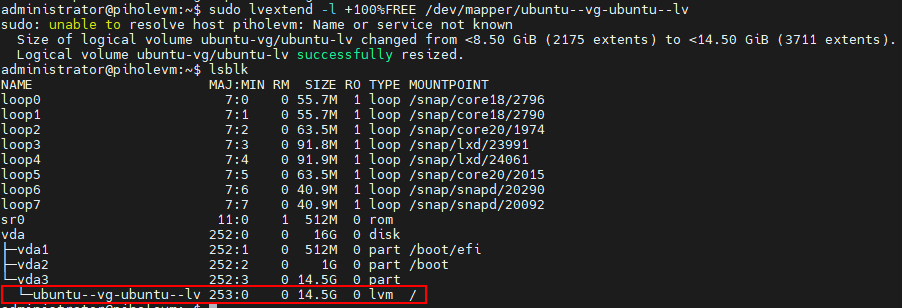
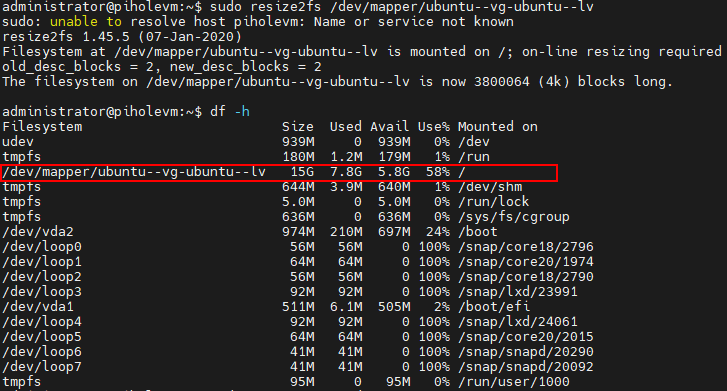
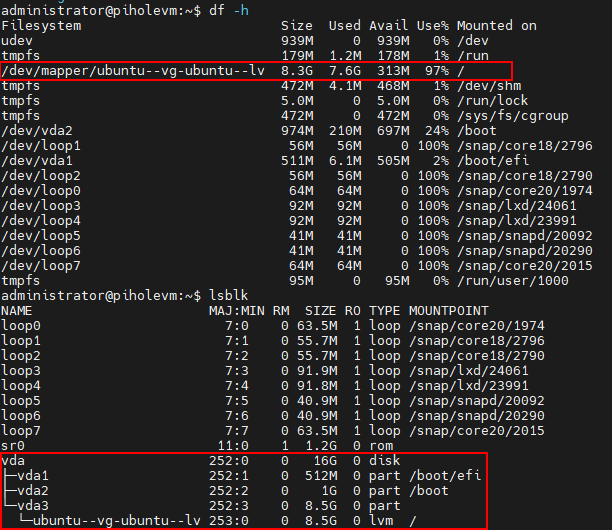
Ok, figured it out. Here is what worked for me: Shutdown VM Adjust capacity in Unraid GUI VM page. Download gparted, move iso to desired location, and set gparted iso as primary boot disk. Boot into gparted iso and Extend vdisk to include new space. Apply and shutdown. Swap back to original vdisk as primary boot drive. Boot up VM SSH into VM (I use Moba) List disks and storage: df -h List file system size lsblk Since this should be lvm, run lvextend: lvextend -l +100%FREE <logical volume> Mine specifically was: lvextend -l +100%FREE /dev/mapper/ubuntu--vg-ubuntu--lv Resize the file system so it can use all of that space. resize2fs <file system path> Mine was resize2fs /dev/mapper/ubuntu--vg-ubuntu--lv "df -h" now shows correct size: Message shows that disk has been resized successfully, which shows in "lsblk" again.
-
Hello, I have PiHole running in a small Ubuntu VM on my Unraid server (6.12.4) and have run out of space on the root vdisk. As I was watching the SpaceInvaderOne video that was in the guides section of the forum, after he showed how to increase the disk size in the Unraid GUI, he talked about extending the partition (although his video showed Windows). I looked up a guide on how to do it in Linux, but it shows that I would have to unmount the disk first. Since this is the root disk that the OS and everything is running off of, I can't unmount it, and I can't change anything if the VM is shut down of course. So, how would I go about increasing the partition size? Or clone this disk to a larger one?
-
Yep, dead drive. switched connections and no dice. I'll order and install one, thanks for your help.
-
Ok server has been shut down completely, then rebooted. These are the diags from that. Disk still not showing in UD. mediavault-diagnostics-20221212-1242.zip
-
Ah, apologies I misunderstood. I just rebooted, so I'll do a full shutdown then post the diags when it starts back up.
-
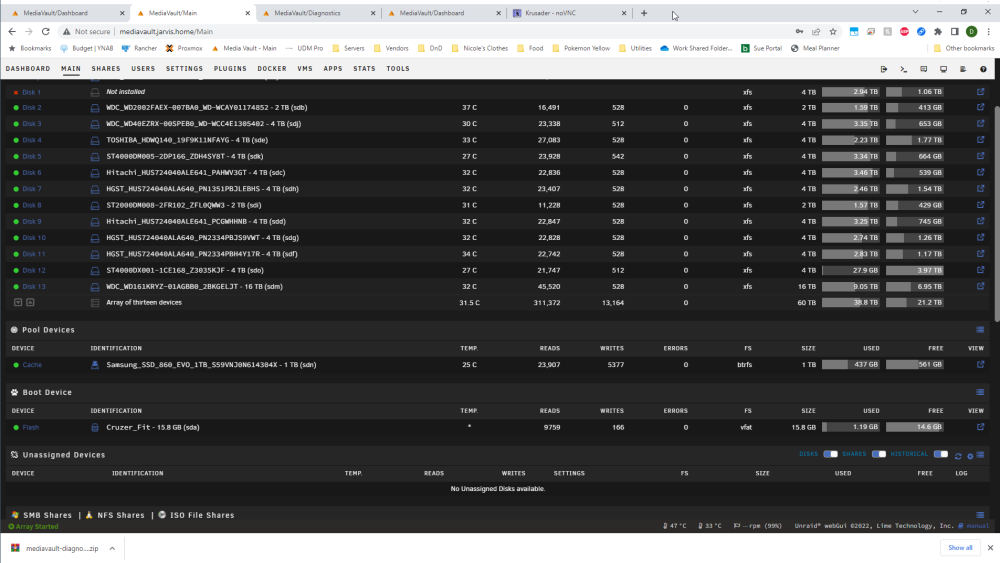
Power cycled server, new diags are posted. sdi is showing in the CLI when the server was booting up, but not showing up in UD: mediavault-diagnostics-20221212-1131.zip
-
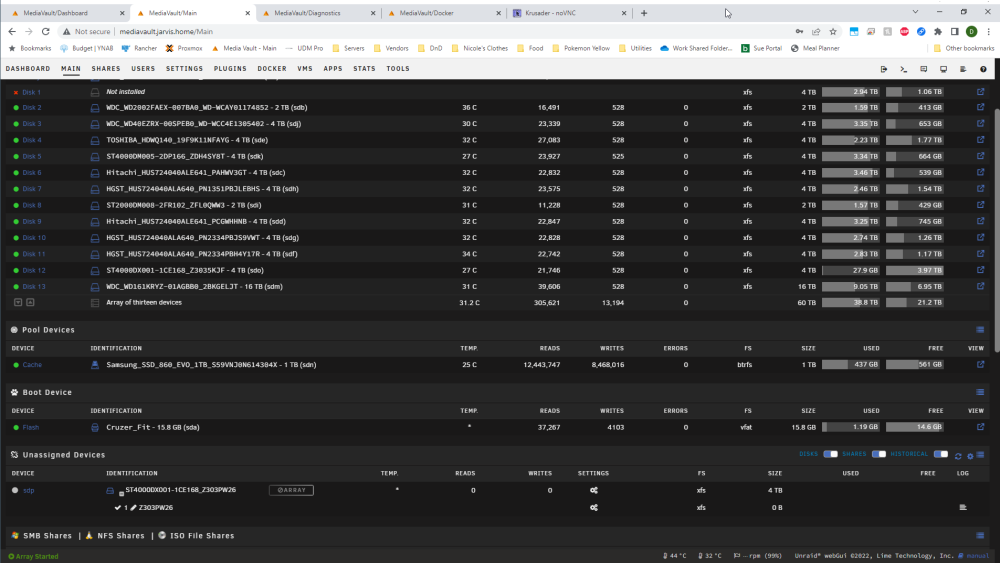
Hello, Woke up this morning to my disk1 showing as disabled. I've had no issues with it for the last few months and haven't touched any of the cables. My server is currently in a server rack in the basement so highly unlikely that it got bumped or anything. Checking the disk log information, I'm seeing a lot of bad sectors (log attached). I stopped the array and unassigned the disk, then when trying to re-assign it the disk was not in the drop down menu. Looking through some previous posts on here, I think the disk may be dying. Attempting to run a smart report immediately fails (whether it was in the array or not) and iirc that is one of the older disks in the array. Diags attached below are from when the array was stopped. I started the array with the disk removed, and the files from disk1 are emulated. Diags from running array are also attached. It looks like the disk (sdp) in UD is unmountable or otherwise can't be added to the array? I had some other disk show similar errors in the past which ended up being some data corruption. I wanted to just check with you guys to see if there was anything I could do before replacing the disk, or if there was a way to get this disk back up and running. Even if this disk can be fixed, should I be looking into replacing it anyways as it's already on its way out? log.txt mediavault-diagnostics-20221212-1045.zip [array-started] mediavault-diagnostics-20221212-1045.zip
-
Hey there, I'm trying to get your DayZ container running on my k3s cluster. It's up and running well, and just had a question on modding the server. Where do I put the mod files that I've downloaded from the Steam Workshop? I've seen documentation from Nitrado for setting up mods on their servers that say to put it in the main parent game folder. I see that your container has an addons folder already, so do I take all the .pbo and .bisign files for each mod and throw them in there, then put the respective "keys" files in the keys folder? Do you have any documentation on how to do this?
-
Ok sweet. And deleting the appdata folders is all good? Or is that going to screw with the like 'previously installed apps' thing of CA?
-
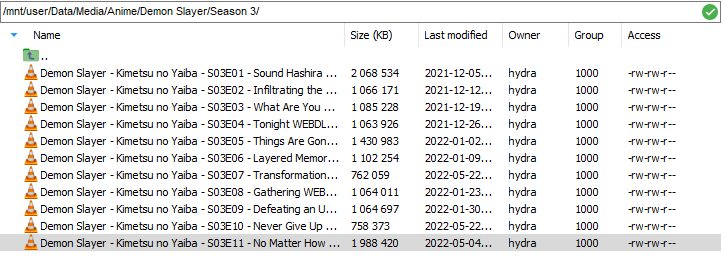
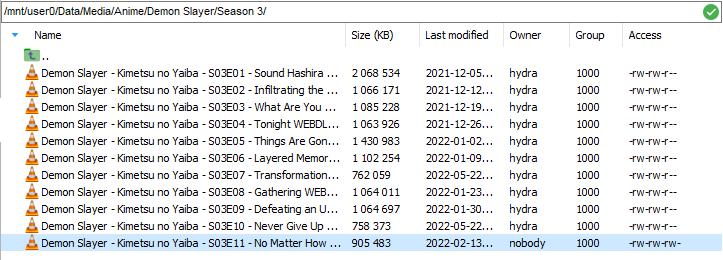
Hello, I have certain folders in the Media share are staying on the cache drive after Mover has ran. Everything else has no problem moving off of the cache disk to the array, except for these folders. I believe it is because the same file already exists on the array so Mover is skipping it or something. If I look in /mnt/user0 vs. /mnt/user vs. /mnt/cache, I can find the same file in the same folder structure (see attached screenshots). Media share is set to Cache:Yes File permissions of cache folders almost match folders on array, and the user0 file is owned by 'nobody' instead of the rest being 'hydra' Is there any issue with me deleting the files off of the cache drive directly via CLI/Krusader? Or what is the best way to resolve this? While I'm in here, I see folders in /mnt/cache/appdata of containers that I've since deleted. Can I delete that appdata folder if I know I'm never going to use that again? Or is there a better way to clean that up? Diags attached. mediavault-diagnostics-20220902-0930.zip

-
16TB drive is in and parity is rebuilding. This time I put "no disk" on parity, then selected the 16TB. Guess it just got hung up somewhere. Thanks for your help.
-
Alright looks like we're back online. Do I have the process right or is there something else I should be doing?
-
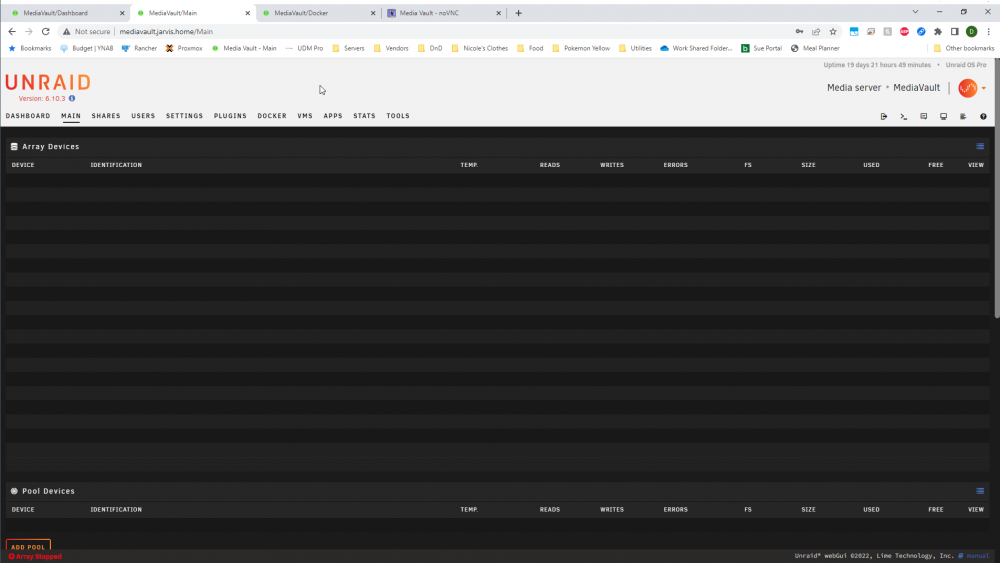
Hello, I recently got a pair of 16TB WD Golds and wanted to put one as my parity disk (upgrading from a 4TB) and then once that is completed, add in the other 16TB as a data disk plus move the old 4TB as another data disk. I have precleared both 16TB disks and had them mounted in unassigned devices as a local backup while I was figuring out some file system issues and waiting for my cloud backup to finish. Searching through the forum I found this process from @Squid which states: I stopped the array and in Main clicked to select the 16TB disk to replace the existing parity drive. Once I did, the screen changed and now none of the disks are showing up: Refreshing the page does nothing, and switching back and forth to another page does nothing. Trying to open the log in the top right shows the window for a second and then closes without displaying any info. The unassigned devices section on main is just spinning with the wavy Unraid logo. Attempted to download diagnostics file, but it's just sitting there after clicking download. I wanted to post in here before I did anything else to not potentially mess something up. Thanks for your help. Unraid Pro v6.10.3 SOLUTION: This ended up being a DNS issue. I run PiHole as an Ubuntu VM on Unraid, as use that for local DNS resolution. When I stopped the array, it shut down the VM so Unraid would only display the cached webpage data. Once I changed the DNS info on Windows and went to the IP address of my server, the problem resolved itself.
-
Recently I have set up some Proxmox VMs that use an Unraid NFS share as their main disk. On Unraid 6.9.2, having the 'Support Hard Links'=Yes would cause stale file handle errors when Mover ran (from what I can determine) on Proxmox and in the VMs, causing them to crash or need a hard reboot. Since turning that to 'no', they've been fine. However, I am in the process of setting up Sonarr and Radarr and in diagnosing some issues their documentation recommends Hard Links to be enabled. Has this issue been resolved in the new 6.10.2 version? Or is that something to do with Unraid itself?
-
Hello everyone, I have 5 NFS shares coming from my Unraid server into my Proxmox cluster of 4 nodes (named Prox-1 through 4 respectively). These shares are: AppData Archives Backups ISOs VM-Datastore They connect on Proxmox fine, but the "Backups" share will error out partway through a backup operation run on Proxmox, and the Archives share will randomly disconnect. Attached are the backup operation logs for a couple of the VMs. As you can see, the write info goes to zero after a point and generally stays there. I've posted over there as well, but wanted to check with you guys to confirm that it's not something on the Unraid side causing issues. Is Unraid erroring out? or is something being overloaded? Diags attached if needed. VMID 100 backup error log.txt VMID 201 backup error log.txt fstab and config.cfg info.txt mediavault-diagnostics-20220511-1439.zip
-
Had corruption in my array. Once that was fixed and the array restarted, the shares returned.
-
This has been resolved. One of my drives had been disabled and once that was back up it started working.
-
Ok array is started with disk 7 mounted now, thank you. It looks like there are a lot of files in the lost+found folder, and Main - Array also shows a lot of free space on the disk, much more than was there before. What's my next step? Do I need to go through lost+found on the drive and move files back to where they should be or will Unraid put back what was there before? Or do it from the lost+found share? I know moving files from a specific disk was not recommended on Unraid but not sure if that applies here.
-
Ok it looks like it completed, here is the output: root@MediaVault:~# xfs_repair -v /dev/md7 Phase 1 - find and verify superblock... - block cache size set to 542384 entries Phase 2 - using internal log - zero log... zero_log: head block 0 tail block 0 - scan filesystem freespace and inode maps... - found root inode chunk Phase 3 - for each AG... - scan and clear agi unlinked lists... - process known inodes and perform inode discovery... - agno = 0 - agno = 1 - agno = 2 - agno = 3 - process newly discovered inodes... Phase 4 - check for duplicate blocks... - setting up duplicate extent list... - check for inodes claiming duplicate blocks... - agno = 0 - agno = 1 - agno = 2 - agno = 3 Phase 5 - rebuild AG headers and trees... - agno = 0 - agno = 1 - agno = 2 - agno = 3 - reset superblock... Phase 6 - check inode connectivity... - resetting contents of realtime bitmap and summary inodes - traversing filesystem ... - agno = 0 - agno = 1 - agno = 2 - agno = 3 - traversal finished ... - moving disconnected inodes to lost+found ... Phase 7 - verify and correct link counts... XFS_REPAIR Summary Tue May 10 11:15:48 2022 Phase Start End Duration Phase 1: 05/10 11:15:48 05/10 11:15:48 Phase 2: 05/10 11:15:48 05/10 11:15:48 Phase 3: 05/10 11:15:48 05/10 11:15:48 Phase 4: 05/10 11:15:48 05/10 11:15:48 Phase 5: 05/10 11:15:48 05/10 11:15:48 Phase 6: 05/10 11:15:48 05/10 11:15:48 Phase 7: 05/10 11:15:48 05/10 11:15:48 Total run time: done What's next? Restart the array and rebuild parity?
-
Ok ran it with that flag, but my computer (not Unraid Server) crashed midway through and killed the SSH session. Is there a way to check on the progress? Maybe run the same command but with the -n flag to check?