






Marshalleq
Members
-
Joined
-
Last visited
Everything posted by Marshalleq
-
@dlandon thanks for your answer, I get where you're going with it, but in my case UD wasn't mounting the NFS share, so at first your response seems unhelpful, though technically it's correct. And this is the problem throughout this thread when this question is asked, no-one really ever answers the question. So after my research I thought I'd help others by answering it here. Main Point As far as I know, NFS doesn't support username password. Instead it will mount anything and handle permissions via the UID/GID match of the local and foreign accounts. There seem to be two cases where this becomes impossible though: 1 - When a 3rd party has assigned you an NFS share and hasn't used the mapall option 2 - When a 3rd party has assigned you an NFS share and hasn't shared which UID it's under So in summary a functioning NFS setup obviously relies on a functioning network and correctly set up NFS export at the other end, which the 3rd party has now resolved for me. I effectively had both of those. And just to add one for good measure, even though I confirmed NFS client connects on the firewall, if I connect across my firewall from a client I get "server <IPADDRESS> requires stronger authentication”. As far as I know the firewall is completely opened up to this host and I am still to resolve this one, but it just goes to show that the error messages aren't always very accurate. Hope it's helpful to someone. Marshalleq
-
Hi all, I'm trying to connect to a remote NFS share that has a specific username / password. I've seen this question asked multiple times, but each time someone says they don't know the answer, or completely ignore the question. I've been scouring this thread for 90 minutes so far and haven't found any answer. So, does anyone know how to use the unassigned devices plugin, to specify connecting to NFS with a username / password? Of course I could use fstab, but I'd prefer not, I have no idea if that survives a reboot or not either. And of course that would mean I have a plain text password showing. Many thanks, Marshalleq
-
Hands down nicest dev EVER.
-
So giving a little back - here's how to get gitlab working with unrair letsencrypt/nginx neverse proxy and SSL. Obviously the lets encrypt container is covered elsewhere, so not going into that. I wouldn't be surprised to find that there are a few extra things to configure in NGINX to get everything working more betterer, but anyway, once you have a domain, change the following settings in gitlab.rb and reconfigure. Point a standard nginx proxy config at it on port 80. There's an official proxy config to base it from here. Configure for reverse proxy by editing gitlab.rb in your docker config location Find and locate the following values and change to below nginx['listen_port'] = 80 nginx['listen_https'] = false external_url 'https://gitlab.yourdomain.com' Add to existing trusted proxies so that the logging doesn’t all come from a single IP address. (example) gitlab_rails['trusted_proxies'] = ['192.168.1.0/24', '172.18.0.0/24'] Reconfigure as per standard reconfig procedure e.g. below # docker exec -it GitLab-CE bash # gitlab-ctl reconfigure That's all that's needed to get the page to come up anyway. I assume mattermost will be similar - hoping I can easily rename that to chat.domain.com
-
Also, I see the mattermost page has a good NGINX config for it, however Gitlab comes with NGINX built in. Does anyone have a functioning NGINX setup using lets encrypt container? It's a lot to learn, when you don't know how the internals of an omnibus container work. Further I've noted that as soon as I add the external url as https, it enables it's own https stack, which I don't want. I assume I just add the external url as just http: and let's encrypt proxy it, like with everything else. However, I'd bet that this external URL will define all sorts of outgoing addresses that need it to be accurate and am wondering if it's even possible to do this. Here was me thinking this was going to be easy. Edit: Seems like I can use this: Disable bundled NGINX In /etc/gitlab/gitlab.rb set: nginx['enable'] = false Taken from here. Which has links to external web server settings. I guess I'll give this a go.
-
@frakman1 seems like we're both trying to do this, maybe we can help each other. I do run the awesome letsencrypt/nginx container though for https but figure I should at least be able to get it to work just on an IP address, but can't even get the package to start after editing gitlab.rb and starting the reconfigure. Does yours start after adding it? I note that unraid says it's started, but after a page refresh it's actually stopped - something to do with crashes not updating the GUI I guess.
-
Did anyone get mattermost running with this docker? I actually hadn't realised you could and have been concentrating on a standalone mattermost docker, but finding a few issues that ultimately stop it from running. I did get gitlab running quite easily and supposedly you edit one file and mattermost works. But when I do that it breaks. So am interested in what others have achieved. I'm spinning up a startup and chat is really important for us with all our remote workers.
-
The Point is you’re not the only one and it’s unlikely to be specific to this docker. Sent from my iPhone using Tapatalk
-
Easy to find others on google: https://forum.level1techs.com/t/troubleshooting-steam-cache-speed-when-downloading-non-cached-games/132384/7 This one highlights to be careful with your DNS, which I agree - I have mine set via DHCP going to my lancache, then that points upstream to my INTERNAL DNS NOT the internet DNS, which in turn then points to the internet from my firewall. I'd recommend you do the same. This one claims to have helped fix the issue on freenas
-
The speed at first download issue used to be a consequence of the steamcache and as such I expect it's something upstream. My recent testing though seemed to indicate that it was resolved in this particular bundle - this one even maxes out my bandwidth when cached which the previous never did. If I recall correctly, there was some issue where the download halved the speed due to downloading two copies simultaneously - i.e. one for your gaming client and one for the cache. I'm sure this is not normal proxy behaviour, however this isn't a typical proxy being that it uses DNS instead of standard traffic routing methods. To that end I'd suggest someone looks upstream for resolution. I'm overseas for a few weeks so a bit difficult for me.
-
Coolness. Thanks for that.
-
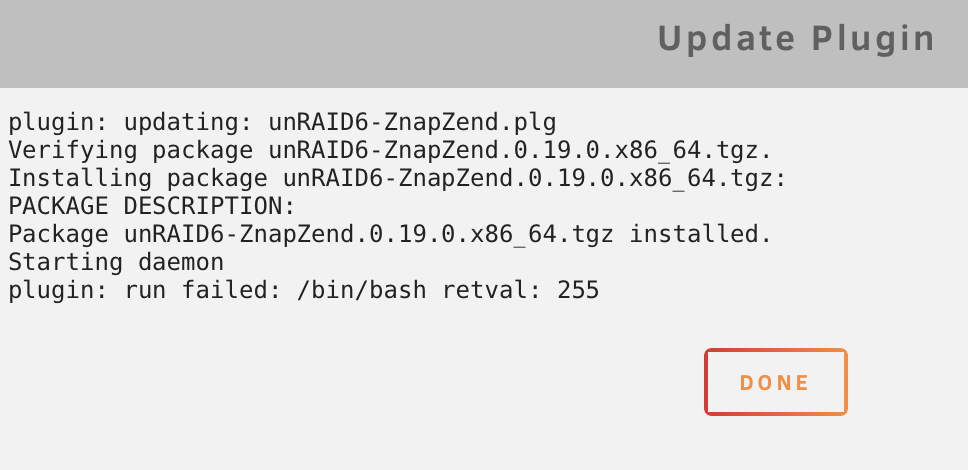
I have endless problems with this not deleting snapshots when it's supposed to. So I thought I'd just update in case it refreshes something. However, I just get the below - first plugin error I've ever had. Is it because I'm not running the beta?
-
I just updated and forgot to check this, lucky! Sent from my iPhone using Tapatalk
-
You have a 128GB RAMdisk?
-
Yeah, I don't know why Bridge mode is called Bridge, because in Unraid it's actually referring to NAT as far as I know. I have a vague recollection it might be some confusing docker terminology. I'd suggest you set up both containers using br0 with their own IP address. Then you can point one to the other. 'Bridge' mode can only have one container within the whole bridge with a specific port. Br0 on the other hand could have the same port on multiple IP addresses.
-
Or possibly set them up on their own IP addresses by using the bridge option.
-
Seems like someone is on it. Unsure if it's implemented or not. https://github.com/uklans/cache-domains/pull/118
-
The lancache is working amazing for me now. And it's much faster than the other steamcache docker. I can actually get this to run at lanspeed (gigabit for me at present) which never happened on the steamcache docker. Thanks so much for this. One thing I was wondering, it does windows updates, what about apple? I haven't seen anyone doing this, so am wondering if it's possible.
-
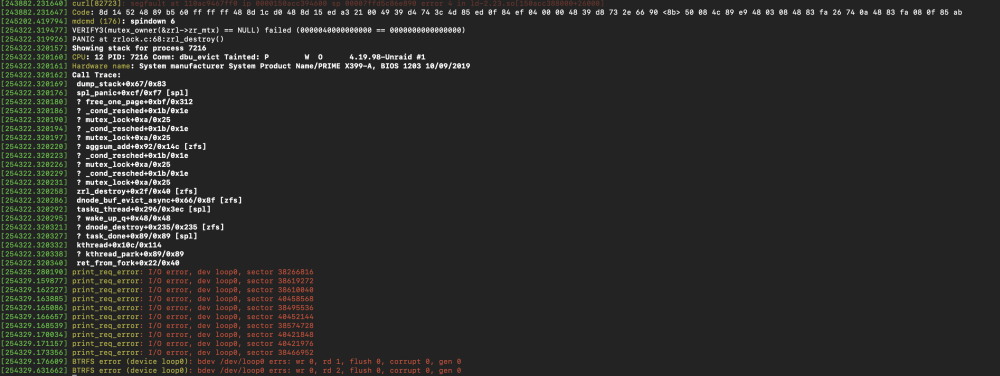
While sitting with an open console, I just had this: I understand the first one is ZFS related, I assume therefore the second is also. Leaving a copy here for a record as I've been having a few issues and there's a chance this is the cause. Edit - dmesg below, now BTRFS involved? Maybe I do have faulty hardware. Similar dev loop errors I found a few days ago, I had to repair filesystems and even rebuild all the BTRFS ones from scratch as it seems most susceptible to corruption. So I'm going to go with not specific to ZFS for now. Edit 2: Memtest confirms I have faulty, or possibly misconfigured memory. There goes my morning....

-
Hmmm, I wonder if this would be faster on ZFS with my 256GB NVME L2 read cache. I have a strong suspicion it would be advantageous....
-
I read recently that there's a lot of compression etc happening which is run by the client too, so that would mean there is also a limitation there. I asked this question on the wiki a while back, apparently it's in the docker logs. Edit: I just checked its not.
-
Can anyone else confirm that they can actually connect to steam using lancache? I tried it a few weeks ago and I was able to do everything in lancache except connect to steam. It resolved DNS etc correctly (actually much faster than steamcache), but steamcache was the only one that would actually let me connect to steam for some reason.
-
Maybe try the nextcloud forums?
-
Don't worry about these right now, they're not stopping you from getting it going (I have these and have a working config). I see port forwarded 80 to 180. In your firewall it says that 180 is for unraid not lets encrypt? Of is that just a generic name? Either way, lets encrypt works by forwarding port 443, then to port 80 or 443, then back. I know technically port 80 will redirect itself, but it's another redirect and there is a maximum number. I'm also unsure if you can forward 443 to 1443 via the router, then proxy that to port 443 then back again (I haven't had coffee yet and am feeling very slow this morning!), you probably can, but it's not the way mine is set up, so I can't comment. For mine, I changed the unraid port to 2080 and 20443 to remove this issue. It seemed to make more sense to me. Then just forwarded the 443 port to unraid which is received by lets encrypt as native 443 since unraid no longer uses that port. Letsencrypt docker handles the rest. It's been a while since I set this up, so I may be wrong, but I don't think your array 0 should have port 444, if everything else is being sent to 443. The other part that I can't verify is if that's actually your real IP address that duckdns is sending back. Have you checked this against what your router says? Finally, I take it plex is working, so I assume that means you don't have a private address range assigned by your ISP - that certainly happens with a few ISP's in my country. Hopefully that gives you a few extra thoughts that leads to something positive!
-
I get nervous when I hear about webdav and reverse proxys to the internet. I hope you didn't expose webdav? As that would certainly result in an undesirable result. To clarify, are you talking about the unraid GUI or the Nextcloud GUI? Have you looked at any logs? I you can't access them, I assume you've tried a reboot?



