





NotYetRated
Members
-
Joined
-
Last visited
Everything posted by NotYetRated
-
Unsure if here is where to suggest improvements etc: It would be great if the system temps could be shown in graphic form as the stats are. With the historical data and all.
-
It maintains access, for reviewing alerts and archived snaps. I think I see your point, it is constantly looking at the drive apparently, even though I am not necessarily calling up the archives etc. I will have to have a look at the Blue Iris forums to see if I can stop this. I really only check the alerts as they happen(when they would be on the cache drive), have yet to have to go back and review.
-
But I set that share to use cache... so shouldnt it write it all to cache then move it over to the disk I specified at night? Attached share settings.
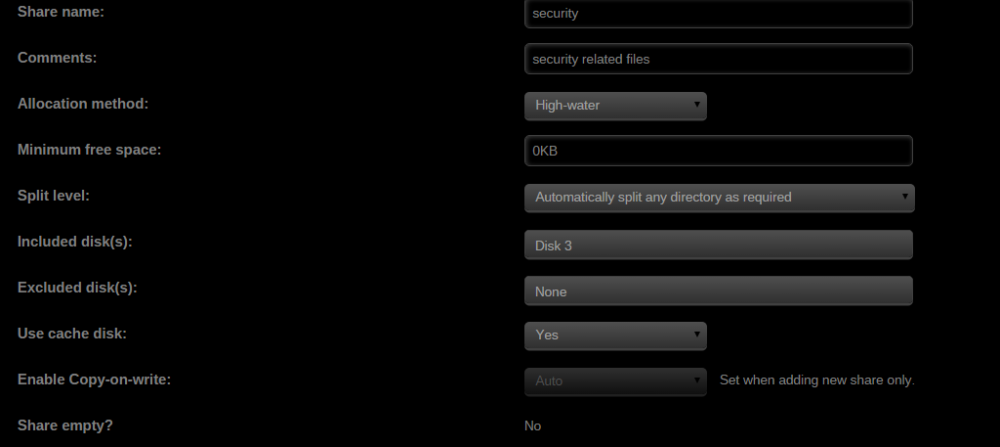
-
I do have Plex, run in a docker, which is off of an unassigned device now. I had thought about Plex being the culprit before, and shut it down for a day trying to diagnose. Thanks for the thought though! I also now realize that I was not very clear in my initial post. Edited for clarification.
-
I have my Blue Iris system set to save to a Cache'd unRaid location. However, I have noticed that disk never spins down. I have been periodically checking streams, and the only thing going is my Blue Iris stuff. If I shut down this VM, the disk will eventually spin down and stay down. Thoughts, or a method for looking in to this? not really sure where to even start from here. EDIT: To clarify, my cache drive is an SSD. I mean the array disk I have set to exclusively have my Blue Iris share use, never spins down.
-
Hmm, I think I passed it correctly, though i don't get a /dev/ttyS0 or /dev/ttyUSB0.... root@BigBang:~# lsusb Bus 004 Device 001: ID 1d6b:0003 Linux Foundation 3.0 root hub Bus 003 Device 001: ID 1d6b:0002 Linux Foundation 2.0 root hub Bus 002 Device 001: ID 1d6b:0003 Linux Foundation 3.0 root hub Bus 001 Device 008: ID 046d:c52b Logitech, Inc. Unifying Receiver Bus 001 Device 081: ID 10c4:ea60 Cygnal Integrated Products, Inc. CP210x UART Br idge / myAVR mySmartUSB light Bus 001 Device 007: ID 0781:5583 SanDisk Corp. Bus 001 Device 002: ID 0764:0501 Cyber Power System, Inc. CP1500 AVR UPS Bus 001 Device 001: ID 1d6b:0002 Linux Foundation 2.0 root hub root@BigBang:~# docker exec -it openhab bash root@223a3924f122:~# ls -l /dev total 0 drwxr-xr-x 3 root root 60 Sep 15 21:27 bus lrwxrwxrwx 1 root root 13 Sep 15 21:27 fd -> /proc/self/fd crw-rw-rw- 1 root root 1, 7 Sep 15 21:27 full c--------- 1 root root 10, 229 Sep 15 21:27 fuse lrwxrwxrwx 1 root root 11 Sep 15 21:27 kcore -> /proc/kcore drwxrwxrwt 2 root root 40 Sep 15 21:27 mqueue crw-rw-rw- 1 root root 1, 3 Sep 15 21:27 null lrwxrwxrwx 1 root root 8 Sep 15 21:27 ptmx -> pts/ptmx drwxr-xr-x 2 root root 0 Sep 15 21:27 pts crw-rw-rw- 1 root root 1, 8 Sep 15 21:27 random drwxrwxrwt 2 root root 40 Sep 15 21:27 shm lrwxrwxrwx 1 root root 15 Sep 15 21:27 stderr -> /proc/self/fd/2 lrwxrwxrwx 1 root root 15 Sep 15 21:27 stdin -> /proc/self/fd/0 lrwxrwxrwx 1 root root 15 Sep 15 21:27 stdout -> /proc/self/fd/1 crw-rw-rw- 1 root root 5, 0 Sep 15 21:27 tty crw-rw-rw- 1 root root 1, 9 Sep 15 21:27 urandom crw-rw-rw- 1 root root 1, 5 Sep 15 21:27 zero root@223a3924f122:~# ls -l /dev/bus total 0 drwxr-xr-x 3 root root 60 Sep 15 21:27 usb root@223a3924f122:~# ls -l /dev/bus/usb total 0 drwxr-xr-x 2 root root 140 Sep 15 21:26 001 root@223a3924f122:~# ls -l /dev/bus/usb/001 total 0 crw-rw-r-- 1 root root 189, 0 Sep 13 21:25 001 crw-rw-r-- 1 root root 189, 1 Sep 13 21:25 002 crw-rw-r-- 1 root root 189, 6 Sep 13 21:25 007 crw-rw-r-- 1 root root 189, 7 Sep 14 00:13 008 crw-rw-r-- 1 root root 189, 80 Sep 15 21:26 081 root@223a3924f122:~# All of my USB devices appear on bus 1. Device 81 is the zwave stick specifically. I can see it in unRAID devices, as well as using your ls command within the openHAB docker, but not in that directory. I try passing /dev/bus/usb/001/081, to no avail. Not even sure if this is the proper way? Google is kind of failing me, as this is brand new territory for me, haha.
-
The history logging can not be longer than the uptime of your system. What is your uptime? That would explain it, I had recently rebooted to add hardware.
-
Still tinkering with owncloud to see what my issue is, however am also exploring openHAB. Have a Z-wave network on a vera controller which I am relatively displeased with. The controller is just, i am not much a fan. Especially of the new UI7. I installed your docker and got the demo up and running, though am now curious as to how I would go about passing my USB z-wave stick to it. I run the docker privileged, though am not sure how to map the stick. Any help would be appreciated! EDIT: I believe I got it, simply volume mapping /dev/bus/usb. However, from there I don't know how to assign it to openHAB. I am in the openHAB config. From the tutorial I am following, it simply tells me to point it to /dev/ttyUSB0, though this does not seem to work. I have multiple devices plugged in to my unRAID server, I am not quite sure how to isolate and pick which specific one I want to mount/map to... If anyone else has been through this, some insight would be welcome!
-
The default port mapping is for port 8443 being routed to the owncloud container and it looks like you're using port 8442. Have you double checked which port you're actually using? This may be the reason that the port forwarding from the router is not working. Double checked, ports forwarded correctly on router. I had something on 8443 already, which is why I had to swap it to 8442. I normally use an apache reverse proxy to access my owncloud remotely so that I don't have to open up a lot of different ports. I just tried forwarding port 8443 from my router to my unraid machine, and it worked perfectly. Accessing via https://WANIP:8443/owncloud got me right to the interface. I'm not quite sure what's wrong with your setup, but I'll think about it for a while. Ya weirdest issue... Locally, I can access https://LOCALIP:PORT/owncloud just fine. Android app works with that local address. Remotely, my WAN IP does not work. I get a "file not found" page when attempting from a windows PC on Chrome. And the android app simply says "unknown error occurred" when trying to add the server. All other dockers/web pages etc that I have port forwarded in this exact fashion work fine. (plex, sab, couchpotato, etc.) I am really scratching my head here haha. It is not the end of the world, as I can log in to my openVPN home network, and then my phone connects fine to the local ip, but is a bit of an inconvenience.
-
The default port mapping is for port 8443 being routed to the owncloud container and it looks like you're using port 8442. Have you double checked which port you're actually using? This may be the reason that the port forwarding from the router is not working. Double checked, ports forwarded correctly on router. I had something on 8443 already, which is why I had to swap it to 8442.
-
Stats historical logging does not appear to be working. When I select to show me any previous time frame, 2 days, week, month etc, it just shows me the last 12 or so hours.
-
Trying to set up owncloud, got the UI to load by logging in with https://IP:8442/owncloud, the webui button from docker control panel does not work... However I get an error in owncloud admin config: This server has no working Internet connection. This means that some of the features like mounting external storage, notifications about updates or installation of third-party apps will not work. Accessing files remotely and sending of notification emails might not work, either. We suggest to enable Internet connection for this server if you want to have all features. No memory cache has been configured. To enhance your performance please configure a memcache if available. Further information can be found in our documentation. Please double check the installation guides ?, and check for any errors or warnings in the log. Thoughts? I left default "bridge" and port mappings. Oddly enough, I can access it via my android phone when connecting to LOCALIP:8442/owncloud I cannot access it through my router, the 8442 port is forwarded properly. I feel it has something to do with the above error message...
-
Ohh crap, I have not had the need to plug in and assign my second Xbox one controller, had not thought of that issue.... Perhaps will HAVE to just pass an entire PCIe USB card through
-
Password on MineOS doesn't want to work. Default username is still "mc" correct? nope, it is "minecraft"
-
Bookmarking this, as I will probably run in to it soon when my second FLIRC and Media Center Keyboards come in. Thanks much!
-
Is there any way to specify multiple folders on my unRAID which I want linked/backed up to my Dropbox? I don't necessarily want to have all of the files I want backed up under the same folder structure....
-
JonP, this is rather worrisome. Those SCSI ID's can change, just as much as the sd symbols and the ata numbers. It's true that some systems seem to be more 'stable', especially small systems with no added disk controllers, but otherwise, I can't see how hard coding the SCSI ID in will work across boots. It will at times, but not reliably. A user could reboot and it would stop working, then reboot again, and it would start working, if that session happened to match the same lsscsi list. If you have multiple diagnostics zips available, test this yourself, compare the lsscsi.txt files. I personally haven't had this issue, but yes, some may. This is why we haven't put it formally into the webGui yet. Eric and I are working on a VM device manager for the webGui. The goal here is to manage device assignments differently, where a user could specify a device for use with a VM, then we would do the legwork at runtime to determine the appropriate changes to XML for VMs. E.g., if the SCSI address changed, the /dev/disk/by-id path won't, and we can use something like udevadm to trace back to the actually SCSI ID. There is another method for passing through a block device as well which we are experimenting with, and doesn't use SCSI IDs. The difference in methods could impact performance though. It should be noted that whenever I provide these guides, they are a temporary way to establish a level of functionality that isn't supported officially in the webGui yet. I want to hear from folks experiences in using these methods so we can adjust our formal support implementation path. Baked in support would be awesome. Currently, when I reboot unRAID for whatever reason(new build here so im doing quite a lot right now), I have to go in a change the address, as the device address seems to change every reboot. Always changes between the same 2 numbers, oddly enough. Even changes when I don't touch my drives during the reboot/power off. Also, as far as performance or issues, I am not positive this is unRAID/KVM/passthrough related yet, but my SABnzbD downloads are mostly failing. WinRAR unpack issues, "unexpected end of archive". Have even downloaded some NZB's which I had recently grabbed before making the unRAIR leap. Going to install on my desktop and test it out to see what might be up. When I first booted the VM up with the disk passed through, I formatted, copied some files to/from to test, and windows gave me a filesystem corruption error(didnt jot it down). Ran it through a chkdsk and have not had that error since, though still have the odd unpack issues. Ok, if you'd like to be a guinea pig, here's another method for passing through a block device that does not utilize the virtio-scsi controller. Changing your existing VM to this may possibly not work (you may have to reinstall windows or try a few things to get it to boot again). 1 - Remove all the custom xml stuff I had you add originally. 2 - Add a new <disk> section that looks like this: To find what to put in the highlighted portion, you will need to login to your server from command line. Then type the following command: ls /dev/disk/by-id Find the one that represents your storage device (but without the -part1 at the end) and paste that in the section above that says YOUR DISK ID HERE. This should work regardless of what SCSI IDs change to after reboots. No problem being a guinea pig, though itll have to wait until later this weekend, as I am about to head out. Will let you know how it goes!
-
JonP, this is rather worrisome. Those SCSI ID's can change, just as much as the sd symbols and the ata numbers. It's true that some systems seem to be more 'stable', especially small systems with no added disk controllers, but otherwise, I can't see how hard coding the SCSI ID in will work across boots. It will at times, but not reliably. A user could reboot and it would stop working, then reboot again, and it would start working, if that session happened to match the same lsscsi list. If you have multiple diagnostics zips available, test this yourself, compare the lsscsi.txt files. I personally haven't had this issue, but yes, some may. This is why we haven't put it formally into the webGui yet. Eric and I are working on a VM device manager for the webGui. The goal here is to manage device assignments differently, where a user could specify a device for use with a VM, then we would do the legwork at runtime to determine the appropriate changes to XML for VMs. E.g., if the SCSI address changed, the /dev/disk/by-id path won't, and we can use something like udevadm to trace back to the actually SCSI ID. There is another method for passing through a block device as well which we are experimenting with, and doesn't use SCSI IDs. The difference in methods could impact performance though. It should be noted that whenever I provide these guides, they are a temporary way to establish a level of functionality that isn't supported officially in the webGui yet. I want to hear from folks experiences in using these methods so we can adjust our formal support implementation path. Baked in support would be awesome. Currently, when I reboot unRAID for whatever reason(new build here so im doing quite a lot right now), I have to go in a change the address, as the device address seems to change every reboot. Always changes between the same 2 numbers, oddly enough. Even changes when I don't touch my drives during the reboot/power off. Also, as far as performance or issues, I am not positive this is unRAID/KVM/passthrough related yet, but my SABnzbD downloads are mostly failing. WinRAR unpack issues, "unexpected end of archive". Have even downloaded some NZB's which I had recently grabbed before making the unRAIR leap. Going to install on my desktop and test it out to see what might be up. When I first booted the VM up with the disk passed through, I formatted, copied some files to/from to test, and windows gave me a filesystem corruption error(didnt jot it down). Ran it through a chkdsk and have not had that error since, though still have the odd unpack issues.
-
Adjust the large bolded numbers for the four numbers in the scsi id. For most, this will only be the first number in the <adapter> section. If you are installing Windows directly to this device, you will need to load the vioscsi driver during the installation process for the installer to detect the device. Follow the same procedure as is documented in the wiki for setting up a normal Windows VM, but instead of selecting viostor, browse to the vioscsi folder. Let me know if any of this is unclear or if this doesn't work for you. Worked like a charm, thanks so much!
-
Hello, you mention VirtIO is faster than directly passing through NIC's in most instances. I have a system with dual Intel NIC's on the mobo. I was intending on setting one for unraid, and passing the second to a Windows VM which hosts Plex, and numerous other things. So it is advisable, and faster, to turn bridge on and set my VM to it? (br0). I had tried this, but wasn't given access to the net on my VM, however it did assign me the proper IP(based on a static IP to the MAC I set, router handles it) I believe I read I need to turn teaming on, is any teaming more beneficial than another? I have like 6 options...
-
Hello, is this for PCI devices only, or would it would for an onboard NIC? My mobo has dual ports, I am looking to give the second one solely to a VM.
-
There is actually a way to pass through an entire block-level device to unRAID a virtual machine (not using a virtual disk image file at all). I'll have to write this up in a reply for you a little later today. That would be fantastic. I did some googling, and think I found a couple of options, however I am not 100% familiar with Linux, or at all with unRaid yet, and dont quite want to mess anything up. Thanks in advance!
-
Hello, I have unRaid set up and would like to properly configure permissions via SMB for my Windows systems. I had things working with standard user names on Windows 7 Boxes, I.E. "name", but my windows 10 box has a user account tied to my email address. (required for being a windows experience member, i.e. free copy of windows 10), so my user name is "[email protected]". When I RDP in to this box, I specifically have to type my username as "[email protected]". How can I achieve this with unRaid? What are my options for easily allowing SMB sharing to this box?
-
Hello, very new to unRaid. Tinkering with getting my setup online, a couple of questions. I have had issues with, and read about issues people have had with running Plex Server, Sabnzbd etc in dockers, with hangs and such, so I would like to just proceed with installing them on my Blue Iris Windows VM. I need the VM for BlueIris anyways, so why not, right? I currently have the windows VM online, with the VM image file on my cache drive(an SSD). I have another, old 250GB "scrap" drive, which I want to use for my download drive. I don't want the wear and tear of my downloads/extracts etc on my SSD's, and have this drive so figure why not use it. 1. How can I pass this 250GB drive on to my windows VM to use it as a download drive? I don't want to include this in my unRaid system or cache. 2. I actually have 2, 240GB Intel SSD's. Currently only one added as cache drive. Will add the second once I finish removing files from it. I have already created my cache with 1 drive, and put stuff, like my VMs on it. When I add the second, will I have to format and lose the data I have already? If so, options? 3. My Plex Media Server, I am thinking I will simply host it on my Windows VM as well, at least until the docker hang up issues all get sorted. My library is quite big, and growing. Once I set a VM image size, can I expand it later? Easily? Thanks in advance!
