





johnsanc
Members
-
Joined
-
Last visited
Everything posted by johnsanc
-
I had Samba run into an issue and lock a temp file it with DENY_ALL. The only way to resolve that is to restart samba, so I decided to just shut down my VM and stop the array to restart it. Upon restarting the array I noticed disk1 was in an error state. I plan to just rebuild the disk because it looks healthy otherwise. Anyone know why this occurred? The syslog seems to show a read/write error during unmounting of disks... or am I reading the log incorrectly? Diagnostics attached. Any insight is appreciated. tower-diagnostics-20240411-2248.zip
-
Thanks for trying to help, but yeah I do have cores isolated from host and pinned to VM. Its one of the first things I adjusted. I even tried different combinations of cores isolated and pinned with the same results. BIOS updates are another issue... I tried that weeks ago and any BIOS update past the one I'm currently on simply doesn't work correctly. Cannot access UEFI at all. Oddly enough the firmware update must have worked since I can boot into my Windows NVME just fine, just cannot access UEFI to change anything to get unraid to boot from usb... so that's a no-go. In case you were curious: https://forum.asrock.com/forum_posts.asp?TID=32460&PID=114573
-
Upgraded to 6.12.9 - performance is even worse now with the same behavior of a single vcpu being used to 100% during a file transfer. Only about 45 MiB/s. Need more people to try this with AMD, so far I believe literally everyone else who has tried this is using Intel.
-
No idea. So far I've seen no one report any results using AMD though. So hopefully someone else can try. The CPU behavior is very weird. I followed every guide to the letter and everything else works perfectly fine.
-
Doh, you are right. I just removed the ^M characters at the end of each line and it worked. Speed is still terrible for me though. 60-70 MB/s max. A single vcpu gets utilized to 100% according to unraid dashboard.
-
Just tried this method. I also get the same message: virtiofsd died unexpectedly: No such process The log says: libvirt: error : libvirtd quit during handshake: Input/output error
-
Thanks for the suggestion. Same issue though, ~40-60 MiB/s and a single cpu thread gets pegged to 100%. With emulated CPUs however the performance graph in Windows doesn't lock up. I think we just need more people trying this out with different hardware configurations. So far everyone I have asked uses Intel CPUs and it seems to work as expected.
-
Just for good measure, spun up a completely new Window 11 VM using a vdisk instead of NVME, same issue. Also it locks up user input on VNC while its transferring.
-
Completely reinstalled Windows 11, exact same performance issues and weirdness with a single thread used at 100% and Windows performance graphs halting while a transfer is running. Yes I am using the Rust version. I will wait until other people with AMD CPUs test this out. I am completely out of ideas. Edit: Also confirmed that the regular non-Rust version has the exact same issue.
-
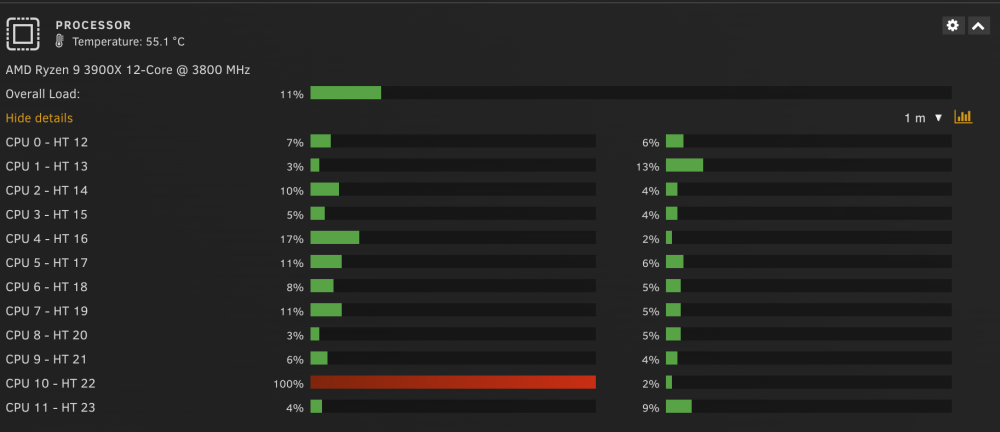
OK so I tried adjusting my CPU isolation and pinning and I got the speed up 60 MiB/s consistently now by shifting all the CPUs for the VM to higher numbers and leaving lower numbers for Unraid. However, I also noticed some weird behavior. When I am copying to my VM's NVME from the virtiofs drive, all CPU graphs in Windows stop completely and then resume once the transfer is complete. I checked both task manager and process explorer. I also noticed that a single thread was at 100% whenever I am moving something. What is going on here? Is that normal?
-
Everything else with the VM appears to work just fine. I wiped out all old virtio-win drivers and guest tools and reinstalled. After a bit of googling was able to finally completely uninstall everything without the installer error, so that's good. Also verified I have no old drivers and only the latest is used. Either way, still the same performance issue. I'm not completely reinstalling windows just to mess with this. I'll just stick with Samba since its way more performant in every scenario I've tested with the latest drivers.
-
I'm not familiar with driver store explorer... I'll look into that. I do have issues with installing new drivers. The installer always fails and has to rollback so I need to manually install each one.
-
Yes I do have a setup like yours 16/24 are allocated to the VM. The test Windows 10 VM i setup as a test only had 2/24 allocated and performed better (but still not great). I am out of ideas as to why my Windows 11 VM would perform so poorly... the only major difference is that its running on a separate NVME instead of a vdisk on my cache pool. I also noticed worse performance of remote desktop (RDP) whenever VirtioFS is enabled and memorybacking configured. As soon as I disable these RDP is much snappier.
-
New stable drivers seem fine. Speed is still terrible for me on Windows 11 at only 40 MiB/s or so. I tried to setup a clean Windows 10 VM and transfers are about 100 MiB/s for the exact same file. Samba on Windows 11 transfers this 2 GiB file at 650 MiB/s with explorer. No idea what could be causing the discrepancy, but glad its at least stable even if I won't be using it.
-
I do the same, Windows VM running on nvme with no vdisk. I also have 16 threads and 40 GB of RAM
-
So Yan confirmed the Windows drivers aren't optimized for performance... but that doesn't really explain the drastic difference between @mackid1993's results and mine. (400 MB/s vs my 60 MB/s)
-
@mackid1993 - I am using the latest WinFSP: 2.0.23075. Its possible I could have something wrong with my setup or misconfigured, but I'm not sure what that might be. I followed all the directions here and got it up and running properly. I am using your launcher script and that also works just fine, just lackluster performance is all. For my setup my SMB speeds are about what I would expect to/from my SSD cache.
-
@mackid1993 - Thanks for sharing. Your speeds are much better than mine, but still pretty poor compared to SMB. Were you transferring to/from spinning disks or from an SSD cache pool to your to VM? I'm curious what speeds you get between a fast unraid cache drive and your VM.
-
Yes I have - The rust version made no significant difference. Speeds are still 45-60 MB/s. On the plus side, the VM seems stable and hasn't locked up with the 100% cpu utilization issue. Note: I opened an issue here for more visibility beyond these forums: https://github.com/virtio-win/kvm-guest-drivers-windows/issues/1039
-
I'm trying out the new drivers to see if the VM freeze issue is resolved. However... is there a way to make the performance any better? Directory listings with tens of thousands of files are significantly faster than smb shares, but actual transfer speeds are terrible. I am getting about 45 MB/s with virtiofs vs 275 MB/s with samba shares. Do I have something misconfigured? I don't understand all the hype over virtiofs if this kind of performance is normal.
-
For anyone else running into this issue, I figured out how to fix it. In my case I was still using the old clover bootloader and my nvme controller was not bound at boot. So to fix I did: Changed primary vDisk to none since I wanted to boot from the NVME Went into the system devices profiler and bound my nvme controller at boot Set the NVME to boot order of 1
-
I decided to give virtiofs another go since its been awhile and I have since upgraded to Windows 11. I noticed that while directory listings are faster than samba shares, the transfer speed is pretty bad. I can only get about 50 megabytes/second. Is there any configuration change I can try to improve performance?
-
Yes that explains the behavior of not abiding by the disk allocation settings, but it doesn’t really explain why the movement of files on cache across shares is always copy and delete. Why would the attempted rename operation fail then fall back to copy/delete in that case? It feels like this is just an area for some move logic improvements if files are already on the cache and just need to be moved across shares. Also, for some reason I thought share settings are evaluated on any movement of files between shares to ensure both the allocation rules are followed and such that the movement is as fast as possible. For example, I thought a rename operation should occur only if both shares include the same disk number for which the file actually resides on the source share. If there is a mismatch then I would expect copy/delete. I thought this is why @SpaceInvaderOne setup his root share demo that way to ensure both shares included the same disk to allow for a rename, but apparently that’s not a requirement.
-
I was watching a Spaceinvader One video about moving files around quickly between shares using a rootshare and was trying to figure out why my tests kept copying files instead of moving instantly. In his video he configured two shares that had a common disk and used the array as the primary storage. After some testing, it turns out that if the file is on the cache drive it will always copy/delete instead of being moved instantly. I tested this in midnight commander as well moving a file that resided on the cache between /mnt/user/Downloads/Test to /mnt/user/Games/Test. I conducted the same test, this time with a file that resided on the array and it moved instantly across shares. I'm not sure if its a bug or by design, but this type of move doesn't honor the disk allocation rules either. Either way, why does the cache behave in a way where cross-share movement must copy/delete but movement of a file on the array is instant? That being said, I may adjust a few workflows because in some cases its writing data to cache twice when it doesn't need to. E.g. first download to the Download share, then move to Games share where both shares use the cache drive as primary storage. This isn't a big deal, more of a curiosity. Any insight is appreciated.
-
I clicked download, noticed it was going reallllly slow with sed, closed out of the window, but the browser itself was left open. Perhaps even though it wasn't rendering on the screen it was still slogging along. I was monitoring that temp folder in midnight commander to see what it was doing and I could tell it first saved the full log and was very slowly trimming it down over time. If you are suggesting that the zip was actually created quickly but the log in the browser was just slow I can tell you with certainty that is not correct. I monitored the temp files as they were being processed and it was slow as molasses.

