





jowi
Members
-
Joined
-
Last visited
Everything posted by jowi
-
Yeah, i know, and i do. But then you have to rewire everything... and there is not much room in the closet. Maybe i just wire it up anyway, so when it is needed, i only have to turn it on, and switch the cable modem connection to the emergency router in stead of the unraid server... but then what happens if i reboot the unraid server and the pfsense vm starts up? Then there are 2 routers with ip address 192.168.1.1... or can i just use e.g. 192.168.1.1 for pfsense and 192.168.1.2 for my failover router, and just disable dhcp on the failover router while pfsense is running? I would like to 'switch' if unraid/pfsense is down for some reason, without a lot of recabling. Just unplug the cablemodem from pfsense, and plug it in the failover router, enable dhcp and get on with it? Is that possible?
-
I've been running pfsense in a vm on a headless UNRAID server for some time now, and it works great... until the server has an issue. And then you can't do anything... you can't reach pfsense, you can't ssh or even IPMI into unraid... you don't have network, you don't have internet. The only thing you can do is turn the server off HARD and pray that your disks are ok... And IF you are rebooting, you can't IPMI to enter bios or even see bios etc because you can reach the server only after it has booted and pfsense is started... it's a great way get into pfsense, but i'm gonna go the dedicated pfsense hardware route as soon as i can.
-
I'm waiting for 6.9, i'm not very keen on the issue with VM's and Docker containers using static IP addresses both running on the same host network interface that is in (all?) versions after 6.5. But at least now i know why i can't find the plugin anymore.
-
no, 6.5.3.
-
I've looked again and again, but... WHERE is it? It doesnt show up anywhere in the Apps section? If i search for it, it doesn't show up? Has it been removed?
-
Ok... did not realize this was a stupid question. I leave it as is then.
-
What is needed to add a container like this to the main page of Community Applications?
-
Try stopping and restartng it, the logo might show up after all. I had the icon in the dockerman/images folder at first, but it could not find it... now i point to some online icon. Will try changing that as well, don’t want to point to an online icon. But i’m glad the docker is working
-
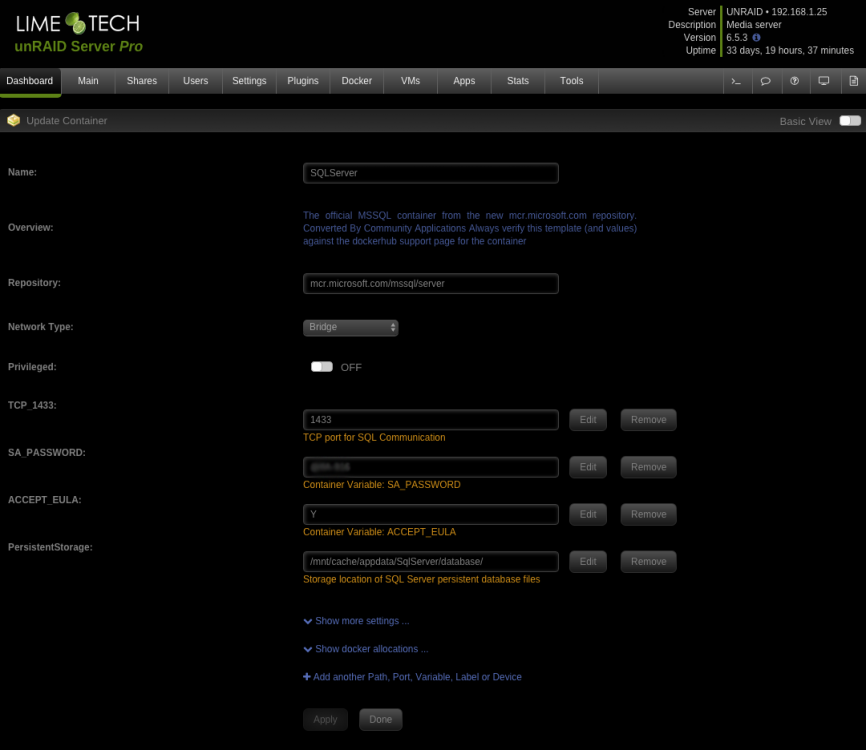
After removing the docker and re-installing it, all seems to be ok. Path is now also showing, so i think i'm good. For completeness and for others, here are the settings and the xml. <?xml version="1.0"?> <Container version="2"> <Name>SQLServer</Name> <Repository>mcr.microsoft.com/mssql/server</Repository> <Registry>https://hub.docker.com/_/microsoft-mssql-server</Registry> <Network>bridge</Network> <MyIP/> <Privileged>false</Privileged> <Support>https://hub.docker.com/_/microsoft-mssql-server</Support> <Project/> <Overview>The official MSSQL container from the new mcr.microsoft.com repository. Converted By Community Applications Always verify this template (and values) against the dockerhub support page for the container</Overview> <Category/> <WebUI/> <TemplateURL/> <Icon>http://www.xydata.co.uk/wp-content/uploads/2016/02/SQL-Server-250x250.jpg</Icon> <ExtraParams/> <PostArgs/> <DateInstalled>1575384584</DateInstalled> <DonateText/> <DonateLink/> <Description>The official MSSQL container from the new mcr.microsoft.com repository. Converted By Community Applications Always verify this template (and values) against the dockerhub support page for the container</Description> <Networking> <Mode>bridge</Mode> <Publish> <Port> <HostPort>1433</HostPort> <ContainerPort>1433</ContainerPort> <Protocol>tcp</Protocol> </Port> </Publish> </Networking> <Data> <Volume> <HostDir>/mnt/cache/appdata/SqlServer/database/</HostDir> <ContainerDir>/var/opt/mssql/data</ContainerDir> <Mode>rw</Mode> </Volume> </Data> <Environment> <Variable> <Value>P@ssw0rd</Value> <Name>SA_PASSWORD</Name> <Mode/> </Variable> <Variable> <Value>Y</Value> <Name>ACCEPT_EULA</Name> <Mode/> </Variable> </Environment> <Labels/> <Config Name="TCP_1433" Target="1433" Default="" Mode="tcp" Description="TCP port for SQL Communication" Type="Port" Display="always" Required="false" Mask="false">1433</Config> <Config Name="SA_PASSWORD" Target="SA_PASSWORD" Default="" Mode="" Description="Container Variable: SA_PASSWORD" Type="Variable" Display="always" Required="false" Mask="false">P@ssw0rd</Config> <Config Name="ACCEPT_EULA" Target="ACCEPT_EULA" Default="" Mode="" Description="Container Variable: ACCEPT_EULA" Type="Variable" Display="always" Required="false" Mask="false">Y</Config> <Config Name="PersistentStorage" Target="/var/opt/mssql/data" Default="" Mode="rw" Description="Storage location of SQL Server persistent database files" Type="Path" Display="always" Required="false" Mask="false">/mnt/cache/appdata/SqlServer/database/</Config> </Container>
-
Thanks, will do that later today.
-
What i did not realize was that if you map an external folder to an existing 'internal' container folder, the internal folder gets replaced by the external one... until now i've just added external folders to containers so they became available in the container as an additional folder, like /music for /mnt/disk1/music etc. The added/mapped folder no longer shows up, also not when moving the slider to advanced or 'show more settings'. It does however is stored in the dockerman xml file, and if i stop/restart the container it is still mapped and used.
-
I don't think mapping is enough? If i map it, the docker has access to it; but i need to tell sql server that it actually has to use the mapped path in stead of the (internal) /var/opt/mssql/data. By the looks of it, this can be done by adding some other environment variable which will be used by startup of mssql, that is something i have to check and figure out. *edit* i did not think just mapping e.g. /appdate/sqlserver to the container's /var/opt/mssql/data would work but it does i thought with adding paths this way you would just 'create' access to an external path, but in fact it replaces the path inside the container? So my /mnt/cache/appdata/sqlserver is actually replacing the container's '/var/opt/mssql/data'? Anyway, this works, but... for some reason, if you restart the docker, the path i just added in dockerman, is no longer in the settings? Environment paramters like SA_PASSWORD and ACCEPT_EULA are still there but the path is gone... SQL Server is still using /cache/appdata so that is ok...
-
Will try that later today or in the next couple of days, i will report back
-
Thanks, tried it and this works. Added SA_PASSWORD and ACCEPT_EULA as environment variables, sql server is running and i can connect to it from other machines in the network using sql management studio etc. so great What i'm not seeing is any entry in /mnt/cache/appdata, where all other dockers seem to live (partially?). Now i know sql server uses .mdf/.ldf etc files to store it's data; where are they now? My guess is they are not persistent and in memory somewhere? Or, i hope not, on the usb stick taking up space? The latter i *really* don't want or do they live in the docker.img somehow? *edit* did some more reading; .mdf etc live in /var/opt/mssql/data inside the container. There is a way to connect to .mdf db's outside the container (so e.g. in appdata...) but it looks like they stay persistent in /var/opt/mssql/data when stopping the docker or after a reboot. Don't know what happens when the docker gets updated. Will look into that!
-
Tested the one from the screenshot, but it gives an error (Error: image operating system "windows" cannot be used on this platform). Looks like it is a docker built on windows not on linux? Also unknown what version etc. and passwords... it is all ment well i guess but i'm not gonna try 40 (!) pages of mssql dockers that people created mostly for their own use. I will go try a few, but this is not what you want... i tested another one and looked at the dockerhub page for info on passwords etc, it was there but nothing works... so unless i get lucky i think i still need to make my own docker container?
-
I did not use a sql server docker from (someone else's) docker hub, i got it directly from microsoft using: docker pull mcr.microsoft.com/mssql/server:2019-GA-ubuntu-16.04 and installed it according the instructions on https://docs.microsoft.com/en-us/sql/linux/quickstart-install-connect-docker?view=sql-server-linux-ver15&pivots=cs1-cmd so i got a 'bare metal' docker running in which does show up in UNRAID's docker tab but i can NOT change ANYTHING from the unraid docker tab. The one you show is just one of many sql server dockers on dockerhub, don't know what version etc. mostly for personal use; don't know what they use as SA password etc, don't know if it's sql server 2015, 2017, 2019 etc. What they DO have is the 'UNRAID container' (by lack of a better word, still don't know what it is called) but it is what you are showing in the screenshot. What i want is to make THAT, using the docker pull i showed earlier. And... what is 'DockerMan'?
-
The sql server dockers in de CA dockerhub section aren't what i need, mostly are personal test projects or obsolote versions. What i am looking for is a way to 'push' the Microsoft SQL Server docker in an UNRAID 'template' or container ( => i think this is what it is called?), so when i install it, it will have some settings/user interface like the 'normal' dockers from CA, where you can add settings, change network, set an icon etc. Is there some section on the forum on how to 'encapsulate' a dockerfile so it acts like an UNRAID docker (by lack of a better word)? Like i said, when i run the docker provided by Microsoft, it installs and runs perfectly, it also shows up in UNRAID's dockers tab, but... it has no options to set environment vars, paths icon etc. Nor does it seem to be installed in /appdata/ where all other dockers are?
-
I've used docker to fetch a sql server docker using the steps here: https://docs.microsoft.com/en-us/sql/linux/quickstart-install-connect-docker?view=sql-server-linux-ver15&pivots=cs1-cmd and it actually works, which is very nice the docker (and sql server) is running and i can connect to it from other machines within my network using the SQL Server Management Studio. I do have some questions: - where is the docker downloaded/installed to? It is not in appdata, nor in the location i used to enter the commands? - the sql server docker can be seen in UNRAID's docker menu, with a default ? icon, and no settings... how do i make an actual 'UNRAID' (?) docker that has settings (like port, SA password etc) and is placed in appdata, like all other dockers?
-
Thanks Mikela, when i installed the docker, none of these 4 paths were configured or even present in the docker. I've added them manually and now Roon works like a charm 👍
-
Nothing? I can't find any usefull info myself. A link into the right direction would be appreciated.
-
Where can i find instructions on how to set up the server? The paths etc?
-
Ok, i'm lost. Roon docker is running, but now what? There is no webgui, nothing? Is there no gui? What about the paths that are mentioned, also by mikela?
-
Did enable it, still no roon...? Or do we need to restart apps? *edit* oh wait there is a tiny blue link you have to click that searches dockerhub... you would expect that it will search automatically when you enable the settings... at least i would.
-
Would be interested in Roon as well. Can't find it either.
-
i forgot what a great community this is if you are not an autistic bearded linux freak with asperger from the 70s. Damn. well thanks for your ‘help’.


