





jowi
Members
-
Joined
-
Last visited
Everything posted by jowi
-
Looks like logging into the console of the letsencrypt docker and running the command 'certbot renew' did the trick.
-
I just recieved an email from letsencrypt regarding renewal of certificates (e.g. for nextcloud). I followed SpaceInvaderOne's guide for installing LetsEncrypt but i don't recall installing any certificates, let alone renewing them? What do i need to do?
-
No previous experience with ubiquiti equipment and software, but i installed an ap-ac-lite few days ago, and besides having some issues updating the ap and 'adopting' it from the control software (5.10.26) everything looks fine
-
Ok, i think i know what the 'problem' is... i was testing the connection by starting the openvpn from a windows pc inside my internal network... that won't work probably. Using my iphone, disconnecting it from wifi and using 4G (so, external) i can connect to my unraid machine without any problem using openVPN server. So i guess the only way to test this is with an actual, external machine. Or in other words, is there a way to test this locally, from inside the network?
-
Followed the tutorial, but can't get it working... forwarded 1194 to my unraid server on pfsense, added A records so my domain is correct (the same way i've been using it for nextcloud, which works perfectly) but for some reason none of my devices connect. They always timeout. What am i missing? The ip adress in the logging below (removed) matches the domain. Port forwarding should be ok as well, docker is running in bridged mode, priviliged. Added a user like in the video. Should that user match an existing user on the unraid server maybe? Fri Jun 28 10:17:10 2019 OpenVPN 2.4.7 x86_64-w64-mingw32 [SSL (OpenSSL)] [LZO] [LZ4] [PKCS11] [AEAD] built on Apr 25 2019 Fri Jun 28 10:17:10 2019 Windows version 6.2 (Windows 8 or greater) 64bit Fri Jun 28 10:17:10 2019 library versions: OpenSSL 1.1.0j 20 Nov 2018, LZO 2.10 Fri Jun 28 10:17:10 2019 MANAGEMENT: TCP Socket listening on [AF_INET]127.0.0.1:25340 Fri Jun 28 10:17:10 2019 Need hold release from management interface, waiting... Fri Jun 28 10:17:10 2019 MANAGEMENT: Client connected from [AF_INET]127.0.0.1:25340 Fri Jun 28 10:17:11 2019 MANAGEMENT: CMD 'state on' Fri Jun 28 10:17:11 2019 MANAGEMENT: CMD 'log all on' Fri Jun 28 10:17:11 2019 MANAGEMENT: CMD 'echo all on' Fri Jun 28 10:17:11 2019 MANAGEMENT: CMD 'bytecount 5' Fri Jun 28 10:17:11 2019 MANAGEMENT: CMD 'hold off' Fri Jun 28 10:17:11 2019 MANAGEMENT: CMD 'hold release' Fri Jun 28 10:17:11 2019 WARNING: --ns-cert-type is DEPRECATED. Use --remote-cert-tls instead. Fri Jun 28 10:17:11 2019 Outgoing Control Channel Authentication: Using 160 bit message hash 'SHA1' for HMAC authentication Fri Jun 28 10:17:11 2019 Incoming Control Channel Authentication: Using 160 bit message hash 'SHA1' for HMAC authentication Fri Jun 28 10:17:11 2019 MANAGEMENT: >STATE:1561709831,RESOLVE,,,,,, Fri Jun 28 10:17:11 2019 TCP/UDP: Preserving recently used remote address: [AF_INET]xxx.xxx.xxx.xxx:1194 Fri Jun 28 10:17:11 2019 Socket Buffers: R=[65536->65536] S=[65536->65536] Fri Jun 28 10:17:11 2019 UDP link local: (not bound) Fri Jun 28 10:17:11 2019 UDP link remote: [AF_INET]xxx.xxx.xxx.xxx:1194 Fri Jun 28 10:17:11 2019 MANAGEMENT: >STATE:1561709831,WAIT,,,,,, Fri Jun 28 10:18:11 2019 TLS Error: TLS key negotiation failed to occur within 60 seconds (check your network connectivity) Fri Jun 28 10:18:11 2019 TLS Error: TLS handshake failed Fri Jun 28 10:18:11 2019 SIGUSR1[soft,tls-error] received, process restarting Fri Jun 28 10:18:11 2019 MANAGEMENT: >STATE:1561709891,RECONNECTING,tls-error,,,,, Fri Jun 28 10:18:11 2019 Restart pause, 5 second(s) ...etc
-
It didn't i had to add a bridge in between the to subnets... When i first installed it i did not understand that each nic would form a separate subnet. I am thinking of using a separate nic/subnet with an extra access point, for IOT stuff, Nest, Alexa etc. But i'm not sure if e.g. the Nest app on the 'normal' wifi will then be able to access the thermostat if that is on another subnet...
-
I've been told that my config, with the netgear dd-wrt ap connected to a separate NIC (OPT1, WIFI see above pic), makes no sense, if i use a bridge to connect LAN and WIFI... It would be better to just add the access point to the switch and make it a part of the LAN network. Does that makes sense?
-
Which update do you guys have issues with? I'm at sabnzbdvpn 2.3.8 [0dd1f64] updated yesterday, no issues at all.
-
I don't think i made myself clear... In both cases, i'm using pfsense on unraid.... so i'm not talking about the performance of the netgear router, purely the performance of sabnzbdvpn with it's vpn enabled, and sabnzbdvpn with it's vpn disabled, but openvpn on pfsense... so: 1. pfsense NO openvpn - sabnzbdvpn docker with vpn ENABLED: 10MB/s download speed 2. pfsense WITH openvpn enabled - sabnzbdvpn docker with vpn DISABLED: 30MB/s
-
I've been running sabnzbdvpn successfully for some time now, my topspeed while downloading with openvpn enabled in the docker, was about 10MB/s. Few weeks ago i've replaced my old router with PFSense, running on an UNRAID VM, and i configured openvpn there, so that every connection within my network, now runs over the vpn by default. So i have no need for the vpn in sabnzbdvpn anymore, so i disabled it in the docker config (VPN_ENABLED=no). But now i notice that when i'm downloading, the download speed has tripled, from 10MB/s to almost 30MB/s... and yes, it is over vpn. How is it that openvpn within the docker is so much slower then the same openvpn within PFSense? Both are running on the same hardware...?
-
I don't think so... but you could try. Did you also add vfio-pci.ids=8086:105e to the syslinux menu config?
-
I could get the quad nic to be in a separate group using the guide, but in the end i just moved the quad nic card to another physical slot, and after that i did not have to configure anything, it was in a separate group natively. Did you try that?
-
No, the whole openvpn client installation was not in his video's. I'm referring to several other online tutorials and video's on how to install openvpn client.
-
Not much pfsense knowledge here i guess... it's a complex piece of kit. Hard to understand the concepts. I did manage to set up an openvpn client for my vpn provider (GooseVPN in the Netherlands) and it is up and running. But... not the way i want, and not anything like the tutorials on it. Usually once you have the openvpn client set up, you add a new interface for it, and then use that interface as the gateway for your other interfaces, like LAN and LAN2 (where LAN2 in my case is igb2, and has a DD-WRT wifi router attached to it as AP). Also you have to add rules for both LAN/LAN1 that allow the vpn to work... But... if i set this up this way, only my LAN is working over the openvpn, and my WIFI (LAN2) is not. LAN2/WIFI can't connect to anything anymore... So what i did now is just add the openvpn client, and once that is up, i set the outbound NAT rules, and from then on both my LAN and LAN2 are routed through the vpn... which is ok, but it is not working like the tutorials say it should with using the gateways and whatnot.
-
I have set up the above topology. Unraid is running pfsense, and my DD-WRT router is now configured as an access point. So far so good. All devices can connect, eiter using the LAN (192.168.1.x) or WIFI (192.168.2.x) subnets. I can also access the unraid GUI on subnet 192.168.1.x on my (wifi) ipad which is in subnet 192.168.2.x. Also good. Me happy. But... if i turn on my vpn on my ipad (goose vpn, in app form on the local device like pia/nordvpn etc) i can surf the internet etc but i can not acces the 192.168.1.x subdomain anymore? So i can not enter unraid's webgui etc. If i turn off the (local) vpn, all is ok... btw, if i use the vpn on my wired mac mini, there is no problem entering the unraid gui. Both mac-mini as unraid are on the same subnet. How do i change this? Or is this a DD-WRT setting i'm missing? *edit1* i also can not acces my receiver and apple tv (both are in 192.168.1.x) from apps on the ipad (192.168.2.x)... this must be related? How do i make both subnets 'see' each other for all devices (not just some?) *edit2* Fixed the subnet-could-not-see-eachother issue by defining a bridge between them. Don't know if that is the best solution but it works. Also tried rules that would allow traffic from subnet a to b and vice versa but did not work. The (local) vpn issue remains.
-
I think it is mandatory to use a switch to connect all your devices, including unraid, so at least the (static?) devices can 'see' each other if the unraid server + pfsense is turned off. Also connect the IPMI from the unraid server to the switch so you can manage the server from another pc even if the unraid server is turned off. IPMI will give itself a static ip anyway as it seems (see pic, eth0..3 is quad nic, IPMI/LAN is internal supermicro nics, all other devices connect to the switch as well, AP is my old wifi router as an access point, upperleft is the cablemodem)
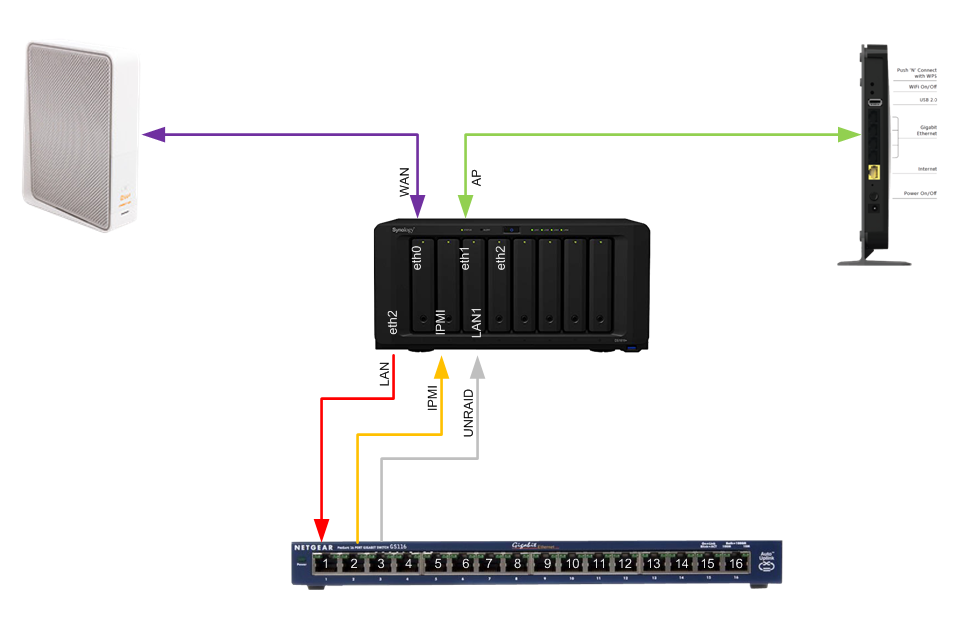
-
Thanks that seems to fix it!
-
Anyone?
-
I've used the "unassigned devices" plugin and that let me format it as ext4. Btw, i've stopped using dropbox altogether, since they also only allow 3 devices all of a sudden... this makes it useless. They want to force you to take a subscription... i've now installed NextCloud using SpaceInvaderOne's excellent tutorial. Much better
-
No, left the docker where it was (on my ssd drive /mnt/cache) and just changed the location of the dropbox data to the ext4 usb stick.
-
I've had this running succesfully for a few weeks now. I also used the sabnzbd-vpn proxy for Sonarr. Worked like a charm, but today i noticed errors in Sonarr that the nzb indexers i've been using, could not be found. Also the api connection from sonarr to sab did not work anymore. After some testing i decided to disable the use of sabnzbd's proxy in sonarr, and... now sonarr can connect to sab and to the indexers...? I've restarted all dockers, checked settings,,, all is well, but for some reason i can't use the sabnzbd proxy from outside anymore? Sabnzbd's logging shows it succesfully connects to my vpn provider in a correct matter, and downloading works as well. If i setup a separate binhex-privoxyvpn docker with the exact same ovpn files and settings i'm using in sabnzbdvpn, and use that as proxy in sonarr, sonarr works just fine and can connect to sabnzbd and nzb indexers just fine... What is wrong? Sabnzbd was updated a few days ago to 2.3.8 [0dd1f64], did something break?
-
I've solved it by installing dd-wrt on the netgear router. dd-wrt lets you set an internal DNS server, pihole in this case. Now all clients on my network are indeed using pihole as dns. But... i have a new 'problem' now; some clients are using a vpn (goosevpn) and the vpn tunnel probably is not affected by pihole.
-
One thing i notice, i’ve installed vpn on my mac and other devices, it looks like pihole has no effect on that? That seems correct if i think about it? How can pihole be combined with vpn? Should i just remove all vpn clients from the devices and use vpn on the router?
-
At the absolute worst time to do any serious upgrading (sunday morning...) i decided to upgrade the Netgear WNDR3700 to the latest DD-WRT build... upgrading went well, after a lot of reading and googling had some problems setting up wifi (and forgot that i also needed to re-setup Alexa, Nest etc...) but it works. And even better, DD-WRT has an option 'local DNS' and if i put in the ip adres of pihole there... it works! So upgrading was a bit of gamble, but so far so good.
-
Can't find anything else then setting the DNS to pihole's IP like it says in the video. I don't understand how else to make this work. I looked at ddwrt, but i don't want risking bricking the thing; i have no alternative at the moment...

