





lovingHDTV
Members
-
Joined
-
Last visited
Everything posted by lovingHDTV
-
Typically, this works well for me. However, if the routing container disappears then the web interfaces gets stuck in a loop of trying to rebuild all the dependent containers. It never returns so that I can fix the underlying problem. The underlying issue is that when I updated glueTUN it disappeared and became an abandoned image. So I need to re-install it. I had to edit every dependent docker to no longer route through glueTUN, then apply and stop the docker. I could then add glueTUN back and redo all the other dockers. Is this how it is expected to work?
-
Thanks, kicked of a correcting check.
-
Yesterday my server lost power and it had an unclean shutdown. I the past I have always run pairty check with auto correct turned on. Recenlty I disabled that as I figured I wasn't able to see if I ever had errors. I never saw a report that says xxx errors corrected. The parity run that automatically kicked off when I restarted the server has reported a ton of errors. Current operation started on Sat 01 Jan 2022 02:03:48 PM EST (yesterday) Finding 68180805 errors Elapsed time: 21 hours, 48 minutes Estimated finish: 5 hours, 31 minutes I had successfully ran a parity check a week or so ago without error, so something happened when the server lost power. Ideas on where I can start looking to try and figure out what is happening? My disk smart data is fairly clean I only have a single drive with 8 allocated sectors. I do see messaging in syslog: Jan 2 08:42:13 tower kernel: eth0: renamed from veth756310a Jan 2 08:50:09 tower kernel: veth756310a: renamed from eth0 Jan 2 08:50:23 tower kernel: eth0: renamed from veth71571d0 Jan 2 09:35:12 tower emhttpd: spinning down /dev/sdj Jan 2 09:51:27 tower kernel: md: recovery thread: P incorrect, sector=19532874280 Jan 2 09:51:27 tower kernel: md: recovery thread: P incorrect, sector=19532874288 Jan 2 09:51:27 tower kernel: md: recovery thread: P incorrect, sector=19532874296 Jan 2 09:51:27 tower kernel: md: recovery thread: P incorrect, sector=19532874304 Jan 2 09:51:27 tower kernel: md: recovery thread: P incorrect, sector=19532874312 Jan 2 09:51:27 tower kernel: md: recovery thread: P incorrect, sector=19532874320 .... Jan 2 09:51:27 tower kernel: md: recovery thread: P incorrect, sector=19532876584 Jan 2 09:51:27 tower kernel: md: recovery thread: P incorrect, sector=19532877352 Jan 2 09:51:27 tower kernel: md: recovery thread: stopped logging Jan 2 10:18:48 tower emhttpd: spinning down /dev/sdi Jan 2 10:18:58 tower emhttpd: spinning down /dev/sdh Jan 2 10:18:58 tower emhttpd: spinning down /dev/sdf Jan 2 10:19:01 tower emhttpd: read SMART /dev/sdh J thanks, david tower-diagnostics-20220102-1144.zip
-
Tha That worked fine. thanks
-
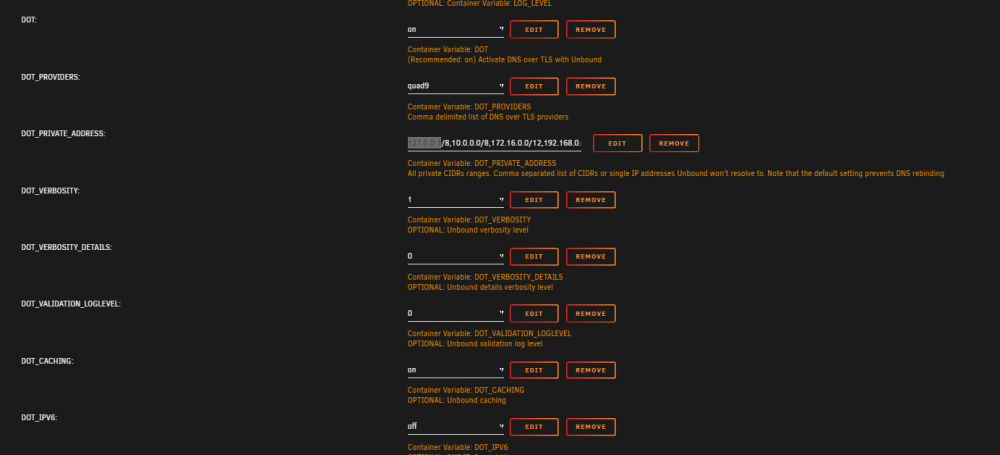
Things are running fine now. Sonarr can successfully send requests to qbittorrent and nzbget and import the resulting downloads. In order to get nzbget to work I had to disable DOT. When I enable DOT, nslookup in GluetunVPN, nzbget and the other dockers it fails to work. I get the following: sh-5.1# nslookup secure.usenetserver.com Server: 127.0.0.1 Address: 127.0.0.1#53 ** server can't find secure.usenetserver.com: NXDOMAIN sh-5.1# nslookup www.google.com Server: 127.0.0.1 Address: 127.0.0.1#53 Non-authoritative answer: Name: www.google.com Address: 142.250.191.196 Name: www.google.com Address: 2607:f8b0:4009:81a::2004 This is true for the two docker I have that have nslookup installed. My DOT settings are fairly default. I just changed to quad9. Is there something I need to change in each docker to get this to work? If I run it on the unraid machine I get: root@tower:/mnt/cache/appdata/gluetun# nslookup secure.usenetserver.com Server: 192.168.1.1 Address: 192.168.1.1#53 Non-authoritative answer: secure.usenetserver.com canonical name = news.usenetserver.com. news.usenetserver.com canonical name = us.na.news.geo.usenetserver.com. us.na.news.geo.usenetserver.com canonical name = news.iad.usenetserver.com. Name: news.iad.usenetserver.com Address: 85.12.62.221 Name: news.iad.usenetserver.com Address: 85.12.62.240 thanks
-
Why do I find the answer 5 minutes after posting? I looked for an hour . . . Anyway for someone else that may have the same issue. You need to add the FIREWALL_OUTBOUND_SUBNETS
-
I have the docker up and running. I've added ports for sonarr, jacket, nzbget, qbittornet. Each docker can access the internet and I have verified it has the VPN IP address. Each docker works with its interface to the internet. Sonarr can find TV series, qbittorren is downloading torrents, etc. However, Sonarr cannot access the downloaders, nor jacket any longer. they just timeout. So I'm missing the piece that integrates them together. I must have messed something up. Suggestions? thanks david
-
OK I'll start from the beginning. When I load the opvn setup file from my VPN provider (Privado) I get: + exec sg vpn -c 'openvpn --cd /vpn --config /vpn/jfk-032.ovpn --script-security 2 --redirect-gateway def1 --auth-user-pass /vpn/vpn.auth ' Options error: Unrecognized option or missing or extra parameter(s) in /vpn/jfk-032.ovpn:24: data-ciphers (2.4.9). Here is the header part of the opvn file. I added the vpn.auth portion only. client dev tun #dev-node "PrivadoVPN (OpenVPN)" proto udp remote jfk-032.vpn.privado.io 1194 resolv-retry infinite nobind persist-key persist-tun persist-remote-ip verify-x509-name jfk-032.vpn.privado.io name tls-client #block-outside-dns route-ipv6 ::/0 route 0.0.0.0 0.0.0.0 vpn_gateway tls-cipher TLS-DHE-RSA-WITH-AES-256-CBC-SHA:TLS-DHE-DSS-WITH-AES-256-CBC-SHA:TLS-RSA-WITH-AES-256-CBC-SHA remote-cert-tls server auth-user-pass vpn.auth verb 3 auth SHA256 data-ciphers AES-256-CBC data-ciphers-fallback AES-256-CBC route-delay 3 From what I've read (not an expert at all), it means I have to run version 2.5 client.
-
I do have piHole, but already have the extra paramenters. I think it is because data-ciphers are now required. I commented those lines out, but think that is probably the issue. thanks
-
Looks like this is a known issue. Privado requires v2.5 Upgrade openvpn to 2.5.x to manage data-ciphers options · Issue #392 · dperson/openvpn-client (github.com) david
-
I've recently been getting the following error when I try to connect to Privado VPN. Prior to this everything has been running fine. I don't recall any changes I've made. Ideas? thanks david
-
Good to know. I continued as described in the write up as that seemed the least risky. Should be done with the rebuild in a few hours. thanks
-
The copy just finished. It is now at the prompt for me to start the array, expand and rebuild the data drive. Can I shutdown the system and move it to its closet before rebuilding? I'd like to get it back onto its UPS and off my work bench. thanks david
-
I was able to complete the parity swap flow. I unassigned the original parity, assigned the 14TB drive as the new parity. I then assigned the old parity as the new data drive. I then got the "copy parity over" button and it is currently copying the old parity drive to the new drive. Then it is supposed to rebuild the data drive.
-
What happens when you mislabel two drives because their serial numbers are off by one letter? You get really confused!!!! Anyway, my isssue is that the drive that didn't get plugged in all the way had the wrong serial number label on it. So, I was "debugging" a perfectly good working drive. When I left it unplugged, because I gave up on it, I then saw TWO drives missing. Panic ensued. . . Hint: When you print serial number labels for you drives so you can easily match the drive in the case to the drive in UnRaid. Make sure you do it correctly
-
I do have a couple 1TB and 2TB drives, but they are smaller than the missing 5TB. Does that matter?
-
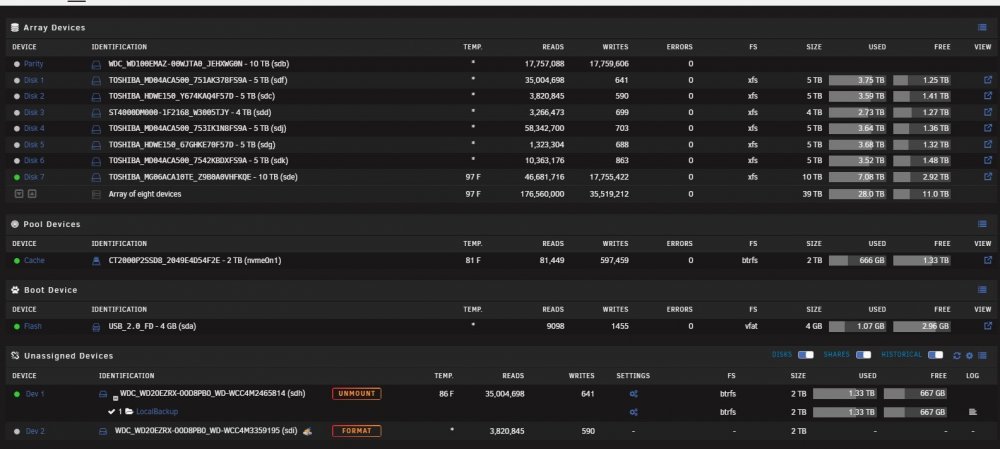
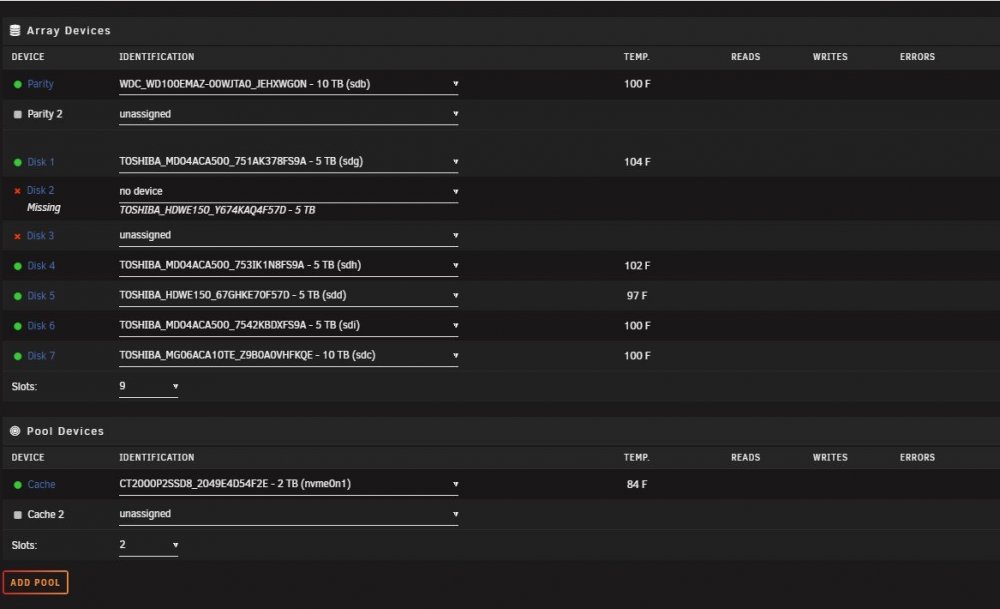
I'm at a complete loss now. After rebooting several times trying to get he 5TB drive to come up. I gave up and hooked in the 4tB drive again. When I boot I now see the 4TB drive, but another 5TB drive is gone. I've attached diagnostics in case someone can spot something. tower-diagnostics-20211212-1428.zip
-
I have a 4TB drive getting a lot of read errors, so I ordered a couple 14TB drives. I precleared them both. I'm following this guide: The parity swap procedure - Unraid | Docs I got as far as stopping the array, unassigning the data drive to be replaced. starting the array, verifying it was missing and shutting down. I then removed the data drive and installed the new 14TB drive that will become my parity. my current parity is 10TB. I booted up and see the new 14TB drive, but now another drive has gone missing. I've fussed with power and sata cables, rebooted several times and cannot get the newly failed drive to come back up. So how do I re-install my 4TB drive that has read errors, but at least is working back into its slot? I think if I can do this, I can complete the parity swap with the newly failed drive, then after that is done use my second 14TB drive to swap out the original 4TB drive with read errors. I think I can re-install the 4TB drive, then assign it to the proper slot and say yes this is correct? I think I've done that before, but wanted to ask before making things worst. A couple pictures. One before, one after. thanks david
-
I've been running UnRaid since the very begining of time. A long long time. I've rebuilt my server a few times, and just went along with the updates. I've known for a while my docker setup is bad, but it is now affecting the reliability of my system so I need to fix it. It is a mess. /mnt/cache - ssd /mnt/disks/LocalBackup - hdd /mnt/user/appdata - set to cache only docker vdisk location: /mnt/disks/LocalBackup/docker-settings default appdata storage location: /mnt/user/appdata (where did this come from?) the system share is pointed to Cache pool. Today: I have dockers installed in three locations. /mnt/cache/appdata /mnt/user/appdata (I assume this is the same thing as /mnt/cache/appdata as it is cache only?) /mnt/disks/LocalBackup/docker-settings (this is a UD mounted disk. I moved many dockers here because they were hammering the ssd so I moved them here) - /dev/sdh It was suggested that I move to multiple cache pools now, instead of relying on UD. I watched SpaceInvaderOne's YT video on how to create them. All about Using Multiple Cache Pools and Shares in Unraid 6.9 - YouTube So what is the best way to consolidate this abomination? What I'd like to accomplish: I'd like to use the SSD only for the "traditional" cache drive. Making file writing to the array faster. I'm fine with everything else going onto the hdd. I'm even thinking of making the hdd a pool of two disks for redundancy as I have several just sitting on my desk to use. What should the default appdata storage location be? Should it be on the array? I really don't understand why/when this became a thing. I had always thought cache was cache and not the array, but at some point they got merged or something. Suggestions wanted. What I think I need to do: 1. stop dockers 2. backup everything temporarily onto the array 3. unmount /dev/sdh 3. create new cache pool using /dev/sdh - will this just mount up as it already has a file system and still maintain all the data? 4. change appdata share to be on /dev/sdh pool I think that will get dockers going, but what do I do for the ssd? How do I set it up so that the mover uses it for caching shares? I'm think I don't have to do anything because my cached shares are already setup using it. thanks david
-
This happened last time as well. When it reboots the unassigned disk there my dockers are located doesn't get mounted. It is device sdh. When I look at the syslog, it looks like it got mounted, prior to dockerd, but when I look at the system it isn't. I then mount it via the GUI, and start the docker successfully. Ideas? tower-diagnostics-20211205-1209.zip
-
I've no real need for BTRFS features. Not sure why it is such. I'll look to changing that later. I missed it in the wiki where it says you can just run it on the command line. will try to powerdown, but I suspect it won't work, and I'll have to power cycle it, like last time I just did finish a parity check, so at least I know it was good as of Friday yep, no go on the powerdown. I can still see the dockers running.
-
Maybe we could get the Manual/Troubleshooting - Unraid | Docs updated to give the location: /usr/sbin/diagnostics tower-diagnostics-20211205-1118.zip Hoping someone can help
-
The GUI became unresponsive last night after my docker backup. I do have access from the terminal, and can remote in. How do I dump diagnostics from the command line as I cannot use the tool in the GUI? thanks david
-
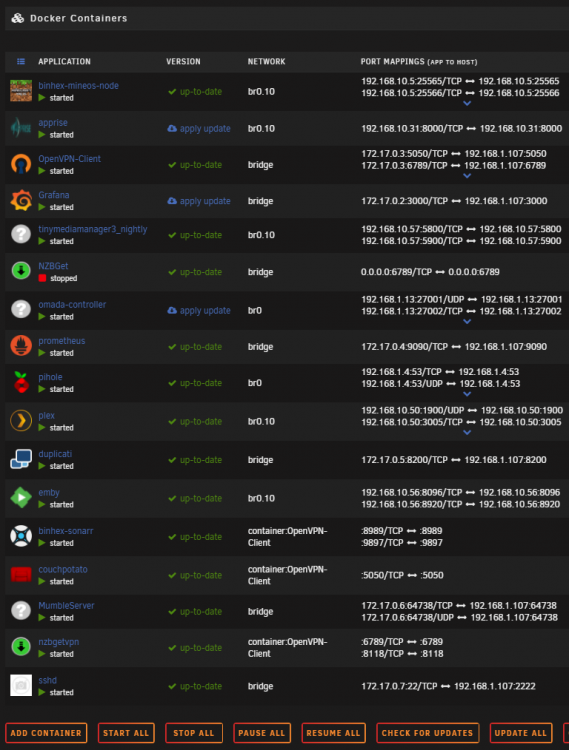
I setup the openvpn conatiner following this article: How to route any Docker container on Unraid through a VPN (unraid-guides.com) However, I cannot access the webGUI directly from the docker page anymore. I tried both using the http://[IP]:[PORT:8989]/ and also changed it to the UnRaid servers IP: http://192.168.1.107:[PORT:8989]/ All I get is: about:blank#blocked I can get there by manually typing http://192.168.1.107:8989 into the browser. I'd like to be able to just click on the WebUI option like before. any ideas? Here is my current setup: thanks david
-
I had to manually change the server.config file to point to java-17 instead of java-16 in case someone else hits this. david


