





steve1977
Members
-
Joined
-
Last visited
Everything posted by steve1977
-
I do believe I have a SMART issue for a long while. You helped me validate that this can safely be ignored (only due to disk used longer than suggested lifespan). And I had rebooted many time since and never faced an issue. It's an NVME, so quite painful for me to uninstall the disk. Let me try whether I can disable SMART checking in Bios. I didn't see such setting though. Is it meant to be like this that it just stops booting if one disk fails smart?
-
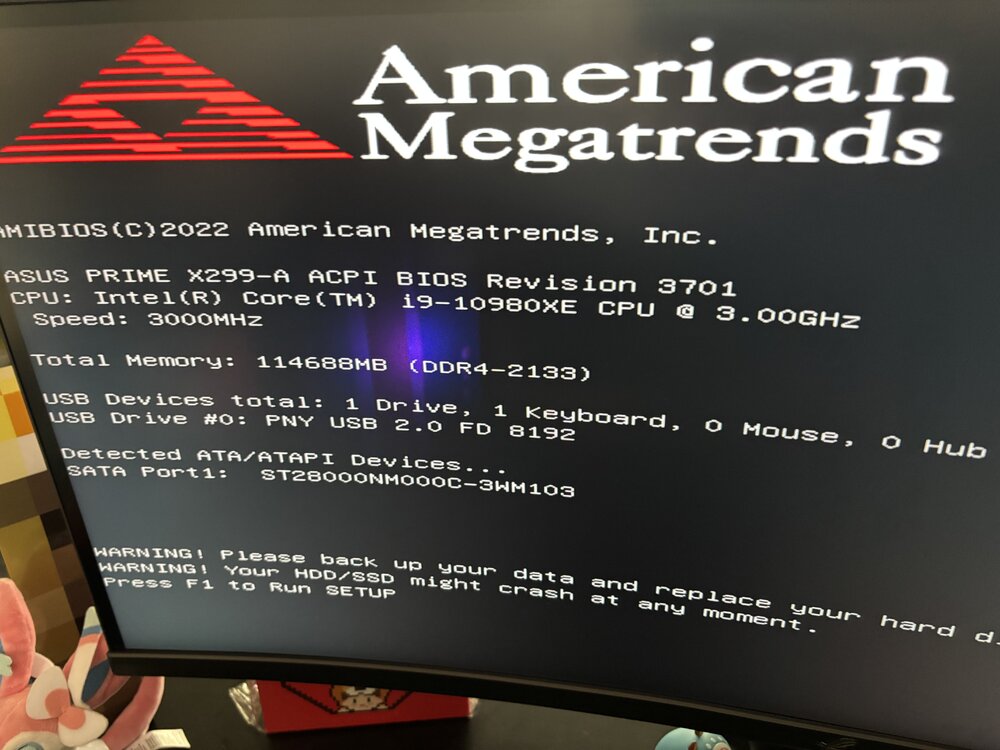
Screenshot below
-
I've been replacing my HBA card and moving a few things around. So, I would not rule out that this is a cablign issue or I broke something. Error is very weird though. I can no longer boot into Unraid. I checked the Flash card and run chkdks and chkdsk / r in windows. No error returned. When I boot, it gives me the error message that my disk migh crash at any time and asks me to go press F1 for bios. I am aware as one of my nvme disks is beyond its normal useage. But per se nothing that should scare me and also not what should be leading to this error? The issue is that it doesn't go passes this screen. When I go into bios, it shows the flash disk being the primary boot disk. So, that's also not the issue. I booted without the HBA disk and also removed all sata disks, but no change. Any idea what leaves me "stuck"?
-
How would you determine which one to replace first?
-
Thank you. I’ll need to upgrade 3 harddisks to larger size (going to 28TB). Shall I replace the ones with the udma crc errors? Or just the smallest size ones? Or any way to prioritize? Shall I send another diagnostic log with all my current disks to help me prioritize?
-
Thanks both for your help. Attaching a diagnostic log: Array disks 5, 6 and 14 show SMART health errors in the dashboard, but not when running the short smart / identity. Cache 2 is the opposite (NVME disk). Dashboard shows the disk is healthy, but the smart check shows error. You helped me in another threat that I can safely ignore this as this is related to how long I've used the disk, but it does not show any hardware issues (yet). Unassigned disk 1 is a brand new unformatted disk that I plan to use as future parity disk Unassigned disk 2 is a HD that I used to have some issues with and trying to move over all files before it dies. It shows though that all files are working. You can tell that I have some disk issues. I have a 9300-8i HBA and one of my concerns is that it is overheating, which leads to some issues? So, I am considering to upgrade to 9400-8i or 9500-8i, which may have better heat. Would love to hear your thoughts specifically on disks 5, 6 and 14. Ideally also on unassigned disk 2. tower-diagnostics-20250928-0919.zip
-
Thanks. Any thoughts on my SMART question?
-
Mmh... That's weird. Is there a way to check the integrity of the flash disk? Some form of chkdsk or whatever else? Also, how to go ahead about the zfs pool thing? Does it matter, which drive of the mirror I assign first or can I just swap main with mirror as they are anyways the same? Lastly, I also noticed a SMART test failed on one of the disks. Not sure this was like this before or whether that's new. The short self-test completes without errors, but the disk shows "failed" in the dashboard. Also when I select "identity", it says that the smart test passed. That's a traditional 18TB HD disk that is part of the array. Not sure anything to worry about and the disk is really failing or just a false negative in the dashboard? As said, the self-test completes without error and the identity tab also says "passed".
-
I made some changes to my hardware. Added a few disks, changed HBA, etc. Ulitmateltely nothing major though. Still same Mobo/CPU/Ram/GPU and also still the same flash disk. So not sure why this should have an impact. A few things were weird after starting my Unraid server: SSH was disabled. I am certain I didn't change this setting. Had to re-enable it again. Not a big deal My cache pool wasn't assigned anymore. So, I just manually added the two mirroed ZFS disks back. All worked after adding them back. I wasn't sure which of the two ZFS NVME disks was the main one and which one the mirrored one and don't whether it matters. All data still there and all good. One file on the cache pool is outdated. No clue why and I just edited it back. Just a list of folders for mover exclusion, but weird that it changed it back Time on my Windows was out of time. I had to manually set it back Net net, nothing major, but very weird... Any idea what could drive this change and anything to watch out for? And also whether my practice to randomly assign the two zfs disks back to a pool is something that can be done this way?
-
Did you ever figure this out?
-
Please decide whetehr better to move this into the docker container part of this forum. There used to be a docker container in CA with a Muscbrainz mirror. Unfortunately, this has been deprecated for some years. I believe many of us have started to look into self-hosting again since the issues with Lidarr metadata. Even once Lidarr is fixed, there may stay be interested using a local mirror for MBZ Picard. There is a detailed description below how to set this up with docker-compose. Amy chance we can see a container on CA again? Or if note, anyone can help how to set up below with docker-compose in Unraid? Thanks! https://github.com/blampe/hearring-aid/blob/main/docs/self-hosted-mirror-setup.md
-
My VM used to run flawless. Now upgraded the cache disk to ZFS. And my VM no longer works. Getting same issue as above. Anyone has fixed it?
-
Thanks again for your help. The transition from the old XFS to the new ZFS disk worked well using the mover approach. I re-enabled VM and Docker. However, there is one issue now, which feels quite odd. I only have on GPU. I forgot what I had assigned it to prior to the change. However, It is now assigned to both my Plex docker container and also my VM. I always use both my VM and my Docker at the same time. So, this would not have been possible with this assignment. Unless I found a way to assign it to both in parallel? I have now just removed it from my VM, but weirdly enough getting an error message when doing so. Any idea why this has happened? Shouldn't the docker and VM settings be unchanged after disabling / enabling them? Or was there some way how to assign the GPU to both and still run them in parallel?
-
It completed. So seems you were right and it was just incredibly slow. I have now added the old XFS disk as a second disk to the pool. And it runs (fast). I was surprised that it didn't offer me any options how I'd like to set up the pool? I read somewhere that it will set it up as mirror by default. That's what I want, so should be all good. Just curious where the settings would have been if I had preferred a different setup? Also, the "old pool" now just "not installed". I don't find the option to just remove it?
-
Ok... Thanks. It feels though that it may take 48 hours for just 500gb. Not a big deal and I can wait, but love to hear from you whether that's really what's "normal"? Worried that maybe the new disk is faulty and I may lose the data through this moving exercise.
-
I celebrated too early. It is moving, but it is incredibly slow. So, there still seems to be something wrong. Attaching the logs. Three shares: /appdata, /data, /domains, /iso. Thanks for looking into it. tower-diagnostics-20250920-1809.zip
-
This seems to have been the issue... That's quite annoying as I need the plugin for my workflow. Not for the ZFS/XFS transition though, so let me finish this first. And then I hope that I can use the plugin again. I will give it a try, thanks!
-
I am trying to migrate from an XFS cache disk to an ZFS cache pool. Somehow, I am stuck doing the "move". Mty old cache disk is an NMVE 1TB disk, formatted as XFS. Bought the identical model and formatted it as ZFS. Then created a ZFS pool with this disk. Disabled VM and docker. Now set up the user shares to move from the old XFS disk to the new ZFS disk. Ran "mover". It says "mover is running". However, I cannot see any read/write activity on either of the two disks. And also, the new ZFS disk is still empty. Attaching diagnostic log. Appreciate any help! tower-diagnostics-20250920-1533.zip
-
Wow, this is really great and super helpful. Appreciate you taking the time to share in such depth. The path is clear. I will go with a mirrored ZFS pool. Great there is no issue per se in having dockers, scratch and VM on the same disk. That makes my life far easier. I won't "hammer Plex" and also won't "hammer" a lot of arr unpacking. Typically, only one client streams from Plex (rare occasions 2) and there is also just regular streaming activity and not excessive. Also no crazy arr activity. However, my arr libraries are HUGE. So, the library files are also quite massive. Don't know how the arrs work and whether a large library impacts read/write activity to the disks. Just a regular folder scanning takes forever. And I can imagine the constant usenet searches and artist refresh (for the thousands of artists on lidarr) have some form of negative impact on something. Assume largely on the array though, so nothing to do with my cache disk? With this additional info, any thoughts how to set up my mirrored cache disk? I probably should disable compression for all folders (no gain?). I don't know what recordsize is and how to set it. Or other settings?
-
Got it. Your suspicion was right. I indeed thought yould create a (real-time) pool between cache zfs nvme disk and array zfs sata disk. In fact, I thought I read this somewhere. If that's not the case, then the answer is that I will add two nvme disk to keep them mirrored. Assume the mirroring doesn't have a massive impact on performance?
-
I am getting the backups ready. I had always thought that NVME disks are lasting forever, but seems their life expectancy isn't quite as long... Maybe I should just upgrade the disk to avoid data loss. Additional benefit would be getting a better NVME disk. Would the speed gain be noticeable by moving from an PM961 to a Samsung 980 or 980Pro or 990Evoplus. I am restricted by PCI3.0 bus speed as I don't just yet plan to upgrade the mobo. Thoughts on these choices?
-
My NVME disk seems to be working well. However, I realized that the SMART test has failed. I am hopeful that I may be able to ignore this as it may be a result of the "percentage used" being above 100% rather than anything else? I read on the forum that I can well use the disks longer than their intended use. From the log below, it is less clear to me though whether there may be other issues as well and I should better replace the drive? Any thoughts? https://pastebin.com/CG6hGrNz
-
Thanks @JorgeB . re 1 - Link explains to move from cache to array. In my case, I would use the mover to move from pool (XFS disk) to a newly created one-disk pool (ZFS disk). And then I reformat the XFS to ZFS and add it as second disk to the ZFS pool? re 3 - If larger, it would only use the the size of the smallest disk though? re 4 - Let me simplify my question. I have more than sufficient space on my NVME disk for docker, VM and scratch folder (for arr downloads). Would I be better off to separate these three things (i.e., dedicated disk for VM, dedicated disk for dockers, dedicated disk for scratch folder for downloads). Or does it not really matter and I can keep all three on one NVME disk? And another question - I just read that I could also format one of my array disks as ZFS and then mirror the cache disk to the array. This way, I wouldn't need a second NVME disk and the cache disk would even be double-protected (mirrored and protected by parity). Is this a smart thing to do? I am wondering whether I'd lose a lot of performance as the NVME would suddenly be much slower as it woudl be mirrored to a regular sata hdd? Also not sure whether this would slow down the VM. I remember running the VM on an array before, which was super slow. So, if I now run the VM on an nvme cache disk, but mirror it to a sata array disk, would this be the same and slow?
-
Unraid 7 brought a new "shiny" toy with ZFS pools, which I am keen to try it out. My current setup as follows: 12 HDD disks for media storage, 1 parity disk. All formatted as XFS 1 NVME as cache disk, XFS formatted, hosts appdata/dockers, VM, and *arr download directory (using mover to copy to array once per day) The most obvious change and no-regret seems to change the formatting of my cache disk to ZFS as this seems to bring performance and security advantages. When doing so, I can also think of creating redudancy to it. A few questions: 1) I can buy a second NVME disk and mirror my current NVME to it. This would then be a ZFS pool with full redudancy. This seems straight foward. Alternatively, I could format one of my array disks as ZFS and then create a backup of my NVME drive to the array. This would make it double-protected (mirrored and parity), but I don't carae about this. Maybe it may make it slower though? Any thoughts among these two options? 2) If I were to format one of the array disks to ZFS to backup the cache disk per above, which array disk should I choose? A "movie disk" (with only large files with minimal writes) or a "tv disk" (with more smaller files also with minimal writes) or a "music / other disk" (with endless small files and more frequent reads). Or does it not matter? Or would it be even better to have a dedicated disk, in which case I can also just go with the mirrored ZFS pool. 3) I currently have docker, VM and scratch folders on the same NVME disk. Are there any advantages / needs to have them on different disks? If so, I could consider having 2 or even 3 NVME disks. One for dockers, one for the VM and one for the scratch files (arr downloads). I don't need the extra space, so all three things nicely fit on one disk now. I am curious though on any performance differences or other advantages I'd have if I were to separate them? Thanks for any thoughts you may have!
-
I won't be using NVME, but historically had some issue with heat. When you say "power consumption", does it also mean that 9400/9500 would get less hot? How much wattage are we talking about?
