






Drider
Members
-
Joined
-
Last visited
Everything posted by Drider
-
I do have DD-WRT, but as much as I wish I knew the script to place in the router, it looks like I'll go with DDClient, as I'm sure it will be more my pace of understanding to configure. Unless of course you could point me in the right direction ... ? Thanks!
-
I've been going through your blogs, and I must say thank you. You have a TON of good information in there. It looks like I'll be following 90% of what you've posted, as you're setup is pretty much what I desire. I've installed Organizr, and I've been playing with it a bit, look slike I'll be jumping on the bandwagon. I only have a couple problems with organizr: I get this error at the top of my homepage if I have Ombi request turned on, I'm not sure if it's because Ombi needs an update. (It's the only answer I've found as of end of March 2018 from support posts on GitHub) Notice: Undefined offset: 0 in /config/www/Dashboard/functions.php on line 5067 Notice: Undefined offset: 0 in /config/www/Dashboard/functions.php on line 5067 I'm trying to use unBlurr vBeta as a Theme, and all work except when I try to add: For Plex Users who want the chat button to go to the chat tab instead of the chat sidebar It places a bar over the entire homepage blocking the top of the page and specifically the save button. I have to use adblocker to kill the item in order to regain control. Sorry for the off topic questions, I know they should be placed elsewhere. It looks lie I have a lot more reading, trial and error to go through, but at least I have a good reference point. Don't you take down that blog anytime soon! @aptalca I'm still a bit puzzled on how to get DDNS to update directly to cloudflare, if you could be so kind as to answer: Is there a docker or plugin that I need to install specifically for this, or will I be be needing to go a custom script route? Should I be using a service like DNS-O-Matic ? Maybe I'm just missing it within the LetEncrypt container..
-
I already have my jail.local configured, as present in my original post. It's just a matter on turning it on. Would .htpasswd be recommended on top of Ombi using Plex account sign in? Would turning on .htpasswd with PLex user authentication in Ombi cause my users to have to sign in twice? If so would .htpasswd be recommended over Ombi Plex user sign on? Not sure about organizr, just started looking into it, and it's intriguing, but not quite ready to undertake that project yet.. Referenced in my original post I've setup as subdomain. Not sure how that would play out with your suggestion as domain.com/ombi, and prefer not to use my base business domain. geoblocking is definitely a must, and thank you for referencing this. I had no idea it existed, and will get implemented asap.
-
Thank you for your reply, it's very informative, and definitely gives a better understanding of what I'm trying to accomplish with DNS/DDNS. You're right I did go through what felt like 5000 forums posts and hundreds of configs, splicing together the files I currently use. I believe I have a good base, providing some security, (again I'm not sure as to how much beyond I need), and not mucking up with too much unneeded. I have posted the same security related questions on the forums I found information outside of Lime. I was not aware I could cut out the intermediary DDNS by using CloudFlare. I've always been used to using DDNS with some kind of update client, I didn't know CloudFlare could do this automatically. I'll have to do some digging to understand how this is properly configured, as I'm a little foggy what host my subdomain A record should point to, I assume my current dynamically assigned IP? I'm not entirely sure how I'd get a client updating the, as the router I use has a field for custom DDNS service, but I'm not sure where to even begin with that. I guess Some more searching may shed some light. I believe I understand what you're saying here, and it sounds like all I need to do is set only_subdomains true and this will accomplish what I'm looking for in both only allowing mattflix.ouritservice.com, while refusing connections the the other subdomains pointed here (Given my default and subdomain site-confs are correct), as well as allowing me to use seperate site conf files. I think I've had the lightbulb "ahh" moment. .. at least I hope. Now, if anyone could provide some insight into the security side of this using Ombi and Plex user logins. Thanks for your response!
-
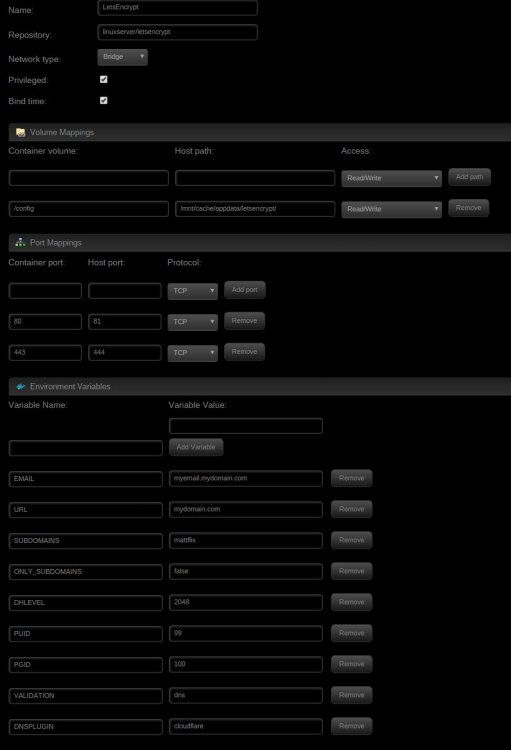
I've gotten everything working so far for use with Ombi on unRAID 6.1.9, (I'll eventually be moving everything over to the sister server v6.5.0) My questions now are really focused on security. I have this server on my home network, with a few business servers running on the same network, and some business data even in the same unRAID server. I'm hoping I may list my setup configurations here, and someone may be able to answer a few questions. (All sensitive information fields have been redacted) DDNS DDNS is handled through freedns.afraid.org where mysub.strangled.net resolves to my home dynamically agssigned IP provided by my ISP. The DDNS update is maintained by the DDNS updater in my DD-WRT flashed router. DNS The domain I use is actually a split domain, as the base domain mydomain.com points to an external business mail server. I set up a separate sub-domain for use, we'll call it: mattflix.mydomain.com. This is a CNAME using cloudflare DNS, that resolves to my DDNS domain provided by freedns. This setup looks like so: mattflix.mydomain.com --> mysub.strangled.net --> external IP at home. Questions: I assume because I am using a sub-domain of mydomain.com and not the base domain, this is what would be limiting me to only being able to use one letsencrypt/nginx/site-conf file (default) instead of what I've seen in this thread about using multiple files one for each subdomain? I've tried every possible way I could find, and think of, to make this work, with the default, without, with main server block in the default, and separate in each site conf.. But every time I have more than one site-conf file it kills the page and gives a connection refused. (This does the same if I try to list more than one sub-domain /location in the default file. I'm just confirming a suspicion here, and I know I can switch to mydomain.com/service over subdomains, or just buy a dedicated base domain.com. Just want to confirm that is the solution or I'm doing something wrong. Also: I currently have a couple subdomain.mydomains.com that resolve to the same DDNS destination. The problem is they all translate to mattflix.mydomain.com. I'd like if possible to only allow specifically mattflix.mydomian.com resolve, and any other valid subdomain.mydomain.com either time out, or error. I tried but just couldn't get it, I played around with the server listen block, and I suspect I'm just missing something in there? Port Forwarding / LetsEncrypt Docker Container Setup Firewall port forwarding is standard: External --> Internal 80 ---> 81 | 443 --> 444 /letsencrypt/nginx/site-confs/default ## Source: https://github.com/1activegeek/nginx-config-collection/blob/master/apps/ombi/ombi.md server { listen 80; server_name mattflix.mydomain.com; return 301 https://$host$request_uri; } server { listen 443 ssl; server_name mattflix.mydomain.com; ## Set root directory & index root /config/www; index index.html index.htm index.php; ## Turn off client checking of client request body size client_max_body_size 0; ## Custom error pages error_page 400 401 402 403 404 /error.php?error=$status; #SSL settings include /config/nginx/strong-ssl.conf; location / { ## Default <port> is 5000, adjust if necessary proxy_pass http://myipaddress:38084; ## Using a single include file for commonly used settings include /config/nginx/proxy.conf; proxy_cache_bypass $http_upgrade; proxy_set_header Connection keep-alive; proxy_set_header Upgrade $http_upgrade; proxy_set_header X-Forwarded-Host $server_name; proxy_set_header X-Forwarded-Ssl on; } ## Required for Ombi 3.0.2517+ if ($http_referer ~* /) { rewrite ^/dist/([0-9\d*]).js /dist/$1.js last; } /letsencrypt/nginx/strong-ssl.conf ## Source: https://github.com/1activegeek/nginx-config-collection ## READ THE COMMENT ON add_header X-Frame-Options AND add_header Content-Security-Policy IF YOU USE THIS ON A SUBDOMAIN YOU WANT TO IFRAME! ## Certificates from LE container placement ssl_certificate /config/keys/letsencrypt/fullchain.pem; ssl_certificate_key /config/keys/letsencrypt/privkey.pem; ## Strong Security recommended settings per cipherli.st ssl_dhparam /config/nginx/dhparams.pem; # Bit value: 4096 ssl_ciphers ECDHE-RSA-AES256-GCM-SHA512:DHE-RSA-AES256-GCM-SHA512:ECDHE-RSA-AES256-GCM-SHA384:DHE-RSA-AES256-GCM-SHA384:ECDHE-RSA-AES256-SHA384; ssl_ecdh_curve secp384r1; # Requires nginx >= 1.1.0 ssl_session_timeout 10m; ## Settings to add strong security profile (A+ on securityheaders.io/ssllabs.com) add_header Strict-Transport-Security "max-age=63072000; includeSubDomains; preload"; add_header X-Content-Type-Options nosniff; add_header X-XSS-Protection "1; mode=block"; #SET THIS TO none IF YOU DONT WANT GOOGLE TO INDEX YOU SITE! add_header X-Robots-Tag none; ## Use *.domain.com, not *.sub.domain.com when using this on a sub-domain that you want to iframe! add_header Content-Security-Policy "frame-ancestors https://*.$server_name https://$server_name"; ## Use *.domain.com, not *.sub.domain.com when using this on a sub-domain that you want to iframe! add_header X-Frame-Options "ALLOW-FROM https://*.$server_name" always; add_header Referrer-Policy "strict-origin-when-cross-origin"; proxy_cookie_path / "/; HTTPOnly; Secure"; more_set_headers "Server: Classified"; more_clear_headers 'X-Powered-By'; #ONLY FOR TESTING!!! READ THIS!: https://scotthelme.co.uk/a-new-security-header-expect-ct/ add_header Expect-CT max-age=0,report-uri="https://domain.report-uri.com/r/d/ct/reportOnly"; /letsencrypt/nginx/proxy.conf client_max_body_size 10m; client_body_buffer_size 128k; #Timeout if the real server is dead proxy_next_upstream error timeout invalid_header http_500 http_502 http_503; # Advanced Proxy Config send_timeout 5m; proxy_read_timeout 240; proxy_send_timeout 240; proxy_connect_timeout 240; # Basic Proxy Config proxy_set_header Host $host:$server_port; proxy_set_header X-Real-IP $remote_addr; proxy_set_header X-Forwarded-For $proxy_add_x_forwarded_for; proxy_set_header X-Forwarded-Proto https; proxy_redirect http:// $scheme://; proxy_http_version 1.1; proxy_set_header Connection ""; proxy_cache_bypass $cookie_session; proxy_no_cache $cookie_session; proxy_buffers 32 4k; This all gets me an A+ on securityheaders.io which is great and all, but what does that actually do for me? I'm concerned about brute force, DDOS, and some thug trying to muscle into my server. I've been trying to read up on fail2ban and it's implementation, however from what I've found, because I'm using this for Ombi, and it authenticates off of the users Plex account, this bypasses the fail2ban? I've tried monitoring the fail2ban status however I get this error when I try to check the status: docker exec -it LetsEncrypt bash root@d3fc185ce9d5:/$ fail2ban-client -i Fail2Ban v0.10.1 reads log file that contains password failure report and bans the corresponding IP addresses using firewall rules. fail2ban> status nginx-http-auth Failed to access socket path: /var/run/fail2ban/fail2ban.sock. Is fail2ban running? fail2ban> I know the first time I ran the command, everything reported, though it reported no activity. /letsencrypt/fail2ban/jail.local # This is the custom version of the jail.conf for fail2ban # Feel free to modify this and add additional filters # Then you can drop the new filter conf files into the fail2ban-filters # folder and restart the container [DEFAULT] # ##"bantime" is the number of seconds that a host is banned. bantime = 259200 # ## A host is banned if it has generated "maxretry" during the last "findtime" seconds. findtime = 600 # ## "maxretry" is the number of failures before a host get banned. maxretry = 3 [ssh] enabled = false [nginx-http-auth] enabled = true filter = nginx-http-auth port = http,https logpath = /config/log/nginx/error.log # ignorip = myipaddress.0/24 [nginx-badbots] enabled = true port = http,https filter = nginx-badbots logpath = /config/log/nginx/access.log maxretry = 2 [nginx-botsearch] enabled = true port = http,https filter = nginx-botsearch logpath = /config/log/nginx/access.log ## Unbanning # ## SSH into the container with: # docker exec -it LetsEncrypt bash # ## Enter fail2ban interactive mode: # fail2ban-client -i # ## Check the status of the jail: # status nginx-http-auth # ## Unban with: # set nginx-http-auth unbanip 77.16.40.104 # ## If you already know the IP you want to unban you can just type this: # docker exec -it letsencrypt fail2ban-client set nginx-http-auth unbanip 77.16.40.104 I know there's no such thing at perfectly 100% secure, but with port 80 & 443 being open, and only relying on Ombi/Plex password security, I just feel like my ass is hanging in the wind. Any guidance would be most appreciated.
-
Intriguing: Is it possible to make Sonarr split it's requests to multiple DelugeVPN containers? Apologies if this has been asked an answered here, I skipped right to the end today.
-
Thank you so much for your offer, it's a delightful change from the normal response I find on the infrequent posts for help I place here in the forums. I forced my way though 16 hours of reading posts, (10 invested before my original post), here in the forums, and trial and error after the initial response to my inquiry was basically met with the same information inquired by my posting. It's always frustrating learning new things with unRAID. Spending countless hours scouring Threads that are 100's of pages long, to finally piece together an understanding of a site-conf file, (and change a Cloudflare SSL setting I've still not seen mentioned), is just .... nerve wracking. Especially looking at it now in a completed working form, and seeing it's literally a 10 minute job. If only a quick reference of working files were stickied at the top of a thread, and not needing pieced together through 1800 posts.. (Many examples I found were conflicting, and took a lot of time to find correct syntax) ... and I know I've looked before, but am I not seeing where a Search Thread, or discussion option is?.. I don't even find it in the advanced search... Searching the entire forum for a specific item is ... Futile. Anyway, I was able to get to the point of a 502 error, and from there I backtracked to one of these posts I'd read having the same issue, and resolving. (setting proxy_pass to http and not https, again conflicting posts in this thread mostly showing https) I own a Business to Business consulting firm, and I really would love to start offing the benefits of unRAID to our clientele, but the support system is just infuriating. I just can't risk the time that could be potentially lost in troubleshooting answers in the bottomless abyss of these forums. Disclaimer to those that might think I'm being to harsh: No, I'm not a linux expert, Yes, I know what the search button does, and I typically don't even post until I've worn the thing out. Yes I HAVE learned many things from this forum. Yes, I understand every setup is different, and with different variables. Though I'm not an expert in all things I.T. I have enough natural talent in the field that I mostly piece things together by deciphering working examples. I'm sorry for the rant, I guess I'm just very analytical, and wish there was a better learn "on your own support system" for unRAID, or at least a more organized way of finding key information. Time is quite valuable. Thanks again for your offer of assistance. (It's late, and been a long day, I'm sure there's a few typos in this post, my apologies.)
-
Is there a guide or tutorial on setting up the \nginx\site-confs\default file? I'm on unRAID 6.1.9 (I know old), and when I configure a fresh install everything works great, meaning I can remote to my mail server 400 miles away, browse to subdomain.mydomain.com and get it to redirect me to the https://subdomain.mydomain.com default index.html. I actually impressed myself because I got it to work through Godaddy redirecting a CNAME to my free-dns subdomain back to the dynamic IP here at home, while keeping the secure lock and correct address in the address bar. Problem is, I've been hitting a severe roadblock trying to get the correct format in the default site-confs file to get to my OMBI docker container. It seems like everytime I edit the default file, it borks the whole system, and no matter where I connect from I get an ERROR_CONNECTION_REFUSED. Trying to undo edits and save, or replacing the file with a backup resolves nothing, and I end up having to uninstall/reinstall the container, to get back to functional. EDIT: I did try newperms Tool on my appdata folder, which actually help to speed up my server GUI navigation, but nothing else... Maybe someone can give me the quick version, but a guide or reference for editing that file would be just as appreciated. My base url for ombi: /request Ports are default at 3579 for both container and host as I can't seem to find where I can change that. and the server's host address is 192.168.0.69 I know I'm close, but just can't seem to get it... It would also be nice to utilize just the sub-domain.domain address for my users navigating to the site omitting </request>. From what I can tell in the default file example this is possible, no? Bonus Round: I have basic authentication turned on for myself and my users, using the built in PLEX account authentication, but what's the most secure way to implement this? To quote linuxserver.io: Is this something I should be interested in setting as well? Any guides, or reference for implementation? I appreciate the help, as i'm finally getting around to actually using the 2xE5-2670 128GB RAM beast I built a couple years back, ... (The first one at least...)
-
Hi bonienl, First thanks for the plugins! I just found this thread a day or so ago, and I'm really enjoying the benefit of quite a few of the plugins. I posted this in the Dynamix - V6 Plugins Thread, but thought I'd place it here as well. I was just wondering if it might be possible to add a Second CPU Core Temperature output field to the System Temp plugin? Those of us running dual CPU systems, (Thanks to the E5-2670 Fire sale), would find it most welcome I'm sure. Thanks again!
-
Hi bonienl, First thanks for the plugins! I just found this thread a day or so ago, and I'm really enjoying the benefit of quite a few of the plugins. I was just wondering if it might be possible to add a Second CPU Core Temperature output field to the System Temp plugin? Those of us running dual CPU systems, (Thanks to the E5-2670 Fire sale), would find it most welcome I'm sure. Thanks again!
-
S.M.A.R.T. status becomes unavailable if the script can't detect your controller properly. Do you mind sharing your server configuration and which controller is hosting your disk? I think this has been mentioned a couple of times before in this thread, that some new drives doesn't have SMART enabled by default and therefor need it enabled before starting the script. After adding the drive to the array, SMART is available. I have had this on a few new drives when using your plugin and script. It might have been johnnie.black that mentioned this. I question that this is my issue, because I can run full SMART status requests from the unRAID web GUI, and I get full SMART status reporting through the unRAID GUI as well. I did try adding the drive(s) to the array and back, but same result. Feel like I was left at the buss stop. Any advice? S.M.A.R.T. status becomes unavailable if the script can't detect your controller properly. Do you mind sharing your server configuration and which controller is hosting your disk? But of course, It's happened on two different controllers now, first the on board Intel C602 chipset controller. (The board I use also comes with 4 on board Marvell SE923, Though I've not tried on those SATA headers as there's already some known issues in unRAID with the Marvell chipsets. ) The second, and now currently running pre-clear, an Intel RS2WC080 RAID Controller SAS/SATA MD2 6GB/s PCIe 2.0x8 flashed to the LSI SAS2008 IR/IT firmware. Fun part is if I look at the drives through the unRAID web GUI, all S.M.A.R.T. status is reported, and correct. I'm moving on from this plugin. Hopefully the information here will help someone in the future should they have the same issues. (Should they resolve it, please send me a PM ) ... ... If of course, they can ever find it... Tom at the least should consider using a more up to date, and friendly forum software. Anyway. I've found: Every configuration results in the same scenario of no S.M.A.R.T. status results being shown during or after the pre-clear. Including blank S.M.A.R.T. status in the final report saved on the flash drive. unRAID: 6.1.9 Pre-Clear Plugin: 2016.09.27 Tried 8 brand new drives from various manufacturers including Western Digital, HGST, Toshiba, Hitachi, and Samsung. (I use Pre-Clear a lot as a way of testing new drives before they go into a client's PC/Workstation/Server) Drives were tested in AND out of a 5 in 3-5.25" iStar hot-swap bay. They were connected directly to the motherboard as well as to the Raid card in both scenarios, (see previous message for configuration details of RAID controller, and on-board chipset). Saarg's mention of having to add to the array first to activate S.M.A.R.T. status is outside the question. It would be counter intuitive to add a drive to the array, wait the hours for it to clear, wait for a parity check because of a newly added drive, then remove the drive, wait for a parity check, pre-clear the drive, wait for pre-clear, add the cleared drive to the array, and again wait for a parity check..... Greatly defeats the purpose. (Waiting for Parity checks in between is exaggerated, but not unreasonable with a server holding data not wanting to be lost.) Null and voided anyway, as after trying the suggestion, led to the same results. After having to read through 18 pages, (such the normal process when looking for any guidance with unRAID troubleshooting.) it was found that aptalca was the one having "similar" issues to what I am experiencing. I say "Similar" because all of the drives report S.M.A.R.T. status within my unRAID GUI, and all show S.M.A.R.T. status as "Enabled". However after using his code via putty session, my drives don't magically start showing the S.M.A.R.T. status as his do... They actually disappear from the list of drives with in the Pre-Clear Plugin, at which point I have to reboot the server to have the plugin list the drives again. I would like to expand upon his statement, that there is no "Pre-Clear Start" report generated. Maybe I'm missing something, or perhaps this is also another bug I am experiencing, but Having a Start and End report is quite valuable, I would think? I frankly just don't have anymore time to put into this. I'll continue to initiate Pre-Clear Via Putty. ... Bummer.
-
S.M.A.R.T. status becomes unavailable if the script can't detect your controller properly. Do you mind sharing your server configuration and which controller is hosting your disk? I think this has been mentioned a couple of times before in this thread, that some new drives doesn't have SMART enabled by default and therefor need it enabled before starting the script. After adding the drive to the array, SMART is available. I have had this on a few new drives when using your plugin and script. It might have been johnnie.black that mentioned this. I question that this is my issue, because I can run full SMART status requests from the unRAID web GUI, and I get full SMART status reporting through the unRAID GUI as well. I did try adding the drive(s) to the array and back, but same result. Feel like I was left at the buss stop. Any advice?
-
S.M.A.R.T. status becomes unavailable if the script can't detect your controller properly. Do you mind sharing your server configuration and which controller is hosting your disk? I think this has been mentioned a couple of times before in this thread, that some new drives doesn't have SMART enabled by default and therefor need it enabled before starting the script. After adding the drive to the array, SMART is available. I have had this on a few new drives when using your plugin and script. It might have been johnnie.black that mentioned this. I question that this is my issue, because I can run full SMART status requests from the unRAID web GUI, and I get full SMART status reporting through the unRAID GUI as well.
-
S.M.A.R.T. status becomes unavailable if the script can't detect your controller properly. Do you mind sharing your server configuration and which controller is hosting your disk? But of course, It's happened on two different controllers now, first the on board Intel C602 chipset controller. (The board I use also comes with 4 on board Marvell SE923, Though I've not tried on those SATA headers as there's already some known issues in unRAID with the Marvell chipsets. ) The second, and now currently running pre-clear, an Intel RS2WC080 RAID Controller SAS/SATA MD2 6GB/s PCIe 2.0x8 flashed to the LSI SAS2008 IR/IT firmware. Fun part is if I look at the drives through the unRAID web GUI, all S.M.A.R.T. status is reported, and correct.
-
Hi gfjardim, First thank you for the script/plugin, been using them for a while now since unRAID 6.0, and using Joe L.'s pre-clear script long before. You've made the process such a breeze now. Quick question, and I'm sure it's been asked before, but I just don't have the time to go through the thread. (Perhaps edit(ing) the first post with updates, and a FAQ?, something I think needs to be done a lot more on these forums, or move to a better forum software... but I digress) My issue is I'm not getting any S.M.A.R.T. reporting in neither the status view while pre-clear is running, or at the end in my reports. The box is just blank. I'm sure it's a quick fix, and other than that everything is working well. Thanks again!
-
Subscribed and watching. This will be quite useful for a few clients I'm getting ready to setup with unRAID servers. I'll be looking forward to the polished & tested version.
-
I've been trying to send you PM's but I'm not sure they're going through. I'll take them, if you're not getting my PM's you can Email me at a burn email account I set up: Thanks. EDIT: Removed Burn E-mail.
-
DIBS! Two questions first: Do you have the Half Height Brackets? Is it $75.00 for both Cards & the Cables? Thanks, and awaiting to pay pending answers! EDIT: Sent PM as well.
-
where do I get my hands on the 6.2 beta?
-
I imagine you'll be updating the first post of this thread once the changeover is completed?
-
Drive 2 (DBGS) finished sometime early this morning. Again results look ok to me, as they look pretty much identical to drive 1, but feedback is still appreciated. preclear_rpt_DBGS: ========================================================================1.14 == invoked as: ./preclear_disk.sh -M4 -A -c3 /dev/sdf == TOSHIBADT01ACA300 X3S99DBGS == Disk /dev/sdf has been successfully precleared == with a starting sector of 1 == Ran 3 cycles == == Using :Read block size = 8388608 Bytes == Last Cycle's Pre Read Time : 6:28:52 (128 MB/s) == Last Cycle's Zeroing time : 17:11:58 (48 MB/s) == Last Cycle's Post Read Time : 12:48:26 (65 MB/s) == Last Cycle's Total Time : 30:01:32 == == Total Elapsed Time 84:51:12 == == Disk Start Temperature: 29C == == Current Disk Temperature: 30C, == ============================================================================ ** Changed attributes in files: /tmp/smart_start_sdf /tmp/smart_finish_sdf ATTRIBUTE NEW_VAL OLD_VAL FAILURE_THRESHOLD STATUS RAW_VALUE Temperature_Celsius = 200 206 0 ok 30 No SMART attributes are FAILING_NOW 0 sectors were pending re-allocation before the start of the preclear. 0 sectors were pending re-allocation after pre-read in cycle 1 of 3. 0 sectors were pending re-allocation after zero of disk in cycle 1 of 3. 0 sectors were pending re-allocation after post-read in cycle 1 of 3. 0 sectors were pending re-allocation after zero of disk in cycle 2 of 3. 0 sectors were pending re-allocation after post-read in cycle 2 of 3. 0 sectors were pending re-allocation after zero of disk in cycle 3 of 3. 0 sectors are pending re-allocation at the end of the preclear, the number of sectors pending re-allocation did not change. 0 sectors had been re-allocated before the start of the preclear. 0 sectors are re-allocated at the end of the preclear, the number of sectors re-allocated did not change. ============================================================================ preclear_start_DBGS: Disk: /dev/sdf smartctl 6.2 2013-07-26 r3841 [i686-linux-3.9.11p-unRAID] (local build) Copyright (C) 2002-13, Bruce Allen, Christian Franke, www.smartmontools.org === START OF INFORMATION SECTION === Model Family: Toshiba 3.5" HDD DT01ACA... Device Model: TOSHIBA DT01ACA300 Serial Number: X3S99DBGS LU WWN Device Id: 5 000039 ff4d25220 Firmware Version: MX6OABB0 User Capacity: 3,000,592,982,016 bytes [3.00 TB] Sector Sizes: 512 bytes logical, 4096 bytes physical Rotation Rate: 7200 rpm Device is: In smartctl database [for details use: -P show] ATA Version is: ATA8-ACS T13/1699-D revision 4 SATA Version is: SATA 3.0, 6.0 Gb/s (current: 6.0 Gb/s) Local Time is: Tue Dec 24 18:34:07 2013 EST SMART support is: Available - device has SMART capability. SMART support is: Enabled === START OF READ SMART DATA SECTION === SMART overall-health self-assessment test result: PASSED General SMART Values: Offline data collection status: (0x80) Offline data collection activity was never started. Auto Offline Data Collection: Enabled. Self-test execution status: ( 0) The previous self-test routine completed without error or no self-test has ever been run. Total time to complete Offline data collection: (22222) seconds. Offline data collection capabilities: (0x5b) SMART execute Offline immediate. Auto Offline data collection on/off support. Suspend Offline collection upon new command. Offline surface scan supported. Self-test supported. No Conveyance Self-test supported. Selective Self-test supported. SMART capabilities: (0x0003) Saves SMART data before entering power-saving mode. Supports SMART auto save timer. Error logging capability: (0x01) Error logging supported. General Purpose Logging supported. Short self-test routine recommended polling time: ( 1) minutes. Extended self-test routine recommended polling time: ( 371) minutes. SCT capabilities: (0x003d) SCT Status supported. SCT Error Recovery Control supported. SCT Feature Control supported. SCT Data Table supported. SMART Attributes Data Structure revision number: 16 Vendor Specific SMART Attributes with Thresholds: ID# ATTRIBUTE_NAME FLAG VALUE WORST THRESH TYPE UPDATED WHEN_FAILED RAW_VALUE 1 Raw_Read_Error_Rate 0x000b 100 100 016 Pre-fail Always - 0 2 Throughput_Performance 0x0005 100 100 054 Pre-fail Offline - 0 3 Spin_Up_Time 0x0007 131 131 024 Pre-fail Always - 438 (Average 439) 4 Start_Stop_Count 0x0012 100 100 000 Old_age Always - 12 5 Reallocated_Sector_Ct 0x0033 100 100 005 Pre-fail Always - 0 7 Seek_Error_Rate 0x000b 100 100 067 Pre-fail Always - 0 8 Seek_Time_Performance 0x0005 100 100 020 Pre-fail Offline - 0 9 Power_On_Hours 0x0012 100 100 000 Old_age Always - 1 10 Spin_Retry_Count 0x0013 100 100 060 Pre-fail Always - 0 12 Power_Cycle_Count 0x0032 100 100 000 Old_age Always - 12 192 Power-Off_Retract_Count 0x0032 100 100 000 Old_age Always - 12 193 Load_Cycle_Count 0x0012 100 100 000 Old_age Always - 12 194 Temperature_Celsius 0x0002 206 206 000 Old_age Always - 29 (Min/Max 21/29) 196 Reallocated_Event_Count 0x0032 100 100 000 Old_age Always - 0 197 Current_Pending_Sector 0x0022 100 100 000 Old_age Always - 0 198 Offline_Uncorrectable 0x0008 100 100 000 Old_age Offline - 0 199 UDMA_CRC_Error_Count 0x000a 200 200 000 Old_age Always - 0 SMART Error Log Version: 1 No Errors Logged SMART Self-test log structure revision number 1 No self-tests have been logged. [To run self-tests, use: smartctl -t] SMART Selective self-test log data structure revision number 1 SPAN MIN_LBA MAX_LBA CURRENT_TEST_STATUS 1 0 0 Not_testing 2 0 0 Not_testing 3 0 0 Not_testing 4 0 0 Not_testing 5 0 0 Not_testing Selective self-test flags (0x0): After scanning selected spans, do NOT read-scan remainder of disk. If Selective self-test is pending on power-up, resume after 0 minute delay. preclear_finish_DBGS: Disk: /dev/sdf smartctl 6.2 2013-07-26 r3841 [i686-linux-3.9.11p-unRAID] (local build) Copyright (C) 2002-13, Bruce Allen, Christian Franke, www.smartmontools.org === START OF INFORMATION SECTION === Model Family: Toshiba 3.5" HDD DT01ACA... Device Model: TOSHIBA DT01ACA300 Serial Number: X3S99DBGS LU WWN Device Id: 5 000039 ff4d25220 Firmware Version: MX6OABB0 User Capacity: 3,000,592,982,016 bytes [3.00 TB] Sector Sizes: 512 bytes logical, 4096 bytes physical Rotation Rate: 7200 rpm Device is: In smartctl database [for details use: -P show] ATA Version is: ATA8-ACS T13/1699-D revision 4 SATA Version is: SATA 3.0, 6.0 Gb/s (current: 6.0 Gb/s) Local Time is: Sat Dec 28 07:25:19 2013 EST SMART support is: Available - device has SMART capability. SMART support is: Enabled === START OF READ SMART DATA SECTION === SMART overall-health self-assessment test result: PASSED General SMART Values: Offline data collection status: (0x84) Offline data collection activity was suspended by an interrupting command from host. Auto Offline Data Collection: Enabled. Self-test execution status: ( 0) The previous self-test routine completed without error or no self-test has ever been run. Total time to complete Offline data collection: (22222) seconds. Offline data collection capabilities: (0x5b) SMART execute Offline immediate. Auto Offline data collection on/off support. Suspend Offline collection upon new command. Offline surface scan supported. Self-test supported. No Conveyance Self-test supported. Selective Self-test supported. SMART capabilities: (0x0003) Saves SMART data before entering power-saving mode. Supports SMART auto save timer. Error logging capability: (0x01) Error logging supported. General Purpose Logging supported. Short self-test routine recommended polling time: ( 1) minutes. Extended self-test routine recommended polling time: ( 371) minutes. SCT capabilities: (0x003d) SCT Status supported. SCT Error Recovery Control supported. SCT Feature Control supported. SCT Data Table supported. SMART Attributes Data Structure revision number: 16 Vendor Specific SMART Attributes with Thresholds: ID# ATTRIBUTE_NAME FLAG VALUE WORST THRESH TYPE UPDATED WHEN_FAILED RAW_VALUE 1 Raw_Read_Error_Rate 0x000b 100 100 016 Pre-fail Always - 0 2 Throughput_Performance 0x0005 100 100 054 Pre-fail Offline - 0 3 Spin_Up_Time 0x0007 131 131 024 Pre-fail Always - 438 (Average 439) 4 Start_Stop_Count 0x0012 100 100 000 Old_age Always - 12 5 Reallocated_Sector_Ct 0x0033 100 100 005 Pre-fail Always - 0 7 Seek_Error_Rate 0x000b 100 100 067 Pre-fail Always - 0 8 Seek_Time_Performance 0x0005 100 100 020 Pre-fail Offline - 0 9 Power_On_Hours 0x0012 100 100 000 Old_age Always - 86 10 Spin_Retry_Count 0x0013 100 100 060 Pre-fail Always - 0 12 Power_Cycle_Count 0x0032 100 100 000 Old_age Always - 12 192 Power-Off_Retract_Count 0x0032 100 100 000 Old_age Always - 12 193 Load_Cycle_Count 0x0012 100 100 000 Old_age Always - 12 194 Temperature_Celsius 0x0002 200 200 000 Old_age Always - 30 (Min/Max 21/32) 196 Reallocated_Event_Count 0x0032 100 100 000 Old_age Always - 0 197 Current_Pending_Sector 0x0022 100 100 000 Old_age Always - 0 198 Offline_Uncorrectable 0x0008 100 100 000 Old_age Offline - 0 199 UDMA_CRC_Error_Count 0x000a 200 200 000 Old_age Always - 0 SMART Error Log Version: 1 No Errors Logged SMART Self-test log structure revision number 1 No self-tests have been logged. [To run self-tests, use: smartctl -t] SMART Selective self-test log data structure revision number 1 SPAN MIN_LBA MAX_LBA CURRENT_TEST_STATUS 1 0 0 Not_testing 2 0 0 Not_testing 3 0 0 Not_testing 4 0 0 Not_testing 5 0 0 Not_testing Selective self-test flags (0x0): After scanning selected spans, do NOT read-scan remainder of disk. If Selective self-test is pending on power-up, resume after 0 minute delay. Thanks! -D
-
Greetings! I purchased two 3TB drives last week, as the deal was WAY too good to pass up, ($30.00/TB). I'v been running them both through 3 cycles of preclear in which one has finished, (I'll post the (3) resulting files below), but the other is still running. I'm a bit concerned about the second drive as I'll explain below my results of drive one. preclear_rpt_SEGS: ========================================================================1.14 == invoked as: ./preclear_disk.sh -M4 -A -c3 /dev/sdg == TOSHIBADT01ACA300 X3S97SEGS == Disk /dev/sdg has been successfully precleared == with a starting sector of 1 == Ran 3 cycles == == Using :Read block size = 8388608 Bytes == Last Cycle's Pre Read Time : 6:28:20 (128 MB/s) == Last Cycle's Zeroing time : 5:37:51 (148 MB/s) == Last Cycle's Post Read Time : 12:20:30 (67 MB/s) == Last Cycle's Total Time : 17:59:25 == == Total Elapsed Time 60:29:20 == == Disk Start Temperature: 27C == == Current Disk Temperature: 28C, == ============================================================================ ** Changed attributes in files: /tmp/smart_start_sdg /tmp/smart_finish_sdg ATTRIBUTE NEW_VAL OLD_VAL FAILURE_THRESHOLD STATUS RAW_VALUE Temperature_Celsius = 214 222 0 ok 28 No SMART attributes are FAILING_NOW 0 sectors were pending re-allocation before the start of the preclear. 0 sectors were pending re-allocation after pre-read in cycle 1 of 3. 0 sectors were pending re-allocation after zero of disk in cycle 1 of 3. 0 sectors were pending re-allocation after post-read in cycle 1 of 3. 0 sectors were pending re-allocation after zero of disk in cycle 2 of 3. 0 sectors were pending re-allocation after post-read in cycle 2 of 3. 0 sectors were pending re-allocation after zero of disk in cycle 3 of 3. 0 sectors are pending re-allocation at the end of the preclear, the number of sectors pending re-allocation did not change. 0 sectors had been re-allocated before the start of the preclear. 0 sectors are re-allocated at the end of the preclear, the number of sectors re-allocated did not change. ============================================================================ preclear_start_SEGS: Disk: /dev/sdg smartctl 6.2 2013-07-26 r3841 [i686-linux-3.9.11p-unRAID] (local build) Copyright (C) 2002-13, Bruce Allen, Christian Franke, www.smartmontools.org === START OF INFORMATION SECTION === Model Family: Toshiba 3.5" HDD DT01ACA... Device Model: TOSHIBA DT01ACA300 Serial Number: X3S97SEGS LU WWN Device Id: 5 000039 ff4d24bf5 Firmware Version: MX6OABB0 User Capacity: 3,000,592,982,016 bytes [3.00 TB] Sector Sizes: 512 bytes logical, 4096 bytes physical Rotation Rate: 7200 rpm Device is: In smartctl database [for details use: -P show] ATA Version is: ATA8-ACS T13/1699-D revision 4 SATA Version is: SATA 3.0, 6.0 Gb/s (current: 6.0 Gb/s) Local Time is: Tue Dec 24 18:34:07 2013 EST SMART support is: Available - device has SMART capability. SMART support is: Enabled === START OF READ SMART DATA SECTION === SMART overall-health self-assessment test result: PASSED General SMART Values: Offline data collection status: (0x80) Offline data collection activity was never started. Auto Offline Data Collection: Enabled. Self-test execution status: ( 0) The previous self-test routine completed without error or no self-test has ever been run. Total time to complete Offline data collection: (22365) seconds. Offline data collection capabilities: (0x5b) SMART execute Offline immediate. Auto Offline data collection on/off support. Suspend Offline collection upon new command. Offline surface scan supported. Self-test supported. No Conveyance Self-test supported. Selective Self-test supported. SMART capabilities: (0x0003) Saves SMART data before entering power-saving mode. Supports SMART auto save timer. Error logging capability: (0x01) Error logging supported. General Purpose Logging supported. Short self-test routine recommended polling time: ( 1) minutes. Extended self-test routine recommended polling time: ( 373) minutes. SCT capabilities: (0x003d) SCT Status supported. SCT Error Recovery Control supported. SCT Feature Control supported. SCT Data Table supported. SMART Attributes Data Structure revision number: 16 Vendor Specific SMART Attributes with Thresholds: ID# ATTRIBUTE_NAME FLAG VALUE WORST THRESH TYPE UPDATED WHEN_FAILED RAW_VALUE 1 Raw_Read_Error_Rate 0x000b 100 100 016 Pre-fail Always - 0 2 Throughput_Performance 0x0005 100 100 054 Pre-fail Offline - 0 3 Spin_Up_Time 0x0007 134 134 024 Pre-fail Always - 425 (Average 427) 4 Start_Stop_Count 0x0012 100 100 000 Old_age Always - 12 5 Reallocated_Sector_Ct 0x0033 100 100 005 Pre-fail Always - 0 7 Seek_Error_Rate 0x000b 100 100 067 Pre-fail Always - 0 8 Seek_Time_Performance 0x0005 100 100 020 Pre-fail Offline - 0 9 Power_On_Hours 0x0012 100 100 000 Old_age Always - 1 10 Spin_Retry_Count 0x0013 100 100 060 Pre-fail Always - 0 12 Power_Cycle_Count 0x0032 100 100 000 Old_age Always - 12 192 Power-Off_Retract_Count 0x0032 100 100 000 Old_age Always - 12 193 Load_Cycle_Count 0x0012 100 100 000 Old_age Always - 12 194 Temperature_Celsius 0x0002 222 222 000 Old_age Always - 27 (Min/Max 20/27) 196 Reallocated_Event_Count 0x0032 100 100 000 Old_age Always - 0 197 Current_Pending_Sector 0x0022 100 100 000 Old_age Always - 0 198 Offline_Uncorrectable 0x0008 100 100 000 Old_age Offline - 0 199 UDMA_CRC_Error_Count 0x000a 200 200 000 Old_age Always - 0 SMART Error Log Version: 1 No Errors Logged SMART Self-test log structure revision number 1 No self-tests have been logged. [To run self-tests, use: smartctl -t] SMART Selective self-test log data structure revision number 1 SPAN MIN_LBA MAX_LBA CURRENT_TEST_STATUS 1 0 0 Not_testing 2 0 0 Not_testing 3 0 0 Not_testing 4 0 0 Not_testing 5 0 0 Not_testing Selective self-test flags (0x0): After scanning selected spans, do NOT read-scan remainder of disk. If Selective self-test is pending on power-up, resume after 0 minute delay. preclear_finish_SEGS Disk: /dev/sdg smartctl 6.2 2013-07-26 r3841 [i686-linux-3.9.11p-unRAID] (local build) Copyright (C) 2002-13, Bruce Allen, Christian Franke, www.smartmontools.org === START OF INFORMATION SECTION === Model Family: Toshiba 3.5" HDD DT01ACA... Device Model: TOSHIBA DT01ACA300 Serial Number: X3S97SEGS LU WWN Device Id: 5 000039 ff4d24bf5 Firmware Version: MX6OABB0 User Capacity: 3,000,592,982,016 bytes [3.00 TB] Sector Sizes: 512 bytes logical, 4096 bytes physical Rotation Rate: 7200 rpm Device is: In smartctl database [for details use: -P show] ATA Version is: ATA8-ACS T13/1699-D revision 4 SATA Version is: SATA 3.0, 6.0 Gb/s (current: 6.0 Gb/s) Local Time is: Fri Dec 27 07:03:28 2013 EST SMART support is: Available - device has SMART capability. SMART support is: Enabled === START OF READ SMART DATA SECTION === SMART overall-health self-assessment test result: PASSED General SMART Values: Offline data collection status: (0x84) Offline data collection activity was suspended by an interrupting command from host. Auto Offline Data Collection: Enabled. Self-test execution status: ( 0) The previous self-test routine completed without error or no self-test has ever been run. Total time to complete Offline data collection: (22365) seconds. Offline data collection capabilities: (0x5b) SMART execute Offline immediate. Auto Offline data collection on/off support. Suspend Offline collection upon new command. Offline surface scan supported. Self-test supported. No Conveyance Self-test supported. Selective Self-test supported. SMART capabilities: (0x0003) Saves SMART data before entering power-saving mode. Supports SMART auto save timer. Error logging capability: (0x01) Error logging supported. General Purpose Logging supported. Short self-test routine recommended polling time: ( 1) minutes. Extended self-test routine recommended polling time: ( 373) minutes. SCT capabilities: (0x003d) SCT Status supported. SCT Error Recovery Control supported. SCT Feature Control supported. SCT Data Table supported. SMART Attributes Data Structure revision number: 16 Vendor Specific SMART Attributes with Thresholds: ID# ATTRIBUTE_NAME FLAG VALUE WORST THRESH TYPE UPDATED WHEN_FAILED RAW_VALUE 1 Raw_Read_Error_Rate 0x000b 100 100 016 Pre-fail Always - 0 2 Throughput_Performance 0x0005 100 100 054 Pre-fail Offline - 0 3 Spin_Up_Time 0x0007 134 134 024 Pre-fail Always - 425 (Average 427) 4 Start_Stop_Count 0x0012 100 100 000 Old_age Always - 12 5 Reallocated_Sector_Ct 0x0033 100 100 005 Pre-fail Always - 0 7 Seek_Error_Rate 0x000b 100 100 067 Pre-fail Always - 0 8 Seek_Time_Performance 0x0005 100 100 020 Pre-fail Offline - 0 9 Power_On_Hours 0x0012 100 100 000 Old_age Always - 61 10 Spin_Retry_Count 0x0013 100 100 060 Pre-fail Always - 0 12 Power_Cycle_Count 0x0032 100 100 000 Old_age Always - 12 192 Power-Off_Retract_Count 0x0032 100 100 000 Old_age Always - 12 193 Load_Cycle_Count 0x0012 100 100 000 Old_age Always - 12 194 Temperature_Celsius 0x0002 214 214 000 Old_age Always - 28 (Min/Max 20/30) 196 Reallocated_Event_Count 0x0032 100 100 000 Old_age Always - 0 197 Current_Pending_Sector 0x0022 100 100 000 Old_age Always - 0 198 Offline_Uncorrectable 0x0008 100 100 000 Old_age Offline - 0 199 UDMA_CRC_Error_Count 0x000a 200 200 000 Old_age Always - 0 SMART Error Log Version: 1 No Errors Logged SMART Self-test log structure revision number 1 No self-tests have been logged. [To run self-tests, use: smartctl -t] SMART Selective self-test log data structure revision number 1 SPAN MIN_LBA MAX_LBA CURRENT_TEST_STATUS 1 0 0 Not_testing 2 0 0 Not_testing 3 0 0 Not_testing 4 0 0 Not_testing 5 0 0 Not_testing Selective self-test flags (0x0): After scanning selected spans, do NOT read-scan remainder of disk. If Selective self-test is pending on power-up, resume after 0 minute delay. Looking at my report(card)s for this drive, am I safe to assume this drive is good for placement in the array? On that note, I really don't know what I'm looking at/for in these reports. Is there an outline of how exactly read these reports? If its already been detailed in this thread, please just say so, and I'll hunt it down, I just didn't want to go through 44 pages of postings to find nothing. Really I'd like to eventually be able to judge the condition of these drives for myself. Now, about the second drive. It's still in the 3rd cycle of preclear in step 2 of 10. Everything was fine and dandy through cycle one of preclear on both drives, and they were both pretty much neck and neck the whole way through. it was in cycle 2 I became concerned as the second drive PLUMMETED in speed on step 2, (went from ~160MB/s to ~55MB/s), all other steps have ran at what appears to be nominal speeds. It again showed the same behavior in cycle 3 as it's currently in step 2 at 77% complete while running 49.3MB/s Again, I'm new to all of this, so maybe my concern is overreaction, but expert opinion/thought/advice on this is most welcome Thanks for all your assistance, -D
-
Ah, wonderful news! Thanks so much, I will follow your advise and check every couple months. -D Sent from my SCH-I545 using Tapatalk
-
Greetings! My first post, but I've been around the forums about two months now, gathering information, and learning. (Thank God for search buttons!) I've built my first unRAID box, thanks to my father, and I'm looking to add the HDD's I was previously using to store media files, (.iso's). The drives were never in a system, but always used in a Thermaltake BlacX Duet. Anyway, I'd like to use these drives, as I don't have much else at the moment, and I will plan to upgrade them eventually, just not sure exactly when. I'm not sure what all I need to attach but for now, here's the 4 preclear.sh reports: 4BXV1: ========================================================================1.14 == invoked as: ./preclear_disk.sh -A /dev/sdg == ST31500341AS 9VS4BXV1 == Disk /dev/sdg has been successfully precleared == with a starting sector of 64 == Ran 1 cycle == == Using :Read block size = 8388608 Bytes == Last Cycle's Pre Read Time : 5:05:15 (81 MB/s) == Last Cycle's Zeroing time : 4:21:02 (95 MB/s) == Last Cycle's Post Read Time : 10:24:25 (40 MB/s) == Last Cycle's Total Time : 19:51:44 == == Total Elapsed Time 19:51:44 == == Disk Start Temperature: 30C == == Current Disk Temperature: 31C, == ============================================================================ ** Changed attributes in files: /tmp/smart_start_sdg /tmp/smart_finish_sdg ATTRIBUTE NEW_VAL OLD_VAL FAILURE_THRESHOLD STATUS RAW_VALUE Raw_Read_Error_Rate = 116 117 6 ok 103695522 Seek_Error_Rate = 62 61 30 ok 1576598 Spin_Retry_Count = 100 100 97 near_thresh 0 End-to-End_Error = 100 100 99 near_thresh 0 High_Fly_Writes = 84 91 0 ok 16 Airflow_Temperature_Cel = 69 70 45 near_thresh 31 Temperature_Celsius = 31 30 0 ok 31 Hardware_ECC_Recovered = 60 48 0 ok 103695522 No SMART attributes are FAILING_NOW 0 sectors were pending re-allocation before the start of the preclear. 0 sectors were pending re-allocation after pre-read in cycle 1 of 1. 0 sectors were pending re-allocation after zero of disk in cycle 1 of 1. 0 sectors are pending re-allocation at the end of the preclear, the number of sectors pending re-allocation did not change. 0 sectors had been re-allocated before the start of the preclear. 0 sectors are re-allocated at the end of the preclear, the number of sectors re-allocated did not change. ============================================================================ BCJ7: ========================================================================1.14 == invoked as: ./preclear_disk.sh -A /dev/sdf == ST31500341AS 9VS4BCJ7 == Disk /dev/sdf has been successfully precleared == with a starting sector of 64 == Ran 1 cycle == == Using :Read block size = 8388608 Bytes == Last Cycle's Pre Read Time : 4:41:25 (88 MB/s) == Last Cycle's Zeroing time : 4:23:44 (94 MB/s) == Last Cycle's Post Read Time : 10:34:57 (39 MB/s) == Last Cycle's Total Time : 19:41:07 == == Total Elapsed Time 19:41:07 == == Disk Start Temperature: 33C == == Current Disk Temperature: 34C, == ============================================================================ ** Changed attributes in files: /tmp/smart_start_sdf /tmp/smart_finish_sdf ATTRIBUTE NEW_VAL OLD_VAL FAILURE_THRESHOLD STATUS RAW_VALUE Seek_Error_Rate = 70 69 30 ok 10659712 Spin_Retry_Count = 100 100 97 near_thresh 22 End-to-End_Error = 100 100 99 near_thresh 0 High_Fly_Writes = 1 1 0 near_thresh 477 Airflow_Temperature_Cel = 66 67 45 In_the_past 34 Temperature_Celsius = 34 33 0 ok 34 Hardware_ECC_Recovered = 55 35 0 ok 30022470 No SMART attributes are FAILING_NOW 0 sectors were pending re-allocation before the start of the preclear. 0 sectors were pending re-allocation after pre-read in cycle 1 of 1. 0 sectors were pending re-allocation after zero of disk in cycle 1 of 1. 0 sectors are pending re-allocation at the end of the preclear, the number of sectors pending re-allocation did not change. 43 sectors had been re-allocated before the start of the preclear. 43 sectors are re-allocated at the end of the preclear, the number of sectors re-allocated did not change. ============================================================================ 07CY: ========================================================================1.14 == invoked as: ./preclear_disk.sh -A /dev/sdi == ST31000340AS 5QJ107CY == Disk /dev/sdi has been successfully precleared == with a starting sector of 64 == Ran 1 cycle == == Using :Read block size = 8388608 Bytes == Last Cycle's Pre Read Time : 3:19:23 (83 MB/s) == Last Cycle's Zeroing time : 3:16:38 (84 MB/s) == Last Cycle's Post Read Time : 7:36:59 (36 MB/s) == Last Cycle's Total Time : 14:14:01 == == Total Elapsed Time 14:14:01 == == Disk Start Temperature: 30C == == Current Disk Temperature: 31C, == ============================================================================ ** Changed attributes in files: /tmp/smart_start_sdi /tmp/smart_finish_sdi ATTRIBUTE NEW_VAL OLD_VAL FAILURE_THRESHOLD STATUS RAW_VALUE Raw_Read_Error_Rate = 118 115 6 ok 192958221 Seek_Error_Rate = 51 51 30 near_thresh 253411065852 Spin_Retry_Count = 100 100 97 near_thresh 6 End-to-End_Error = 100 100 99 near_thresh 0 Airflow_Temperature_Cel = 69 70 45 In_the_past 31 Temperature_Celsius = 31 30 0 ok 31 Hardware_ECC_Recovered = 57 40 0 ok 192958221 No SMART attributes are FAILING_NOW 0 sectors were pending re-allocation before the start of the preclear. 0 sectors were pending re-allocation after pre-read in cycle 1 of 1. 0 sectors were pending re-allocation after zero of disk in cycle 1 of 1. 0 sectors are pending re-allocation at the end of the preclear, the number of sectors pending re-allocation did not change. 2 sectors had been re-allocated before the start of the preclear. 2 sectors are re-allocated at the end of the preclear, the number of sectors re-allocated did not change. ============================================================================ 0843: ========================================================================1.14 == invoked as: ./preclear_disk.sh -A /dev/sdh == WDCWD1001FALS-00J7B1 WD-WMATV3090843 == Disk /dev/sdh has been successfully precleared == with a starting sector of 64 == Ran 1 cycle == == Using :Read block size = 8388608 Bytes == Last Cycle's Pre Read Time : 3:35:01 (77 MB/s) == Last Cycle's Zeroing time : 3:14:57 (85 MB/s) == Last Cycle's Post Read Time : 7:34:28 (36 MB/s) == Last Cycle's Total Time : 14:25:27 == == Total Elapsed Time 14:25:27 == == Disk Start Temperature: 34C == == Current Disk Temperature: 35C, == ============================================================================ ** Changed attributes in files: /tmp/smart_start_sdh /tmp/smart_finish_sdh ATTRIBUTE NEW_VAL OLD_VAL FAILURE_THRESHOLD STATUS RAW_VALUE Temperature_Celsius = 115 116 0 ok 35 No SMART attributes are FAILING_NOW 0 sectors were pending re-allocation before the start of the preclear. 0 sectors were pending re-allocation after pre-read in cycle 1 of 1. 0 sectors were pending re-allocation after zero of disk in cycle 1 of 1. 0 sectors are pending re-allocation at the end of the preclear, the number of sectors pending re-allocation did not change. 1 sector had been re-allocated before the start of the preclear. 1 sector is re-allocated at the end of the preclear, the number of sectors re-allocated did not change. ============================================================================ Thanks so much for all your help! -D

